Shasoc
Offline
• • • • • • •
Upload & Sell: On
|
RustyBug wrote:
The matter of perspective (presented as "low shooting angle" in this discussion) is indeed a key attribute into the matter of composition. But, while some parts of the conversation seem to be suggesting a presumptive "more interesting" aspect to the use of a low shooting angle, I think it is akin to any other aspect of composition.
By that, I mean the the composition is a composite arrangement of the elements (derived from the Latin componere ... with / together and to place). As the originator of the phrase "Your Message, Your Pic, Your Call" more than a decade back ... this remains as true today, as it it has been for eternity past > eternity forward.
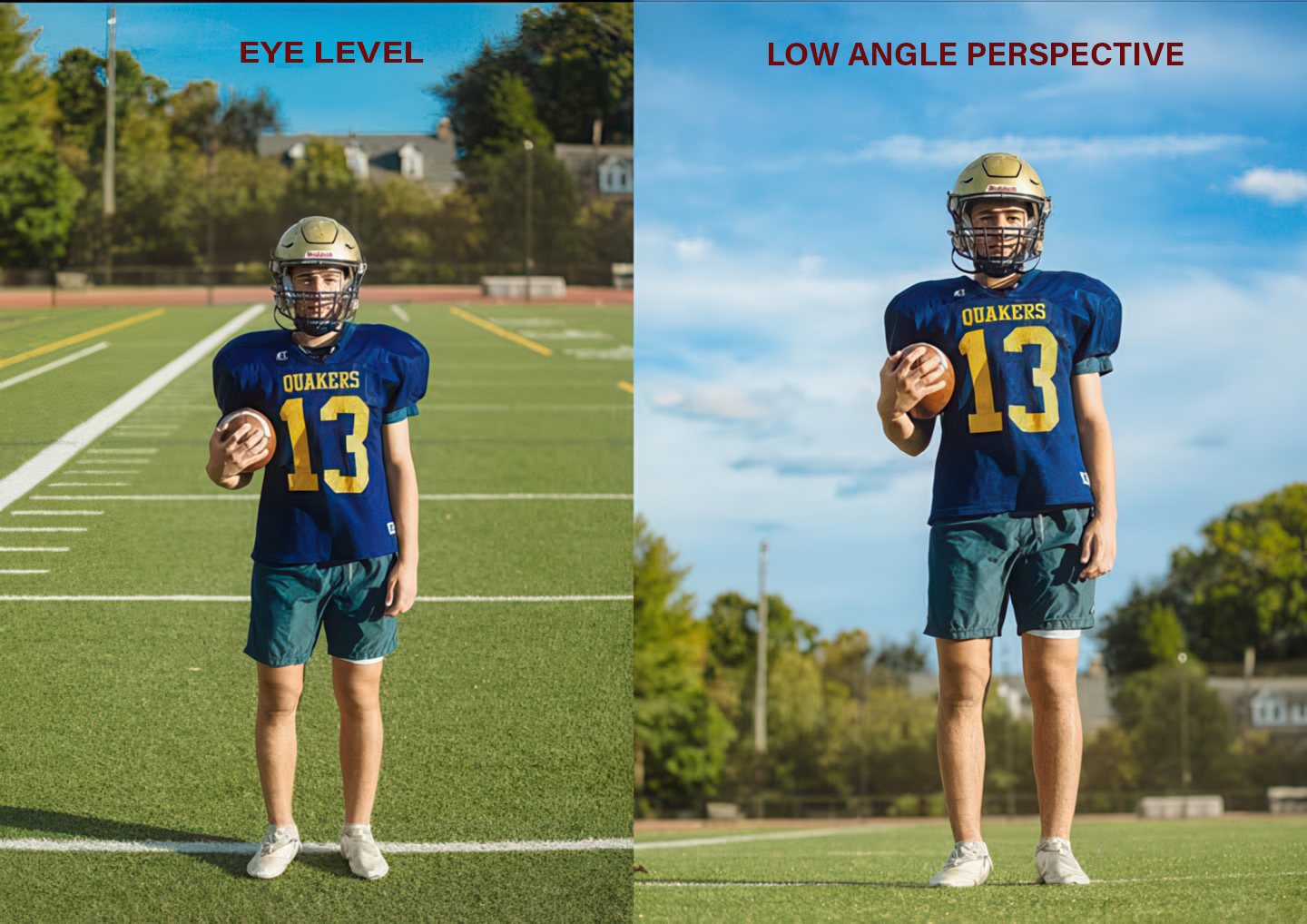
That said, the technique of changing your perspective to a lower shooting angle has an impact on multiple aspects regarding the pieces of the composition. In the case of the football player, it was mentioned that the BG was also effected. But, it also shifted the prominence of context away from the field of play. Personally ... of the two football players, I'd prefer the left image (maybe crop above head / below house BG ... as it retains additional elements of contribution to the message (imo), rather than reducing them.
As to the "power" that it conveys to "go low" ... one also has to consider that with vertical subjects, the amount of foreshortening effect it might have on the elements closest / closer to the lens. With standing people, the distance to their knees is know much closer than the distance to their head ... and depending on focal length chosen, the lower shooting position can foreshorten in a way that appears unnatural, particularly, if there are forward projections that accompany the vertical variance.
That said, to suggest that a technique (any technique) cannot be blindly used to convey something. Granted the shift in perspective ... it revises / re-arranges the relationships of scale / mass. Whether this is done in the X, Y or Z axis (Y in this case of going low), one needs to be aware of whether or not the shift in perspective conveys the shift in scale / mass that is a match to the message desired to be conveyed, for re-arranging the balance of the components in scale / mass.
As to the matter of it making the image "more interesting" ... idk, kinda depends. An excellent image (imo) doesn't depend on technique to make it interesting. Using different perspective to yield different viewpoints provides for "different" composition choices. Whether or not that makes it more interesting will be subjective to the viewer's frame of reference. Adding "interest" through varying technique is an option ... but, here again I don't think it is golden technique to be heralded without a full consideration of how it is shifting the scale / mass / weight / proportions.
As with any of our variant choices (shooting angle, in this instance), the moderation / modulation of that choice can be a key aspect to how well it provides the conveyance we desire to present. To a degree, this choice kinda reminds me of "getting in close" with a wide angle lens, just in the vertical Y axis, vs. the X or Z axis. It kinda reminds me of the difference that we notice when folks (naturally) shoot with a waist level finder vs. an eye level finder, as to how it suggests an "immersive" viewpoint. Granted, one can place the viewpoint perspective at anything from ground level to waist to eye to overhead. Each present a differing perspective, and depending on how much the viewing audience has been subjected to such a perspective, any one of them could be considered "interesting", for the variation in technique ... which may / may not have any relevance on how interesting the subject / comp is otherwise.
I think that a shooting angle other than eye level (overhead, waist, ground) affords an opportunity to shift the relationships of scale / mass / weighting / foreshortening, relative to FG / Subject / BG / context. While I certain have used a variety of them, and recall the use of the technique enamoring me when introduced to it half-century ago (landscape FG, etc.), it is but one piece of the decision making that goes into the full aspect of the composition. I certainly can / have / will use variant perspective, so it's not like I'm against it. I just think it warrants judicious utilization, rather than neither presumption of expectation, nor inferred necessity.
Imo, lean too hard into the technique, purely for the sake of the technique ... and it runs the risk of turning into a parlor trick, rather than exceptionalism in composition when / where the re-weighting is warranted. For some, that can be a thin line of distinction ... and maybe that's the point ... the more extreme the use of the technique is being suggested to provide a more prominent variance. I get that. Just, that I don't subscribe to the autonomy that it conveys the attributes mentioned without judicious understanding of application. Nor do I necessarily find it "more interesting" in all cases. It can be, certainly.
But, I do think that one has to consider if the technique is being applied like ketchup vs. an understanding of when it aids the composition. As to shoot from a low angle for people ... how low of an angle might we suggest for "pear shaped" person, with more mass in the lower Y axis, etc.? How might that differ from shooting a football player with the (artificially) added mass of the shoulder pads and helmet that exists in the higher Y axis? How high / low ... yes, it offers variation, but its utility isn't ubiquitous (imo) to creating more interesting or conveying more power.
Again, I'm just suggesting that varying the perspective (like anything) is a double-edged sword that when it is used in good alignment with the vision for the message to be conveyed, it can render well to that. OTOH, if it isn't well aligned, it may not present well. Getting low with a child or a dog can vs. getting low with 7 foot athlete ... or a pregnant woman ... well, you get the gist. Not a "one size fits all" technique that deserves universal praise (imo). You still gotta know when it aids your message as harmonious / complementary vs. when it works against you ... vs. when it calls attention to itself, for the sake of calling attention to itself (as a technique differentiation, antidote to "boring"), vs. full awareness of its impact on the composition. I'm recalling an image made of Queen Elizabeth ... sitting (meaning knees bent / low forward projection) in regal attire ... and how a lower angle perspective would render her feet and knees larger and her head smaller, more distant. Would a lower perspective with bigger knees convey her more powerful? Just sayin'. 
For the novice, the assertions of its significance could be a "revelation" in technique. For the seasoned folks, it's but one tool in their comprehensive bag of composition.
YMMV

...Show more →
To be honest I didn't read the whole comments of yours. Just a couple of your points I want to comment on.
You wrote: the conversation seem to be suggesting a presumptive "more interesting" aspect to the use of a low shooting angle
No really. The conversation was suggesting a presumptive “more imposing, dominant, regal”. “More impressive” “More powerful” subject.
Another quote of yours: In the case of the football player, it was mentioned that the BG was also effected. But, it also shifted the prominence of context away from the field of play. Personally ... of the two football players, I'd prefer the left image (maybe crop above head / below house BG ... as it retains additional elements of contribution to the message (imo), rather than reducing them.
It is not a matter of which one to like better. It is a matter of intent. If the intent of the shot is to give more importance to the subject and make it look like Superman, then a low angle seems to be very effective on conveying that message. No matter the BG.
Don't you think the right image works better for that intent? Whether you like that image or not?
I tried to read the rest of the your (very long) comment, but I felt as if you were complicating a simple concept, and I got lost trying to catch the point you were trying to make 
Socrate
|