I noticed where Hassy offers HEIC as an option (stills only, application) in concert with RAW (as an alternative to jpg, or as an alternative to RAW).
Curious to hear folks input on pro / con ... use cases, differentiation vs. jpg, etc. ... personal experience with, strategy of incorporation (or not), et al.
Heic is probably the future, as soon as it’s more broadly adopted. It’s better than jpeg and nearly as flexible as raw without the added step of dealing with demosaicing software.
Unfortunately, the one big obstacle remains for some time now, HEIC = very limited adoption and compatibility other than Apple devices. Google AI tells me this might be due to "...proprietary technology and patent-licensing issues."
For a practical example if you want to post your HEIC files on this forum and many others, you'll have to covert the HEIC file to a compatible format like JPG, PNG, TIFF etc. End result quality wise, I think it might be better to covert directly from RAW/DNG to one of these other compatible formats rather than converting from HEIC to JPG for example.
Jack Flesher wrote:
Heic is probably the future, as soon as it’s more broadly adopted. It’s better than jpeg and nearly as flexible as raw without the added step of dealing with demosaicing software.
I get HEIC files from my son once in a while. Had the same photo been shot in JPG using the same phone camera, are there really any quality differences? I am thinking that the quality would be more about the choice of camera used and not whether the file is HEIC or JPG.
^ The point of HEIC on a phone is that it results in a smaller, more highly compressed storage file size, while offering the same image quality as a jpeg. Therefore the average user would need less storage space (could buy a cheaper phone) or can store more images for a given amount of storage. So there won't necessarily be a visual difference, but on the back end the HEIC file will use less storage space. There are potentially other image quality benefits, such as deeper bit depth for displaying a wider tonal range on HDR displays.
Actually, HEIC offers smaller file size, better color depth and better resolution than the same image in jpeg. As a plus it can also contain action, as in a "live still" that a jpeg cannot. Moreover, you can select what part of the live still you think is "best" for a print or jpeg out.
I don't think there's much doubt that the various HEIC, HEIF, etc are better than JPEGS. But are you going to be able to open and edit them in 10 years
And is one particular file type going to take over making the others difficult to use and did you use that file type. Probably the biggest advantage being smaller file size vs jpegs, also better editing
It's not meant to replace raw, though. Raw is still better for editing. So probably limited use on a Hasselblad
RustyBug wrote:
I noticed where Hassy offers HEIC as an option (stills only, application) in concert with RAW (as an alternative to jpg, or as an alternative to RAW).
Curious to hear folks input on pro / con ... use cases, differentiation vs. jpg, etc. ... personal experience with, strategy of incorporation (or not), et al.
Some of my comments match what others have said
Is HEIC a replacement for raw - absolutely not. While HEIC offers better quality for a given compression file size than JPEG, it is still a lossy compression method, and you can generate artifacts when performing post-processing, similar to JPEG. Raw does not have that issue.
Is HEIC a better lossy compressed image format compared to JPEG? Technically, absolutely. For a given image quality, the file size is smaller, and likewise for a given file size, HEIC is of better quality than JPEG.
However, the issue regarding HEIC being ubiquitous has a couple of issues. Many users want to complete their tasks without hassle. Not being adopted broadly means that more pushups are required in many situations where one needs to convert from HEIC to JPEG, etc. Many will not adopt, given those annoyances.
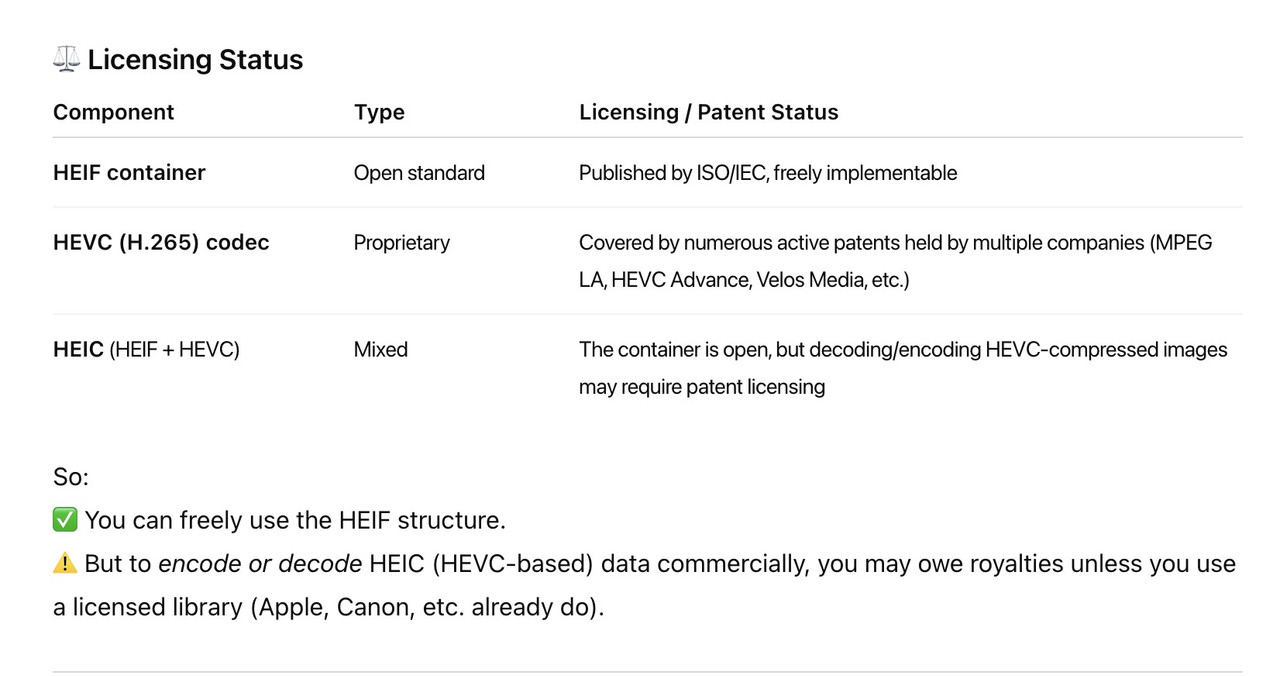
It becomes a chicken-and-egg issue. It needs broad adoption for many to adopt. For HEIC to become ubiquitous, the barriers to adoption need to be removed. HEIC is not a totally open standard. The following graph shows what is open and what is not:
For broad adoption, royalties or licensing would need to be dropped.
Just my opinions, of course
John Wheele
You still want the RAW file for sophisticated processing like DXO, Topaz, even the Abode.
Alternatives to jpeg have been tried before, such as jpeg 2000, but it died due to lack of widespread implementation.
My take is that I'll have the RAW files on the SSD ... and the HEIC files on the CFe (as a better backup than jpg).
Of course, I'll want the RAW for best possible, but I'm thinking that the HEIC may make the better (non-RAW) backup. Granted, it'll get saved as a different file format if it gets developed (similar workflow to RAW) in order to be used, but if something should happen to the RAW, I'm thinking I'd rather have the HEIC in my hip pocket than a jpg.
That, and if I'm doing a high volume event (vs. ultimate IQ), the HEIC might make for a more efficient approach, yet better IQ than jpg.
Just cross-checking this, in case I'm missing something (pragmatic / technical / etc.).
What do you mean "My take is that I'll have the RAW files on the SSD ... and the HEIC files on the CFe (as a better backup than jpg)."? CFe are SSDs. If a typo SSD->SD then why capture RAW to SD and HIAC to CFe? Obviously it all makes sense to you, but it's not really clear.
the X2D 100C features a built-in 1TB SSD with a write speed up to 2370MB/s, and a read speed up to 2850MB/s. 5 Although ample storage is built-in, additional space can be added using the CFexpress Type B card slot.
Just thinking to setup for RAW to the SSD and HEIC to the CFe.
Historically, I've set up RAW to SD1 and JPG to SD2 on other cameras with dual storage slots.
But, being unfamiliar with HEIC, I wanted to cross-check what other users experiences were with HEIC files ... relative to either RAW or JPG perspectives. I could still do RAW + JPG, of course.
Alternatively, I could save both to ssd AND both to CFe, but I prefer to have them separated. So, that puts me back to the choice of RAW > SSD + HEIC / JPG > CFe. Thus the question regarding HEIC experience of others with the HEIC file type.
Hi @RustyBug
I did not recognize in your first post that you were focused on the X2D 100C and its storage options in its memory cards.
I will assume that you are saving the raw in the SSD whose content gives you the best options in post processing when needed
As far as choosing on HEIC vs JPEG for the second card. I most likely would chose HEIC. And for clarifiation, Hasselblad notes that the option is actually HEIF (HEIC is HEIF using a particular CODEC of H.265). Both HEIF and JPEG have different options avaiable to them in compression amount and in the HEIF also bit depth. Hasselblad does not specifiy which compression option is used for either. However, the HEIF mode is 10 bit depth where JPEG is always 8 bit depth.
So with no other information, I would chose the HEIF option given the better bit depth. I would assume Hasselblad is offereing HEIF as a higher quality option than JPEG. It is possible to reverse engineer what compression options are used with either with a sample of each from the camera yet not sure that would be worth the effort.
A key thing to try out when using the HEIF option, is that it can be read by any post procesing software that you use. If HEIF is supported, that would be my choice over JPEG.
Raw is potentially sharper than jpeg, but does it matter? Debatable, and HEIF/HEIC probably doesn't beat it.
More colors, but I'm trying to remember if I ever had color issues shooting jpegs. Over 16 million colors of jpegs is generally enough.
The main advantages is file size. Raw is better for editing, but can you really tell the difference, raw vs jpeg, just pulling it up on a monitor? HEIF likely between the 2, but is it going to be around long term, or do you just need it now anyway