This is a specific question about how the up to 8 stops IBIS of the GFX100S II compares in real life to the up to 5.5 stops IBIS in the A1.
Is the following summary from ChatGPT credible? It sounds reasonable for the A1 in my experience, but I have never used the GFX100S II.
"Sony A1: practical “usable” shutter speeds will typically align near the spec: you may get a few stops below reciprocal (e.g., 2–4 stops improvement depending on lens) — i.e., you might reach 1/8–1/4s usable for short focal lengths in good technique.
GFX100S II: you will likely be able to go slower — often another ~2–3 stops compared with the A1 in the same test conditions (e.g., where A1 gives safe 1/8s, GFX100S II may give 1/2–1s). Remember this depends on using a compatible GF lens."
Is this correct, for example with the GF 20-35mm F4 lens?
I would say this is roughly correct, although after shooting the A1 II, for awhile, I am starting to forget what the A1 was like. The A1 II is definitely an upgrade from the A1. By my memory, the true IBIS performance of the A1 with a statistically high hit-rate would be a little over 3 stops with a 50mm lens. Having shot for so many years (plus firearms), my technique is pretty good.
I find the IBIS on the GFX100S II to be even better than the A1 II. I can utilize amazingly low shutter speeds with this camera - particularly with wider angles like the GF 20-35mm. This is particularly amazing since I am looking at 100mp files at 100%, compared to looking at 50/61 mp files on the Sony cameras.
What really blows me away is when shooting the GF500mm at slow speeds. In a test, I shot this lens at 1/8 second, handheld with a target at 30 feet, and about seven out of ten shots would be pin-sharp. Of course, this lens also has OS. I've never experienced anything close to this, before.
Thank you!
I really appreciate your responses.
I am expecting a demo GFX100S II from Fuji, to test drive. Now I have an idea on what to expect.
I would really like to keep the ISO as low as possible when hand-holding the camera, and so the excellent IBIS should help.
RoamingScott wrote:
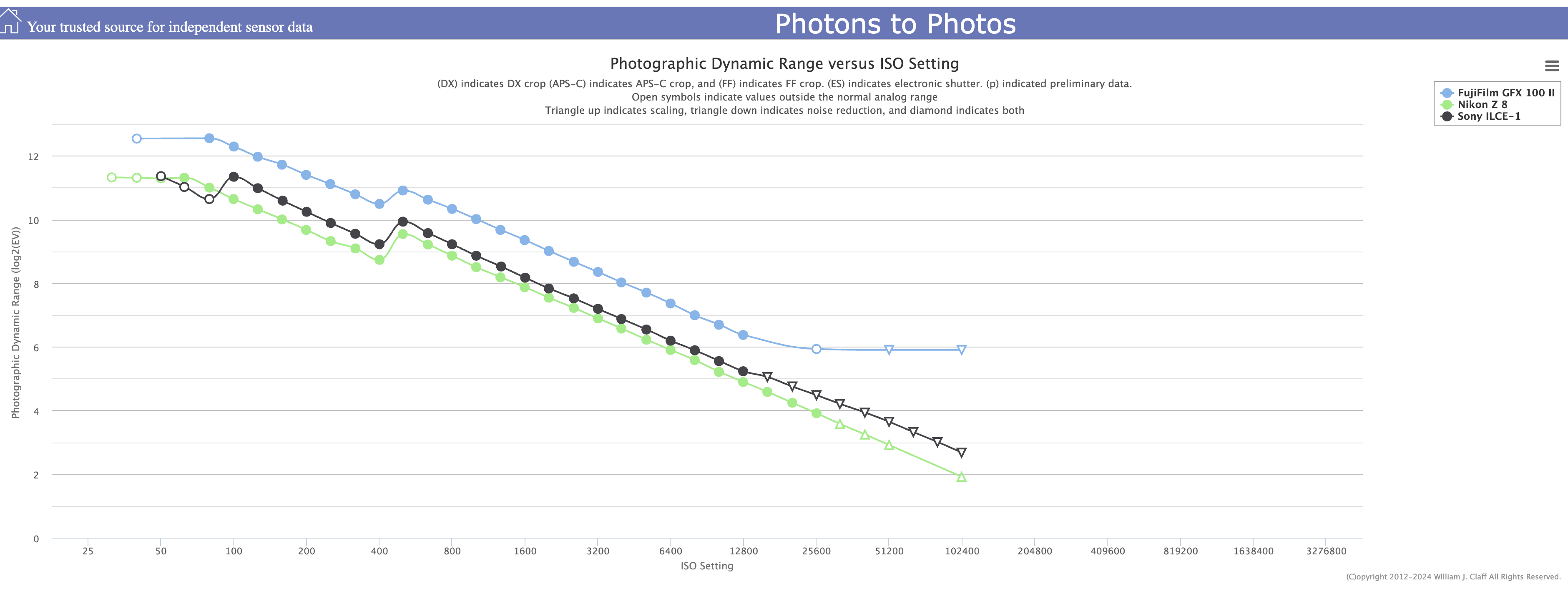
You really can't think about GFX ISO in quite the same way. It's excellent even at 1600 and 3200.
All sensors are (and must be) compared "the same way" that is under the condition of the same amount of light received by the sensors. This means comparing DR at the equivalent ISOs related by the square of the crop factor.
When we follow the equivalence condition then we find similar DR for sensors of different sizes at the equivalent ISOs, when an equivalent ISO exists for the smaller sensors.
I am sure I am not explaining this clearly, and most photographers are not familiar with the conditions of photographic equivalence; thus, we can forget about what I said, except it makes practical sense to remember that larger sensors do not give any advantage in DR at the higher ISO values like 1600 or 3200. None whatsoever.
I’ve had a limited amount of time with the GFX100S II but have owned the A1 , GFX100S and A1 iI since launch so take this with a grain of salt but there are a couple factors in play that tilt the scales for my use cases towards the Sony. I did find the 100II AF considerably better than the 100S and hand holding the 100SII with the improved ibis better but not night and day better.
1. Faster glass. My fastest GF lens is 1.7. I can get away with either lower ISO or faster shutter speeds with the A1/A1 II shooting faster glass.
2. Useful ES - shutter shock free with the Sonys. Not the case with the GFX.
3. Slop factor. IMO there’s less margin for error with 102mp vs 50mp.
Of all my cameras for ibis the champion is still the little Oly OM-1. Awesome for stabilization.
liggy wrote:
I’ve had a limited amount of time with the GFX100S II but have owned the A1 , GFX100S and A1 iI since launch so take this with a grain of salt but there are a couple factors in play that tilt the scales for my use cases towards the Sony. I did find the 100II AF considerably better than the 100S and hand holding the 100SII with the improved ibis better but not night and day better.
1. Faster glass. My fastest GF lens is 1.7. I can get away with either lower ISO or faster shutter speeds with the A1/A1 II shooting faster glass.
2. Useful ES - shutter shock free with the Sonys. Not the case with the GFX.
3. Slop factor. IMO there’s less margin for error with 102mp vs 50mp.
Of all my cameras for ibis the champion is still the little Oly OM-1. Awesome for stabilization.
To ruthenium's point about ISO, with FF vs. 44 X 33, you can use faster glass when it is available and shoot at a lower ISO when you aren't already at base ISO at the same shutter speed and get really similar performance from the two cameras. Alternatively, you can think about it as you can stop down 44 x 33 and turn up the ISO and get just as much depth of field with a FF system. People often talk about advantages at high ISO for the larger format and advantages of greater depth of field for the smaller format, but if you are using lenses with the same field of view and the same entrance pupil there are only really small differences and they are just about how efficient the sensors are and the direction of the advantages are hard to predict (ex. at high ISO m4/3rds sensors are really efficient and have a small advantage).
The real question, I believe is does the system have the lenses you want to use in the way you want to use them keeping in mind lenses will have a different field of view on different systems. That 55 f/1.7 you have has no counterpart on Sony. It would take a 40 f/1.3 equivalent with AF on Sony to get a lens like that. Now may you consider 35 f/1.2 as close enough to that and there are a couple of those. Maybe you are fine with MF and the Voigtlander 40 f/1.2 will work for you, but if you prefer 40mm to 35mm on FF and you want a fast 40mm AF lens about the only alternative is the old and huge 40 f/1.4 made for DSLRs on Sony. Now that is an interesting lens that some people like, but there are some reasons to prefer the 55 f/1.7 on a GF camera to that lens on Sony.
There are of course lots of lenses that are available on FF that aren't available on GF. If those are your jam, then FF could make more sense to you.
Of course the useful ES is a reason to like the A1 or A1 II. What it is most useful for, IMO, is shooting silently. That is important sometimes. It is required sometimes at events. It can prevent some targets (e,g., skittish animals from running away). It can even allow you to shoot without people knowing you are doing so sometimes, which can allow candids that you couldn't get otherwise. That said, EFCS, allows shutter shock free images with the GF. If silence isn't needed, then I don't know of a time when either manual shutter or EFCS won't allow at least as good of image quality. You aren't sacrificing image quality by using the GF camera. Obviously you can't shoot at the higher fps that a camera like the A1 or A1 II allows, and you can't shoot at the super high shutter speed it allows, but that is hardly an issue with GF cameras as even in bright light with and f/1.7 lens I have never needed those faster shutter speeds.
With regard to slop factor, I think you are just allowing yourself more leniency with the A1 than the GF camera. Yeah, you lose any advantage of higher MP if you downscale to 50MP, but if you do there is no reason you don't have the same slop factor when you downscale in that way. You won't see anything in the GF file that you won't see in the A1 file. The 100MP file does allow easy access to more magnification and if you use that you will start to see things, but if you downscale that 100 MP to 50 MP you can have exactly the same slop factor.
@Steve Spencer - all good points. I use them in completely different situations so it boils down to right tool for the job.
I have the 80 1.7, not the 55. I swear I’m almost faster manually focusing with the CV 40 1.2 than the 80 using AF on the 100S. Really nice rendering but not exactly the best GF lens in terms of AF speed.
I should add that my handholding technique is lousy. When I shoot the 100S is almost always on a tripod and more often than not I like shooting things that move which makes the A1 II an obvious choice.most of the time.
The 100S II feels like a significant upgrade over the 100S in both AF and IBIS but not to the point where I’d make it my everyday carry over the A1 II.
InFocus2014 wrote:
What really blows me away is when shooting the GF500mm at slow speeds. In a test, I shot this lens at 1/8 second, handheld with a target at 30 feet, and about seven out of ten shots would be pin-sharp. Of course, this lens also has OS. I've never experienced anything close to this, before.
Slightly OT and early days for me with the lens, but I haven't managed anywhere close to that with my GF 500mm/100 II..I wonder how much of that is down to your skill and/or perhaps whatever residual handheld shake you have is particularly well corrected by the lens/IBIS?
So far I am unable to get better than about 50% acceptable sharpness at 1/125 if there is any wind, and below as far as I can see the hit rate is low enough that I might as well not bother (for whatever reason it's been at least mildly windy every time I've taken this lens out).
_Refraction wrote:
Slightly OT and early days for me with the lens, but I haven't managed anywhere close to that with my GF 500mm/100 II..I wonder how much of that is down to your skill and/or perhaps whatever residual handheld shake you have is particularly well corrected by the lens/IBIS?
So far I am unable to get better than about 50% acceptable sharpness at 1/125 if there is any wind, and below as far as I can see the hit rate is low enough that I might as well not bother (for whatever reason it's been at least mildly windy every time I've taken this lens out). ...Show more →
Something doesn't seem right. You should definitely have better results with 1/125 second with this setup. What IBIS doesn't control for this long lens (primarily Yaw), the OS should handle, readily. I get a high percentage of sharp shots at 1/125 second with my Sony 300mm with x2 (600mm) and A1 II and I think that the stabilization is just a bit better with my Fuji setup.
As a note, I used electronic shutter for both, so I do not experience any shutter-shock, which could be present at these slower shutter speeds. If you are using the mechanical shutter, you might give the electronic shutter a try.
_Refraction wrote:
Slightly OT and early days for me with the lens, but I haven't managed anywhere close to that with my GF 500mm/100 II..I wonder how much of that is down to your skill and/or perhaps whatever residual handheld shake you have is particularly well corrected by the lens/IBIS?
So far I am unable to get better than about 50% acceptable sharpness at 1/125 if there is any wind, and below as far as I can see the hit rate is low enough that I might as well not bother (for whatever reason it's been at least mildly windy every time I've taken this lens out). ...Show more →
What types of shots are you taking in this mild wind, I assume nothing that is moving (foliage, etc) due to the wind correct?
As a note, I used electronic shutter for both, so I do not experience any shutter-shock, which could be present at these slower shutter speeds. If you are using the mechanical shutter, you might give the electronic shutter a try.
Thanks, I guess I'll give it another round of testing this week when there's a clear day.
I had started with EFCS and wondered if the IBIS wasn't stabilising properly so also tried the mechanical shutter. There was no appreciable increase or decrease in my hit rate, so either it isn't present at this speed or it is outweighed by whatever else I'm inadvertently doing! The giant clunk of the 100 II shutter and vibration in my hands was a bit off-putting so I've gone back to EFCS.
tsdevine wrote:
What types of shots are you taking in this mild wind, I assume nothing that is moving (foliage, etc) due to the wind correct?
That's right. I've been testing on things like rocks, buildings, a car park two beaches away...spectacular results at 1/500 for example but quite patchy at 1/125.
NB: on that basis I have largely ruled out atmospheric distortion on the thinking that air currents shouldn't differ that dramatically across these time scales, but happy to be corrected by anyone who knows more about that than me, which wouldn't take much.


 IMO there’s less margin for error with 102mp vs 50mp.