charley5
Offline
• • •
Upload & Sell: On
|
CharleyL wrote:
I can tell you how I do it in my studio. For me, controlling the environment light is the key, but I still have my "work light", an LED 14" diameter ceiling light that I can usually leave on during the shoot. I use an F-8 camera test setting and most times just one studio light for these. I always start by taking a "Test shot" with no flash at all at the camera sync speed of 1/250 second for my flash. If the "Test Shot" shows no, or very little image, mostly black, I am ready. If any image is visible, I'll bump up the F-Stop setting and try again. The F- Stop setting determines depth of focus, so a decision needs to be made about whether to turn off the house light or not, depending on the depth of focus needed for the shot. It's a bit of a balancing act sometimes. Once you have a Test Shot that's completely black and the Depth of Focus meets your requirement, you are ready for the shot.
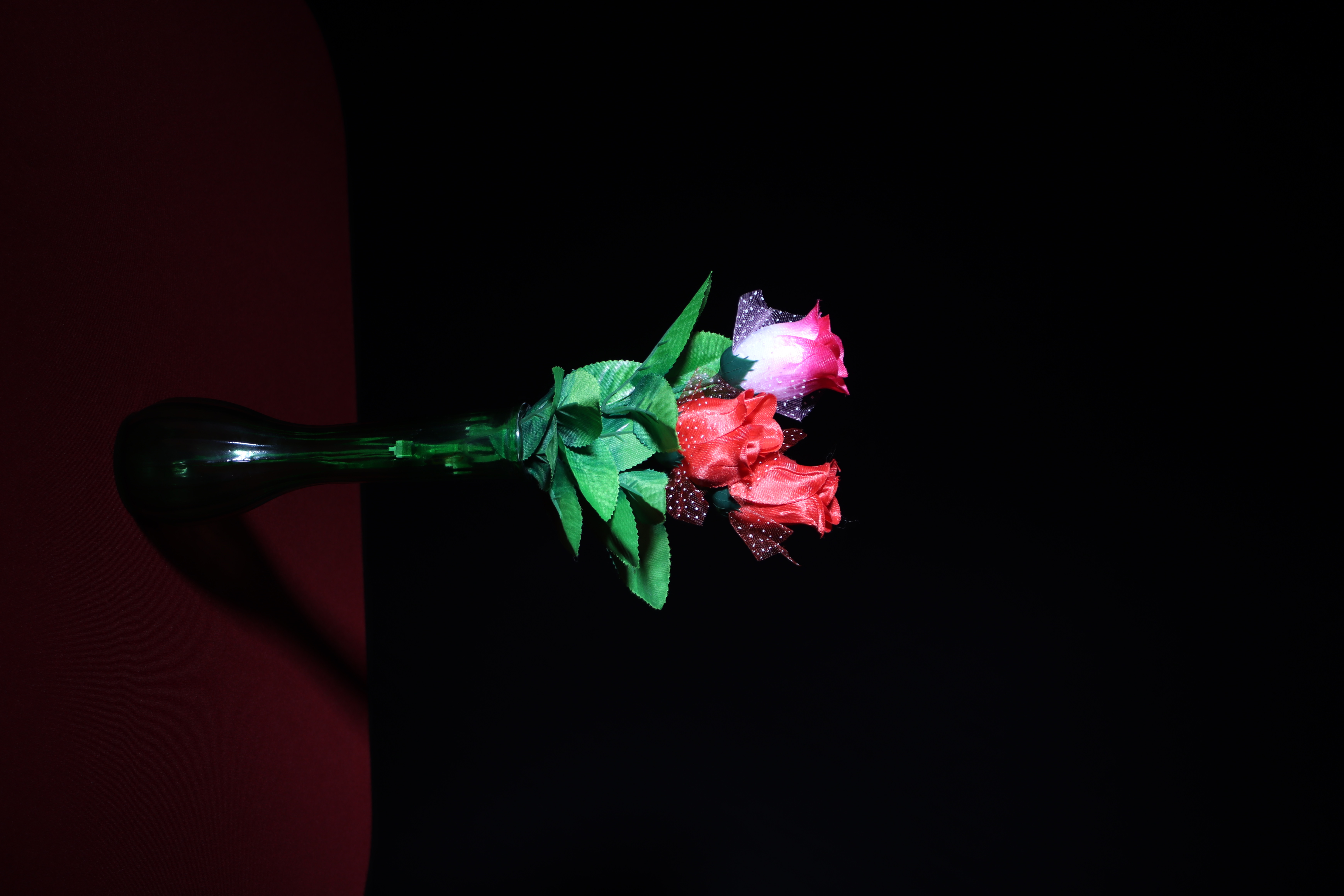
For just lighting a hand, you won't need much light, unless you want significant shadows. Most any speedlight or studio light will work. A small soft box will help even and spread out the light, but I frequently use one of my studio strobes and 7" reflector. To keep the light constrained and aimed so it lights my flowers, but with minimal spread I usually install a grid on the reflector. These are honeycomb material with holes that restrict the light to mostly pointing forward. For the roses shot that I have included, I used a 10 degree grid. They are readily available in 10 degree increments up to 60 degrees, maybe more, but I haven't seen any others. The studio strobe was located about 5' from the flowers and using the 10 degree grid kept the column of light small enough to only light the flowers, with minimal light leakage to light the vase and table top. About 5' behind the flowers I had stands, cables, etc. that did not show in the shots. Changing the power setting of the studio strobe to just this right level to keep the background black (thankyou Inverse Square Law of light).
I took only two shots before I had the the shot that I wanted. Only the studio strobe light level setting was changed before shot two. I reduced it to more shadow, but still have visible the vase and the table.
I don't remember the settings, only which studio strobe was used and the distance to the roses. No two photography light sources are identical, so the level setting isn't important. You just take several shots, changing the light setting until you get the level that works for the shot and you get the shot that you want.
Be it studio portrait photography, still life, etc. I use the same technique to begin each shoot. If multiple light sources are used I do "test shots" with only one light at a time, and adjust it for the desired result.
Only after getting all lights adjusted one at a time will I turn all of them on at their adjusted light levels and begin the photo shoot.
For hand photography you likely can do this using only one speedlite, but find a dark or nearly dark location so your F-Stop adjustments won't need to be too high to block out the light from the environment. Probably a small table to rest the hand and steady it, a piece of black cloth for a table cloth, and a chair for the subject with the hand to sit in. A few "Test shots" to get the light level to suit the shot, and you should be good. I wouldn't light or shoot straight down. A slight angle for both the light and camera angle (off camera light) would be best to minimize specular reflections from shiny skin. Again, a small softbox would help. There are some designed to be added to speedlites. A sheet of thin white writing paper attached to the speedlite so it forms a loop out in front of the speedlite lens.
A small piece of tape top and bottom should hold the paper to the speedlite well for the shoot. The light from the speedlite will shine through the paper and disperse, making a relatively soft light on the subject hand.
CharleyL
...Show more →
This is excellent, Charley. Thank you. I will be going out into the street, so I will have to compromise on some of your points. My main concern is the lighting, which I will have little control over. But your comments on camera settings and the use of a speedlite give me a better sense about how to approach it. Thanks again!
-Charles
|