p.1 #1 · Anyone using rechargeable lithium AA batteries?
I've been a longtime NiMH rechargeable AA/AAA battery user. Eneloop/Eneloop Pro, PowerEX, Amazon Basics high capacity and more recently the made in Japan Ikea NiMH that are supposedly Eneloops...
These have worked fine for powering speedlites, radio triggers and other photographic and computer peripherals with the tradeoff being that some devices don't really like that NiMH operates at 1.2V.
I recently noticed on Amazon a selection of rechargeable AA lithium batteries at very reasonable prices compared to Eneloops. TBH, I'm not sure how long these rechargeable AA lithium batteries have been on the market because I have a ton of NiMH and wasn't really looking for replacements, yet. But I could see use cases for these in place of NiMH. Only concern at the moment is the relatively significant number of poor reviews.
If you've used these rechargeable AA lithium batteries, please share your experiences.
p.1 #2 · Anyone using rechargeable lithium AA batteries?
I'll be interested to hear about their fire-safe properties. I treat my rechargeable Lithium drone batteries as hazardous material and store them in a fireproof container. It's unlikely that I'll replace my 100+ Eneloops (which are getting old) with a Lithium-based alternative, unless the Lithium AA batteries are proven to be safe for unattended charging - which my drone batteries are not.
p.1 #3 · Anyone using rechargeable lithium AA batteries?
It depends on what you mean by fire safe. Nickel based cells can easily start a fire if metallic materials short the treminals. However, they do not spontaneously burst into flames from being ruptured.
The Li-Ion simuated AA cells contain a small cell and switching regulator to produce ~1.5VDC output. Knowing that they must be smaller than a full 14500 cell, the marked capacity is often unrealistic and in many cases just marketing hype. You won't get much if anything more than an Eneloop pro. The usable current range is quite limited. It does not support high currents and at low current the circuit may fluctuate and exhibit hysteresis. IIRC mine was about 500mA and wigged out at low current.
If you need capacity and numerous cycles use Eneloop Pro. If you need closer to 1.5V just use Energizers or other alkaline batteris.
p.1 #4 · Anyone using rechargeable lithium AA batteries?
EB-1 wrote:
It depends on what you mean by fire safe. Nickel based cells can easily start a fire if metallic materials short the treminals. However, they do not spontaneously burst into flames from being ruptured.
The Li-Ion simuated AA cells contain a small cell and switching regulator to produce ~1.5VDC output. Knowing that they must be smaller than a full 14500 cell, the marked capacity is often unrealistic and in many cases just marketing hype. You won't get much if anything more than an Eneloop pro. The usable current range is quite limited. It does not support high currents and at low current the circuit may fluctuate and exhibit hysteresis. IIRC mine was about 500mA and wigged out at low current.
If you need capacity and numerous cycles use Eneloop Pro. If you need closer to 1.5V just use Energizers or other alkaline batteris.
Thanks for the summary. That's pretty much what I deduced from reading a bunch of Amazon reviews - that they're not 'real' 1.5V cells and a number of reviews echo your comment about unrealistic rating and unsuitability for high current requirements (such as in a flash). Many reviews also indicated one out of eight batteries DOA.
I was thinking of these for things like wireless keyboards, mice and radio slaves where I've more or less reverted to regular AA alkaline batteries (i.e. Costco/Kirkland). NiMH more or less for flash units sometimes augmented by external HV (lithium) packs or now flash units with OEM internal lithium packs.
But I do like the nifty 4 and 8-cell chargers some of these batteries come with. Some of these chargers are apparently also NiMH compatible. Would be tempting to try with my NiMH, though if 8 cells are being charged, it's apparently only 300mAh per cell, which would be like ~8 hours for an Eneloop Pro or equivalent. https://www.amazon.com/imuto-Rechargeable-Battery-Batteries-Included/dp/B0DMN5Q9TL
p.1 #5 · Anyone using rechargeable lithium AA batteries?
The only devices I've had trouble using AA NiMH Eneloops are Godox triggers. Several different triggers would constantly show low or no battery with the 1.2V NiMH. The power draw is so low that I've just continued using alkalines in the triggers and they last quite a while. Flashes that use AA seem perfectly happy with the 1.2V NiMH cells. Many flashes now use proprietary higher voltage Li-ion batteries giving much higher flash output and faster recycle times than any AA could. AA Li-ion seems like a solution in search of a problem.
p.1 #6 · Anyone using rechargeable lithium AA batteries?
EB-1 wrote:
It depends on what you mean by fire safe. ...
My drone batteries warn the user to never charge them unattended. That's not fire safe. Bringing a hundred batteries into my house with this disclaimer on them, will not happen. That's what I mean by "fire safe".
p.1 #7 · Anyone using rechargeable lithium AA batteries?
Maybe that drone has a sketchy BMS and is charging quite rapidly. I'd not put the risk level very high at 0.25-0.35A per cell since it is not a fast charge, but it is never zero. Do you use a fast charging laptop or cell phone and leave it unattended?
p.1 #8 · Anyone using rechargeable lithium AA batteries?
The risk level is sufficiently high that the manufacturer says so on the battery packs. I don't have any other devices with this high a risk level. That doesn't mean that I don't use it, it means that I take more precautions with it.
p.1 #9 · Anyone using rechargeable lithium AA batteries?
I would never use a drone due to the risks, but not the battery.
Seriously, there is not any need for the lithium rechargeable AAs.
EBH
Aug 20, 2025 at 02:21 PM
AmbientMike Offline • • • • • • [X]
p.1 #10 · Anyone using rechargeable lithium AA batteries?
rscheffler wrote:
I've been a longtime NiMH rechargeable AA/AAA battery user. Eneloop/Eneloop Pro, PowerEX, Amazon Basics high capacity and more recently the made in Japan Ikea NiMH that are supposedly Eneloops...
These have worked fine for powering speedlites, radio triggers and other photographic and computer peripherals with the tradeoff being that some devices don't really like that NiMH operates at 1.2V.
I recently noticed on Amazon a selection of rechargeable AA lithium batteries at very reasonable prices compared to Eneloops. TBH, I'm not sure how long these rechargeable AA lithium batteries have been on the market because I have a ton of NiMH and wasn't really looking for replacements, yet. But I could see use cases for these in place of NiMH. Only concern at the moment is the relatively significant number of poor reviews.
If you've used these rechargeable AA lithium batteries, please share your experiences....Show more →
Lithium ion batteries operate at 3-4.2 volts or so, are completely different. I can't imagine putting them in a flash, probably dangerous to you and anyone else present and destroy the flash
AA sized is a 14500, I've used them in a device taking them but certainly not in AA devices only taking regular AA, alkaline ni mh etc
I suppose they might have done something to make the voltage regular AA, but vastly overstated capacity sounds like regular cheapo li ion. You can get good quality , properly stated capacity but you can't use regular li ion in flash etc.
p.1 #11 · Anyone using rechargeable lithium AA batteries?
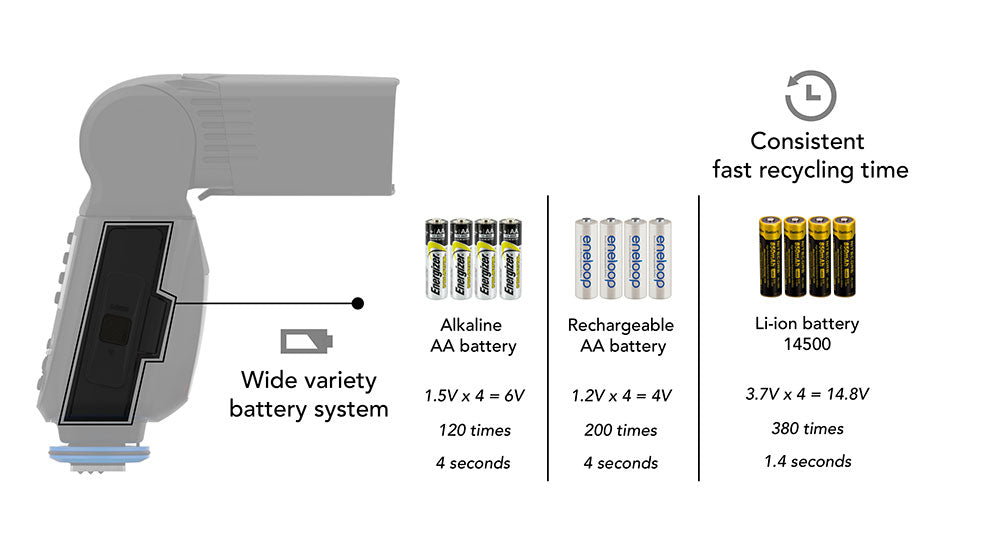
Nissan makes a few flashes (e.g., for Nikon, Canon) that use either AA cells or Li-Ion 14500 cells and perform better with the latter. I believe they are the only ones to do that in a multi-cell device (some LED flashlights are also "multi-fuel"). Obviously one cannot use a regular 4.2V Li-Ion in a 1.5V only space; that can be bad news.
The cells mentioned initially in this thread contain a smaller internal Li-Ion cell and a switching voltage regulator to output 1.5V.