p.3 #1 · What would most improve your phiotography?
I would say buying more gear. I have a a9III coming in tomorrow.
I would also say hanging around with people that are taking photos of the same genre as you.
90% of the time when I go shooting, I'm with at least one other person, sometimes, many people.
Shooting wildlife is all about knowing where that wildlife is, by having a group of like minded people,
it helps a lot when 12 people are trying to find a subject rather than just one.
Then after shooting, compare photos, camera settings, traits that were observed so the next time, a
person can be more prepared for what is about to happen.
And if it's your hobby and not your job, try to have fun with it.
p.3 #2 · What would most improve your phiotography?
EB-1 wrote:
I'm interested in my photographs, not random photographs by important or famous people.
Of course I read books with examples to learn about photography back in the 20th century.
From a purely artistic perspective, If I'm looking at someone else's work I'd much rather look at a painting, drawing or sculpture.
My family is very artistic for hundreds of years, so I grew up with their paintings, drawings, sculptures around.
I cannot say I share your views at all, other than to point out that there are many viewpoints and routes.
EBH
from
I will agree that looking at paintings (and other non-photographic art forms) can be as instructive about understand visual media and as inspiring as looking at photographs. So if our budding photographer prefers to look at, say, paintings, I don’t have a problem with that. (As you probably know, the so-called a rat world regards photography as just another visual medium, not necessarily something that stands apart.)
As I look at such work — and I do that a lot (it was kind of my career) — I always think about what I can learn from their way of seeing.
I would not discount the value of learning about and becoming inspired by “random… important of famous people.”
(I taught college-level music for decades. Occasionally I would get a question from a student who was becoming interested in one of those “random” famous composers: What should I listen to next? My answer was, follow your nose — bridge from one interesting thing to another, keep your ears open, and see where it leads you.
But in every expressive medium that comes to mind for me — photography, music, painting, sculpture, drama, and… — every young practitioner I’ve known was deeply interested in the work created in the medium, and aspired to understand it and create something that had the power they felt when they experienced the work of others. It is called inspiration…
p.3 #3 · What would most improve your phiotography?
I guess I would vote for taking more photographs but first I need inspiration. I have the time and enough gear and experience and education but I’m lacking inspiration at the moment.
p.3 #4 · What would most improve your phiotography?
jwpstl wrote:
I guess I would vote for taking more photographs but first I need inspiration. I have the time and enough gear and experience and education but I’m lacking inspiration at the moment.
That’s a challenge for a lot of people. A few thoughts:
1. Slow times are natural in creative work. It is almost never a straight line. Exciting, fulfilling periods are often separated by periods when things are less exciting and productive.
2. This is a problem that never goes away completely, but there are things you can do. One is simply to recognize that it is a normal cycle and not a sign that you are failing. Sometimes waiting it out is enough, but a lot of people feel that just doing the work, even if it feels less exciting, is important. Even if it isn’t exciting you, it can be good to simply make photographs, in a somewhat non-judgmental way, a matter of doing the work.
3. Speaking of work, sometimes photography is work. I love “doing photography” and I go to great lengths to do it. But years ago, on a long trip to a particular location, after days of rising before dawn and being out until after dark, I realized that (duh!) it isn’t continuous, uninterrupted “fun.” (see #2 above.) But in order to have those elusive moments of creative fervor, one has to work through less exciting “between” times.
4. Try making a photo (or photos) every day. Not all of them will be good, much less great. But it is like being a musician — regular, repeated practice is necessary to keep your eyes tuned up and to be ready for opportunities.
5. Photograph something new. If you like landscapes, try street photography. If you like portraits, go photograph birds.
6. Come up with a project. It could be documenting a place or group or person over time. It could be photographing the sunset every day. There are tons of options.
7. Take a class or a workshop. Seek out a photography club and attend their programs.
p.3 #5 · What would most improve your phiotography?
I voted for “Spending more time looking at & critiquing photos I have already taken”. I’ve taken about 8000 pictures this year as an amateur and it’s given me a lot of joy to do that. Looking at these critically has reminded me how much I need to work on:
1. Composition
2. Post processing
Taking pictures that are actually interesting and tell a story is hard, then processing them to be cohesive and draw attention to the interesting parts of the scene is hard too. I feel I’m early in my journey and can’t always articulate why a composition isn’t interesting, even if it has a clear subject or a foreground, midground and background. This is what I hope to achieve by spending time with my photos and learning composition from others.
p.3 #6 · What would most improve your phiotography?
RoamingScott wrote:
A few thoughts.
Firstly, most people would be best served by paying for an industry leading post processing program (the horror, apparently!) and spending 6 months deep diving into it. The learning is easy and free thanks to Youtube. It's exceedingly clear that many buy gear that they are not capable of leveraging to their full advantage and are under-processing their images. Hyperfocusing on Lightroom over the years has been a great investment personally, and keeping up to speed on all the new features as they emerge makes it easier to digest bite by bite vs trying to catch up all at once. Now, even extremely complex edits are just second nature, and I can fly through something that would have taken me multiple days in years past in perhaps half an hour.
Secondly, I have never particularly understood the desire to glom onto a specific teacher or mentor in terms of workshops. I have seen MANY people try to emulate a photographer that they find particularly inspiring while not understanding a lick about what MAKES the work so inspiring, and their own copy-cat work emerges as a clear imitation of something much better. This isn't to say that having aspirational figures is a total negative, but I find that many people take the path of least resistance of simply copying bar for bar instead of learning how to feel your way through the artistic process for themselves.
For me, my best work appears suddenly and often surprisingly when I am out and about with a camera...imagine that! Years of preparation (learning how to post process and developing a personal style all my own) meeting a fleeting moment of inspiration often leads to a nearly effortless dance in the field. Having gear that I'm super familiar with and don't have to fiddle with in the middle of that dance removes friction, and the "final" processed image appears to me in my mind's eye over the top of what I'm capturing in RAW form.
This is a synergy that has become more automatic with every year that I continue down a sometimes monotonous road of staying on top of PP technology and software developments and improvements. It has made it much easier to enable me to convey a the exact "mood" I feel in that moment, and by extension, have my photography tell the story I want it to.
That's a long way of saying that getting my ass out there and sitting my ass behind my monitor and putting in the 10,000 hours has been a bullet proof method for my own personal improvement. Any information you need to know is at your fingertips for free. The are no excuses if you dedicate yourself to the process.
I think it's important to recognize that all of the methods discussed in this thread so far have merit at some point in the journey to mastery. Some are just more pertinent than others at various points.
I also think it's super important to realize that stage 3 could last for decades, depending on your innate artistic ability, available time to hone your craft, and sheer will to keep learning and growing through repetition.
p.3 #7 · What would most improve your phiotography?
RoamingScott wrote:
A few thoughts.
Firstly, most people would be best served by paying for an industry leading post processing program (the horror, apparently!) and spending 6 months deep diving into it. The learning is easy and free thanks to Youtube. It's exceedingly clear that many buy gear that they are not capable of leveraging to their full advantage and are under-processing their images. Hyperfocusing on Lightroom over the years has been a great investment personally, and keeping up to speed on all the new features as they emerge makes it easier to digest bite by bite vs trying to catch up all at once. Now, even extremely complex edits are just second nature, and I can fly through something that would have taken me multiple days in years past in perhaps half an hour.
Secondly, I have never particularly understood the desire to glom onto a specific teacher or mentor in terms of workshops. I have seen MANY people try to emulate a photographer that they find particularly inspiring while not understanding a lick about what MAKES the work so inspiring, and their own copy-cat work emerges as a clear imitation of something much better. This isn't to say that having aspirational figures is a total negative, but I find that many people take the path of least resistance of simply copying bar for bar instead of learning how to feel your way through the artistic process for themselves.
For me, my best work appears suddenly and often surprisingly when I am out and about with a camera...imagine that! Years of preparation (learning how to post process and developing a personal style all my own) meeting a fleeting moment of inspiration often leads to a nearly effortless dance in the field. Having gear that I'm super familiar with and don't have to fiddle with in the middle of that dance removes friction, and the "final" processed image appears to me in my mind's eye over the top of what I'm capturing in RAW form.
This is a synergy that has become more automatic with every year that I continue down a sometimes monotonous road of staying on top of PP technology and software developments and improvements. It has made it much easier to enable me to convey a the exact "mood" I feel in that moment, and by extension, have my photography tell the story I want it to.
That's a long way of saying that getting my ass out there and sitting my ass behind my monitor and putting in the 10,000 hours has been a bullet proof method for my own personal improvement. Any information you need to know is at your fingertips for free. The are no excuses if you dedicate yourself to the process.
I agree with you about this. Post-processing leads one to look intensively at what makes a photograph better and what does not. It also helps you to develop a personal style that is more distinctive than is usually possible with an unprocessed image. So the post-processing process involves critiquing your own work and also extending your own aspirations. Doing this combined with taking more photos is a potent process for deepening one's work.
p.3 #8 · What would most improve your phiotography?
chiron wrote:
I agree with you about this. Post-processing leads one to look intensively at what makes a photograph better and what does not. It also helps you to develop a personal style that is more distinctive than is usually possible with an unprocessed image. So the post-processing process involves critiquing your own work and also extending your own aspirations. Doing this combined with taking more photos is a potent process for deepening one's work.
Yes, developing one's style is very key to improving your photography. The style exists both with the images you take and the processing you apply. Randomly taking photos and processing the images will not improve your skills. You must zero in on your own style and perfect that...so I don't totally agree with just taking more photos to improve...taking photos that are focused on your own style will allow you to tweak your work until you are happy with the results.
p.3 #9 · What would most improve your phiotography?
chez wrote:
Yes, developing one's style is very key to improving your photography. The style exists both with the images you take and the processing you apply. Randomly taking photos and processing the images will not improve your skills. You must zero in on your own style and perfect that...so I don't totally agree with just taking more photos to improve...taking photos that are focused on your own style will allow you to tweak your work until you are happy with the results.
So, we agree!
Beautiful photographs, beautifully processed. Are these all with the A7RIII? Which lenses? I ask because I am always intrested to see what and how much is possible with various gears. It actually helps to tame the desire for more gear.
p.3 #10 · What would most improve your phiotography?
chiron wrote:
So, we agree!
Beautiful photographs, beautifully processed. Are these all with the A7RIII? Which lenses? I ask because I am always intrested to see what and how much is possible with various gears. It actually helps to tame the desire for more gear.
p.3 #12 · What would most improve your phiotography?
I'm mostly doing photography as a fun hobby and for the memories with family. Plus the walkabouts get me away from the desk, out and about. Been walking a tonne more since then.
I've been really enjoying watching Roman Fox on youtube and think that has been quite helpful for me with what to keep in mind during my photo walkabouts.
Getting that practice in for some travel photography.
p.3 #13 · What would most improve your phiotography?
chiron wrote:
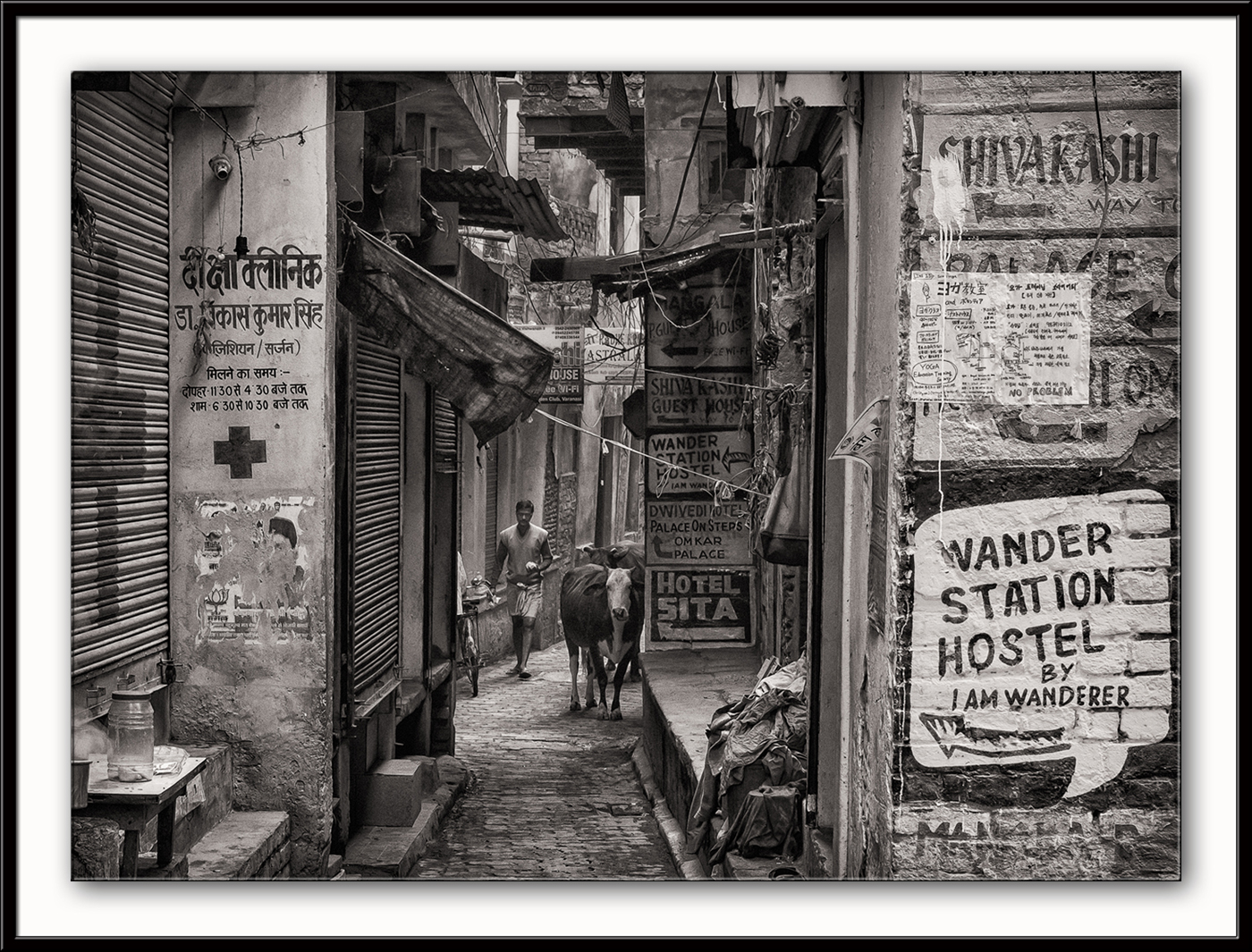
Have you made multiple trips to Varanasi?
No, just one time. I could spend a year there and not see all the nooks and crannies. Unfortunately my exotic travel has halted as my wife’s Parkinson’s has advanced resulting in our trips being limited to places that are more suited to disabled people. We’ve been spending our winters in small Mexican towns.
p.3 #14 · What would most improve your phiotography?
This thoughtful post is the kind of Scott I’d love to see more of around here. (That’s a compliment, Scott.)
Literally moments before I read it I was thinking about how it (“competence,” “skill,” whatever we want to call “it”) is not about one single thing, but a whole package of them. Technical skill is a part of it, sensitivity is a part, reaching an intuitive relationship to the work is another, obviously you have to have a camera, understanding the work of others helps, and so on.
Rather than telling people the “one” best thing to help them improve, it might be more about helping balance the component experiences and think about how they fit together.
I’d suggest one small change to the way the “four steps” are labeled, though some might argue that it is more a matter of semantics — I don’t think that last stage is about unconsciousness competence as it is about intuitive competence. A subtle distinction, perhaps, but I think that practitioners at that level are very much conscious of what they are doing, just at a different level.
That’s part of what the “10,000 hours” mantra and similar perspectives are getting at. Once you do a thing enough (and “enough” is a whole lot) you can begin to operate intuitively rather than trying to analyze everything based on “rules” and similar.
I think it's important to recognize that all of the methods discussed in this thread so far have merit at some point in the journey to mastery. Some are just more pertinent than others at various points.
I also think it's super important to realize that stage 3 could last for decades, depending on your innate artistic ability, available time to hone your craft, and sheer will to keep learning and growing through repetition.
p.3 #15 · What would most improve your phiotography?
chez wrote:
No, just one time. I could spend a year there and not see all the nooks and crannies. Unfortunately my exotic travel has halted as my wife’s Parkinson’s has advanced resulting in our trips being limited to places that are more suited to disabled people. We’ve been spending our winters in small Mexican towns.
Yes, Varanasi definitely qualifies as exotic travel. Must be quite an adventure just to get there. Great images. I'm sorry to hear about your wife's Parkinson's. My mother dealt with having that for 25 years. It is good that you are still finding interesting places to go together.
p.3 #16 · What would most improve your phiotography?
chiron wrote:
Yes, Varanasi definitely qualifies as exotic travel. Must be quite an adventure just to get there. Great images. I'm sorry to hear about your wife's Parkinson's. My mother dealt with having that for 25 years. It is good that you are still finding interesting places to go together.
Yeh, it’s an ugly diseases that slowly robs one of their life. I try to get out a bit while in Mexico, but it’s not the same as getting up before dawn and walking the alleys of Varanasi.
We are going to babysit a Doberman on the Big Island in October for my wife’s sister. Hoping to catch the volcano spilling it’s guts.
p.3 #17 · What would most improve your phiotography?
In my opinion, the biggest improvement is what makes a photo more appealing and interesting?
Learning good composition and how to avoid (and delete distractions in post) will be a big improvement for most photographers. This will help you control and direct the viewer's eye to what the photographer intended.
p.3 #18 · What would most improve your phiotography?
chez wrote:
Yeh, it’s an ugly diseases that slowly robs one of their life. I try to get out a bit while in Mexico, but it’s not the same as getting up before dawn and walking the alleys of Varanasi.
We are going to babysit a Doberman on the Big Island in October for my wife’s sister. Hoping to catch the volcano spilling it’s guts.
I'm very sorry for your struggles. Take what you can from what remains. Big Island is very beautiful and getting near to flowing lava is a powerful experience.
p.3 #19 · What would most improve your phiotography?
Something that isn't on the list is probably what I need to explore more: Vision is an evolutionary thing that may come easy for some but what would make me a better photographer is coming to terms with my Style, because it is what makes me happiest.
Rather than new / more gear (I've learned that I can still take terrible images with the best!) I would like to spend a week or so with Simon Booth in the UK and work with him to take a deep, critical, dive into my portfolio. With a mentor such as he looking over my shoulder we could work through the complexities of visualizing and processing my work. I own more than enough gear but its my brain that needs an update.
p.3 #20 · What would most improve your phiotography?
Once my wife gives birth to our 2nd kid, and then we have some time off work, that will help improve my photography, even more so when we can again go on day trips to new places, as I can only get so much out of my backyard and office..