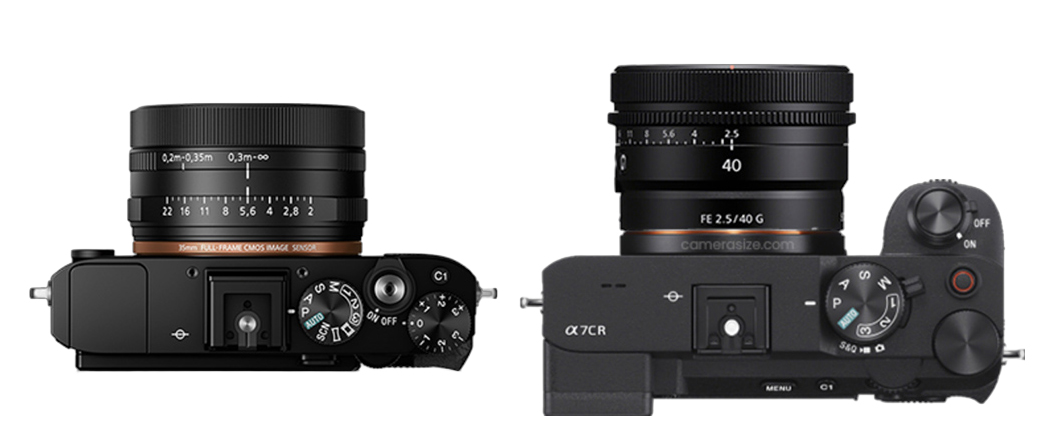
For those thinking about the Sony A7CR with the FE 40mm f/2.5 as an alternative to the smaller RX1R series, here is a side-by-side comparison:
The A7CR offers better ergonomics with a solid grip and IBIS, but it is still a larger setup, even though it is about as compact as a full-frame camera with a high-performing lens can get. It is, however, much smaller than the Leica Q3 43.
Fred Miranda wrote:
For those thinking about the Sony A7CR with the FE 40mm f/2.5 as an alternative to the smaller RX1R series, here is a side-by-side comparison:
The A7CR offers better ergonomics with a solid grip and IBIS, but it is still a larger setup, even though it is about as compact as a full-frame camera with a high-performing lens can get. It is, however, much smaller than the Leica Q3 43.
if you are willing to forgo AF the cv 40/1.2 SE or lux FLE probably come closer to the RX1 magic.
Jul 29, 2025 at 01:47 PM
Steve Spencer Online • • • • • • • Upload & Sell: On
Fred Miranda wrote:
For those thinking about the Sony A7CR with the FE 40mm f/2.5 as an alternative to the smaller RX1R series, here is a side-by-side comparison:
The A7CR offers better ergonomics with a solid grip and IBIS, but it is still a larger setup, even though it is about as compact as a full-frame camera with a high-performing lens can get. It is, however, much smaller than the Leica Q3 43.
I suppose if you are looking to add to the A7CR and make as small a kit as possible with AF, you might want the Sony/Zeiss 35 f/2.8, but that combo is a stop slower, the kit is quite a bit heavier, and personally I would prefer the rendering of the lens from the RX1R III. You would gain a better grip and IBIS, but I can see why people would prefer the RX1R III. It isn't for me as I don't like using a camera that small which I find too hard to hold (and I even find the A7CR to small), but I can see the attraction of the RXR1 III to some even with its limitations and even though it isn't for me.
sebboh wrote:
if you are willing to forgo AF the cv 40/1.2 SE or lux FLE probably come closer to the RX1 magic.
There is magic for sure, especially if you enjoy smooth focus transitions. There is almost no outlining in specular highlights and in some ways it reminds me of the Sigma 45mm f/2.8 C but with better SA correction.
Although the Sonnar 35mm f/2 has been carried over from body to body since the original RX1, it's not without flaws. Its AF motors are not silent and are slower than Sony's best today. There is noticeable axial CA, the sunstars are not well defined, and if I remember correctly, the aspherical element left some onion pattern in the bokeh. What sets it apart is its very low optical vignetting, so bokeh balls stay nice and round even off-axis.
I would not expect the 35mm f/1.4 FLE to have that same rendering and I never really liked the FE 35mm f/2.8 despite it's great size.
For me, when I want AF I can always use the Techart adapter without any performance penalty since I have a Kolari mod.. My small 35mm lens with an autofocus adapter is the MS Optics 36mm f/1.3 which weighs only 72 grams. I usually set AF tracking to the center, acquire focus quickly, and when I recompose, the focus follows the subject without any hesitation even in low light. The EA9 adapter works very well with the A7CR body.
Fred Miranda wrote:
There is magic for sure, especially if you enjoy smooth focus transitions. There is almost no outlining in specular highlights and in some ways it reminds me of the Sigma 45mm f/2.8 C but with better SA correction.
Although the Sonnar 35mm f/2 has been carried over from body to body since the original RX1, it's not without flaws. Its AF motors are not silent and are slower than Sony's best today. There is noticeable axial CA, the sunstars are not well defined, and if I remember correctly, the aspherical element left some onion pattern in the bokeh. What sets it apart is its very low optical vignetting, so bokeh balls stay nice and round even off-axis.
I would not expect the 35mm f/1.4 FLE to have that same rendering and I never really liked the FE 35mm f/2.8 despite it's great size.
For me, when I want AF I can always use the Techart adapter without any performance penalty since I have a Kolari mod.. My small 35mm lens with an autofocus adapter is the MS Optics 36mm f/1.3 which weighs only 72 grams. I usually set AF tracking to the center, acquire focus quickly, and when I recompose, the focus follows the subject without any hesitation even in low light. The EA9 adapter works very well with the A7CR body....Show more →
yes, the low optical vignetting combined with a very smooth focus transition creates a very unique look that is particularly good for taking wide open shots at fairly long focus distances that keeps the background slightly oof with no crazy business. it's also very good for bokeh stitches since the bokeh is so even. no other FF 35mm lens can do this as well imo. the cv 40/1.2 can generate substantial separation at distance wide open, which can kind of give a similar look, and both it and the FLE can do modern sharp but with slight SA for portraits that is more pleasing than anything from the new hyper corrected lenses imo.
i'm not much for AF but the lux pre-asph has always been my choice for a tiny 35mm. lately i have really been enjoying the rollei 40/2.3 that i pulled off an XF 35 though.
Fred Miranda wrote:
For those thinking about the Sony A7CR with the FE 40mm f/2.5 as an alternative to the smaller RX1R series, here is a side-by-side comparison:
The A7CR offers better ergonomics with a solid grip and IBIS, but it is still a larger setup, even though it is about as compact as a full-frame camera with a high-performing lens can get. It is, however, much smaller than the Leica Q3 43.
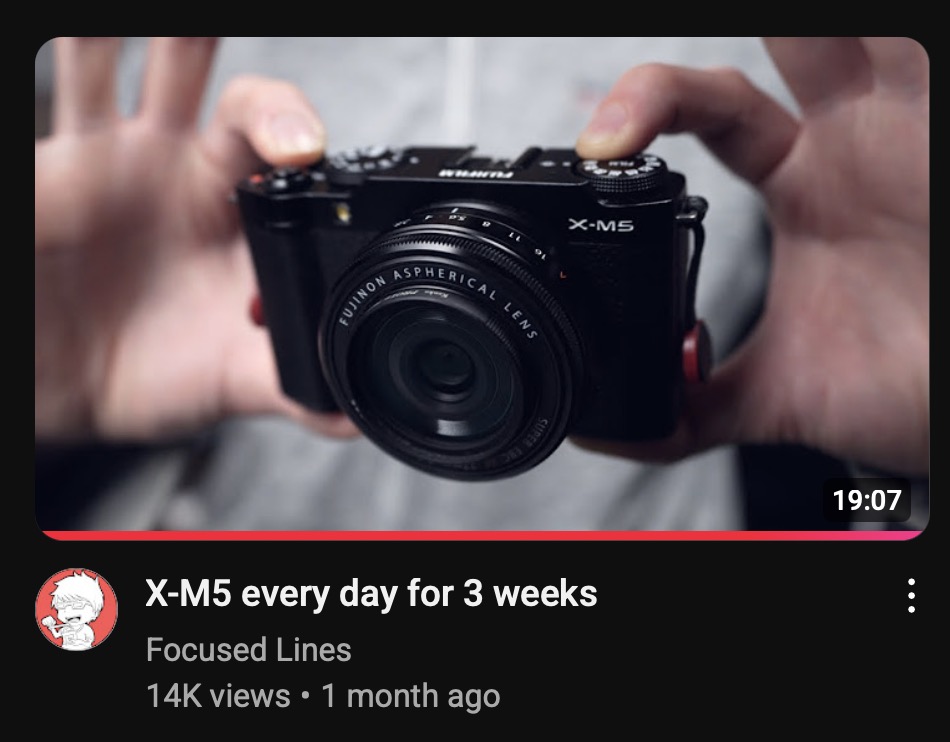
In fairness, with the EVF sunshade, a lens hood (because flare control is poor), a thumb grip, and a hand grip added to the RX1R III, they would be much closer in size. I watched Julia Trotti's review of it today, and even in her small hands, it looked incredibly difficult for her to wield for a portrait shoot. The RX1R III reminds of my Fujifilm X-M5, which practically requires a handgrip and thumb grip unless I want to hold it like an iPhone with my fingertips.
highdesertmesa wrote:
In fairness, with the EVF sunshade, a lens hood (because flare control is poor), a thumb grip, and a hand grip added to the RX1R III, they would be much closer in size. I watched Julia Trotti's review of it today, and even in her small hands, it looked incredibly difficult for her to wield for a portrait shoot. The RX1R III reminds of my Fujifilm X-M5, which practically requires a handgrip and thumb grip unless I want to hold it like an iPhone with my fingertips.
Yep, once you start adding grip and hood accessories to the RX1, its size gets pretty close to a bare A7C series body. I also like that the viewfinder is no longer pop-up...it was charming at first but became annoying with regular use.
highdesertmesa wrote:
In fairness, with the EVF sunshade, a lens hood (because flare control is poor), a thumb grip, and a hand grip added to the RX1R III, they would be much closer in size. I watched Julia Trotti's review of it today, and even in her small hands, it looked incredibly difficult for her to wield for a portrait shoot. The RX1R III reminds of my Fujifilm X-M5, which practically requires a handgrip and thumb grip unless I want to hold it like an iPhone with my fingertips.
i never saw any benefit from any of the hood options i tried, so i would just skip it. i did end up using a step down ring which added about the same is a filter would (more for physical protection then sun shading).
i don't really understand what is going on with that grip - you hold the camera like you would any of the classic film SLRs of OM-1 size with your middle finger going down the front. i don't have big hands, but i need large men's gloves and i have no problem. it would have to be a giant grip to give any real benefit imo. i can see how a thumbs up would be helpful for a relaxed grip though.
sebboh wrote:
i never saw any benefit from any of the hood options i tried, so i would just skip it. i did end up using a step down ring which added about the same is a filter would (more for physical protection then sun shading).
i don't really understand what is going on with that grip - you hold the camera like you would any of the classic film SLRs of OM-1 size with your middle finger going down the front. i don't have big hands, but i need large men's gloves and i have no problem. it would have to be a giant grip to give any real benefit imo. i can see how a thumbs up would be helpful for a relaxed grip though....Show more →
I was joking about the fingertip grip (the person in the screenshot was just holding the camera out to show it off). Even with the GFX100RF, I hold it from the bottom (resting in the palm).
sebboh wrote:
yes, the low optical vignetting combined with a very smooth focus transition creates a very unique look that is particularly good for taking wide open shots at fairly long focus distances that keeps the background slightly oof with no crazy business. it's also very good for bokeh stitches since the bokeh is so even. no other FF 35mm lens can do this as well imo. the cv 40/1.2 can generate substantial separation at distance wide open, which can kind of give a similar look, and both it and the FLE can do modern sharp but with slight SA for portraits that is more pleasing than anything from the new hyper corrected lenses imo.
i'm not much for AF but the lux pre-asph has always been my choice for a tiny 35mm. lately i have really been enjoying the rollei 40/2.3 that i pulled off an XF 35 though....Show more →
I shoot lots of panos and RX1 Sonnar is superb for it for just the reasons you stated. The 35i does well too, but the higher optical vignetting you have to be a bit careful with. You can shoot them WO on the Sonnar and you get this wonderful sense of depth.
I had the original RX1 about 10 years ago. Recently I purchased a Nikon 35mm f1.4 Z and to my eyes, there are some similarities between the OOF rendering of it and the RX1's Sonnar - mild soap bubbles without being over the top, and round bokeh balls even closer to the edges. It doesn't have the sparkle of the RX1, though the f1.4 aids in subject separation (just not 40mm f1.2 levels). I don't have an RX1 to shoot side by side images but I did revisit the RX1 thread. You can let me know if I'm seeing things.
Anyway, I was initially excited about the RX1 RIII's announcement but more recent cameras having IBIS, secondary memory/internal memory and a tilt screen have spoilt me (basically my Zf). I wouldn't have minded the camera being maybe $750 more expensive if it contained more of these improvements. I'd have been happy for the camera to be 100g heavier and a bit bulkier. The original RX1 came out at the time where mirrorless cameras/systems were touted as being smaller than DSLRs and it was a real statement of miniaturisation by Sony. But we have moved past that now. Even Sonys mirrorless cameras aren't the same dimensions and weight as they were over a decade ago (the gen 1s). A missed opportunity to take advantage of the camera world becoming more desensitised to slightly larger bodies. I guess credit to Sony for sticking to their initial RX1 design and size philosophy.
Now that the dust is settling, it seems like the RX1R III is a camera with “soul,” if I had to use that unfortunate label. Sony’s tech-forward cameras are often called “soulless” computers with a lens attached, but when they make cameras emphasizing UX, usability, and design, it defies expectations and people get upset.
I see the RX1R III as the heir to the tradition of the Konica Hexar AF and RF, and Minolta CLE and TC-1.
raizans wrote:
Now that the dust is settling, it seems like the RX1R III is a camera with “soul,” if I had to use that unfortunate label. Sony’s tech-forward cameras are often called “soulless” computers with a lens attached, but when they make cameras emphasizing UX, usability, and design, it defies expectations and people get upset.
I see the RX1R III as the heir to the tradition of the Konica Hexar AF and RF, and Minolta CLE and TC-1.
Fred Miranda wrote:
More or less. Those were really the two main options at the time, and for a while people were weighing the RX1 II against the Q or Q2. Even though both have built-in lenses and full-frame sensors, I never really saw them as being in the same class. The Q isn't much smaller than an M body, while the RX1 series stands out for its compactness. It's not exactly pocketable like the APS-C GR series, but it's probably the smallest full-frame option with a high-performing lens.
Sorry, I kind of lost track of this thread...
The RX1 vs Leica Q design philosophy reminds me of Sony's first-gen FF mirrorless releases. When I asked a friend who worked at Sony at the time why the cameras were so small (and therefore uncomfortable to use), he implied it was what the Japanese/Asian market wanted. Over the past 10+ years though, Sony did modify the ergonomics of those cameras to make them more usable. IMO, the first Sony FF mirrorless I actually didn't mind using was the a9. Yet the RX1 appears to stick to this original 'as small as possible, because we can' type of philosophy with the same relatively large 35/2 that conflicts with such a philosophy, still glued to it.
I've always thought the Sonnar 35/2 was THE reason to get this camera. Not because it's a small camera, or whatever other reason. Clearly (IMO) it's (lens) enthusiasts who will be drawn to this camera and my thinking is most would (gladly) accept a more comfortable to use, somewhat larger body. Especially if it meant Sony didn't corner-cut other specs. Therefore, Sony could have redesigned the v3 as a more 'harmonious' design to complement the lens.
Leica's Q cameras are larger than the current RX1 design, but there's a logical reason for this: the average human hand size. IMO it's also why the M series is roughly a 4x6" block - it's comfortable to hold and controls don't feel cramped. I don't think it's a coincidence many cameras are roughly the same general size. Even m43 cameras don't fully realize how small cameras 'could' be made, because they still need to be usable via human hand interface.
While it will never happen, it would be cool for Sony to provide customers with two RX1 options: as is (small) and "Pro," or whatever you want to call it, that is upsized to actually be enjoyable to use. Even cooler would be if the entire lens and sensor 'package' could be swapped across such bodies as a self-contained module. Basically a design concept cribbed from the Ricoh GXR. Rather than swapping in/out a range of lens modules, you'd be swapping in/out body designs based on whether you want as small as possible or comfortable and good ergonomics. But then, why not a range of lens modules? Like perhaps at least a pancake for a truly as small as possible FF option that the current Sonnar lens doesn't suit.
Those cameras had traditional interfaces for basic settings. No rear LCD display, multi-function D-pad, dials, buttons, etc. to clutter up the limited real estate. And the 35/2 Sonnar is larger than the typical M lenses used/sold with the CL or attached to the various compacts of that era.
IMO the RX1's current camera dimensions would make more sense with a smaller lens. But as I posted earlier, IMO *the* reason for the RX1 is precisely its amazing lens.
I was going through some of my older images (more than 3k in total) taken with the RX1R and RX1R II and started wondering if Sony could improve the lens a bit. Maybe what makes people call it magical is how high resolution and full of micro-contrast it is at the center and mid-frame, with a gentle falloff toward the corners. That, combined with its smooth focus transitions, lack of outlining, and an almost "gaussian" quality rendering, helps subjects pop with clarity while keeping the background undistracting.
Still, I think there's room for improvement. The aspherical elements cause onion rings in specular highlights, and fringing is quite visible in some shots and flare is evident (and ugly) when shooting against the light. That could definitely be addressed with newer optics while still keeping the "magic".
Also, the lens uses older motors. Replacing those with modern linear motors would go a long way in improving autofocus performance. My concern is that even if Sony gives the camera a new processor and updated AF algorithms, the outdated motors could still limit its focusing speed and reliability, especially compared to something like the FE 40mm f/2.5.
Overall, I think Sony did a great job modernizing the body. It now fits better with the rest of the lineup, the built-in EVF is a welcome upgrade from the pop-up one, and the new battery (which is not great but vastly better than the previous) is much more practical. But it feels like they missed a big opportunity by not improving the lens and its mechanics, even though it's a design many people love. Even Ricoh redesigned their well-regarded 18mm f/2.8 lens for the upcoming GR IV, despite already having outstanding performance on APS-C.
One final thought...after looking at the images of the new camera and comparing it to the RX1R II, I think Sony could’ve kept the tilt LCD and focus mode dial. It might not have looked as sleek or modern, but for many users, that feature is indispensable.
Fred Miranda wrote:
Also, the lens uses older motors. Replacing those with modern linear motors would go a long way in improving autofocus performance. My concern is that even if Sony gives the camera a new processor and updated AF algorithms, the outdated motors could still limit its focusing speed and reliability, especially compared to something like the FE 40mm f/2.5.
Not an issue according to the PetaPixel review on YouTube. Autofocus is awesome according to them.
They even explicitly mention that the slow performance with the previous model seems to have been algorithm-related rather than an issue with the focusing motor itself.
rscheffler wrote:
The RX1 vs Leica Q design philosophy reminds me of Sony's first-gen FF mirrorless releases. When I asked a friend who worked at Sony at the time why the cameras were so small (and therefore uncomfortable to use), he implied it was what the Japanese/Asian market wanted. Over the past 10+ years though, Sony did modify the ergonomics of those cameras to make them more usable. IMO, the first Sony FF mirrorless I actually didn't mind using was the a9. Yet the RX1 appears to stick to this original 'as small as possible, because we can' type of philosophy with the same relatively large 35/2 that conflicts with such a philosophy, still glued to it. ...Show more →
i refused to upgrade my OG a7 for a decade because all the new bodies were too big. i finally got a a7cii last year – wish it was thinner or at least had the sensor recessed deeper into the body. i was attracted to the leica q due to the better vf and better manual focus implementation, but it is just too big for a fixed lens camera (i'd rather use the a7cii with a small lens).