Grenache wrote:
Indeed, the Fuji and Hassie current offerings might better be described as Middle Format, rather than what has been known as Medium Format. The resolution advantages are maximized on these Middle Format sensors only when no cropping (of both dimensions) is done, or if the same scene would have required cropping on a 35mm sensor as well.
In terms of the “medium format look,” this is an eye of the beholder concept. One might see it as better than 35mm, but I don’t think anyone would objectively say it looks like a 6x6 or other film style.
None of the above is to cast shade on either product nor company. It is just to calibrate expectations. I have been on the fence about acquiring one for some time, but it is not to get “the medium format look.” If there were a reasonable price point on a larger sensor approaching PhaseOne size, I’d have already snagged one. Because these are “tweeners,” it has been harder for me to justify.
No. Medium format is anything larger then 135 format. There were plenty of medium format films smaller than 645.
In modern times any *medium format look* has been decimated by modern 135 format lenses. Really the only advantages to a larger sensor are file pliability and colour depth. And mostly that’s all eradicated as well because we view images on such average devices that anything from a phone looks good. There’s maybe 1% of images that really benefit from the larger sensor. Long exposures are also much much better on 33x44mm sensors. But a look? Not really.
Objectively, the X2D sensor vastly out resolves any medium format film and lenses. You need to be shooting 4x5 to even get close in resolution and available detail.
Where were the 100mp sensor cameras when I could have justified, afforded and made good, appropriate use them? Even the very best medium format drum scans didn't come close. Shit. Again, horses for courses.
That said, the 135 format is now so good that the comparison no longer makes me cry.
RoamingScott wrote:
Yes, the more square native aspect ratios and the higher resolution giving you more opportunities to use unique aspect ratios are the two big selling points for me. GFX and Hassy still don't have the film 6x7 type "look" to me with their bokeh.
---------------------------------------------
Unfortunately, my Hassy wasn't a steal so I'm sat here giving it a hard look and determining what it gains me and what it doesn't vs my very capable Nikon gear, even down to the "lowly" Zf. I certainly enjoy the output of the X2D, but there are real pain points with shooting with it.
---------------------------------------------
Agree with all of this, though I prefer shooting the Zf over the Z9 for most things...oh how I wish we could get the Z7ii sensor in the Zf body!
---------------------------------------------
I was curious if anyone would pick up on my trick. It's N > H > H > N
---------------------------------------------
And there he is =)
The older I get, the more I value the shooting experience over everything else, since output has become so close, especially if you post process.
---------------------------------------------
Indeed! I didn't think comparing to my APO-L would look similar enough FOV wise, plus this proves my point even better
I think the Ultron is a slept on lens, though.
---------------------------------------------
My wife picked up on the magenta differences immediately. It wasn't meant to be a perfect color match, or I would have edited them. That said, the Hassy colors straight out of camera are some of the most "true to life" to how my eyes see of any camera I've used. Amusingly, I realized through this experiment that the Hassy JPG files out of camera are identical to the RAW files (color wise), but simply without lens corrections, which is odd and funny....Show more →
Missed reading your comment about not seeing the 6x7 bokeh/separation look on the Hass or GFX. I have seen it but only natively with the Mitakon 65 1.4 and then adapted with the EF 85 1.2, Otus 85 1.4, and Minolta 58 1.2.
It’s a real shame that neither manufacturer has made a native lens with an f/1.4 or f/1.2 aperture. Sure it’d be large, but the lenses are already large, and Fujifilm already calls it large format (chuckles from the crowd). The GF f/1.7 lenses were close but no cigar, IMO.
KLaban wrote:
Where were the 100mp sensor cameras when I could have justified, afforded and made good, appropriate use them? Even the very best medium format drum scans didn't come close. Shit. Again, horses for courses.
That said, the 135 format is now so good that the comparison no longer makes me cry.
The end of 44x33 would be a 135 format spinoff that was the same width but slightly taller to change the image ratio to 4:3. Existing 135 format manufacturers could do this with the caveat being some existing native lenses might not perform optimally out to the farthest corners (and some have 3:2 baffles on the rear of the lens that would need optional factory modification/replacement).
highdesertmesa wrote:
Missed reading your comment about not seeing the 6x7 bokeh/separation look on the Hass or GFX. I have seen it but only natively with the Mitakon 65 1.4 and then adapted with the EF 85 1.2, Otus 85 1.4, and Minolta 58 1.2.
It’s a real shame that neither manufacturer has made a native lens with an f/1.4 or f/1.2 aperture. Sure it’d be large, but the lenses are already large, and Fujifilm already calls it large format (chuckles from the crowd). The GF f/1.7 lenses were close but no cigar, IMO.
Easier to get the look on FF today as we have very fast lenses that are simultaneously very sharp in the plane of focus.
Cropping to 1:1 to match 6x6 film:
A 35mm f/1.2 on FF will yield a look similar to a 80mm f/2.8
150mm f/4 lenses are equivalent to 65mm f/1.7 on FF, so the Sigma 65mm is very similar
The look of the 105mm f/2.4 on 6x7 is a bit harder to match. Technically we'd need a 45mm f/1 on FF when cropping to 6:7 aspect ratio. But the 50mm f/1.2 lenses are not too far off and there's a good one for each of the major systems.
On 44x33 the equivalent lenses would be:
80mm f/2.8 --> 45mm f/1.7 (1:1 crop)
105mm f/2.4 --> 63mm f/1.4 (6:7 crop)
150mm f/4.0 --> 90mm f/2.4 (1:1 crop)
flash wrote:
No. Medium format is anything larger then 135 format. There were plenty of medium format films smaller than 645.
In modern times any *medium format look* has been decimated by modern 135 format lenses. Really the only advantages to a larger sensor are file pliability and colour depth. And mostly that’s all eradicated as well because we view images on such average devices that anything from a phone looks good. There’s maybe 1% of images that really benefit from the larger sensor. Long exposures are also much much better on 33x44mm sensors. But a look? Not really.
Objectively, the X2D sensor vastly out resolves any medium format film and lenses. You need to be shooting 4x5 to even get close in resolution and available detail.
That is more a marketing statement. The medium format look is not about resolution. Film had the same resolution, regardless of whether it was rolled into a Hasselblad cassette or a Nikon F1.
There's a use case for medium format, but it's not found in most hobby photography, general travel and family photos.
A friend sent me a portfolio of architectural work from cities in Europe and Asia. He uses a Phase One IQ4 150 and can get 22mm of rise on the long edge using his Schneider-Kreuznach APO-Digitar 60mm f/5.6 XL lens. There's nothing else that can do that and get comparable results.
If Fuji released a 50mm t-s lens as good or better than the 30mm, then that would be close, although it would have to allow for 18mm of shift to match the 22mm my friend is getting on his outfit.
For the vast majority of people, a good full frame camera is probably more than what they need already. But life is short, so if shooting with medium format gives you pleasure, then why not? Fussing about technical benefits over other formats isn't as important as the experience.
I know what I am about to say still won't work in all situations, and some may even find it a bit controversial, but if your goal is to maximize image quality for landscapes, it's easier than ever to add image stacking / HDR into your workflow.
A camera like a Z8 can fire off 20fps within a second. IBIS makes it easier than ever to take a bracket handheld. Electronic shutters eliminate any shutter shock. Cameras have more bracketing options than ever.
Take a 4 image bracket with the same exposure and average them in post, and you gain about a 1 stop improvement in noise / dynamic range. Take an 8 image bracket, and you gain about 2 stops.
If the scene really requires an increase in dynamic range, HDR software has gotten better than ever at producing natural results, it's not like it was 10 years ago. LR HDR merge alone has gotten quite good for images that are not extreme in motion or contrast. Skylum still has the best HDR merge when it comes to dealing with motion and high contrast edges, even though now it's a bit more clunky to use in Luminar. Nik HDR effects pro, while possibly the worst of the 3 for motion, and is easy to over process your images in still has an amazing ability to recover details in extreme highlights, such as an image with the sun in the frame.
If you go with the HDR approach and do a 3 frame bracket with a Z8 at 20fps of -2, 0, +2, you can add about a 4 stop improvement to your image, and it only takes about .2 of a second to take, greatly helping reduce any motion / alignment issues. Admittedly, it's not foolproof yet as I learned one day trying to take brackets from a boat in wavy conditions 😂 But things have improved greatly from the first time I tried bracketing with a d800e at 4fps that could only bracket one exposure apart.
highdesertmesa wrote:
The end of 44x33 would be a 135 format spinoff that was the same width but slightly taller to change the image ratio to 4:3. Existing 135 format manufacturers could do this with the caveat being some existing native lenses might not perform optimally out to the farthest corners (and some have 3:2 baffles on the rear of the lens that would need optional factory modification/replacement).
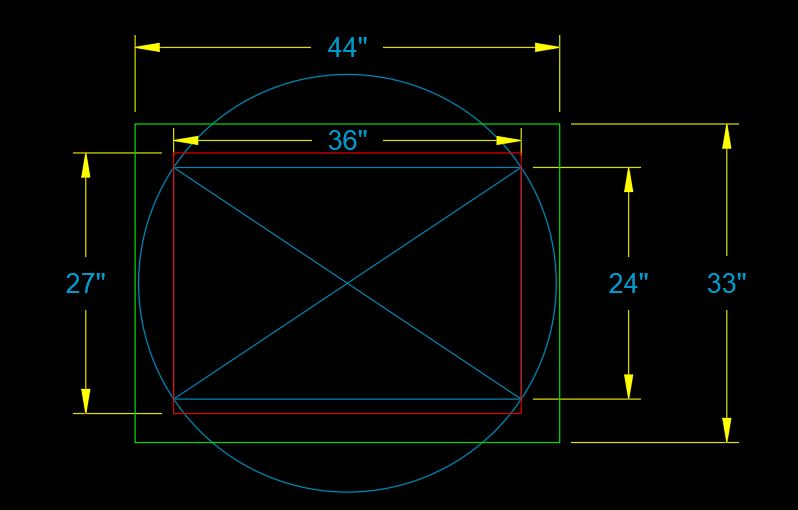
You're talking about a 27mm tall sensor instead of a 24mm tall sensor to get 4:3 with a 36mm width. You'd get 972mm^2 of light gathering area instead of 864mm^2, or a 12.5% increase. 44x33 sensors meanwhile have 1,452mm^2 of light gathering or a 68% increase over a standard 35mm sensor. I'd have a hard time believing that it's worthwhile doing, plus as you mention you'll start running into vignetting (and possibly worse) in the corners.
Edit to add: This is why when people talk about mythical square sensor cameras that allow you to crop in post to any orientation/ratio you want, it doesn't actually work. The image circle is just not anywhere near large enough for that sort of thing.
RoamingScott wrote:
It's funny...everyone that shoots GFX loves the "malleability" of the files...meanwhile, the X2D raw files come out lush with great white balance and need hardly any work at all to look fabulous. Sure, you can shove them around to get a stylized look, but in practice, they don't need the flexibility they possess.
The Nikon HE* RAWs are no slouches and perform great in the vast majority of cases. If you know how to shoot your camera to maximize the IQ in body first, you can get great results with anything.
I don't really buy that the 102mp sensor is leaps and bounds better than the Z9's 45 or even the ZF's 24 in real world use outside of fringe edge cases....Show more →
I never had issues with colors, or quality of images "straight" from camera, in any camera in the last, let's say 20 years. Adjusting colors to my liking is a part of raw processing, and most of the time it is just applying my default settings to images. "Coming great out of camera" have no meaning to me.
I shoot a lot on evening walks, or at dance recitals, with a high iso, and nikon images most definitely do not recover shadows or highlights as well as gfx. It is not a critical difference, but it is there. On the other hand, cannot shoot a dance recital on gfx but can shoot an evening walk with any camera.
olegkin wrote:
I never had issues with colors, or quality of images "straight" from camera, in any camera in the last, let's say 20 years. Adjusting colors to my liking is a part of raw processing, and most of the time it is just applying my default settings to images. "Coming great out of camera" have no meaning to me.
I shoot a lot on evening walks, or at dance recitals, with a high iso, and nikon images most definitely do not recover shadows or highlights as well as gfx. It is not a critical difference, but it is there. On the other hand, cannot shoot a dance recital on gfx but can shoot an evening walk with any camera. ...Show more →
My usual post-processing settings are pretty conservative. But I’ve been watching photographers I admire on YouTube, and they go much more aggressive to get their results. When I change something in C1 by, say, +10, they’re pushing it to +40.
I’ve started experimenting with that approach, and surprisingly, it works more often than not. Yesterday, I watched someone demo Evoto for fashion portraits and they used the same settings I do, but with nearly double the values across the board.
Just a thought for folks looking to add more punch to their images - don’t be afraid to push the sliders and experiment during post-processing.
olegkin wrote:
I never had issues with colors, or quality of images "straight" from camera, in any camera in the last, let's say 20 years. Adjusting colors to my liking is a part of raw processing, and most of the time it is just applying my default settings to images. "Coming great out of camera" have no meaning to me.
I shoot a lot on evening walks, or at dance recitals, with a high iso, and nikon images most definitely do not recover shadows or highlights as well as gfx. It is not a critical difference, but it is there. On the other hand, cannot shoot a dance recital on gfx but can shoot an evening walk with any camera. ...Show more →
olegkin wrote:
I never had issues with colors, or quality of images "straight" from camera, in any camera in the last, let's say 20 years. Adjusting colors to my liking is a part of raw processing, and most of the time it is just applying my default settings to images. "Coming great out of camera" have no meaning to me.
Are you saying that you don't have issues with colours coming straight out of camera because you process the RAW files, so the colour straight from camera is irrelevant?
If that's what you meant, I agree. When we know what we're doing, we can get where we need to go with RAW files and the right camera profile.
I am glad you found the equipment that you like. The comparison.....well.....that's like comparing a full-size truck to a hatchback sedan. With the downscaled images it's like you took the hatchback down a dirt road with some minor ruts and rocks and said look it can go all the places the full size truck can go. Oh and it's faster than the truck and gets better gas mileage all at half the price. There is a vehicle there that makes the most sense in your life and there are some overlapping capabilities and advantages and disadvantages, but that is just a statement about your needs and preferences and not an honest analysis of the capabilities in the most difficult conditions.
bernardl wrote:
Btw I would use an X2D instead if the lenses were weather sealed. Half of my landscape work is done in snowy conditions and the gear often ends up very wet due to condensation. The GFX lenses aren’t 100% as good and the Hassy colors are clearly nicer but the GFX system doesn’t need baby sitting.
I'm going to go as far as to say that 2/3rds of the work I do is in snowy / wet conditions, endless blue skies are not my jam. So I am using either my Hasselblad V film system or the X2D and in either case, I always carry and use one of these:
Ai_Print wrote:
I'm going to go as far as to say that 2/3rds of the work I do is in snowy / wet conditions, endless blue skies are not my jam. So I am using either my Hasselblad V film system or the X2D and in either case, I always carry and use one of these:
woodstork wrote:
Many years ago I shot Mamiya 7 medium format and it provided a significant IQ boost over 35mm film because it hit a meaningful threshold in size increase. Its impact occurred at a glance and even when images from both formats were printed at modest sizes. Major IQ game changer worth all the pain in the rear limitations of the shooting experience.
I think it is also worth considering that the difference between MF and 35mm in the past with film was significantly different from what it is in digital because of more than just the typically larger size differential:
1. The vast majority of films don't resolve remotely as well as digital sensors. We all have a "threshold of acceptability" at which differences are obvious and above which returns are diminishing. Because the film media is so poor performing compared to digital (be it resolving power or noise) that threshold often lived in the 35mm to MF transition for lots and lots of photographers and viewers when shooting film. The difference jumped out at most people, as you say even at modest sizes. These days with that threshold lives further down in the format size space. Most people simply don't see the difference between MF and 35mm, or even FF and APS-C in a fairly wide range of use cases. Of course all of us can often tease out the differences between all formats, but there seems to be a point at which the difference is obvious.
2. When accounting for developing the film things in fact DO NOT scale as expected with format size changes. In digital we all know about "equivalence" and in general as sensor performance has plateaued in many situations we can take identically "equivalent" photos on different sized formats. However in film this really isn't possible because the physical chemistry involved in developing is independent of the format size naturally. Because of what is sometimes called "developer thieving" developer chemistry actually has a sharpening effect on a fixed spatial scale. Namely at a high contrast edge one side "thieves" developer from the other enhancing the edge just like USM does (this is just due to simple reagent diffusion trying to balance the excessive consumption resulting in the dark edge becoming darker and the light edge becoming lighter). So in film the "acuity" or "microcontrast" or whatever term one chooses actually ends up on a finer scale in the finished print for MF than it would for 35mm. The same is not true for digital (and of course we now have exquisite control over such effects in post processing).
3. Typical differences in optics for MF and 35mm systems were more extreme in the past. In theory of course you could get amazing 35mm lenses in the past, in reality you were much more likely to have an optically inferior lens on the 35mm system (if nothing else because you might be shooting with a zoom). The gap has narrowed significantly in the modern digital era, something which has little to do with film vs digital but just with the fact that we have better lenses and affordable prices in the digital era.
Anyway - long winded way of saying our perceptions of the difference between MF and 35mm from the film era are tainted by a lot more than just the fact that "medium" format in film days tended to be larger than in digital days.
---------------------------------------------
RoamingScott wrote:
oh how I wish we could get the Z7ii sensor in the Zf body!
Please, please, please!!!
Or, if I'm honest, better for my shooting needs would be an ultracompact 45MP body stripped of a lot of the higher end features if need be to keep it small (I'd still want IBIS and at least a crappy EVF for bright light). But I think the market for that is vanishingly small while a high resolution Zf would have much more market appeal.
---------------------------------------------
OwlsEyes wrote:
The only advantage of the Hasselblad was that I slowed down and had to spend more time thinking about composition with my fixed lenses. The latter would have occurred if I brought fixed lenses for my Nikon.
Many decades back this was the lesson I learned with a very brief foray into 4x5 photography. Then I forgot the lesson for a bit. Then at the point of my smallest downsizing (down to m43) I remembered it again. The solution for me wasn't to artificially constrain myself by changing the gear I brought into the field, instead it was to constrain myself a bit differently by how I composed to force a contemplative approach while still maintaining the flexibility of broadly capable equipment (e.g. zoom lenses).
My rule was that the camera stayed in the bag while I composed. I composed with a piece of black cardstock with a hole cut in it. This was how I usually had to compose with 4x5 anyway. Once I found the composition that way only then was the camera removed from the bag and the appropriate lens attached for the composition I found. And often a tripod setup as well, but not always. Suddenly my m43 photos looked a lot like my 4x5 photos.
The point I was trying to make here is that fixed lenses aren't necessarily the right solution. They are constraining and those constraints don't necessarily improve compositions. There is no such a thing as "zoom with your feet" for example - that's just a lie. Getting rid of the camera and lenses when composing is how I typically find the "best" composition. Once I've found it then I get the necessary lens out - which if it is a zoom means no compromises at all in the composition, while if it is a prime I either need to crop or deviate from the ideal composition (which of course many times there is plenty of flexibility to do).
---------------------------------------------
highdesertmesa wrote:
For me, the biggest draw of 44x33 is the native image ratio.
This is what I missed most moving from m43 to FF. The 4:3 image ratio is just so much more flexible and useful to me for stills shooting. But of course it is more awkward for 16x9 video and the reality is that sensor reuse across bodies and even manufacturers is almost a necessity these days and hybrid cameras are a big chunk of the market. That said, with anamorphic lenses and the big benefits of open gate recording when targeting footage for multiple outlets it would seem that even video would see advantages in a 4:3 aspect ratio (and in fact m43 with its 4:3 ratio was the basis for Panasonic's early successes in hybrid cameras).
bernardl wrote:
I have one of those and they work great for rain but don’t prevent condensation.
Japanese snow is overall pretty wet, it’s next to impossible to keep equipment dry.
Cheers,
Bernard
Yeah it is very wet, your mid Winter storms are as wet as our very early or late season storms (Co Rockies). I also keep a couple of well used terrycloth washcloths handy for that. I shot MF film in the Faroe Islands for two months, super juicy air on many days. After about 6 weeks, I had to re-lube one of my Hasselblad Flexbodies and completely overhaul a film magazine due to the combo of rain and salt air.
Knock on wood, I have been able to combat condensation with the X2D and the glass fairly well...for now.
Wezre wrote:
You're talking about a 27mm tall sensor instead of a 24mm tall sensor to get 4:3 with a 36mm width. You'd get 972mm^2 of light gathering area instead of 864mm^2, or a 12.5% increase. 44x33 sensors meanwhile have 1,452mm^2 of light gathering or a 68% increase over a standard 35mm sensor. I'd have a hard time believing that it's worthwhile doing, plus as you mention you'll start running into vignetting (and possibly worse) in the corners.
Edit to add: This is why when people talk about mythical square sensor cameras that allow you to crop in post to any orientation/ratio you want, it doesn't actually work. The image circle is just not anywhere near large enough for that sort of thing....Show more →
Your diagram makes the assumption that the usable coverage of current 135 format lenses ends right at the current corners of the format. Some of them do, but many of them have a larger usable image circle. The Canon EF 85 1.2 for example is useful even on the GFX 44x33. As I mentioned, not all current lenses would be ideal on a taller 135 format sensor, but some would. Just like manufacturers release a list of lenses that are ideal on a new ultra-high megapixel body, they'd do the same with the taller sensor. Then moving forward, all pro level lenses would be 4:3 certified – or however they wanted to handle it.
For me the usefulness of a 4:3 sensor that was taller than the 135 format but the same width is when shooting verticals. IMO, vertical 135 format is too narrow and restrictive.
I will agree that an even more useful larger variant of 135 format would be a 36x36 square. I've also argued that a GFX 44x44 sensor would be nice to have – some existing lenses would cover it and future lenses could as well. It also makes having screens that only tilt in the horizontal orientation more fully useful.
^ Neither of these ideas will ever happen, though – it's just fun to speculate.
Some mounts might be big enough to accommodate it, but I think in general, if we want a square 36mm sensor with lenses that have good corner sharpness, we would need a mount with a larger throat diameter and larger lenses. Admittedly, the flexibility of a 36mm square sensor would be cool.


 but can shoot an evening walk with any camera.