fredmiranda.com
Login

Moderated by: Fred Miranda
  New fredmiranda.com Mobile Site
  New Feature: SMS Notification alert
  New Feature: Buy & Sell Watchlist
  

FM Forums | Fuji Forum | Join Upload & Sell

       2       end
  

How much of an X-Pro2 optical VF is blocked by the Voigt 23mm Nokton?


MaunaKea7007
Offline
• •
Upload & Sell: Off
p.1 #1 · How much of an X-Pro2 optical VF is blocked by the Voigt 23mm Nokton?


All:

I have been reading reviews and user threads about the Voigtlander 23mm Nokton for an hour and by luck not found anyone describing this usage element.
When searching here I found no review by Fred... But please let me know if he did one.


Jul 06, 2025 at 04:59 PM
Nielk Mike
Offline
• • •
Upload & Sell: Off
p.1 #2 · How much of an X-Pro2 optical VF is blocked by the Voigt 23mm Nokton?


It is about as big as the 23f2 Fujicron. So there is only a very small part of it showing in the OVF. But: Be aware that the lens doesn't communicate fully with the X-Pro2. No DoF indicator, no f-stop numbers, no auto focus check.


Jul 06, 2025 at 10:44 PM
MaunaKea7007
Offline
• •
Upload & Sell: Off
p.1 #3 · How much of an X-Pro2 optical VF is blocked by the Voigt 23mm Nokton?


Thank you. I've never shot with the 23 f2 so don't know how much that gets in the way, but I did see Voigtlander had kept the front tapered down.
I thought the Nokton 23's contacts did trigger that focus-check magnification, though, when using the EVF.

I have the older clutch 23mm f1.4, which I like, but that won't work at all with OVF. When I had more Fuji bodies this problem didn't come up.


Jul 07, 2025 at 12:57 AM
Nielk Mike
Offline
• • •
Upload & Sell: Off
p.1 #4 · How much of an X-Pro2 optical VF is blocked by the Voigt 23mm Nokton?


Works with the X-T3 and X-Pro3, not with the X-E3 and X-Pro2. Was a bit disappointing when I got that 18f2.8. Not sure why some bodies communicate and some don't.


Jul 07, 2025 at 01:53 AM
gyoung143
Offline
• • •
Upload & Sell: Off
p.1 #5 · How much of an X-Pro2 optical VF is blocked by the Voigt 23mm Nokton?


Theory is that they use the comms protocols for the cinema versions of Fuji lenses, which the Xpro2 doesn't recognise. Disappointing as those are lenses that would ap0eal to Xpro owners.

Gerry


Jul 07, 2025 at 03:25 AM
mdude85
Offline
• • • • •
Upload & Sell: Off
p.1 #6 · How much of an X-Pro2 optical VF is blocked by the Voigt 23mm Nokton?


Yep, was going to come in and mention that lens does not "communicate" with the XPro2.


Jul 07, 2025 at 10:46 AM
MaunaKea7007
Offline
• •
Upload & Sell: Off
p.1 #7 · How much of an X-Pro2 optical VF is blocked by the Voigt 23mm Nokton?


Uh-oh... "We have a failure to communicate..."

I could live without the triggered viewfinder enlargement, but you imply that there is NOTHING sent to the file for metadata, no aperture as set by me... if I buy this and mount it on my X-Pro2 (or my X-Pro1.) I can't think what else would be transmitted. How about my last normal body X-H1? I was going to sell that. Sounds like the X-H1, also, is too old.

Perhaps the small form factor for OVF and the pleasing character of the "look" of the images is enough, but it's not throw-away money. If I stuck with my original 23mm f1.4 for this focal length I'd be giving up the OVF.

1967-1992 shooting with a much-loved Leica M2 with its 35mm f2 Summicron tells me I *might* be able to adapt <grin>. The Tri-X never showed me the aperture down around the sprocket holes when I pulled it out of the fixer to hold the roll up to the light... Always a good moment.


Jul 09, 2025 at 11:34 AM
jjcha
Offline
• •
Upload & Sell: Off
p.1 #8 · How much of an X-Pro2 optical VF is blocked by the Voigt 23mm Nokton?


There is another issue with the VX 23mm F1.2 Nokton not communicating with the camera.

How are you going to acquire focus?

If you are going to do it via focus peaking or other manual focus aid through the EVF or LCD, then you're fine. If you are going to do it based on the lens barrel markings note a few things:

1. The focus throw is far too short to be useful. This is because the minimum focus distance is not the typical 0.7 meters (or even 0.5 meters) of a rangefinder lens. As a result, the throw lacks the "granularity" most shooters feel they need to comfortably adjust their focus at normal focusing distances.

2. This is sometimes remedied by using the electronic distance scale on the LCD / EVF, but since the lens does not communicate with older cameras, this is not an option for you.

3. Further, if you are a zone focuser, the circle of confusion assumption behind the barrel markings is blatantly wrong - far beyond just some subjective preference, but just plain unuseful. This can be remedied in the electronic distance scale on the LCD / EVF (by selecting pixel basis), but again, since this lens does not communicate with older X cameras, this is not an option for you.

I shot with this lens with the X-E4 where it does communicate with the camera and thought it was fine, despite its limitations, because it did communicate with the camera and by using the electronic distance scale in-camera with "pixel basis" for the zone settings. I am a zone focuser that does use manual focus aids from time to time and the electronic communication (i.e., auto magnify to focus peaking) worked really well. But because of the flaws in how this lens handles its manual focusing tools, I cannot recommend it to an X-Pro 2 user unless you tell me you will always acquire focus by using focus peaking or other manual focus aid in the EVF or LCD every single shot.

This is also true of adapting a true M-mount lens, except that with a high quality X-M mount adapter, the distance scale marking on your lens will be true, and you can use the zone focusing markings well enough by being one f-stop more conservative (e.g., if you are using a 35mm M-mount lens, and you are at F4.0, use the zone scale markings for F2.8 and you will be fine).

Note this issue is true of, I believe, one other early VX lens (I think the 27mm Ultron? I'm not sure). They fixed it later on with other lenses, e.g., the 18mm F2.8, by having the correct CoC assumption for the lens barrel markings and the electronic distance scale.


Jul 09, 2025 at 01:12 PM
Nielk Mike
Offline
• • •
Upload & Sell: Off
p.1 #9 · How much of an X-Pro2 optical VF is blocked by the Voigt 23mm Nokton?


jjcha wrote:
There is another issue with the VX 23mm F1.2 Nokton not communicating with the camera.

How are you going to acquire focus?

If you are going to do it via focus peaking or other manual focus aid through the EVF or LCD, then you're fine. If you are going to do it based on the lens barrel markings note a few things:

1. The focus throw is far too short to be useful. This is because the minimum focus distance is not the typical 0.7 meters (or even 0.5 meters) of a rangefinder lens. As a result, the throw lacks the "granularity" most
...Show more

Indeed, all Voigtländer lenses have a rather "generous" DoF for the lenses. With my 18f2.8, it is far deeper than it should be. Had the same issue with Noktons for Sony and in the end returned them.


Jul 09, 2025 at 02:38 PM
gyoung143
Offline
• • •
Upload & Sell: Off
p.1 #10 · How much of an X-Pro2 optical VF is blocked by the Voigt 23mm Nokton?


Work out the DoF by the formula. I don't know whether the Vouigtlander lenses are right or not, but the pixel based settings for the viewfinder scales are a nonsense.
DoF is only relevant if you view an image at 'normal viewing distance, which is part of the calculation, and also fundamental to the illusion. You must view the image (uncropped) from far enough away to see the WHOLE image in one go. It all falls apart if you magnify the image, just as much with a magnifying glass on a print from film as it does on a monitor at 100%.
There is only one sharp plane of focus. In front of and behind that the image gets less sharp the further away you go, faster with larger apertures. The DoF illusion makes use of the inability of the eye and brain to perceive a certain amount of unsharpness.
Last time I looked Wikipedia had a very good explanation of it. Or buy yourself a good reference book, as I had to 60+ yearsago for the photo course I did.

Gerry


Jul 09, 2025 at 03:29 PM


Search in Used Dept. 

jjcha
Offline
• •
Upload & Sell: Off
p.1 #11 · How much of an X-Pro2 optical VF is blocked by the Voigt 23mm Nokton?


Well, let’s be clear.

Convention is 1/1500 or so the film or sensor diagonal. This is behind the approx 0.02mm for APS-C that FujiFilm uses in its “film” basis in its LCD zone markings. This is the same in the latter, corrected VX lenses.

This is the same basis (1/1500) as in the M mount lenses and full frame 0.03mm circle of confusion standard. Zeiss in some applications I believe has been slightly stricter, with 1/1750. But for my purposes here it’s all ballpark in the same zone.

This 1/1500 is behind the approximately 0.056mm-0.06mm for 6x6 medium format Hassleblad 500c lenses, for example.

What Voigtlander used for the 23mm F1.2 is blatantly incorrect and is far, far from 1/1500. I haven’t done the math, but it results in a MASSIVE zone, with like 1 meter to infinity in focus for a 23mm APS-C lens at F4 or so (my memory is hazy, but this is only a slight exaggeration). This suggests a CoC far, far smaller than the 1/1500 the diagonal or 0.02mm of APS-C. We’re not talking 1/1350 or some subjective standard. This is a blatant magnitudes off error.

Ironically, if you set the X-E4 to “pixel” basis with the VX23 F1.2, the zone it shows is consistent with the old 1/1500 convention, or 0.02mm for APS-C that, again, FujiFilm and everyone else (Ricoh, etc.) uses for “film” basis.

This funnily enough is fine for us who want sharpness good enough for traditional viewing of prints (i.e., “film” basis), but this is obviously not good enough for “pixel” peeping.

There is a clear error here. With the 18mm F2.8, Voigtlander corrected this and returned to the classic 1/1500 (0.02mm for APS-C) standard.

gyoung143 wrote:
Work out the DoF by the formula. I don't know whether the Vouigtlander lenses are right or not, but the pixel based settings for the viewfinder scales are a nonsense.
DoF is only relevant if you view an image at 'normal viewing distance, which is part of the calculation, and also fundamental to the illusion. You must view the image (uncropped) from far enough away to see the WHOLE image in one go. It all falls apart if you magnify the image, just as much with a magnifying glass on a print from film as it does on a monitor at
...Show more


Edited on Jul 09, 2025 at 04:34 PM · View previous versions


Jul 09, 2025 at 04:04 PM
gdanmitchell
Offline
• • • • • • •
Upload & Sell: Off
p.1 #12 · How much of an X-Pro2 optical VF is blocked by the Voigt 23mm Nokton?


gyoung143 wrote:
Work out the DoF by the formula. I don't know whether the Vouigtlander lenses are right or not, but the pixel based settings for the viewfinder scales are a nonsense.
DoF is only relevant if you view an image at 'normal viewing distance, which is part of the calculation, and also fundamental to the illusion. You must view the image (uncropped) from far enough away to see the WHOLE image in one go. It all falls apart if you magnify the image, just as much with a magnifying glass on a print from film as it does on a monitor at
...Show more

DOF charts and calculators generally are based on some assumptions about how good is good enough that were developed quite a while ago, way back in the film era. Standards for “sharp enough” were pretty different then — we rarealy maginified the original image to the extent that we do with digital today, and it was actually no common to print larger than 8x10 or maybe 11X14 from 35mm film.


Jul 09, 2025 at 04:05 PM
jjcha
Offline
• •
Upload & Sell: Off
p.1 #13 · How much of an X-Pro2 optical VF is blocked by the Voigt 23mm Nokton?


I found my old post on this topic from 5 months ago and did the math.

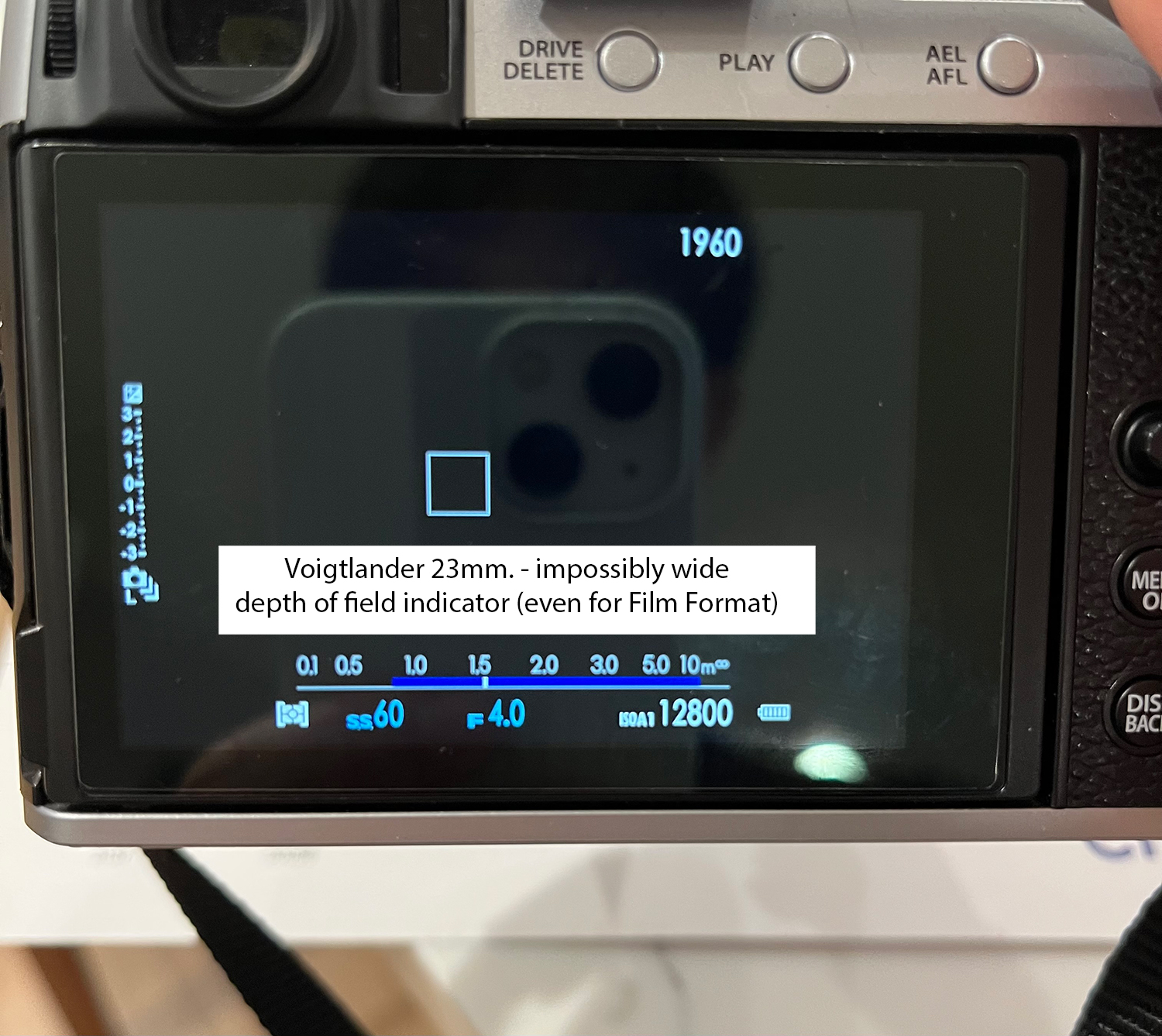
At F4.0, focused at ~1.55 meters, the DoF indicator shows a zone from ~0.8 meters to almost, but not quite infinity. Let's call it 20 meters (see photo below).

This is consistent with a convention of not 1/1500, but something like 1/350.

This is a CoC of 0.08mm.

For APS-C, we can argue if it should be 0.019mm, 0.018mm, 0.020mm, etc. Not 0.08mm.

The actual DoF (with a 0.019mm CoC) should be something like 1.27 meters to 2.0 meters. Not 0.8 meters to near infinity.

Like I said, a ~5x magnitude error.

This is not just choosing some different subjective standard of being generous or stringent. This is just plain useless.


Jul 09, 2025 at 08:34 PM
gyoung143
Offline
• • •
Upload & Sell: Off
p.1 #14 · How much of an X-Pro2 optical VF is blocked by the Voigt 23mm Nokton?


jjcha wrote:
I found my old post on this topic from 5 months ago and did the math.

At F4.0, focused at ~1.55 meters, the DoF indicator shows a zone from ~0.8 meters to almost, but not quite infinity. Let's call it 20 meters (see photo below).

This is consistent with a convention of not 1/1500, but something like 1/350.

This is a CoC of 0.08mm.

For APS-C, we can argue if it should be 0.019mm, 0.018mm, 0.020mm, etc. Not 0.08mm.

The actual DoF (with a 0.019mm CoC) should be something like 1.27 meters to 2.0 meters. Not 0.8 meters to near infinity.

Like I said, a
...Show more
Thank you for this, and the previous post, sorry to say I missed this when you first posted it. I was aware of 'problems' with the Voigtlanders for Fuji in this regard but had dismissed them from interest as I don't need f/1.2, the scales are too compressed for any 'scale' or 'hyperfocal' use, and they don't communicate with my Xpro2
I still have my old set of original Voigtlanders used with Leica film, 15, 21, 28, 35 and 75, only the 28 and tge 75 work well with Fuji sensors, I would like some useful modern ones but these are not.
The SLII 40mm Nikon mount Ultron I have does communicate with Fujis if you use tge Fringer AF Nikon adapter, tge chip tells all to the camera, and even gives you semi auto diaphragm, lens is compact but adapter isn't.

Gerry


Jul 10, 2025 at 03:14 AM
gyoung143
Offline
• • •
Upload & Sell: Off
p.1 #15 · How much of an X-Pro2 optical VF is blocked by the Voigt 23mm Nokton?


gdanmitchell wrote:
DOF charts and calculators generally are based on some assumptions about how good is good enough that were developed quite a while ago, way back in the film era. Standards for “sharp enough” were pretty different then — we rarealy maginified the original image to the extent that we do with digital today, and it was actually no common to print larger than 8x10 or maybe 11X14 from 35mm film.


They are based on what the human eye can perceive, which hasn't changed recently AFAIK. Unless evolution has jumped ahead!
We confronted the realities of the illusion every time we made a print, using a focus magnifier on the baseboard. Or checking sharpfocus of the projector on the screen with a transparency.
'Pixel' based calculations merely show another set of pretty irrelevant compromises. The object of the exercise is to look at pictures, whole pictures not magnified parts, and the conditions relevant haven't changed.

Gerry


Jul 10, 2025 at 03:22 AM
gdanmitchell
Offline
• • • • • • •
Upload & Sell: Off
p.1 #16 · How much of an X-Pro2 optical VF is blocked by the Voigt 23mm Nokton?


gyoung143 wrote:
They are based on what the human eye can perceive, which hasn't changed recently AFAIK. Unless evolution has jumped ahead!
We confronted the realities of the illusion every time we made a print, using a focus magnifier on the baseboard. Or checking sharpfocus of the projector on the screen with a transparency.
'Pixel' based calculations merely show another set of pretty irrelevant compromises. The object of the exercise is to look at pictures, whole pictures not magnified parts, and the conditions relevant haven't changed.

Gerry


While it is logically accurate to say that “they are based on what the human eye can perceive,” it is a whole lot more complicated than that.

To the extent that anything is “in focus” (a fuzzy concept itself, if you look at it closely), no matter what aperture you use (and what format, media, etc.) the only thing that is in optimal focus is in the plane (or more likely some kind of curved surface) at the focus distance… and even there things are not uniformly in focus — for example, corners are likely to be less in focus than the center of the frame.

Everything else is “out of focus” to some degree. Aperture very definitely play a role in how out of focus that areas in front of the zone of optimal focus are at given distances, but in the end it is a question of how much fuzziness is acceptable, not “how deep the focused area is.”

And while we can quantify the out-of-focus-ness in various ways, in the end the question of what is acceptable is pretty subjective and variable. Are we going to look at a small-ish jpg on a computer screen? You can get away with a ot here — that slight OOF-ness at the boundaries of the supposed DOF zone won’t be visible at all, and diffraction blur won’t likely be an issue even at quite small apertures.

Want to make a 30” x 40” print of a highly detailed subject? If you want sharpness at varied distances into the image and you think that your observers/buyers might look closely, the aperture that the DOF chart tells you will work may not be acceptable. On the other hand, if some of the more distant elements are in shadow or are a small part of the image, that bit of OOF-ness may be OK and no one will notice.

It is a subjective then ultimately.

I’m not sure that we actually differentiate that much in the end. Indeed, there are some objective ways to talk about the focus issues that affect DOF… and the actual meaning of those issues is complex and subjective in the context of actual photographs. D


Jul 10, 2025 at 09:42 AM
jjcha
Offline
• •
Upload & Sell: Off
p.1 #17 · How much of an X-Pro2 optical VF is blocked by the Voigt 23mm Nokton?


gdanmitchell wrote:
It is a subjective then ultimately.


Except that it isn't. There are market standards.

Again, my Bronica lenses (6x6 medium format) are based on a CoC of 0.056mm. I believe the Hasselblad 500c lenses are the same, or close enough to not make a meaningful difference. This is, again, 1/1500 the diagonal.

The same for my Leica M-mount lenses, whether Zeiss ZM, Voigtlander VM or Leica M.

The same for my Fujifilm XF lenses. Ricoh GRIII.

My old Nikon FE2 and its lenses.

These are all 1/1500 or close enough not to make a difference.

When a manufacturer decides to do something different -- e.g., the GFX100RF, it screws things up. Fujifilm there decided to use a different standard (based on the most extreme crop, so instead of 0.038mm it's closer to 0.015mm).

The good news is I'm a 28mm shooter so I have my zones in my muscle memory - but I often set my focus distance based on the near or far end of the focus zone, depending on the situation, if I'm not shooting 28mm.

I see the scene in front of me on the street, and if I have a 35mm lens on my M10, for example, I can glance and in a second adjust the lens based on the barrel markings, so that the end of my zone is at 5 meters away. The system works. It worked on my X-E4, my M10, heck even my old D-Lux 3 (though that took more than a few seconds).

I can't do this on my GFX100RF. It makes it less useful as a tool.

I know the 1/1500 is actually a little conservative for me as a tool -- I'm not that picky about my DoF, but having the standard across lenses, across camera systems, is useful to me.

The CoC decision may be a subjective thing. But the decision by manufacturers to put markings on lenses or in a camera DoF scale is not.

The market has long consolidated and it is frustrating when, for example, Hasselblad screwed it up in the XCD V series lenses by using the old ~0.060mm CoC assumption (correct for a 6 x 6cm square film format) for a 44mm x 33mm digital lens! It should be 0.038mm -- and arguably if Hasselblad were catering to a modern, digital, and more demanding pixel peeping audience, and they wanted to deviate from decades of market convention and create a new standard, they should have gone the other direction (and closer to ~0.015mm!).

This is a tool that I use every day when I go shooting (with non 28mm lenses), at least half a dozen times or more while on the street. This is why I notice immediately when a manufacturer screws it up. This is important to me as it is my primary focusing system.

It's not like I can stop on the street while a scene is unfolding in front of me, and ask the dozen or so people on the street to pause for a moment while I dig up a DoF calculator to set my distance since the lens barrel markings on my camera are set with some stupid, off market CoC assumption (like Hasselblad's XCD or the GFX100RF, the VX23mm F1.2, etc.).


Jul 10, 2025 at 11:54 AM
fjablo
Offline
• • • •
Upload & Sell: Off
p.1 #18 · How much of an X-Pro2 optical VF is blocked by the Voigt 23mm Nokton?


jjcha wrote:
The CoC decision may be a subjective thing.


That is exactly the point. Even if there are market conventions from the film era, what were they based on? Likely an 8x10 print held at arms length?

It should be based on whatever the desired output is and that is inherently subjective.


Jul 10, 2025 at 02:11 PM
gdanmitchell
Offline
• • • • • • •
Upload & Sell: Off
p.1 #19 · How much of an X-Pro2 optical VF is blocked by the Voigt 23mm Nokton?


jjcha wrote:
Except that it isn't. There are market standards.

Again, my Bronica lenses (6x6 medium format) are based on a CoC of 0.056mm. I believe the Hasselblad 500c lenses are the same, or close enough to not make a meaningful difference. This is, again, 1/1500 the diagonal.

The same for my Leica M-mount lenses, whether Zeiss ZM, Voigtlander VM or Leica M.

The same for my Fujifilm XF lenses. Ricoh GRIII.

My old Nikon FE2 and its lenses.

These are all 1/1500 or close enough not to make a difference.

When a manufacturer decides to do something different -- e.g., the GFX100RF, it screws things up. Fujifilm
...Show more

First, apologies for my typo — where I typed “then” I meant to type “thing.” (I rarely edit my post here.)

There is a big difference between an objective method of measuring things and the subjective process of determining what objective measurement is the right/acceptable one for your photographs. Which, in a nutshell, is the point I was making.

To use a non-photographic analogy. We can measure distance objectively. It is 10 miles between point A and point B. But is 10 miles too far to walk? On a hot day? In the rain? If you are a fit 20 year old? If you are 90 years old?

We can measure things like CoC and other optical qualities. But the question remains, what measurement is correct/acceptable for a photograph? Are we sharing the photo as a downsized 500/500 pixel jpg on the web? Are we making a 30” x 40” gallery photo? Are we printing a billboard.


Jul 10, 2025 at 03:24 PM
gyoung143
Offline
• • •
Upload & Sell: Off
p.1 #20 · How much of an X-Pro2 optical VF is blocked by the Voigt 23mm Nokton?


gdanmitchell wrote:
While it is logically accurate to say that “they are based on what the human eye can perceive,” it is a whole lot more complicated than that.

To the extent that anything is “in focus” (a fuzzy concept itself, if you look at it closely), no matter what aperture you use (and what format, media, etc.) the only thing that is in optimal focus is in the plane (or more likely some kind of curved surface) at the focus distance… and even there things are not uniformly in focus — for example, corners are likely to be less in focus than
...Show more
It is not 'how much insharpness is acceptable', but how much unsharpnes in discernible, under the conditions specified.
Which are 'normal viewing distance', also specified. You alter the conditions, by magnification for instance, or looking closely at a part of a print then the amount of unsharpness discernible changes. It is a useful method to help produce what most people want to see, the whole picture. There is nothing subjective about it, if you can see it's unsharp, at normal viewing distance, it will be outside the DoF that can be calculated. What you can see unsharp by looking closer, or magnifying on a screen is entirely irrelevant, even though it's of interest technically.
CoC is based on science, a point is defined as a circle of no circumference, the CoC is the largest size of disk that will still be perceived as a point by the human eye and brain.


Gerry


Jul 10, 2025 at 03:26 PM
       2       end


FM Forums | Fuji Forum | Join Upload & Sell

       2       end


Welcome back
Log in to your account