gdanmitchell
Offline
• • • • • • •
Upload & Sell: Off
|
 p.1 #19 · How much of an X-Pro2 optical VF is blocked by the Voigt 23mm Nokton? p.1 #19 · How much of an X-Pro2 optical VF is blocked by the Voigt 23mm Nokton? | |
jjcha wrote:
Except that it isn't. There are market standards.
Again, my Bronica lenses (6x6 medium format) are based on a CoC of 0.056mm. I believe the Hasselblad 500c lenses are the same, or close enough to not make a meaningful difference. This is, again, 1/1500 the diagonal.
The same for my Leica M-mount lenses, whether Zeiss ZM, Voigtlander VM or Leica M.
The same for my Fujifilm XF lenses. Ricoh GRIII.
My old Nikon FE2 and its lenses.
These are all 1/1500 or close enough not to make a difference.
When a manufacturer decides to do something different -- e.g., the GFX100RF, it screws things up. Fujifilm there decided to use a different standard (based on the most extreme crop, so instead of 0.038mm it's closer to 0.015mm).
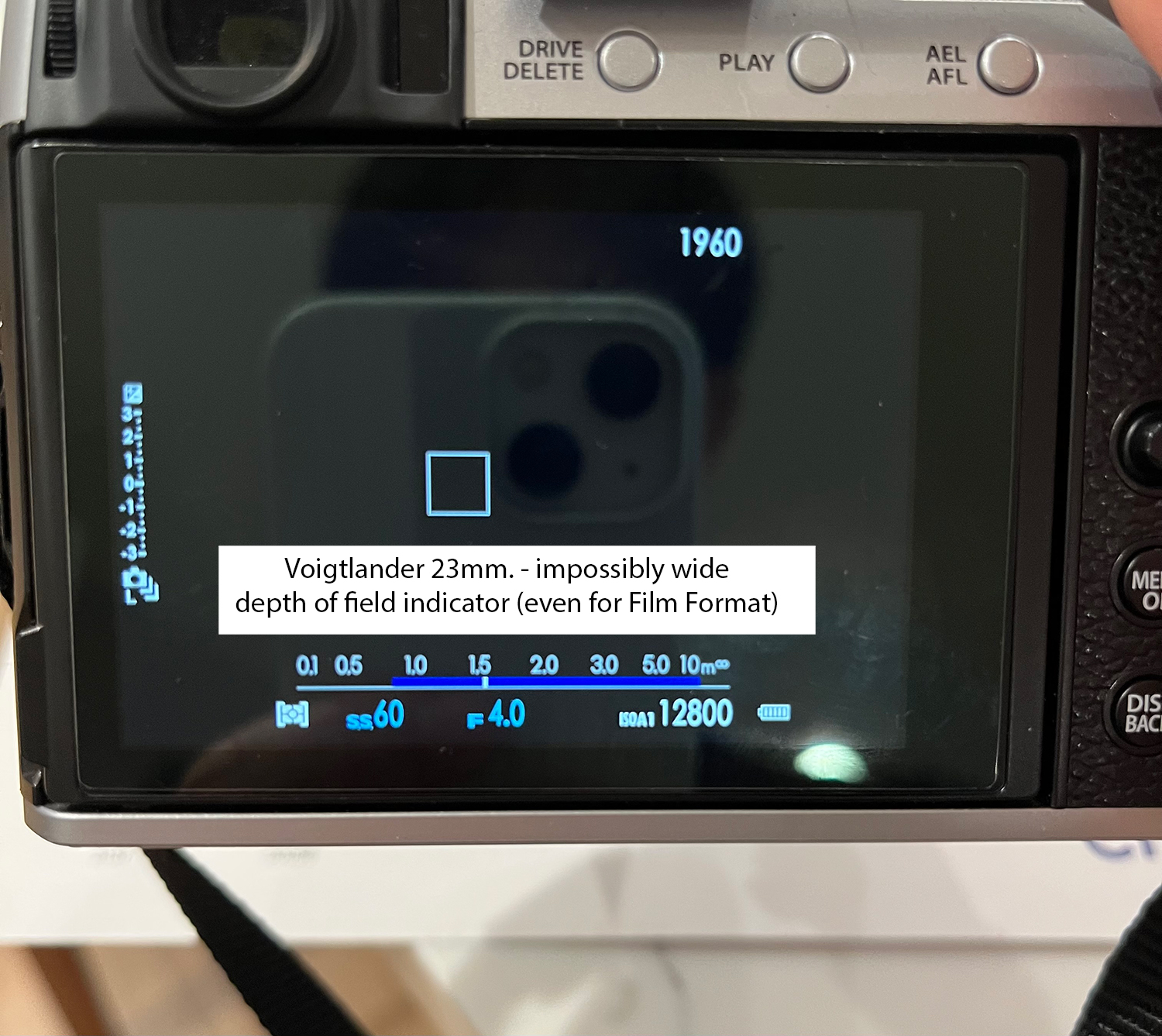
The good news is I'm a 28mm shooter so I have my zones in my muscle memory - but I often set my focus distance based on the near or far end of the focus zone, depending on the situation, if I'm not shooting 28mm.
I see the scene in front of me on the street, and if I have a 35mm lens on my M10, for example, I can glance and in a second adjust the lens based on the barrel markings, so that the end of my zone is at 5 meters away. The system works. It worked on my X-E4, my M10, heck even my old D-Lux 3 (though that took more than a few seconds).
I can't do this on my GFX100RF. It makes it less useful as a tool.
I know the 1/1500 is actually a little conservative for me as a tool -- I'm not that picky about my DoF, but having the standard across lenses, across camera systems, is useful to me.
The CoC decision may be a subjective thing. But the decision by manufacturers to put markings on lenses or in a camera DoF scale is not.
The market has long consolidated and it is frustrating when, for example, Hasselblad screwed it up in the XCD V series lenses by using the old ~0.060mm CoC assumption (correct for a 6 x 6cm square film format) for a 44mm x 33mm digital lens! It should be 0.038mm -- and arguably if Hasselblad were catering to a modern, digital, and more demanding pixel peeping audience, and they wanted to deviate from decades of market convention and create a new standard, they should have gone the other direction (and closer to ~0.015mm!).
This is a tool that I use every day when I go shooting (with non 28mm lenses), at least half a dozen times or more while on the street. This is why I notice immediately when a manufacturer screws it up. This is important to me as it is my primary focusing system.
It's not like I can stop on the street while a scene is unfolding in front of me, and ask the dozen or so people on the street to pause for a moment while I dig up a DoF calculator to set my distance since the lens barrel markings on my camera are set with some stupid, off market CoC assumption (like Hasselblad's XCD or the GFX100RF, the VX23mm F1.2, etc.)....Show more →
First, apologies for my typo — where I typed “then” I meant to type “thing.” (I rarely edit my post here.)
There is a big difference between an objective method of measuring things and the subjective process of determining what objective measurement is the right/acceptable one for your photographs. Which, in a nutshell, is the point I was making.
To use a non-photographic analogy. We can measure distance objectively. It is 10 miles between point A and point B. But is 10 miles too far to walk? On a hot day? In the rain? If you are a fit 20 year old? If you are 90 years old?
We can measure things like CoC and other optical qualities. But the question remains, what measurement is correct/acceptable for a photograph? Are we sharing the photo as a downsized 500/500 pixel jpg on the web? Are we making a 30” x 40” gallery photo? Are we printing a billboard.
|