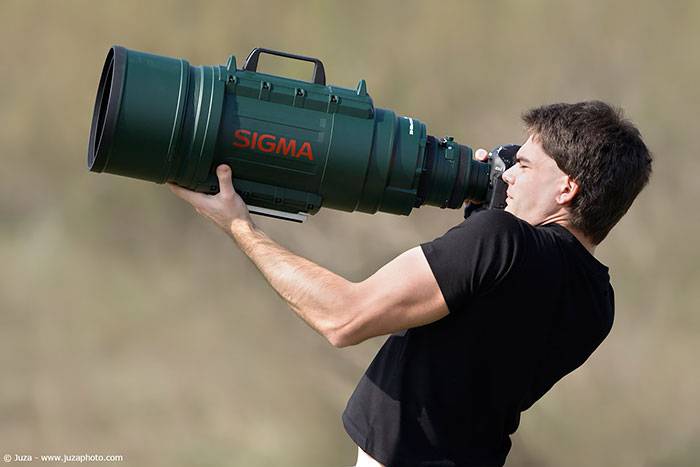
p.1 #1 · 300mm/f2.8 versus 400mm/f2.8 - why the usually huge price difference?
I notice that with many manufacturers the 400mm is usually priced at a clear premium.
This puzzles me, since focal lengths (e.g. 300 or 400mm) are really not that different. Yes, they are not the same but the difference is less than what cropping a full frame image to APSC would yield.
p.1 #2 · 300mm/f2.8 versus 400mm/f2.8 - why the usually huge price difference?
The price difference comes from the amount of glass required. I don't know the actual lens element sizes but the area of the aperture should give a good estimate.
300mm f/2.8 has a 107mm aperture
400mm f/2.8 has a 143mm aperture
The aperture area on the 400mm is about 1.78 times larger than on the 300mm. If you apply that as a multiplier on the price of the 300mm, you'll find that the 400mm isn't really all that expensive - especially considering the cost of manufacturing larger lenses increases exponentially.😁
p.1 #3 · 300mm/f2.8 versus 400mm/f2.8 - why the usually huge price difference?
RT's answer is the right way to think about this - the cost scales with the size of the lens elements, and for super telephoto lenses the front element size dominates this calculation.
Ask yourself a similar question, why is there such a price difference between a 200mm f2.8 (ie. the 70-200 f2.8) and a 300mm f2.8 ? After all 200mm vs. 300mm is only slightly more difference in field of view compared to 300mm vs. 400mm. The answer again is the size of the front lens element needed for 300mm f2.8 is much larger than the 200mm f2.8.
This is also the reason why at 600mm we have f4 instead of f2.8. The 600mm f4 ends up being quite a similar front lens element size to 400mm f2.8 (hence the cost is in the same ballpark). If there ever was a 600mm f2.8 it would have to be massive (aperture would be 214mm so the front element would be more than twice larger than the 400mm f2.8).
p.1 #5 · 300mm/f2.8 versus 400mm/f2.8 - why the usually huge price difference?
markpariente wrote:
RT's answer is the right way to think about this - the cost scales with the size of the lens elements, and for super telephoto lenses the front element size dominates this calculation.
Ask yourself a similar question, why is there such a price difference between a 200mm f2.8 (ie. the 70-200 f2.8) and a 300mm f2.8 ? After all 200mm vs. 300mm is only slightly more difference in field of view compared to 300mm vs. 400mm. The answer again is the size of the front lens element needed for 300mm f2.8 is much larger than the 200mm f2.8.
This is also the reason why at 600mm we have f4 instead of f2.8. The 600mm f4 ends up being quite a similar front lens element size to 400mm f2.8 (hence the cost is in the same ballpark). If there ever was a 600mm f2.8 it would have to be massive (aperture would be 214mm so the front element would be more than twice larger than the 400mm f2.8).
p.1 #7 · 300mm/f2.8 versus 400mm/f2.8 - why the usually huge price difference?
umut_h_toprak wrote:
The price and weight considerations aside, I also wonder at what point the DOF would be too narrow to be usable for most subjects.
One you regularize for the same subject size in frame, the depth of field difference is negligible, given the same aperture. If you compare a 105mm f/2.8 to a 400mm f/2.8 on a depth of field calculator and set the 105mm at 2m and the 400mm at 8m, you'll find that the depth of field for what's in focus is about the same (about 6cm), but a 105mm f/1.4 will actually shrink that DOF down to ~3cm, so it's actually less DOF than the 400mm f/2.8.
What's actually changed is the degree of compression of the background, which is magnified dramatically more with the longer lens.
In sum: when you control for the same magnification, useable DOF is practically constant for the same relative aperture and it actually gets smaller/narrower if you have a wider aperture on the shorter lens. In that respect, the big telephoto is actually easier to work with, since you get larger bokeh in the background while having a little extra DOF to work with for your subject.
Jul 04, 2025 at 07:33 AM
AmbientMike Offline • • • • • • [X]
p.1 #8 · 300mm/f2.8 versus 400mm/f2.8 - why the usually huge price difference?
105/2.8 is going to be extremely different vs 400 2.8 as far as bg. You might get a bit more dof around the subject, but the bg isn't even close.
I tested 85/1.4 vs 200/2.8. Even on similar sized apertures you get less bg on the 200mm vs 85mm, if you keep the subject same size
People generally look at f numbers too much and don't realize 800/11 is the same aperture as 200/2.8, & can probably blur a bg better. Just because 300/2.8 and 400/2.8 are both 2.8, doesn't really mean a lot , other than same exposure
p.1 #10 · 300mm/f2.8 versus 400mm/f2.8 - why the usually huge price difference?
If you check the post I responded to, it was talking about a hypothetical 600mm 2.8 and there was recently also talk of 500mm 2.8. I'm talking about potentially too little DOF with hypothetical specs of this sort.
The comparison you made is not really fair. You could compare 200mm 1.4 (that does not exist, but 200mm 1.8 used to exist, and comes close) to 400mm 2.8.
My point was, if you have 600mm 2.8, this is equivalent to 300mm 1.4 etc. and I wonder if it is actually really usable for the subjects one would want an 600mm lens for apart from niche stuff like astrophotography.
MAubrey wrote:
One you regularize for the same subject size in frame, the depth of field difference is negligible, given the same aperture. If you compare a 105mm f/2.8 to a 400mm f/2.8 on a depth of field calculator and set the 105mm at 2m and the 400mm at 8m, you'll find that the depth of field for what's in focus is about the same (about 6cm), but a 105mm f/1.4 will actually shrink that DOF down to ~3cm, so it's actually less DOF than the 400mm f/2.8.
What's actually changed is the degree of compression of the background, which is magnified dramatically more with the longer lens.
In sum: when you control for the same magnification, useable DOF is practically constant for the same relative aperture and it actually gets smaller/narrower if you have a wider aperture on the shorter lens. In that respect, the big telephoto is actually easier to work with, since you get larger bokeh in the background while having a little extra DOF to work with for your subject.
p.1 #11 · 300mm/f2.8 versus 400mm/f2.8 - why the usually huge price difference?
Labor is a significant percentage of super tele lens costs. Few are produced and there are only a small number of people who know how to assemble them. More of the manufacturing and assembly is done by hand. Rumor had it that final assembly of the legendary 4/3 Olympus 300mm f/2.8 ED was done by a single technician. Production was limited by the working hours of that one person. I'm sure Sony's production is scaled quite a bit beyond that, but the same logic still applies.
There is undoubtedly much more QC involved in producing the extreme lenses too. Achieving sharp focus is more difficult at longer focal lengths and wider apertures. There's less margin for error. I'm just pulling numbers out of the air. But if more common lenses like the 24-70 pass QC with a +/-1% variance, the 300mm might pass with +/-0.3% and the 400mm probably only passes QC with +/-0.1%. That means more time being calibrated and re-calibrated at the factory. It also means more rejected parts which makes the final cost of materials much higher on the top lenses.
Look at the DoF for 300mm versus 400mm @ f/2.8 at 25m. 111cm versus 62cm. The 400mm has almost 1/2 the DoF as the 300mm at the same distance. The 300mm lens could allow a focusing error of 70cm and the image would still appear "sharp" enough to pass inspection. That same error at 400mm would cause a blurred image. Everything is optics grows exponentially. Especially cost.