Thypoch Simera 75mm f/1.4 ASPH. Review
p.8 #1Thypoch Simera 75mm f/1.4 ASPH. Review
A native of Nagaland, working in Goa.
 |
||
 |
||
|
Jul 09, 2026 at 11:27 PM

p.8 #4Thypoch Simera 75mm f/1.4 ASPH. Review
Matt Osborne has published a video review of the LLL 75/1.5 Z21. Reviews of traditional focal length MF portrait lenses (75-90mm) are always welcome simply because few people use them or discuss them.
YouTube Title: 'How good is this new 75mm for Leica?'
Most interestingly, Matt compared the lens with two others he has used - the Voigtlander 75/1.5 Nokton and the Thypoch Simera 75/1.4. I've always felt that Cosina is far more interested in longer lenses that are intended for medium to longer distances and for subject matter other than portraits. In their VM range, the 75/1.5 is the 'odd man out' in having a maximum aperture of f1.5 and in not being an APO lens (though its correction is very sound). It is currently joined by APOs, one at 75mm and two of them at 90mm.
Having both the 75/1.5 Nokton and Simera 75/1.4, I was interested to see how these two fared against each other (I see the LLL enterprise as something very different). Matt prefers the Nokton and it suits his style of work very well - 'black and white, and a little dreamy' might be a fair description. The camera-subject distance is interesting as well, I find myself shooting more head and shoulder shots with both 50mm and 75mm lenses, which certainly is not common these days.
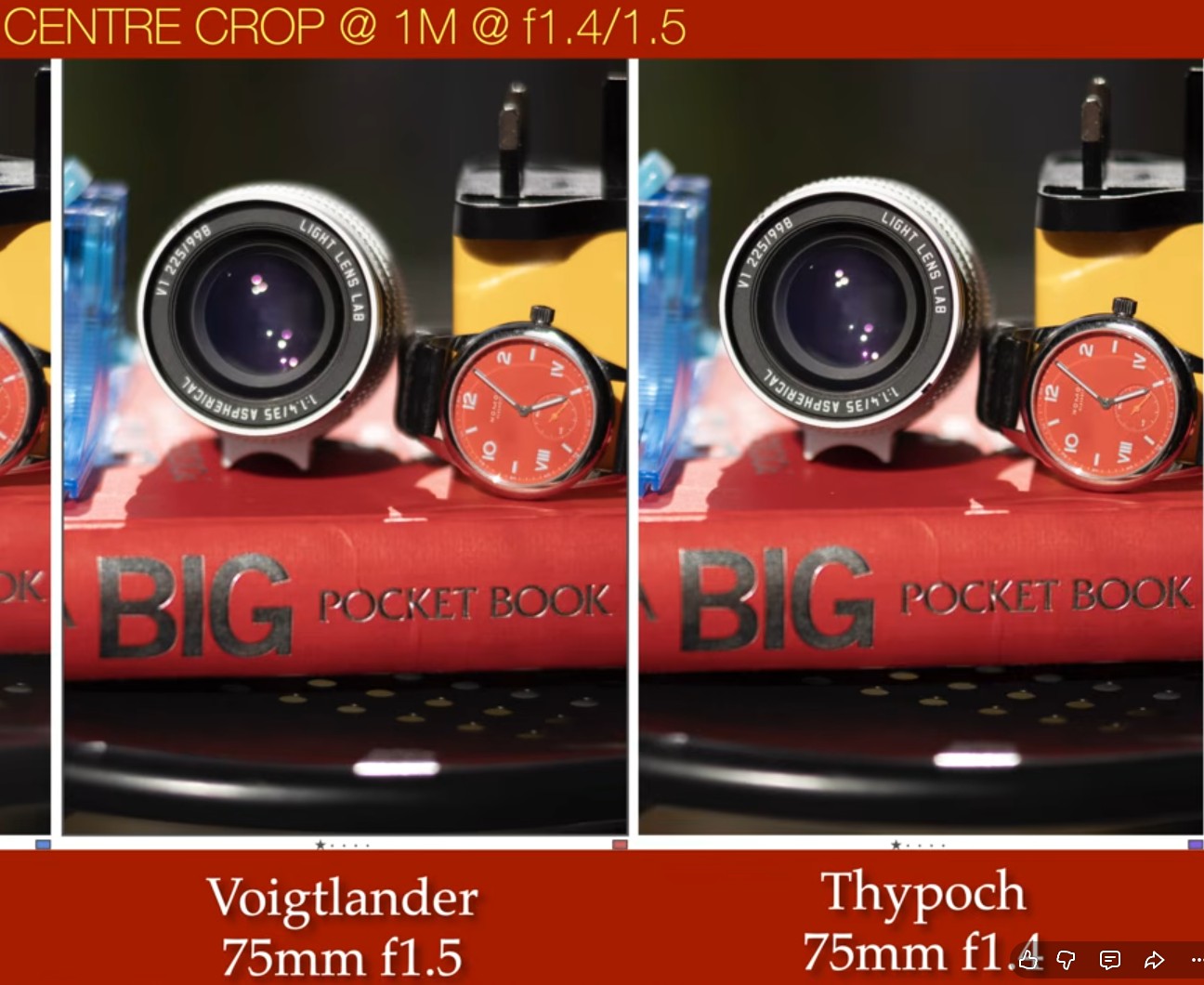
Below I snipped an image from Matt's video showing the close focus of these two lenses, and how they lead to rather different images. (I) the Nokton rushes (comparatively) off its focal plane; (ii) it lacks clarity at the plane; and (iii) in this and other images of Matt's it has less realistic color, which may not matter to BW shooters but it's vital for skin tones. I could add the highlight flare to the list. None of this is to say one is better than the other - it all depends what you are looking for in your portrait length lenses.
One approach seems to be to offer dreamy rendering at close (and near) distances without FLE (none of the CV short telephotos use FLE) or to use FLE and deal with any potential excess 'sharpness' in the optical design itself.
near to MFD (0.7m for Nokton, 0.6m for Simera) (courtesy Matt Osborne)
YouTube Title: 'How good is this new 75mm for Leica?'
Most interestingly, Matt compared the lens with two others he has used - the Voigtlander 75/1.5 Nokton and the Thypoch Simera 75/1.4. I've always felt that Cosina is far more interested in longer lenses that are intended for medium to longer distances and for subject matter other than portraits. In their VM range, the 75/1.5 is the 'odd man out' in having a maximum aperture of f1.5 and in not being an APO lens (though its correction is very sound). It is currently joined by APOs, one at 75mm and two of them at 90mm.
Having both the 75/1.5 Nokton and Simera 75/1.4, I was interested to see how these two fared against each other (I see the LLL enterprise as something very different). Matt prefers the Nokton and it suits his style of work very well - 'black and white, and a little dreamy' might be a fair description. The camera-subject distance is interesting as well, I find myself shooting more head and shoulder shots with both 50mm and 75mm lenses, which certainly is not common these days.
Below I snipped an image from Matt's video showing the close focus of these two lenses, and how they lead to rather different images. (I) the Nokton rushes (comparatively) off its focal plane; (ii) it lacks clarity at the plane; and (iii) in this and other images of Matt's it has less realistic color, which may not matter to BW shooters but it's vital for skin tones. I could add the highlight flare to the list. None of this is to say one is better than the other - it all depends what you are looking for in your portrait length lenses.
One approach seems to be to offer dreamy rendering at close (and near) distances without FLE (none of the CV short telephotos use FLE) or to use FLE and deal with any potential excess 'sharpness' in the optical design itself.
|
||
 |
||
|
near to MFD (0.7m for Nokton, 0.6m for Simera) (courtesy Matt Osborne)
Jul 13, 2026 at 05:26 PM

p.8 #5Thypoch Simera 75mm f/1.4 ASPH. Review
philip_pj wrote:
Matt Osborne has published a video review of the LLL 75/1.5 Z21. Reviews of traditional focal length MF portrait lenses (75-90mm) are always welcome simply because few people use them or discuss them.
YouTube Title: 'How good is this new 75mm for Leica?'
Most interestingly, Matt compared the lens with two others he has used - the Voigtlander 75/1.5 Nokton and the Thypoch Simera 75/1.4. I've always felt that Cosina is far more interested in longer lenses that are intended for medium to longer distances and for subject matter other than portraits. In their VM range, the 75/1.5 is the 'odd...Show more →
Having used the Voigtlander 75 f/1.5 a lot on Leica M and mirrorless, my copy of the lens performs like Bastian describes in his review for philipreeve.net. He suggests:
"We are dealing with one of those lenses here, where the plane with maximum contrast is not the plane with maximum resolution close to the minimum focus distance. The Canon EF 85mm 1.2 L II is another example for this behaviour.
This makes focusing a bit harder, as you have to decide whether you prefer a softer image with more details or a higher contrast one with less details."
I think in Matt's shot with the Voigtlander you can see the difference in these two planes of focus with one plane on the lens in the shot and the other plane at the text on the book at the bottom. In my experience this issue is definitely a complication to using the lens wide open. It is solved really well, as is almost every issue with this lens, by stopping down to f/2.4. Like a number of Voigtlander lenses (the 40 f/1.2 is another example, where shooting it at f/2 makes a world of difference) knowing the benefits of shooting it a bit stopped down is in my experience crucial to getting what I want out of the lens. In my experience the Voigtlander 75 f/1.5 is a great portrait lens with very few flaws if you stop it down to f/2.4. Shot wide open there is various forms of funkiness (this difference in best resolution and contrast planes; notable axial CA, a bit harsh and a little swirly bokeh, high vignetting with strong cat's eye bokeh circles at the edges and corners, weak close up performance, etc.), but all of that goes away at just f/2.4. I think Fred notes something similar in his review of the lens, and for me f/2.4 is plenty shallow enough depth of field at 75mm.
In contrast, the Thypoch has a lot more modest change I believe from wide open to smaller apertures. It is better stopped down a bit but the change is not nearly as dramatic as it is for the Voigtlander. I do think the FLE for close focus is one important factor that keeps change in close focus performance smaller. So as people consider these lenses I think it important to keep in mind how you want to use the lens. Do you want to and hope to use it primarily shooting wide open or are you just as happy or more happy stopping down the lens a bit most of the time? The answer to that question I think can be an important pointer about which lens you might prefer. For me it pushes me to the Voigtlander, but I would not be surprised if it pushes a lot of other folks to the Thypoch.
Jul 13, 2026 at 07:01 PM
p.8 #6Thypoch Simera 75mm f/1.4 ASPH. Review
The FLE in the 75mm Simera in particular has revolutionised my experiences at this focal length, after many lenses at 75/85mm: Voigtlander 75/2.5; Sony FE 85/1.8; Loxia 85/2.4; Nokton 75/1.5. All of which do better for other kinds of work, whereas Simeras are very much people lenses.
I agree about the stop-down tactic, but I often need wide open too - in dark interiors, dusk, and/or to remove fussy backgrounds, and to deal with jumpy subjects. I'm an easy customer to please re many things that bother people - like non-circular balls, focus fade in outer frames and more. I've found a half stop is a good compromise to get a better chance of accurate focus, and f2 in solid lighting and good environs. All have different needs, it seems.
I also want to add that another thorny issue for me with modern lenses is the rapid fall-off, and we see a little of it in the Nokton in the snip. I believe this design choice will not age well, despite it being nearly ubiquitous.
In a word, what the Simeras offer is *gradation* - gradation in color hue, in focus fade across the frame, in focus fade longitudinally, in highlight and shadow handling (via moderate contrast). It makes for a good part of the recipe for the words that cannot be mentioned. And the realism is wonderful.
My general 'problem' (if we can call it that), is that I go out of my way to find what I think are engaging subjects, so I want to show them really well, whereas most MF lenses seem to be made to stamp their signature on all images they are used for - more lens signature, with less of a role for the subject.
I tend to stand close to subjects so the FLE is already engaged, or so I figure. It's kind of important in lenses with an MFD of 0.7 or so. And I will post an example of a recent image to show readers why FLE helps me. One of my favourites. And last, the Voigtlander is a better distance option than the 75mm Simera, agreed.
|
||
 |
||
|
Jul 14, 2026 at 07:31 PM
|
p.8 #7Thypoch Simera 75mm f/1.4 ASPH. Review
I wonder if someone could point out what i am missing with this lens please. I'm considering it as an adapted option for my A7CR, from other threads on lenses to adapt people have concluded that the Voight 75mm f1.5 is a good option
And from earlier in this thread
'With that in mind, I tested the Simera 75mm f/1.4 ASPH. at infinity to evaluate resolution and contrast across the image field when focusing at the center, using a Sony A7R II with its 42MP sensor.
The results were very similar to those from a higher-resolution 60MP Leica sensor, indicating that the Simera 75mm f/1.4 ASPH. adapts well to mirrorless bodies without any noticeable loss in image quality. There were no detectable changes in astigmatism or field curvature. Expect similar performance whether shooting with a Leica M or adapting the lens to a mirrorless system, as Sony has one of the thickest sensor stacks'
However, in this linked review
In this review
BastianK wrote:
Don't think Fred left any questions unanswered, but my review is also online now:
https://phillipreeve.net/blog/review-thypoch-simera-75mm-1-4-their-best-lens-yet/
The conclusion was
'This lens performs worse on the Sony A7rII with its thick filter stack – as we would expect. The midframe looks way worse and needs f/4.0 to f/5.6 to look decent. Interestingly the corners look pretty good from f/4.0, so also on the Sony camera stopped down to f/5.6 you can expect very good across frame performance'
I'm sure i am missing something obvious but can't think what. If i have understood the various threads on this the Thypoch should be a slightly worse option to adapt due to the floating lens element balanced against the suggestion that they don't optimise for differing stack thicknesses
I'd prefer the Thypoch for aesthetic reasons (prefer the knurled grip) if performance was equal but am a little stumped on it now
TIA
Nov 02, 2026 at 11:37 AM
p.8 #8Thypoch Simera 75mm f/1.4 ASPH. Review
Do you often shoot distant city views or landscapes at f1.4 or f2 or f2.8? If so, ignore the rest of my post.
Asking AI: 'what is the worst Sony a7 series photographic camera for sensor-induced outer frame deterioration in performance?'
'The worst Sony a7 series camera for sensor-induced outer frame deterioration is the original first-generation Sony a7R.
This specific type of optical deterioration—commonly referred to in photography communities as corner smearing, edge degradation, or peripheral astigmatism—is explicitly triggered by the thick internal glass filter stack (roughly 2mm) that Sony places directly over its sensors.
While native E-mount lenses are optically corrected to compensate for this glass, the camera severely degrades the performance of adapted legacy lenses—specifically wide-angle rangefinder lenses (like Leica M-mount optics).'
It goes on, adding the following for good measure:
'While all early Sony full-frame mirrorless bodies share a thick cover glass, the Sony a7R (Generation 1) experiences the absolute worst visible degradation due to a compounding mix of physical and technical factors:
Absence of an Anti-Aliasing (AA) Filter: Unlike the standard a7, the a7R removed the optical low-pass filter to maximize resolution. However, because the thick cover glass still forces oblique, steep-angled peripheral light rays to refract drastically before hitting the pixels, it causes severe micro-blurring and smearing in the outer frame.
High Pixel Density (36 Megapixels): The high resolution of the a7R brutally punishes optical flaws. The micro-blurring from light refraction is resolved heavily at a per-pixel level, making the peripheral soft spots look remarkably worse on the a7R than on the lower-resolution 24MP a7 or 12MP a7S.
Severe Corner Color Shifting: Because of the steep angle of incidence on wide rangefinder lenses, the a7R sensor yields strong magenta or green color casts along the left and right edges of the frame.'
PJP: The image above your post was recorded using a Sony a7r body. The reason to post large images at FM is to give readers the opportunity to decide for themselves.
Of the Simera-C lenses, Thypoch has this to say:
'The M-mount version can be adapted to various mirrorless systems via Thypoch's positive-lock adapters, providing flexible compatibility with camera bodies from Sony, Canon, Fujifilm, Lumix, DJI, and more—unlocking the creative possibilities of "M TO ALL." '
PJP: Their M-to-ALL adapter is the best I've used in a personal adapted lens phase lasting nearly 20 years now. The cine people don't fool around, those 0.8 gears really works the rings hard.
But, asking AI about how the light cine/hybrid Sony cameras (industry staadards) compare:
'how does the sensor thickness problems of the Sony photo cameras compare with the Sony FX series cameras?'
AI responds:
'Sony’s mirrorless photo cameras (such as the Alpha a7 and a7R series) and their cinema line counterparts (such as the Sony FX3 or FX30, which share core sensor architectures with cameras like the a7S III) share virtually identical optical sensor stack thicknesses and glass layer designs when comparing equivalent generations.
Key Comparisons
Underlying Hardware Parity: The sensor stack in an enthusiast/hybrid body like the Sony a7S III is functionally the same as the sensor stack found in the Sony FX3 cinema camera. Both utilize the same top cover glass, dust-shaker/IR-cut filter layer (~0.5mm), and underlying optical low-pass/IR-blocking filter compositions (~1.3mm to 1.5mm total stack thickness).
Impact on Adapted Lenses: Because the total thickness of the glass in front of the silicon sensor is largely uniform across Sony’s E-mount ecosystem (roughly 1.5mm–2.0mm total optical thickness depending on the model), edge smearing, color shifting, or corner soft-focus issues with vintage or short-flange rangefinder lenses (like Leica M-mount glass) behave identically whether mounted on an Alpha photo body or an FX-series cinema body.'
I want you to have the full story here, hence the long post. So:
'how popular was and is the sony a7sIII and FX3 cameras?'
AI:
'The Sony A7S III (released July 2020) and the Sony FX3 (launched shortly after as part of the Cinema Line) have both been immensely popular and remain staple choices for filmmakers, content creators, and hybrid shooters.
Popularity and Market Standing
Shared Core: Both cameras share the exact same 12.1-megapixel full-frame sensor, BIONZ XR processor, 4K 120p recording, 10-bit 4:2:2 color, and industry-leading low-light autofocus performance.
Sony A7S III Popularity: Widely regarded as a powerhouse "hybrid" mirrorless camera. It gained massive popularity because it added a high-resolution electronic viewfinder (EVF) and physical photo/video dials, making it the go-to choice for creators who shoot both stills and video.
Sony FX3 Popularity: Shifted heavily toward dedicated video producers and indie filmmakers. Its inclusion in Sony's Cinema Line—paired with a built-in active cooling fan (for uninterrupted recording), 1/4"-20 mounting threads on the body, tally lights, and a detachable XLR top handle—made it a favorite for rigged-out cinema work.
How Popular Are They Now?
Continued Relevance: Even years after launch, both models remain heavily used as A-cameras or B-cameras across YouTube, commercial sets, and documentary work.'
--end--
Nov 02, 2026 at 01:56 PM
p.8 #9Thypoch Simera 75mm f/1.4 ASPH. Review
Won an Thypoch IG contest and picked up this lens, too many new lens in a short period of time so it won't get a ton of use yet but the test photos look amazing. Compared to the 50mm and 28mm I find the aperture less clicky and the bump in the focus from rangefinder coupled to mfd to be much less noticeable have any of you experienced that? It was to the point where I found myself not being able to accurately change aperture with the camera to my eye.
Nov 02, 2026 at 06:34 PM
p.8 #10Thypoch Simera 75mm f/1.4 ASPH. Review
I don't take this lens out often, but when I do I usually come back with a handful of images I really like. I don't know if it's the "best" of the Simera line, but it's a fun lens.


Nov 02, 2026 at 08:40 PM
p.8 #11Thypoch Simera 75mm f/1.4 ASPH. Review
The detent on mine is quiet but clearly noticeable, and the 0.6m is very welcome in such a lens. I find it to be a bit of a mystery in some ways, it's easy to see why people might think of it as a modern lens, but its draw is very pleasing and (I think) flattering. It's good in low light, has few faults and according to the Adorama guy below, plenty of spherical aberration.
So it's another clean but dreamy character lens from them, as seen above, despite the CA which just becomes part of the picture (!). Keep in mind Ben is a cine lens guy, they look at different things and the reference look for them is very 'clean'. For what I want, it's very reliable and very kind to skin, which is now a big thing that lens designers can attend to in portrait lenses.
Even as it looks sharp, it's just kinder to people than some other short teles. High keeper rates, yes. It's a lens you can grow with, but still have it work 'normal', if that makes sense. Many cine people love the look in interiors with soft lighting. But we are all different, different needs, lighting, subjects, etc.
‘if you are looking for what’s called spherical aberration, you get a lot of that on the longer Simera-C lenses. So I started to notice it on the 50, and I really noticed it on the 75’ (4:45)
‘when you open the lens wide to a 1.5 (f1.4) you definitely get that spherical aberration which is that soap bubble look. So if you are looking for a more stylistic look, open these lens wide open and they are going to give you a lot of interesting character.’ (13:45)
..
(Thypoch Simera C Prime Lenses: Full Frame Cine Lens Review & Close Focus with Ben Rutkowski)
I can't bring myself to get too interested in the soon-to-appear 100mm C lens, as it would displace this one in usage, and with the 75mm I still feel comfortable at that distance from people, and I like the focus fade of this 75 a real lot, as part of my 3D schtick. It's very steady and with attractive bokeh. Unless I have a weak moment later on, of course, re the 100mm. cheers.
Nov 03, 2026 at 12:51 AM
p.8 #12Thypoch Simera 75mm f/1.4 ASPH. Review
philip_pj wrote:
The detent on mine is quiet but clearly noticeable, and the 0.6m is very welcome in such a lens. I find it to be a bit of a mystery in some ways, it's easy to see why people might think of it as a modern lens, but its draw is very pleasing and (I think) flattering. It's good in low light, has few faults and according to the Adorama guy below, plenty of spherical aberration.
So it's another clean but dreamy character lens from them, as seen above, despite the CA which just becomes part of the picture (!). Keep...Show more →
I feel like the answer to my question is fully covered in this response, but, I'm just not understanding it :-)
No cityscapes, or any architecture type shots. All I would really use it for is putting something marginally interesting in the centre of the frame at f1.4 and trying to get nice looking bokeh to make an average picture a little more interesting
I suspect that means that either the voight or thypoch would work equally well for me
Thank you
Nov 03, 2026 at 03:13 AM