There was a discussion on another thread about why Cosina calls this CV 90/2 an APO-Ultron instead of an APO-Lanthar. I've always considered the Leica 90mm f/2 AA one of the best 90mm M lenses out there when comparing it to others from different brands. But looking at the resolution and contrast tests, the Voigtlander actually performs even better than the Leica, which really surprised me. It also handles axial CA much better than the Leica APO lens.
So what really makes an APO lens a "Lanthar"? Maybe there is some history I’m missing, but it doesn't seem to be about maximum aperture or even strictly about focal length...after all, we have the 110mm f/2.5 APO-Macro-Lanthar and the 125mm f/2.5 APO-Lanthar. If it's about performance and CA correction, the 90/2 APO should definitely have been called a Lanthar.
Maybe the naming is purely marketing, or perhaps it's tied to design choices like the absence of aspherical elements (though the 110mm f/2.5 APO-Lanthar also has none), but either way, it feels inconsistent given the lens's performance.
Unfortunately, only the APO-Lanthar lenses have published MTF diagrams, so Cosina never provided one for the CV 90/2 APO-Ultron.
Fred Miranda wrote:
Maybe the naming is purely marketing
Probably as it has nothing to do with the presence of lanthanum-based glass elements anymore. And it would be like the design choices for Voigt lenses: kind of random over the range.
Want a focusing tab on wide-angles? A red-dot to have an haptic guide when you mount a lens? A matte black look? Maybe, maybe not...
Anyone have more portraits from this lens they could share? I know the consensus is that it's sharper/more modern than most would probably seek from a portrait lens, but I'm still curious
ShadowDoc wrote:
Anyone have more portraits from this lens they could share? I know the consensus is that it's sharper/more modern than most would probably seek from a portrait lens, but I'm still curious
I'm new to the rangefinder world and am still learning with the patch, so my focus might not be perfect, but I don't find this lens too sharp, I think it's incredibly pleasing in its rendering.
pmeheut wrote:
Probably as it has nothing to do with the presence of lanthanum-based glass elements anymore. And it would be like the design choices for Voigt lenses: kind of random over the range.
Want a focusing tab on wide-angles? A red-dot to have an haptic guide when you mount a lens? A matte black look? Maybe, maybe not...
Yep, they are certainly not using radioactive elements (lanthanum) like in the 1950s, when that was actually a thing for special correction. Today, Cosina keeps the "Lanthar" name, but describes these APO lenses as having five abnormal or partially dispersed glass elements...essentially their high-end ED/anomalous dispersion components.
The irony is that the CV 90mm f/2 APO-Ultron has 6 APD elements out of 8, which is 75% special-element coverage, so by their own marketing rules it technically qualifies as an APO-Lanthar.
jourdan.merritt wrote:
I'm new to the rangefinder world and am still learning with the patch, so my focus might not be perfect, but I don't find this lens too sharp, I think it's incredibly pleasing in its rendering.
I've been looking at glass lately, here is some info on Lanthanum.
Lanthanum is really safe and widely used as an favored material in advanced optical systems. It's 1/10,000th as radioactive as Thorium. Cosina has the name. If they are not using La, maybe they should be.
LLL is certainly using Lanthanum Oxide: 'Development of 900403 Glass
The Original Formula: Developed in the Leitz research lab and manufactured in small batches by Corning in France during the 1960s, this glass was eventually "lost" as production ceased.
LLL’s Recreation: The process took over two years of R&D. LLL used historical Italian research documents and analyzed the chemical properties of vintage Leica elements to identify the necessary lanthanide and lead-infused inclusions.
Technical Profile: The glass is characterized by an exceptionally high refractive index of 1.9005 and an Abbe Number of 40.3.' (a lot of ironies, glass code 900403 is also 35% lead oxide, and lead gives you 1.9-2.0 RI if its proportion of the glass is increased to 60%.)
La is in eyewear too, and much else besides.
'Ultra-high-index lenses are made from glass, as glass has a higher refractive level than plastic. Glass materials with indices of 1.90 and above often incorporate rare earth elements like lanthanum. These materials can achieve thickness reductions exceeding 60% compared to standard plastic but have impact resistance and weight trade-offs. Due to this trade-off, manufacturers reserve ultra-high index glass designs for extreme prescriptions..' https://iotlenses.com/About-IOT/Our-company.html
It would make sense for Cosina, La is widely accepted and it would balance their low dispersion APD glass via the HRI you get with La. I foresee a thriving cottage industry in Chinese 'vintage lens replicas in the near future. They can justify using long-established but demonized fringe materials as being needed to emulate the optical rendering of the original lenses.
I was out yesterday with a new one of these I bought here. Used it on my SL2 with a Novoflex adapter. Initial shots taken in the small town square I shot at a lot. Gave me the ability to compare the images a bit against others taken there with similar lenses. This 90mm sure lives up to it's reputation and it's pretty nice have such a small and light piece of glass on the SL2.
Focusing on the SL2 was very easy even without zooming in on the EVF.
philip_pj wrote:
I've been looking at glass lately, here is some info on Lanthanum.
Lanthanum is really safe and widely used as an favored material in advanced optical systems. It's 1/10,000th as radioactive as Thorium. Cosina has the name. If they are not using La, maybe they should be.
LLL is certainly using Lanthanum Oxide: 'Development of 900403 Glass
The Original Formula: Developed in the Leitz research lab and manufactured in small batches by Corning in France during the 1960s, this glass was eventually "lost" as production ceased.
LLL’s Recreation: The process took over two years of R&D. LLL used historical Italian research documents and analyzed the chemical properties of vintage Leica elements to identify the necessary lanthanide and lead-infused inclusions.
Technical Profile: The glass is characterized by an exceptionally high refractive index of 1.9005 and an Abbe Number of 40.3.' (a lot of ironies, glass code 900403 is also 35% lead oxide, and lead gives you 1.9-2.0 RI if its proportion of the glass is increased to 60%.)
La is in eyewear too, and much else besides.
'Ultra-high-index lenses are made from glass, as glass has a higher refractive level than plastic. Glass materials with indices of 1.90 and above often incorporate rare earth elements like lanthanum. These materials can achieve thickness reductions exceeding 60% compared to standard plastic but have impact resistance and weight trade-offs. Due to this trade-off, manufacturers reserve ultra-high index glass designs for extreme prescriptions..' https://iotlenses.com/About-IOT/Our-company.html
It would make sense for Cosina, La is widely accepted and it would balance their low dispersion APD glass via the HRI you get with La. I foresee a thriving cottage industry in Chinese 'vintage lens replicas in the near future. They can justify using long-established but demonized fringe materials as being needed to emulate the optical rendering of the original lenses. ...Show more →
Thanks for this and for the links, I learned quite a bit.
I had always assumed lanthanum was one of those special glasses used in the 50s and 60s to increase refractive index, and I mistakenly thought it was the radioactive one. That does not appear to be the case at all. Lanthanum itself is not radioactive. The element that caused the issue back then was "thorium oxide". Thorium is mildly radioactive, and that is what made certain older lenses measurable and sometimes prone to yellowing over time.
Modern lenses do seem to use lanthanum oxide, which is stable and not radioactive. It makes sense that Cosina may be using lanthanum based glass in some of their APD elements for the APO-Lanthar line, and that could very well be part of the reasoning behind keeping the Lanthar name for that higher end designation.
I have a few thorium lenses including the leica 50 mm collapsible, the render of the thorium glass to my eye is still different from the lak glass, thorium glass really shines with fall colors, sunsets, sunrises in vibrant lighting scenes. I still have not captured a good rainbow with a thorium but would like to with either the nikkor 35 1.4 or the leica 50 collapsible. There is nothing to fear from the lenses, I have a background in radioactive use and safety. For example I just flew to Japan and back during the active Sun of past weeks, I took a rad meter ( I am interested in and capture solar activity) on the plane and my exposure from the single flight vastly exceeded any dose from the lenses over decade of possible use. Medical therapy that I have had dwarfs any rsk from these lenses. Thorium glass isnt made any longer so there will be no more thorium lenses and safety laws will preclude, but they remain an interesting solution to refractive index in use for some years and still usable. I think thorium leica is quite good with artificial lights, like in cities for color, in BW it is nice with clouds and scenery although putting a yellow filter on my elmer 50 seems quite similar. I would like to try it on a leica monochrome but do not have one of those, but I do like it with the M11 color monochome setting. I am thinking if there is a good bloom of wildflowers in AZ soon maybe I will snap a few with thorium 50 on dig and film and see what I can get. On the flip side I really like the lak glass lenses from LLL, and I am curious if cosina lanthars do indeed have lak elements. It would be technically easy enough to determine, assess the the glass elements with scanning electon microscope spectrometer, in few seconds it would reveal itself, but do not have access to that type of gear any longer. It might mean taking a lens apart to do each element inividually so it would be 1K$ experiment for the lenses plus gear time. People fear this because of the radioactive label, but rads are around you all the time, living in colorado for instance will increase your dose considerably compared to florida, Living in new hampshire ditto because of the granite and radon, and on and on. Flying is still riskier much more so than these lenses.
IFred Miranda wrote:
---------------------------------------------
Thanks for this and for the links, I learned quite a bit.
I had always assumed lanthanum was one of those special glasses used in the 50s and 60s to increase refractive index, and I mistakenly thought it was the radioactive one. That does not appear to be the case at all. Lanthanum itself is not radioactive. The element that caused the issue back then was "thorium oxide". Thorium is mildly radioactive, and that is what made certain older lenses measurable and sometimes prone to yellowing over time.
Modern lenses do seem to use lanthanum oxide, which is stable and not radioactive. It makes sense that Cosina may be using lanthanum based glass in some of their APD elements for the APO-Lanthar line, and that could very well be part of the reasoning behind keeping the Lanthar name for that higher end designation....Show more →
It's everywhere, Fred. Phones, binoculars, pretty much all lenses too, the lenses we are interested in anyway. I suspect a lot of them are using lead too, as they should be. La was used as a replacement for lead oxide to do the same general job of producing both sides of the correction equation - flint glass as well as crown glass.
Lanthanum differs from lead in that it can be manufactured to have a pretty high Abbe number (higher Abbe value is low wavelength dispersion) whereas lead provides high refractive indexes but with low Abbe numbers.
These dispersion levels invoked by lead require greater correction due to higher dispersion of the light wavelengths. By the way, Lanthanum is a 'rare earth' in name alone, it is three times more abundant than lead. China has twice the reserves as the next countries on the list.
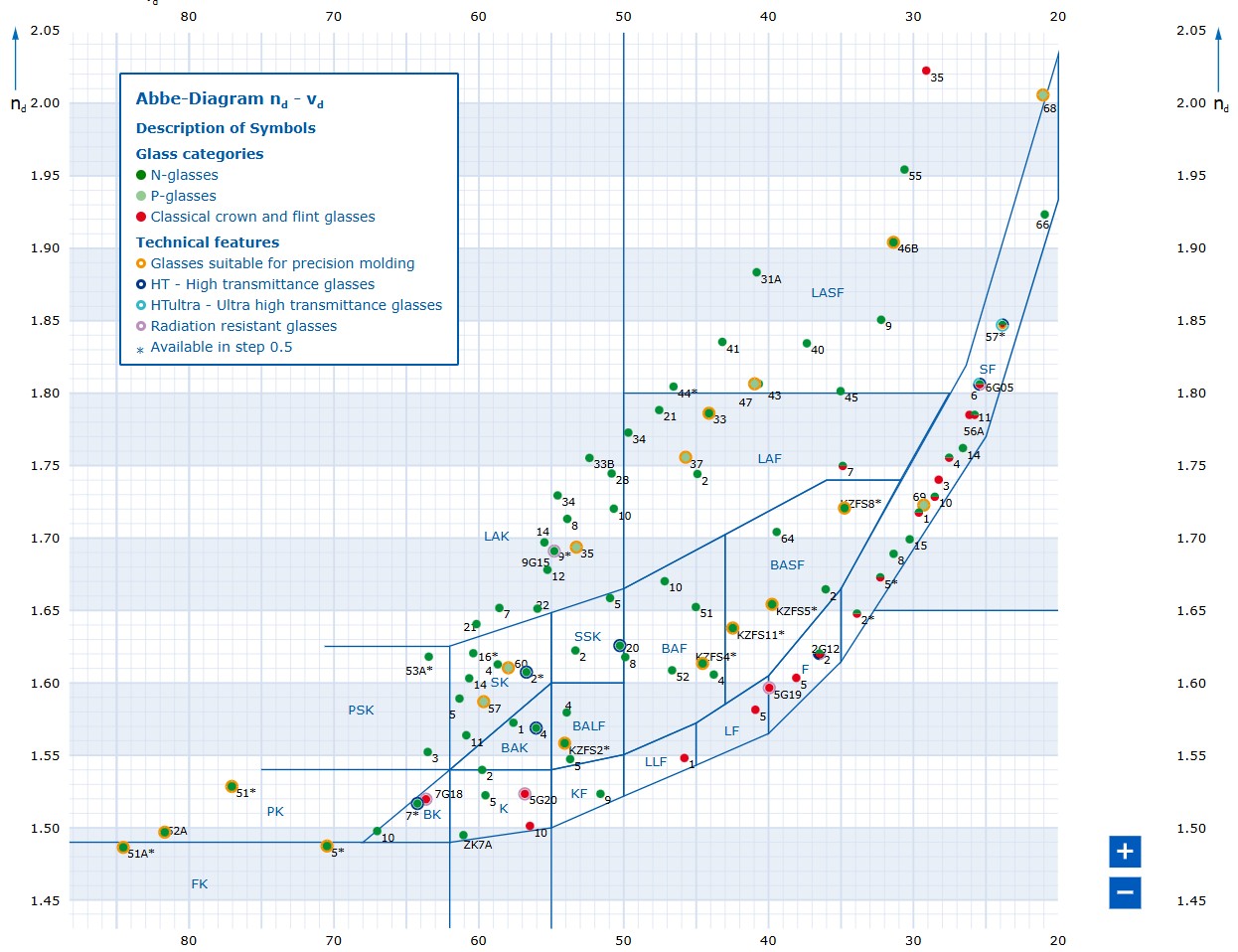
Below is Schott's diagram of its glass catalog showing Abbe values against refractive indexes. Here is the key message: see the major groupings capitalized as LAK, LAF, LASF? The 'LA' is lanthanum, so you can see how important is has been to modern glass formulations.
The green dots mean 'lead-free', and there is a arc of these glass types from LAK (lanthanum crown glass) to LAF (lanthanum active flint glass) ending in LASF (lanthanum dense flint glass). The narrow channel to the right of the diagram shows what they had to work with before - the red dots mean 'classical' crown/flint glasses. The vertical line at Abbe value '50' is the border between low and high dispersion glasses. You can appreciate why glass code 900403 was so important to LLL, its coordinate values are RI of 1.90 and Abbe of 40. Very rarified air up there.
I found this thread in researching a new telephoto for my M11, and noticed some discussion about focus calibration on this lens. So, in case it helps anyone else, I thought I'd bring my recent experience to the table.
I got a used version of the lens for a decent price. Sadly, the rangefinder focus was badly calibrated. The lens itself focused perfectly at the infinity stop on my M11, but at this setting the rangefinder indicated a focus point beyond infinity. With the rangefinder aligned at infinity the lens front-focused - a mm or two short of the infinity stop. All my other lenses work fine, so it was an issue with the calibration of the coupling cam on the lens.
Before sending the lens back, I decided to take a look at the calibration myself. It turned out to be an easy fix. The mount can be removed to access the rangefinder coupling on the lens. The circular lens coupling cam that moves the roller and actuator arm of the camera's rangefinder mechanism is held in place by a locking ring that can be removed with a lens spanner. The coupling cam then lifts out. (I marked the alignment of the cam before removing it, but it turns out that it's keyed so that it can only be replaced in one position).
There were three circular shims of varying thicknesses under the cam. I removed the thinnest shim and reassembled the lens, but it turned out that even this shim was too thick. Removing it moved the calibration too far back the other way so the rangefinder stopped just short of alignment at the lens's infinity stop. Without replacing the shim, I added back less than a shim-width with a very thin smear of clear nail varnish on the end of the coupling cam where it contacts the shims (leaving it to cure for half a day, before reassembling the lens).
This bought the calibration perfectly into line throughout the full focus range. I found it interesting that the perfect calibration was part-way between the two-shim and three-shim options. Maybe CV need some thinner shims, or a pot of clear nail varnish!
Matt White wrote:
There were three circular shims of varying thicknesses under the cam.
This is the case with all the Voigt lenses I disassembled and of course, one can always refer to the excellent https://www.yukosteel.com
Matt White wrote:
This bought the calibration perfectly into line throughout the full focus range. I found it interesting that the perfect calibration was part-way between the two-shim and three-shim options. Maybe CV need some thinner shims, or a pot of clear nail varnish!
At least it worked.
Because mine had back focus and front focus depending on the distance, such a solution does not work.
jourdan.merritt wrote:
I'm new to the rangefinder world and am still learning with the patch, so my focus might not be perfect, but I don't find this lens too sharp, I think it's incredibly pleasing in its rendering.
/quote]
These photos make my eyes hurt. I hope the lens is better than this. Judging lens sharpness when misfocused is pointless.
pmeheut wrote:
This is the case with all the Voigt lenses I disassembled and of course, one can always refer to the excellent https://www.yukosteel.com
Thank you. That's good to know for future reference. Maybe I've been lucky, but this is the first time in about 10 lenses that I've needed to open up one of my Voigtlanders. I did check Yukosteel beforehand but there wasn't much covering calibration of CV coupling cams. I knew I didn't need to mess with the optical units themselves, but I was pleased at how simple it was to get at the shims.
pmeheut wrote:
Because mine had back focus and front focus depending on the distance, such a solution does not work.
Yikes, yeah, that would be more complicated to fix. Something out of alignment in the helicoid or cam, probably?
Most Cosina Voigtlander VM lenses do not use rear mount area calibration shims for flange distance and infinity focus adjustment, though there are exceptions. This lens appears to be one of them. In contrast, all Zeiss ZM lenses, despite also being made by Cosina, include mount shims. I honestly wish that level of consistency were standard across all lenses and manufacturers.
EMH2025 wrote:
I have a few thorium lenses including the leica 50 mm collapsible, the render of the thorium glass to my eye is still different from the lak glass, thorium glass really shines with fall colors, sunsets, sunrises in vibrant lighting scenes. I still have not captured a good rainbow with a thorium but would like to with either the nikkor 35 1.4 or the leica 50 collapsible. There is nothing to fear from the lenses, I have a background in radioactive use and safety. For example I just flew to Japan and back during the active Sun of past weeks, I took a rad meter ( I am interested in and capture solar activity) on the plane and my exposure from the single flight vastly exceeded any dose from the lenses over decade of possible use. Medical therapy that I have had dwarfs any rsk from these lenses. Thorium glass isnt made any longer so there will be no more thorium lenses and safety laws will preclude, but they remain an interesting solution to refractive index in use for some years and still usable. I think thorium leica is quite good with artificial lights, like in cities for color, in BW it is nice with clouds and scenery although putting a yellow filter on my elmer 50 seems quite similar. I would like to try it on a leica monochrome but do not have one of those, but I do like it with the M11 color monochome setting. I am thinking if there is a good bloom of wildflowers in AZ soon maybe I will snap a few with thorium 50 on dig and film and see what I can get. On the flip side I really like the lak glass lenses from LLL, and I am curious if cosina lanthars do indeed have lak elements. It would be technically easy enough to determine, assess the the glass elements with scanning electon microscope spectrometer, in few seconds it would reveal itself, but do not have access to that type of gear any longer. It might mean taking a lens apart to do each element inividually so it would be 1K$ experiment for the lenses plus gear time. People fear this because of the radioactive label, but rads are around you all the time, living in colorado for instance will increase your dose considerably compared to florida, Living in new hampshire ditto because of the granite and radon, and on and on. Flying is still riskier much more so than these lenses.
Which other thorium-containing lenses do you own? I've heard that the early versions of the Leica 50mm f/2 collapsible used thorium in their special elements. The f/3.5 version didn't need that correction.
Fred Miranda wrote:
Most Cosina Voigtlander VM lenses do not use rear mount area calibration shims
They all use shims and are calibrated one by one as far as I know going back the 90mm/3.4 APO in LTM (disassembled 4 of them).
And I'm not sure what you mean buy "in the mount area" but I had access to shims from the mount with the recent 35mm/1.5, 28mm/2 Ultron and others.
Some, you need access from the front which maybe more complicated or at least requiring more than a screwdriver.
Matt White wrote:
I think so yes but I do not see how to fix it because reprofiling the cam is possible but the precision involved is hard to reach for an individual with no dedicated gear.
I once tried to file a cam to fix front-focus because I had no easy access to shims, ended with filings in the helicoids and had to disassemble everything and replace the grease. Now it is even better than new but I've learned to be careful before chewing more than I can eat.