fjablo wrote:
Completely depends on what your desired output resolution is and which part of system resolution will be limiting first. You can still do a lot with 6mp output so a 2x crop from a 24mp sensor is probably fine for many if the glass is „good enough“.
The notion that „great glass“ somehow plays a bigger role than the sensor seems odd as system resolution is multiplicative (basically lens MTF x sensor MTF). So both are equally important or rather it’s a question of the weakest link in the chain.
Concur that both parts are contributing to the math. But, the salient point is that the better the glass (thus the higher the system), the latitude of impact can be thought of in terms of the lpmm units to realize that glass that holds up to 40 lp/mm being cropped may seem akin to shooting with glass that holds up well to the 30 lp/mm realm. Also, noting that if your subject matter is not as dependent upon such fine resolution, you could crop even more and be in the 20 lp/mm territory (enlargement relative).
Just some "left-handed" thinking about how it impacts the "other" units of lp/mm, as an alternative way of considering the impact of how deeply you crop is influenced by the quality of the glass ... as we typically talk about MP's regarding cropping. Rarely do we discuss it in terms of the glass in quantifiable terms. Just kinda struck me that we should be able to quantify the glass side of things relative to % of crop, for assessing our comfort zone / wiggle room.
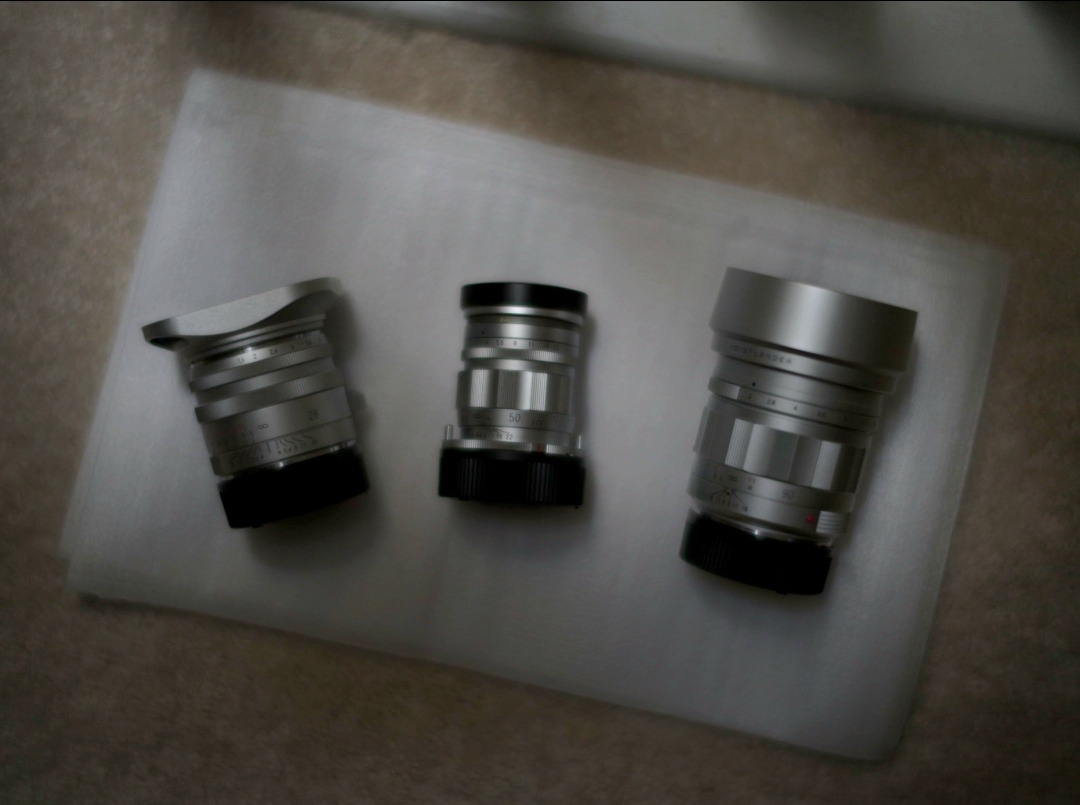
I approach this a bit more subjectively. These days I just find I see better at 28 than 35 and often get frustrated with my 35s. So I have been pairing 28/50 a lot. The traditional 28/50/90 trio might be just the thing.
itai195 wrote:
I approach this a bit more subjectively. These days I just find I see better at 28 than 35 and often get frustrated with my 35s. So I have been pairing 28/50 a lot. The traditional 28/50/90 trio might be just the thing.
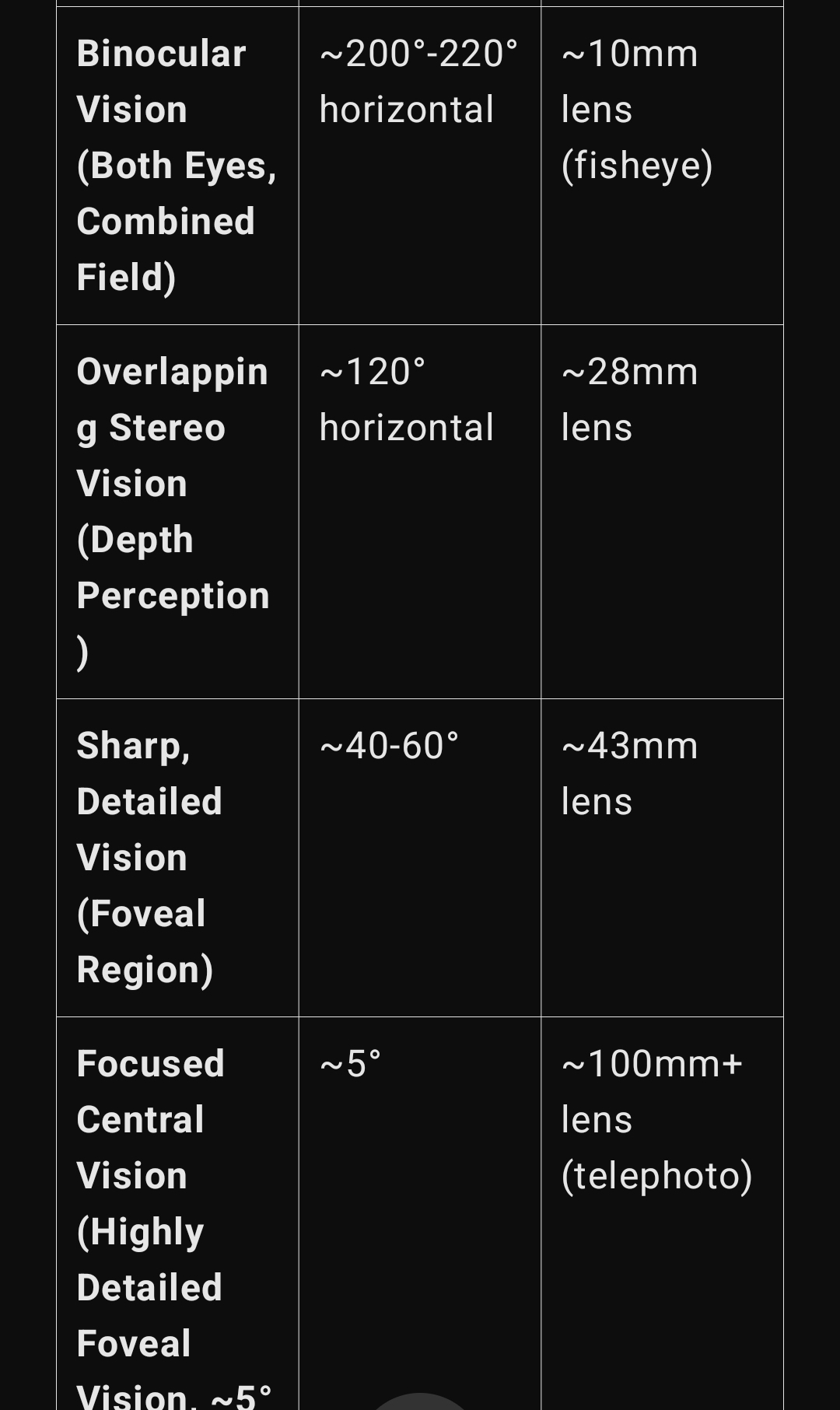
By being not too much of this or too much of that, 28mm is once again taking its rightful place as the prince of full frame focal lengths. There is a completeness and harmony to 28mm images.
I'm wondering if 35/85 being more of a transitory (not here nor there) in reference to particular human FOV ranges is why it's used in film so much to evoke a more dream atmosphere.
I've also been drawn to 10mm for a while and it's the main FL on my Sony for video.
It is funny first half of my life I was an ardent 28 - 50 - 85/90 shooter.
The availability of 65mm (Voigtländer, Sigma and 40mm on APSC ...) has completely changed my perspective.
18 - 35 - 65 - 135 has become my mainstay and I find 28 and 85 not enough or too much.
To me 35mm and 65mm on full frame are the edges of what I perceive as a "normal lens" giving me flexibility to cover this most used field of my photography. 18mm is a true wide angle (which 28mm to me isn't) and 135 gets me to telephoto range and compression. But all this is so personal.
People have so many different ways in which they approach "seeing" and what works for one, might be strange for someone else. It is so great that we have these real choices nowadays.
Knut. wrote:
It is funny first half of my life I was an ardent 28 - 50 - 85/90 shooter.
The availability of 65mm (Voigtländer, Sigma and 40mm on APSC ...) has completely changed my perspective.
18 - 35 - 65 - 135 has become my mainstay and I find 28 and 85 not enough or too much.
To me 35mm and 65mm on full frame are the edges of what I perceive as a "normal lens" giving me flexibility to cover this most used field of my photography. 18mm is a true wide angle (which 28mm to me isn't) and 135 gets me to telephoto range and compression. But all this is so personal.
People have so many different ways in which they approach "seeing" and what works for one, might be strange for someone else. It is so great that we have these real choices nowadays. ...Show more →
It's interesting how the idea of a 'normal' lens has evolved over time. It used to be the trusty 50mm, considered the standard by many. Then, some started to think that 40mm was a better fit for a more natural 'you get what you see' perspective. Things shifted again with 55mm and 65mm, and now Leica has introduced the idea that 43mm is the new go-to!
For me, anything between 40mm and 65mm provides a similar shooting perspective, even though each has its own distinct feel. But once you get to 75mm and higher, the perspective noticeably shifts. If I am unsure of what I will be shooting, I like to bring a 50mm and 90mm lens, but I keep my 28mm mounted on the camera. If I'm sticking to just one lens, I usually compromise and go with a 35mm.
I suppose that is one reason so many people love the SL 28-90mm lens, despite its massive size.
Fred Miranda wrote:
It's interesting how the idea of a 'normal' lens has evolved over time. It used to be the trusty 50mm, considered the standard by many. Then, some started to think that 40mm was a better fit for a more natural 'you get what you see' perspective. Things shifted again with 55mm and 65mm, and now Leica has introduced the idea that 43mm is the new go-to!
For me, anything between 40mm and 65mm provides a similar shooting perspective, even though each has its own distinct feel. But once you get to 75mm and higher, the perspective noticeably shifts. If I am unsure of what I will be shooting, I like to bring a 50mm and 90mm lens, but I keep my 28mm mounted on the camera. If I'm sticking to just one lens, I usually compromise and go with a 35mm.
I suppose that is one reason so many people love the SL 28-90mm lens, despite its massive size....Show more →
The diagonal of 36 x 24 = 43. Thus, the "normal" relationship of a 43mm lens. Not sure that it's the "new go-to", Pentax kinda brought this to the table quite some time back. And, the 40 Summicron-C for the CL was there way back when, as well.
Looking at the "non-normal" focal lengths, we can see that they were derived as multiples of the "normal", as indicated by the diagonal of the format. On the surface, 58 seems like an odd focal length, as does 21, but when looking at it in the context of the geometry ... they kinda fall in place, rather being some seemingly obscure, odd duck.
RustyBug wrote:
The diagonal of 36 x 24 = 43. Thus, the "normal" relationship of a 43mm lens. Not sure that it's the "new go-to", Pentax kinda brought this to the table quite some time back. And, the 40 Summicron-C for the CL was there way back when, as well.
Looking at the "non-normal" focal lengths, we can see that they were derived as multiples of the "normal", as indicated by the diagonal of the format. On the surface, 58 seems like an odd focal length, as does 21, but when looking at it in the context of the geometry ... they kinda fall in place, rather being some seemingly obscure, odd duck....Show more →
Thanks for the formulas! I get the science and the math behind this. I was just thinking about how different focal lengths have been considered "normal" by different people over time and still are today.
Sometimes a Widelux or Noblex or Roundshot sees 'normal'. Sometimes a 300mm on 35mm, nowadays called FF.
If I'm in Hong Kong or on the street in Naples, 24mm is normal. In my home city, Vancouver, 35mm is normal. On the prairies, it's either 21mm cropped to 3:1 or 100mm, depending on my mood.
Normal is as I see on a given day in a given situation. The only time 'normal' really meant anything is when a camera came with a fixed lens, or possibly if you bought an interchangeable lens camera and never changed the lens, which was the way many people used cameras. That was normal.
'Normal' requires a consensus. As I have many lenses, normal has a spectrum.
50mm was chosen by Barnack as the normal lens, for practical and personal preference reasons.
'In 1914, he built the Series 0 Leica prototype for Ernst Leitz Wetzlar GmbH, using a permanently mounted 50mm lens. When the company introduced the Leica I camera in 1925, it came with the same 50mm lens. That design changed the photographic world forever.'
'Even when Leica adopted interchangeable lenses in 1932, the viewfinder was still built for 50mm, reinforcing that lens as the one everybody had to have. When the Leica M Series debuted in 1954, the default viewfinder image was still 50mm.'
Today, extravagant video real estate in high resolution digital enables significant cropping. This gift of technology also changes how you might think of the best lenses for you in a fixed number of lenses. Focus breathing also plays a part, in that your 85mm very likely becomes a 90-95mm at close distances, for example. Both image cropping and breathing (which also crops AOV) mean you should choose the wider lens in each lens choice - your final images can go tighter but never wider.
You might consider *ranges of focal lengths* in each choice. For example, based on what/how I shoot and a preference for 'natural' rendering, I like 28-32mm; 50-60mm and 75-90mm in a three lens set, adding a 21-24mm for four of them (my 'dead zone' is approx 35-45mm). You can only speak of fixed focal lengths as approximates, unless you shoot everything at infinity, where stated lens focal lengths are calculated.
The 50mm and 75mm breathe tighter for close range portrait focal lengths of 55mm and 85mm-ish, reducing the need for post cropping for near distances. I'd be surprised if design teams did not take breathing into account when developing their lenses' looks. Certainly for portrait lenses.
'According to Noam Kroll, “Spielberg, Scorsese, Orson Wells, Malick, and many other A-list directors have cited the 28mm lens as one of their most frequently used and in some cases a favorite”.
I have certainly found lenses around that length to be the most useful on set. A 32mm is often my first choice for handheld, Steadicam, or anything approaching a POV. It’s great for wides because it compresses things a little and crops out unnecessary information while still taking plenty of the scene in. It’s also good for mids and medium close-ups, making the viewer feel involved in the conversation.
When I had to commit to a single prime lens to seal up in a splash housing for a critical ocean scene in The Little Mermaid, I quickly chose a 32mm, knowing that I could get wides and tights just by repositioning myself.'
'I’ve found a 32mm useful in situations where coverage was limited. Many scenes in Above the Clouds were captured as a simple shot-reverse: both mids, both on the 32mm. This was done partly to save time, partly because most of the sets were cramped, and partly because it was a very effective way to get close to the characters without losing the body language..'
Fred Miranda wrote:
It's interesting how the idea of a 'normal' lens has evolved over time. It used to be the trusty 50mm, considered the standard by many. Then, some started to think that 40mm was a better fit for a more natural 'you get what you see' perspective.
'According to Noam Kroll, “Spielberg, Scorsese, Orson Wells, Malick, and many other A-list directors have cited the 28mm lens as one of their most frequently used and in some cases a favorite”.
I have certainly found lenses around that length to be the most useful on set. A 32mm is often my first choice for handheld, Steadicam, or anything approaching a POV. It’s great for wides because it compresses things a little and crops out unnecessary information while still taking plenty of the scene in. It’s also good for mids and medium close-ups, making the viewer feel involved in the conversation.
When I had to commit to a single prime lens to seal up in a splash housing for a critical ocean scene in The Little Mermaid, I quickly chose a 32mm, knowing that I could get wides and tights just by repositioning myself.'
'I’ve found a 32mm useful in situations where coverage was limited. Many scenes in Above the Clouds were captured as a simple shot-reverse: both mids, both on the 32mm. This was done partly to save time, partly because most of the sets were cramped, and partly because it was a very effective way to get close to the characters without losing the body language..'
Interesting, but I think your quotes are related to cinematography with Super-35mm sensors, which would result in viewing angles similar to 42mm (for 28mm lenses) and 48mm (for 32mm) lenses on full frame cameras.
+1 (technically, correct) ... but, I think most folks knew what Fred meant.
Perspective is more governed by where you put your feet (camera), relative to your subject and the accompanying spatial relationships vs. the FOV is relative to the focal length, as achieved from a given perspective (position) for the volume (area x depth) to be captured. Noting that the shape of the depth will be trapezoidal to differing degrees, based on focal length chosen.
The term "perspective" can also be defined as "point of view".