p.1 #1 · Sony A1II CFE-a Memory Card Performance Data
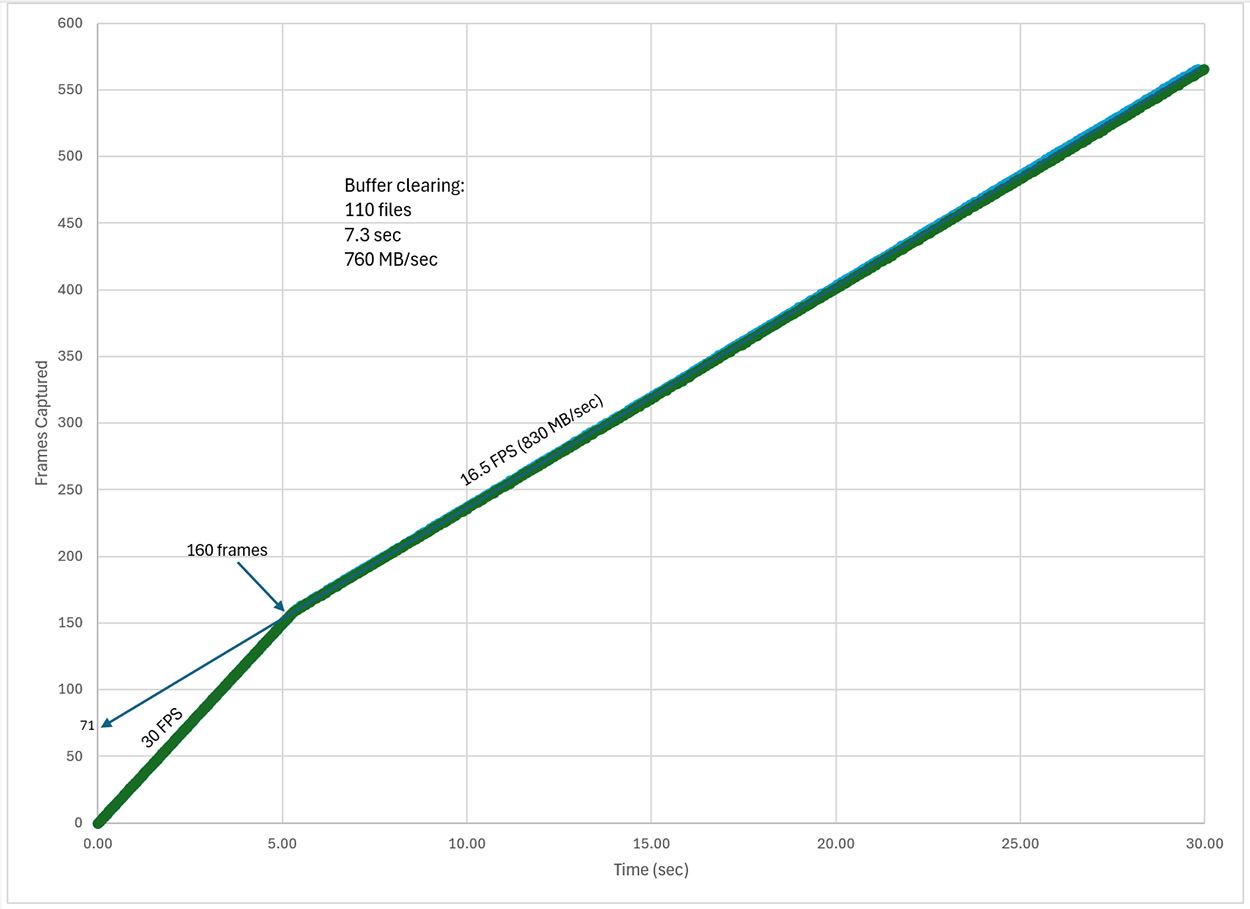
In a prior post I measured the frame rate vs time for CFE-a memory cards in the A1. This post will provide some comparison data for the A1II at 30fps. I have not made the measurements for other frame rates and for uncompressed data. The only situation where most people care about the speed of the camera writing data to the memory card is at the highest frame rate.
The data presented for the A1II is taken with Lexar Gold 160GB ver 2 cards and a Lexar Gold 640GB ver 4 card. You may notice that there is only one curve visible. This is because the data for the cards is so similar that the curves lie on top of each other and any difference is not visible. This is what was observed in the A1 and the A9III for multiple cards with a variety of read and write specs. The performance is determined by the camera electronics, not the memory card, regardless of contrary claims you may find on multiple web sites. In this case the write specs on the ver 2 card and ver 4 are far apart but the camera does not take advantage of the faster data lane of the ver 4 card, and the in-camera performance is identical.
The most noticeable difference between the A1 and A1II at 30fps is that the A1II does not have a second break where the frame rate drops to 9.8fps. At least no second break was seen for a burst of 30 sec duration, which is far beyond what anyone (even me) would want to capture. That could be due to a larger second buffer and/or a faster write rate to the memory card.
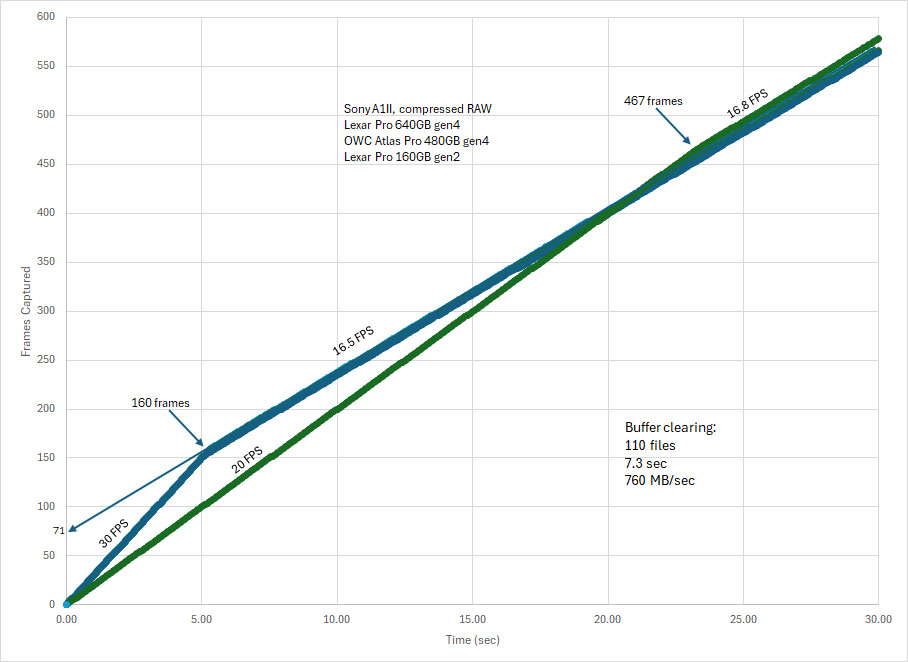
The buffer clearing is quite quick. The data in the box is for a 30 second burst that captured ~580 files. At the end of the burst there were ~110 files in the buffer. It took 7.3 sec to clear the buffer, which means it was writing to the memory card at a rate of ~760 MB/sec. That is a considerable increase over the 617 MB/sec seen in the A1. That is at least part of the reason the buffer has not filled. If shorter bursts are captured the number of files in the buffer is less and the clearing is faster. E.g. a ~5 sec burst has ~75 files in the buffer and it clears in ~5sec.
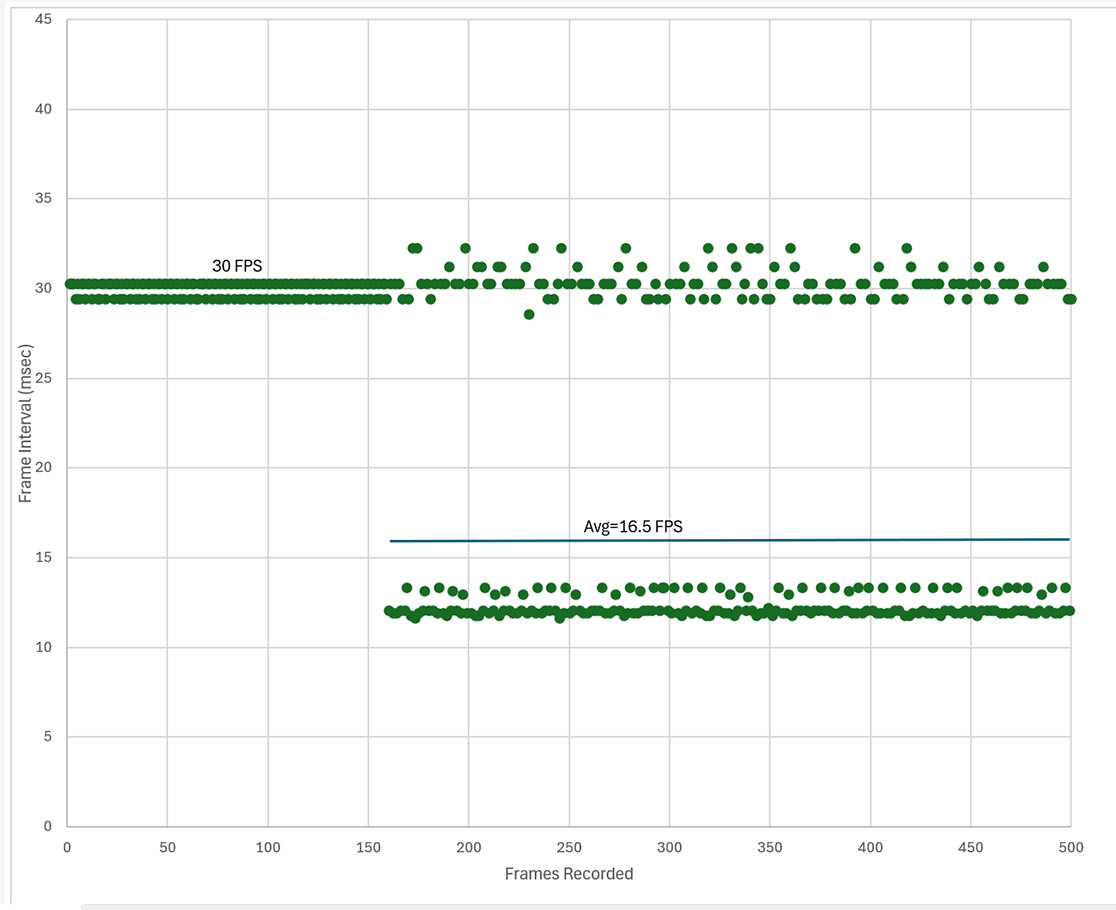
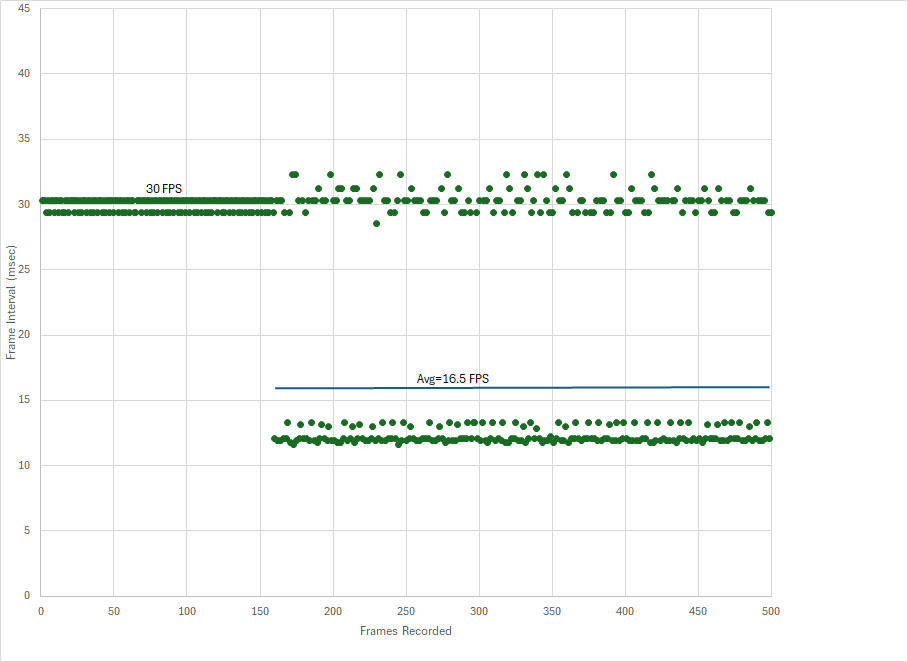
The second chart shows the distribution of the intervals between the frames. As seen before, they frames are not uniformly spaced. The average 30 fps and 16.5 fps but the time interval between frames is varies a lot, especially for the slower 16.5 fps.
p.1 #5 · Sony A1II CFE-a Memory Card Performance Data
Your posts are always interesting and informative. Good to know how things actually work. Not the marketing specs and not speculation from random people on the internet.
p.1 #6 · Sony A1II CFE-a Memory Card Performance Data
Thx for the effort.
This does raise a few questions as to what exactly Sony may be doing there. Kinda replacing a set of unexpected quirks with a new one, even if a good deal faster now.
dclark wrote:
In this case the write specs on the ver 2 card and ver 4 are far apart but the camera does not take advantage of the second data lane and the in-camera performance is identical.
As far as I know all CFE-A cards use a single lane, where CFE-B would use two. So there is no second lane for v4. Instead it doubles the rate using the same single lane. See https://en.wikipedia.org/wiki/CFexpress
p.1 #7 · Sony A1II CFE-a Memory Card Performance Data
Daran wrote:
Thx for the effort.
This does raise a few questions as to what exactly Sony may be doing there. Kinda replacing a set of unexpected quirks with a new one, even if a good deal faster now.
As far as I know all CFE-A cards use a single lane, where CFE-B would use two. So there is no second lane for v4. Instead it doubles the rate using the same single lane. See https://en.wikipedia.org/wiki/CFexpress
Yes, I don't know why I misstated that. The CFE-a version 4 card has a PCIe-4 lane which is twice as fast as the CFE-a version 2 card PCIe-3 lane, but there is still only one lane. Thanks for pointing out the error. I will correct the statement above.
p.1 #9 · Sony A1II CFE-a Memory Card Performance Data
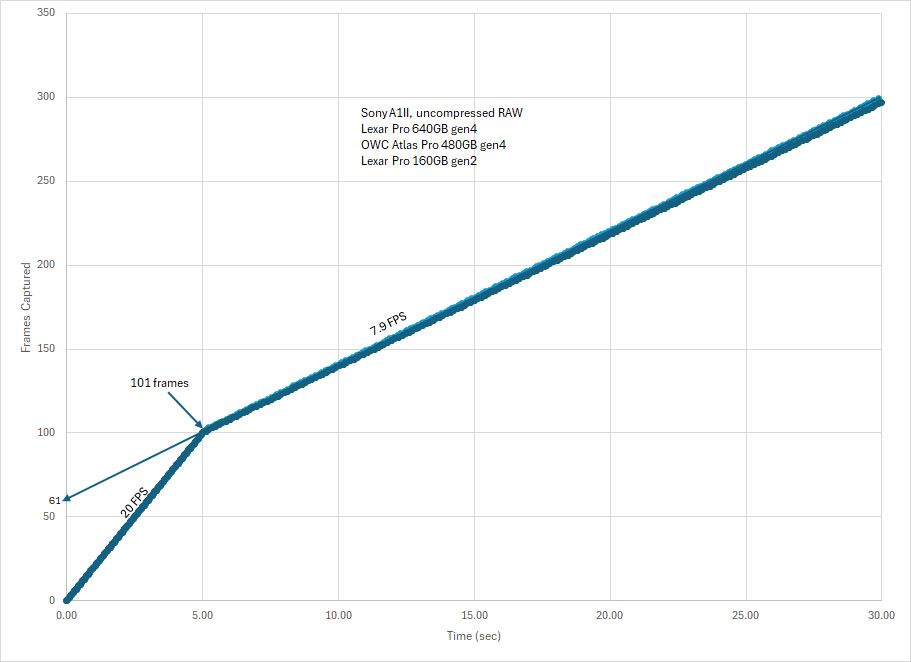
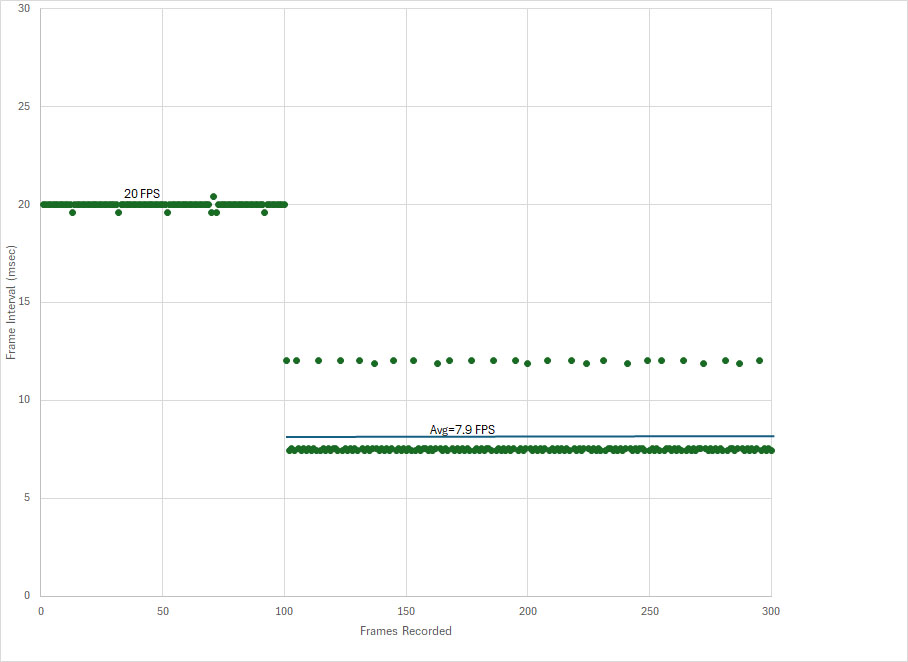
This is an update of the data presented above. I added the OWC Atlas Pro 480GB gen4 card, and 20fps compressed and uncompressed data. As before all the cards perform equally and the curves lie on top of each other. The 20fps data is new but nothing surprising. 20fps compressed frame rate data shows it does not slow down until around 467 frames have been captured and then it slows to 16.8fps which is a barely noticeable change. The 20fps uncompressed captures ~101 frames before slowing to 7.9fps. The fact that the OWC card is rated VPG200 rather than the VPG400 rating of the Lexar cards does not seem to make any difference.
If you want to make measurements with your camera and cards, send me a PM and I will provide a file with information about how I make the measurements and example Excel files to process the data and make the charts. I believe this will work for any camera brand and any memory card type.
p.1 #11 · Sony A1II CFE-a Memory Card Performance Data
FMTopFan wrote:
It is so good to read that the cheaper OWC Atlas Pro VPG200 cards work as fast as the Lexar VPG400 which is more expensive.
I wonder if sustained video recording in 8K would be an issue using the OWC VPG200 card though?
The bottleneck seems to be the camera's bus speed so VPG400 cards are somewhat pointless for stills, and AFAIK even for 8K video recording. From what I've read the 8K video data rate maxes out at about 600Mb/s because the A1ii doesn't shoot RAW internally (only via HDMI out). Compare this to the Canon R5ii, which does shoot native RAW video and requires VPG400 cards to meet its highest data rate, which can top 2.5Gb/s.
I certainly don't plan to bother spending extra for VPG400 cards. Maybe when the A1iii comes around it might be worth it
p.1 #13 · Sony A1II CFE-a Memory Card Performance Data
VPG ratings are just a guaranteed minimum. So a fast VPG200 card may run as faster or faster most of the time but could still drop down to 200MB/s (usually due to heat, age, or lack of space).
I agree though, for most people a recent VPG200 card is a much better value. The cameras can't use the latest speeds but the newer chips seem to run cooler and maintain their peak performance longer.
p.1 #14 · Sony A1II CFE-a Memory Card Performance Data
wordfool wrote:
The bottleneck seems to be the camera's bus speed so VPG400 cards are somewhat pointless for stills, and AFAIK even for 8K video recording. From what I've read the 8K video data rate maxes out at about 600Mb/s because the A1ii doesn't shoot RAW internally (only via HDMI out). Compare this to the Canon R5ii, which does shoot native RAW video and requires VPG400 cards to meet its highest data rate, which can top 2.5Gb/s.
I certainly don't plan to bother spending extra for VPG400 cards. Maybe when the A1iii comes around it might be worth it
For photo no point beyond VPG200.
However, for video I've heard VPG400 records longer before thermal shutdown by the camera.
p.1 #15 · Sony A1II CFE-a Memory Card Performance Data
MohChee wrote:
For photo no point beyond VPG200.
However, for video I've heard VPG400 records longer before thermal shutdown by the camera.
Ah, yes, you're probably right about that. I imagine the sustained write speeds of the cards have a lot to do with heat management, which also no doubt explains why physically larger CFe-B cards are generally a lot faster than the tiny CFe-A cards.