It would have to be something older, since the latest generation of sensors traded off some light gathering ability for higher readout speeds. According to Photons to Photos, the original 9 has the highest sensitivity in the ISO range you're interested in.
That said... pixel density plays a role as well. My 7RV, while technically being less sensitive, makes some impressive ISO 128000 images because the noise shows up extremely fine and uniform. Similar to a high-quality scan of Portra 400.
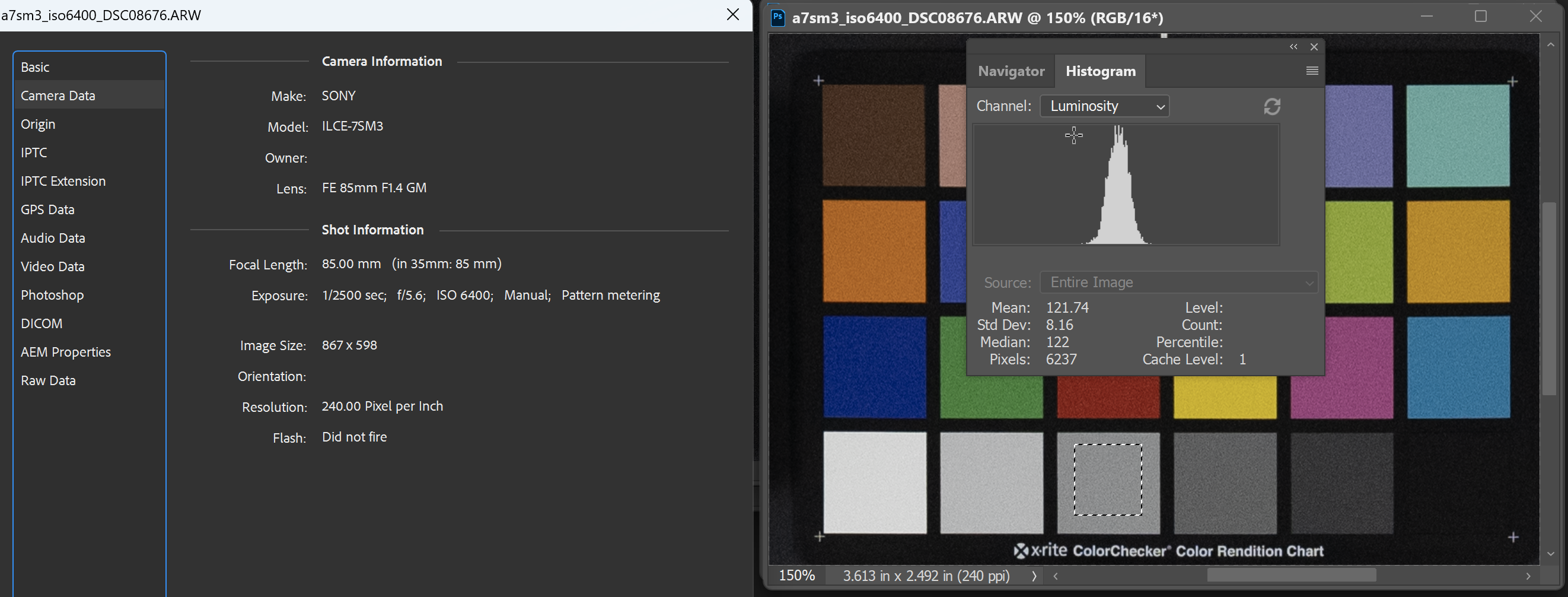
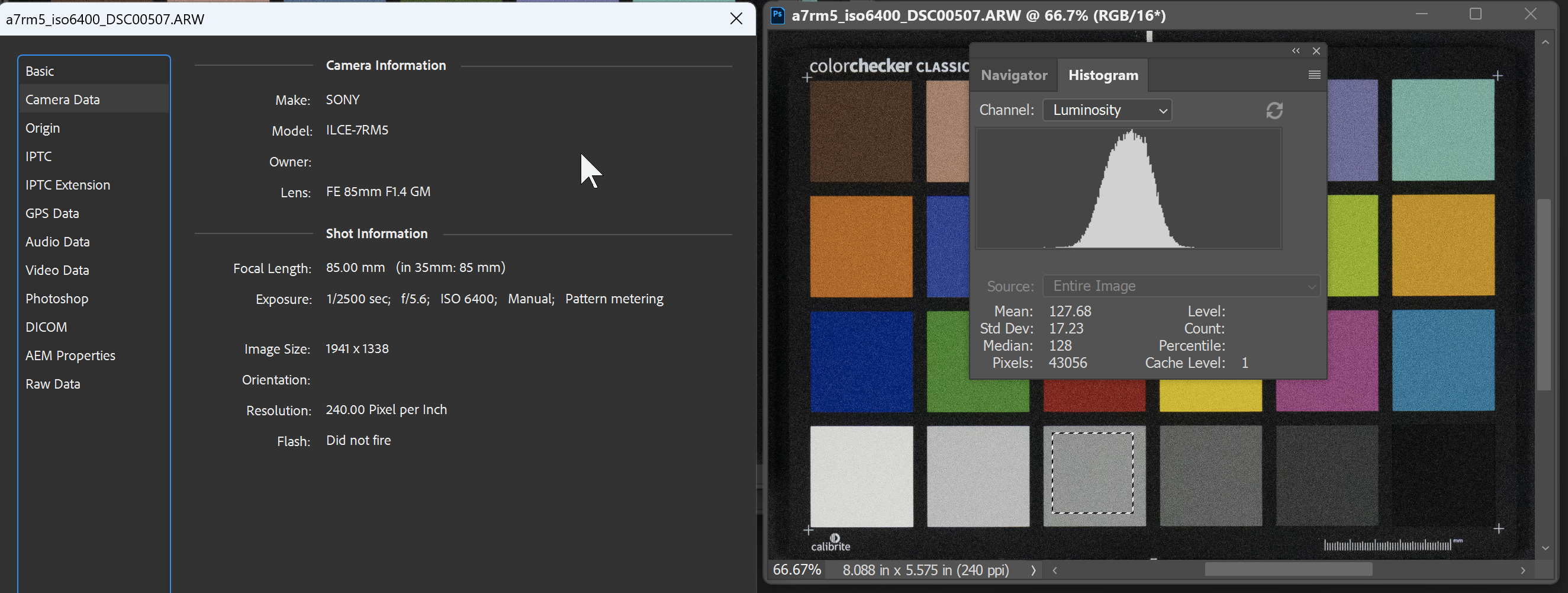
"Best" at what? Maintaining contrast? Color accuracy? Standard deviation of gray patch luminosity is about the only quantifiable metric you can compare difference sensors by. That's mostly showing how well contrast, and therefore edge sharpness, is maintained.
Unsurprisingly, the a7S III shows much lower luminance noise since it's specifically designed for low light performance. The a7R V is by far the worst among current Sony cameras when measured purely on that one metric. Whether that translates to images being more to your liking is up to you.
These are measurements from ISO 6400 dpreview studio comparison images. You can download as many as you want and see what info you can tease out of them.
A7III, A7SIII ha better noise performance at higher iso (over 12800), below that not mutch difference (only when you see at pixel level), also higher resolution provide better noise reduction option because of more detail. But I recommend A7III, I think it"s a best price-performance body.
chiron wrote:
What is the best high ISO Sony camera? I am most interested in the range from 3200 to 12800.
Are you interested in comparing files zooming into 100% magnification or are you interested in comparing files that have the same number of pixels and if you are do you want to downsize the larger file or upsize the smaller file? Are you interested in difference when printing or viewing the files on a screen?
In my view among cameras made in the last ten years there are little difference in high Iso capabilities if files are equalized in size by downsizing the larger file to match the size of the smaller files. If you simply zoom into 100% magnification on the screen, however, without downsizing the larger file, then the smaller file will always look better--you are magnifying it less. Upsizing the smaller file to match the size of the larger file leads to different results. When you do that the images from the smaller file have less noise but also less detail. The files will look pretty similar, however, if you add noise reduction to the file that was originally bigger. So in practice in my experience there any difference between cameras are pretty minimal and in the end are dwarfed by post processing differences. Better noise reduction software and better skill at using whatever noise reduction software you use in my view matters way more at high ISO than what camera you use.
It sounds like Sony finally got rid of the digital low pass filtering in the A7RV. The A7SIII is especially bad since it always combines pixels together.
Dec 20, 2024 at 07:09 AM
Steve Spencer Offline • • • • • • • Upload & Sell: On
QuietOC wrote:
It sounds like Sony finally got rid of the digital low pass filtering in the A7RV. The A7SIII is especially bad since it always combines pixels together.
Low pass filters are always a trade off between reducing moire and increasing resolution. It of course is not simply a matter of having a low pass filter or not, but also the strength of such a filter. Both goals are reasonable goals but you can't optimize both. It is nice that the higher resolution of the A7r V reduces the need for a low pass filter.
Steve Spencer wrote:
Are you interested in comparing files zooming into 100% magnification or are you interested in comparing files that have the same number of pixels and if you are do you want to downsize the larger file or upsize the smaller file? Are you interested in difference when printing or viewing the files on a screen?
In my view among cameras made in the last ten years there are little difference in high Iso capabilities if files are equalized in size by downsizing the larger file to match the size of the smaller files. If you simply zoom into 100% magnification on the screen, however, without downsizing the larger file, then the smaller file will always look better--you are magnifying it less. Upsizing the smaller file to match the size of the larger file leads to different results. When you do that the images from the smaller file have less noise but also less detail. The files will look pretty similar, however, if you add noise reduction to the file that was originally bigger. So in practice in my experience there any difference between cameras are pretty minimal and in the end are dwarfed by post processing differences. Better noise reduction software and better skill at using whatever noise reduction software you use in my view matters way more at high ISO than what camera you use....Show more →
old-gregg wrote:
It would have to be something older, since the latest generation of sensors traded off some light gathering ability for higher readout speeds. According to Photons to Photos, the original 9 has the highest sensitivity in the ISO range you're interested in.
That said... pixel density plays a role as well. My 7RV, while technically being less sensitive, makes some impressive ISO 128000 images because the noise shows up extremely fine and uniform. Similar to a high-quality scan of Portra 400.
---------------------------------------------
jeffbuzz wrote:
"Best" at what? Maintaining contrast? Color accuracy? Standard deviation of gray patch luminosity is about the only quantifiable metric you can compare difference sensors by. That's mostly showing how well contrast, and therefore edge sharpness, is maintained.
Unsurprisingly, the a7S III shows much lower luminance noise since it's specifically designed for low light performance. The a7R V is by far the worst among current Sony cameras when measured purely on that one metric. Whether that translates to images being more to your liking is up to you.
AmbientMike wrote:
12800 doesn't sound too high on a FF camera, really. I doubt I'd be too concerned about it
Higher mp generally has more noise SOOC, but it's better to look after NR imo. People are generally using NR at those ISO on here anyway
---------------------------------------------
Lukacs wrote:
A7III, A7SIII ha better noise performance at higher iso (over 12800), below that not mutch difference (only when you see at pixel level), also higher resolution provide better noise reduction option because of more detail. But I recommend A7III, I think it"s a best price-performance body.
---------------------------------------------
Steve Spencer wrote:
Are you interested in comparing files zooming into 100% magnification or are you interested in comparing files that have the same number of pixels and if you are do you want to downsize the larger file or upsize the smaller file? Are you interested in difference when printing or viewing the files on a screen?
In my view among cameras made in the last ten years there are little difference in high Iso capabilities if files are equalized in size by downsizing the larger file to match the size of the smaller files. If you simply zoom into 100% magnification on the screen, however, without downsizing the larger file, then the smaller file will always look better--you are magnifying it less. Upsizing the smaller file to match the size of the larger file leads to different results. When you do that the images from the smaller file have less noise but also less detail. The files will look pretty similar, however, if you add noise reduction to the file that was originally bigger. So in practice in my experience there any difference between cameras are pretty minimal and in the end are dwarfed by post processing differences. Better noise reduction software and better skill at using whatever noise reduction software you use in my view matters way more at high ISO than what camera you use....Show more →
---------------------------------------------
QuietOC wrote:
It sounds like Sony finally got rid of the digital low pass filtering in the A7RV. The A7SIII is especially bad since it always combines pixels together.
Lots of good insight here. Thank you all.
My cameras now are an A1, A7CR, and an A9. I am not seeing much reason to upgrade to the A1II. I have always liked my A9 a lot, for its size and handling of high ISO, and I also have noticed that it has taken many of my favorite images, which are often made in dim light. And its eye-tracking autofocus is sufficient for getting sharp pictures of people. I even thought for a while about getting a second one. But it is getting a little long in the tooth.
All of the major Sony cameras do cluster pretty tightly in dynamic range above 800 ISO. The dynamic range differences are greater below 800 ISO.
Here is a link for several Sony cameras from Bill Claff's chart of DR vs. ISO:
If you are interested in printing, then I think a whole different set of issues arise regarding how big you want the prints to be, what is the paper (or other surface) you are printing on, whether you are printing in color or black and white, and probably the nature of the printer you are using. I know with my Canon 17-inch wide printer and the matte paper I use for black and white I can shoot at much higher ISOs and get really nice looking prints than I can with the glossy or semi-glossy paper that I typically use when I print in color. After printing lots of files I am pretty sure those details about how I print and post-processing are way more important than what camera I use.
Dec 20, 2024 at 11:19 AM
Steve Spencer Offline • • • • • • • Upload & Sell: On
Oh, and I think the concern about what camera you use emerged when people were comparing FF to APS-C cameras and in that comparison there still is a fairly big difference in dynamic range at high ISO. Here is a comparison of the latest FF and APS-C Sony cameras at photons to photos:
Among FF Sony cameras, and really others brands as far as I can tell, there are not huge differences. So, do shoot a FF camera and try hard not to turn it into an APS-C camera by cropping too much.