fredmiranda.com
Login

Moderated by: Fred Miranda
  New fredmiranda.com Mobile Site
  New Feature: SMS Notification alert
  New Feature: Buy & Sell Watchlist
  

FM Forums | Leica & Alternative Gear | Join Upload & Sell

       2       3       4       end
  

Light Lens Lab 28mm f/2.8 9-Element Review


Fred Miranda
Offline
Admin
Upload & Sell: On
p.1 #1 · Light Lens Lab 28mm f/2.8 9-Element Review


Light Lens Lab 28mm f/2.8 9-Element Review
Order the Light Lens Lab 28mm f/2.8 9-Element lens:

Lens Light Lab Store | Get a 5% discount when you use the FREDMIRANDA code at checkout./b]

___

Review Quick Links:
  1. Initial Impressions
  2. Resolution and Contrast at Infinity distance: LLL 28mm f/2.8 9-Element vs Voigtlander 28mm f/2.8 (M11)
  3. Rendering compared to Voigtlander 28mm f/2.8
  4. Field Curvature
  5. Distortion
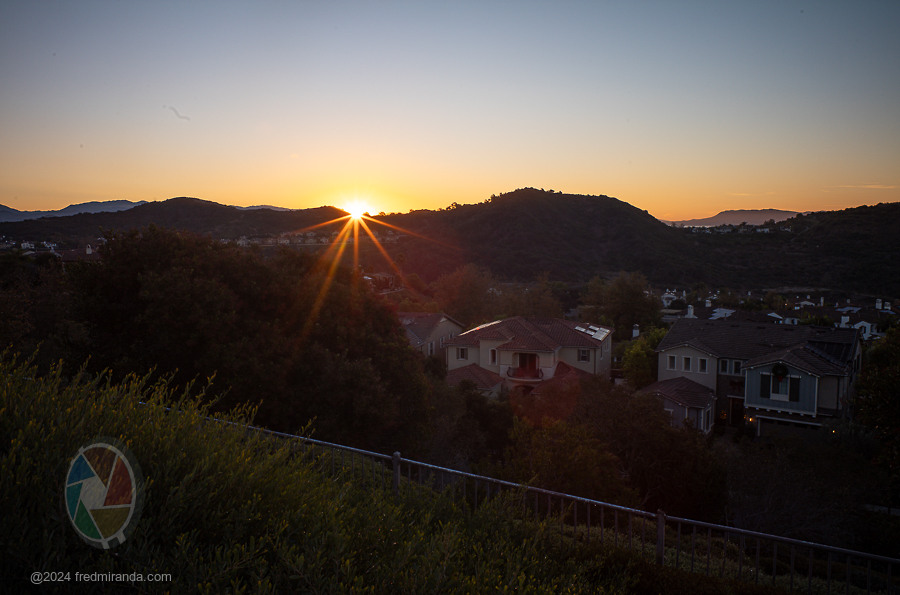
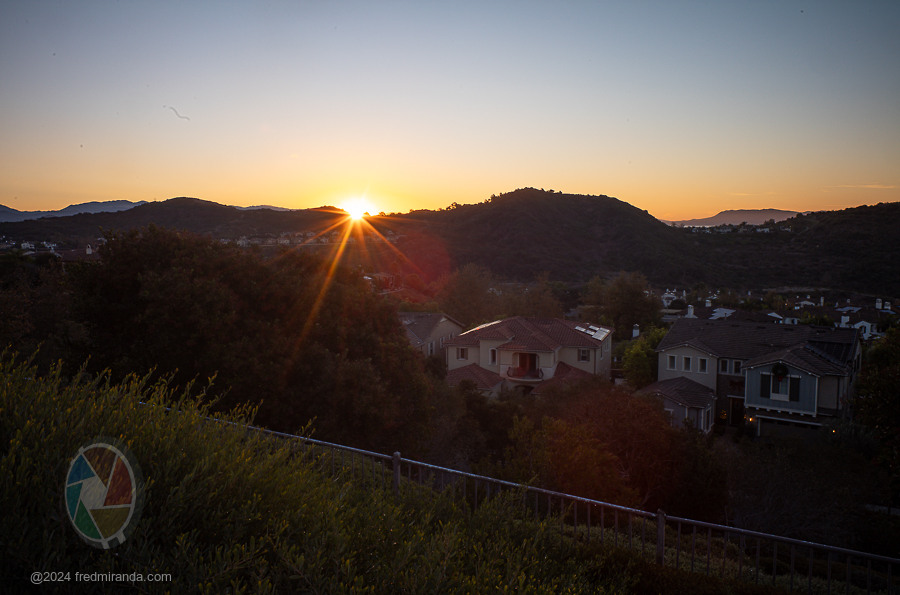
  6. Sunstar Rendering and Flare Resistance
  7. Minimal Focus Distance: Resolution and Contrast
  8. Optical Vignetting and Specular Highlights shape
  9. Chromatic Aberration (CA)

  10. Final Thoughts
  11. Samples


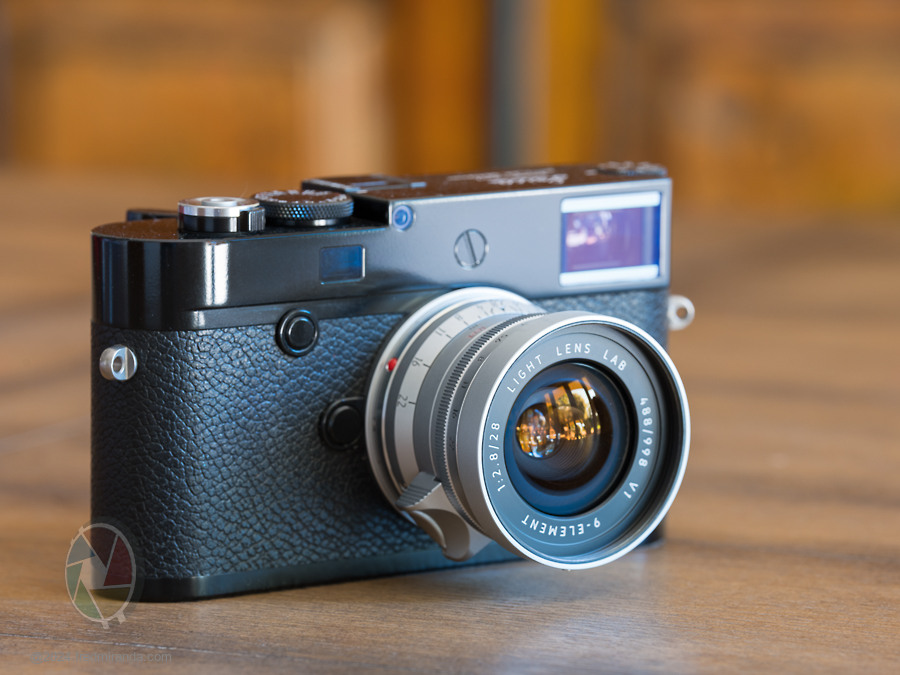
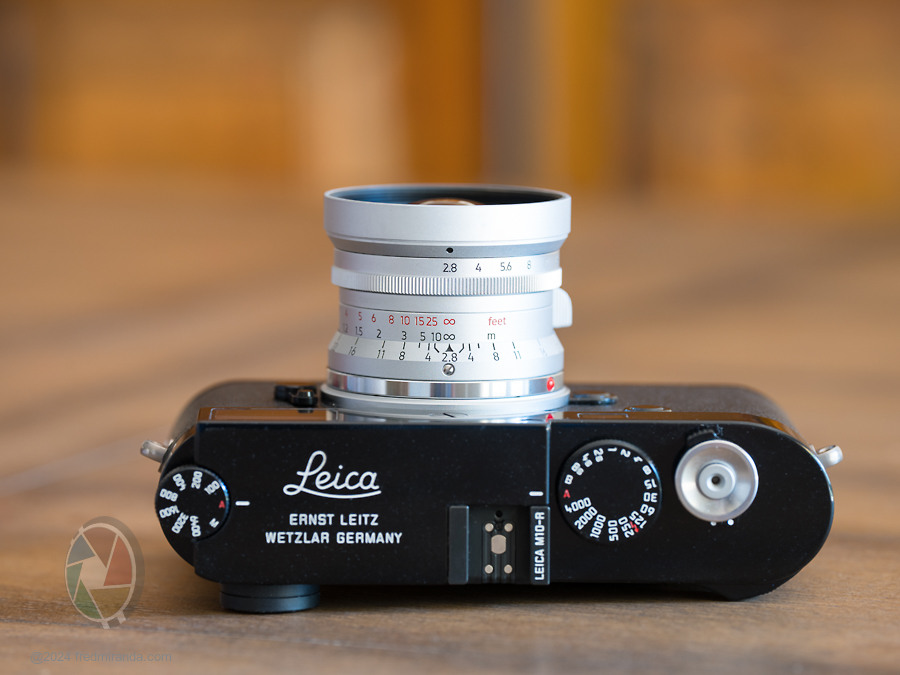
  Leica M10-R Black Paint with Light Lens Lab 28mm f/2.8 9E


Back to Quick Links

Initial impressions of the Light Lens Lab 28mm f/2.8 9-Element lens:

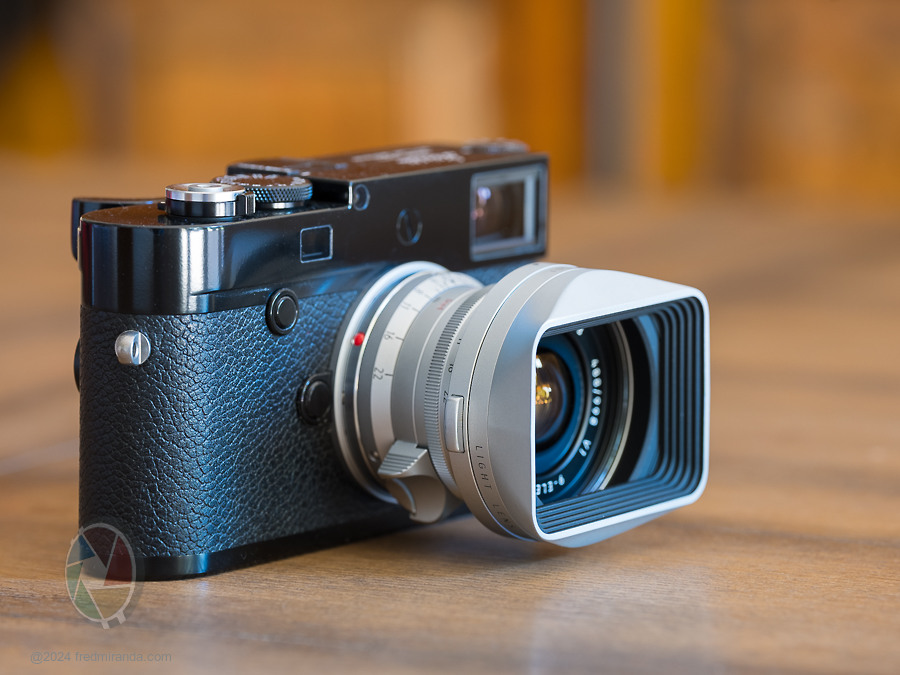
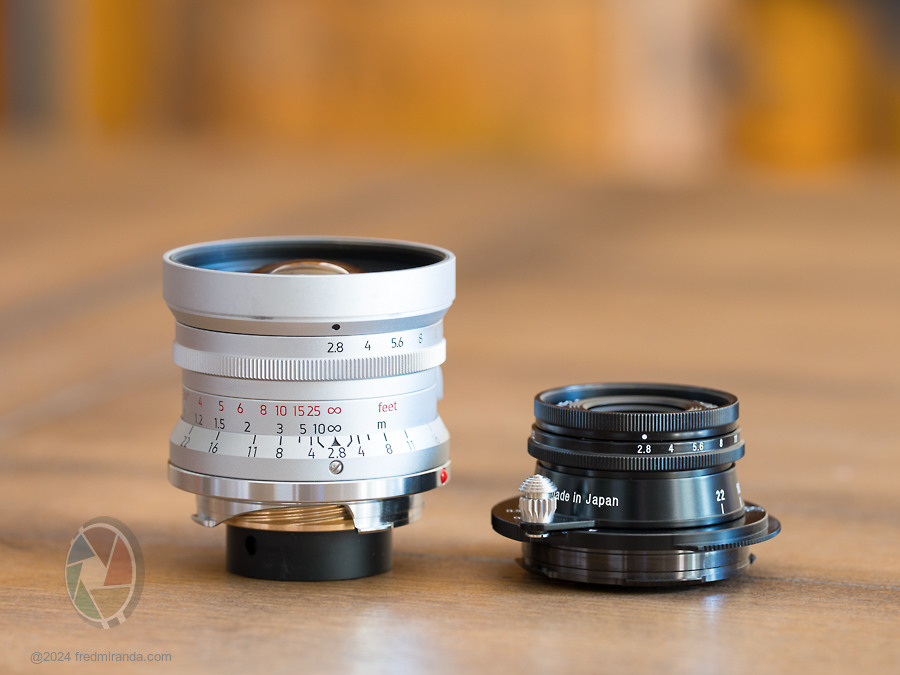
When I first picked up the LLL 28mm f/2.8 9E, I was surprised by its substantial weight and size for a 28mm f/2.8 lens, tipping the scales at 345 grams with the included metal hood. While larger and heavier than modern 28mm lenses with the same maximum aperture, it feels well-balanced on the Leica M10-R BP, although it does intrude significantly into the 28mm framelines. The hood doesn’t alleviate this issue, as it lacks a cut-out for better viewing.


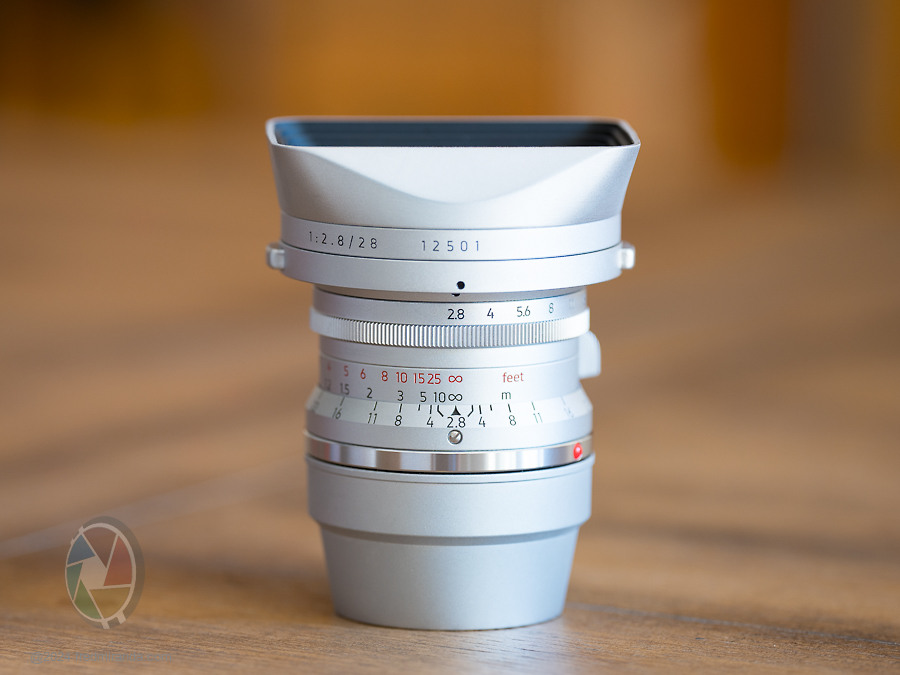
   Light Lens Lab 28mm f/2.8 9E in Silver


While I never owned the Leica 28mm f/2.8 9E, I've seen images taken with it, and they show average optical performance, with limited background blur due to the wide focal length and slow aperture. When Leica originally designed this retrofocus lens in the 1960s, fast wide-angle lenses didn't perform particularly well. This lens was eventually replaced due to its ergonomics, with Leitz introducing other 28mm Elmarits that featured retrofocus designs. These newer versions were much more compact and didn't require the rear element to be so close to the sensor. Over time, Walter Mandler’s designs led to the development of highly refined 28mm Elmarits.

Light Lens Lab took inspiration from this early retrofocus design, preserving the same number of elements while improving the glass to boost performance and create more pleasing rendering.


 Leica M10-R Black Paint with Light Lens Lab 28mm f/2.8 9E


This lens is built with 9 elements in 6 groups, including both fluorite and ED glass, which Light Lens Lab notes was a necessary departure from the original design. It features an infinity lock, with a rotation that is smooth yet offers moderate resistance. Although focusing is precise, the rotation feels somewhat stiff on the silver brass version I’m reviewing. The lens is available in both silver and black, each with a brass barrel.


 Leica M10-R Black Paint with Light Lens Lab 28mm f/2.8 9E


During my initial tests and comparisons with other 28mm lenses, I was surprised by how well this lens performed, competing with modern designs in terms of resolution and contrast across the image, while still maintaining its vintage characteristics.

However, it's important to note that the original Nine Element’s rendering was far from ideal. According to Light Lens Lab, they've improved the glass and addressed some of its imperfections while preserving the original rendering character.


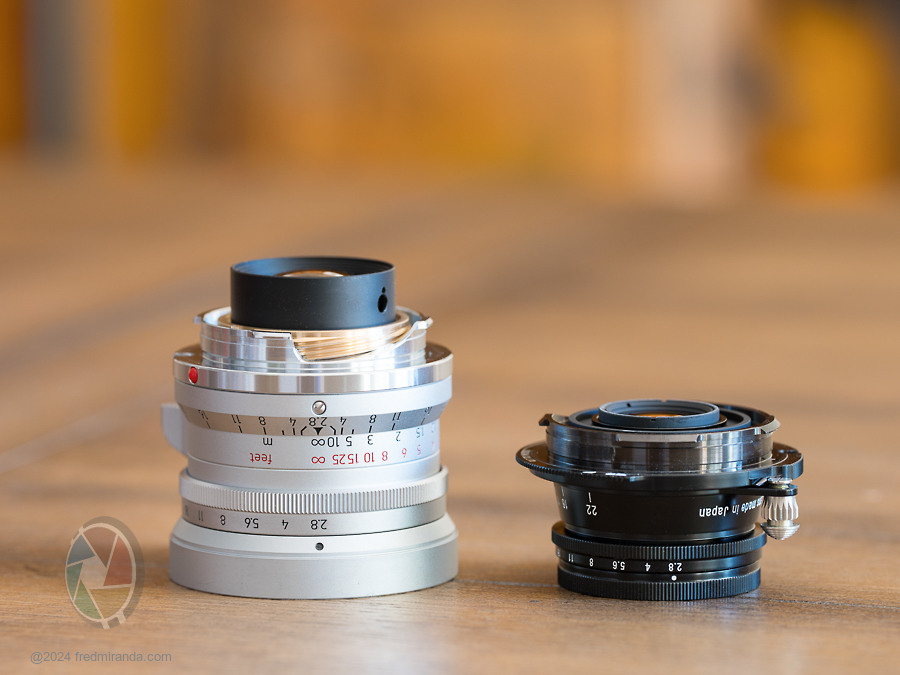
 Comparison of Protruding Rear Element: Light Lens Lab 28mm f/2.8 9E vs Voigtlander 28mm f/2.8


In this review, I won’t be comparing the lens to the original Leica 28mm f/2.8 9E, as that lens is now quite rare. Instead, I’ll compare it to the recently released Voigtlander 28mm f/2.8 Color-Skopar. Although the Voigtlander is much more compact and features a modern design, it shares the same focal length and maximum aperture. This comparison will provide an excellent opportunity to see how the Light Lens Lab lens measures up against one of my favorite 28mm lenses.

The focus throw on this lens is relatively long, about 120 degrees, which is typical for vintage Leica M-lenses. This extended throw, paired with the wide and slow aperture, enables both quick and precise focusing. In comparison to the Voigtlander 28mm f/2.8 Color-Skopar, which has a 180-degree focus throw, I find the 120-degree throw easier to handle for fast focusing when needed. Both lenses have a minimum focusing distance of 0.7 meters.


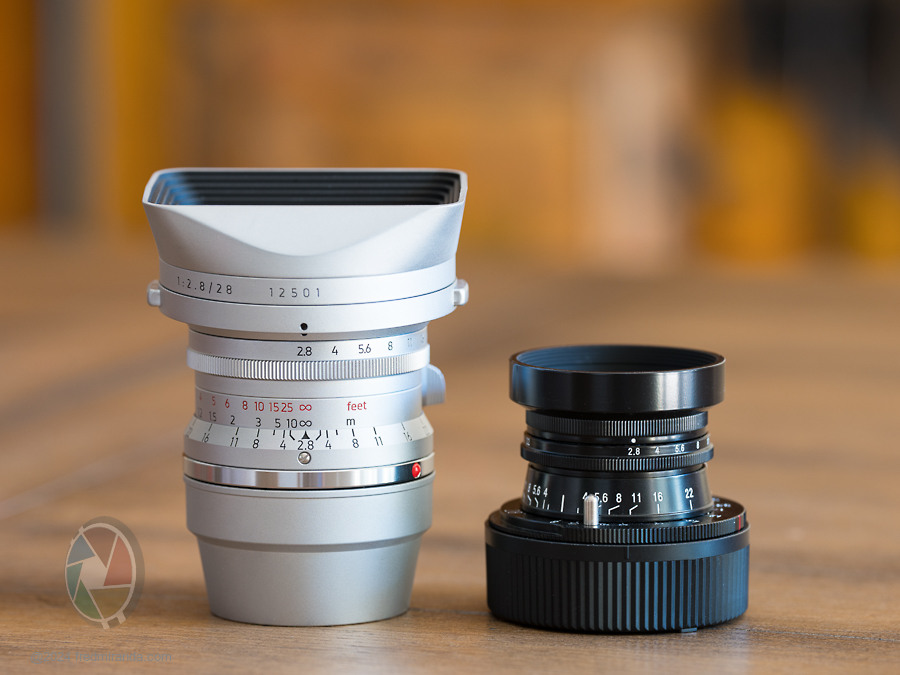
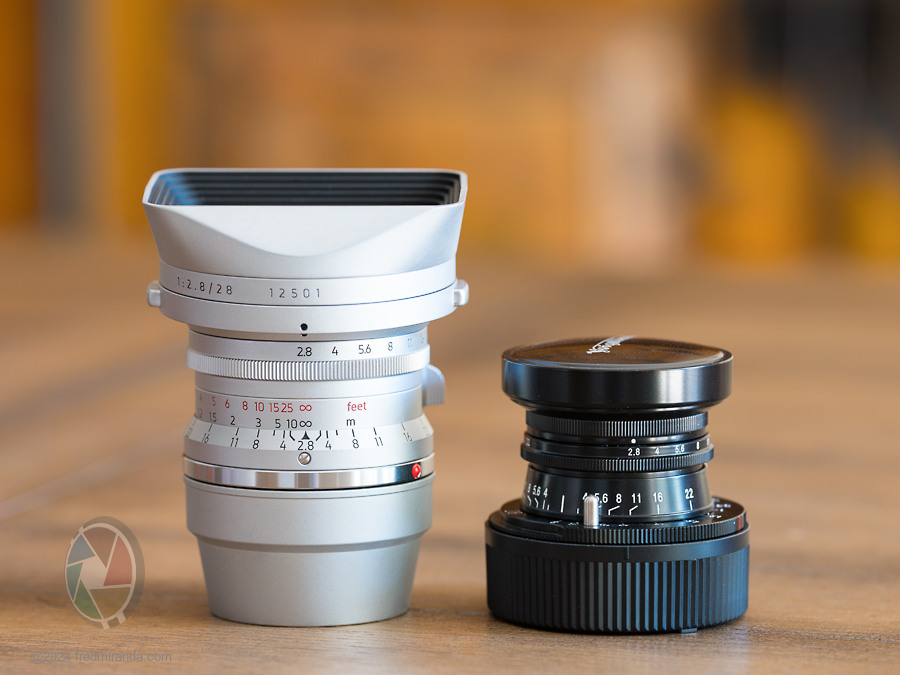
Light Lens Lab 28mm f/2.8 9E vs Voigtlander 28mm f/2.8: Both Equipped with Rear Caps and Hoods


Features:
  1. Modern take on the original "Nine Element" design
  2. Improved performance with fluorite and ED glass
  3. Optimized for digital sensors, reducing red-fringing
  4. Classic brass alloy body with focus tab and infinity lock
  5. Handcrafted in limited quantities with high-quality control
  6. Available in Chrome and Black Paint finishes
  7. Compatible with all digital M-mount cameras (not Leica M5 and CL)


Specifications:
  1. Focal Length: 28mm
  2. Coverage: Full Frame
  3. Optics: Nine elements in six groups
  4. Focus Range: 0.7 meters to ∞
  5. Diaphragm: Even half-stop aperture, manual control from f/2.8 to f/22
  6. Lens Mount: M Mount
  7. Filter Thread: E49
  8. Lens Hood: 12501 Style Clip-On Hood
  9. Length: 56.8mm
  10. Diameter: 52.4mm
  11. Weight (Tested Silver): 303g (345g with included 12501 lens hood)


Nov 21, 2024 at 05:26 PM
Fred Miranda
Offline
Admin
Upload & Sell: On
p.1 #2 · Light Lens Lab 28mm f/2.8 9-Element Review


Back to Quick Links

Resolution and Contrast at Infinity distance: LLL 28mm f/2.8 9-Element vs Voigtlander 28mm f/2.8 (M11)

In my initial thoughts on the Light Lens Lab 28mm f/2.8 9-Element lens, I was genuinely impressed by its resolution and contrast. Given that it’s a clone of the Leica 28mm Elmarit retrofocus design, which wasn’t exactly famous for stellar performance (in fact, it was quite the opposite) this came as a surprise. Leica purists might be a bit disappointed expecting similar results to the original, but it’s great news for anyone wanting to use this lens with today’s high-megapixel sensors..

Testing it on a 60MP sensor and comparing it to the modern Voigtlander design really pushed this lens to its limits and showcased the improvements Light Lens Lab made to the optical design. Surprisingly, the Light Lens Lab 28mm f/2.8 actually outperformed the Voigtlander 28mm f/2.8 Color Skopar when both were wide open. As noted in the Voigtlander review, it doesn’t perform its best at wide open but gets significantly better when stopped down a bit. You can see this clearly in the comparison shots below --- the Light Lens Lab lens outshines the Voigtlander wide open, except for the extreme corners, but the Voigtlander catches up when stopped down.

At f/4 and smaller apertures, both lenses perform admirably. It’s pretty amazing to see such high performance from a lens inspired by a rather underwhelming Leica wide-angle lens from the 1960s.


  1. Distance: Infinity
  2. Focus: Center - Best of three shots at maximum magnification
  3. White Balance: Daylight
  4. Both lenses are well centered, as verified with my decentering test.
  5. Software used: Lightroom with FM Default Landscape Sharpening; all other settings are at default.

    PS: Vignetting, Chromatic Aberration (CA), and distortion were not corrected either in post-processing or in-camera.


    Center Resolution and Contrast
    Resolution and Contrast at Infinity distance: LLL 28mm f/2.8 9-Element vs Voigtlander 28mm f/2.8 (M11)
    (open the browser window to view entire image without resizing)


    f/2.8


    f/4


    f/5.6


    f/8


Nov 23, 2024 at 02:02 PM
Fred Miranda
Offline
Admin
Upload & Sell: On
p.1 #3 · Light Lens Lab 28mm f/2.8 9-Element Review


Mid-field Resolution and Contrast
Resolution and Contrast at Infinity distance: LLL 28mm f/2.8 9-Element vs Voigtlander 28mm f/2.8 (M11)
(open the browser window to view entire image without resizing)


f/2.8


f/4


f/5.6


f/8


Nov 23, 2024 at 02:02 PM
Fred Miranda
Offline
Admin
Upload & Sell: On
p.1 #4 · Light Lens Lab 28mm f/2.8 9-Element Review


Extreme Corner Resolution and Contrast
Resolution and Contrast at Infinity distance: LLL 28mm f/2.8 9-Element vs Voigtlander 28mm f/2.8 (M11)
(open the browser window to view entire image without resizing)

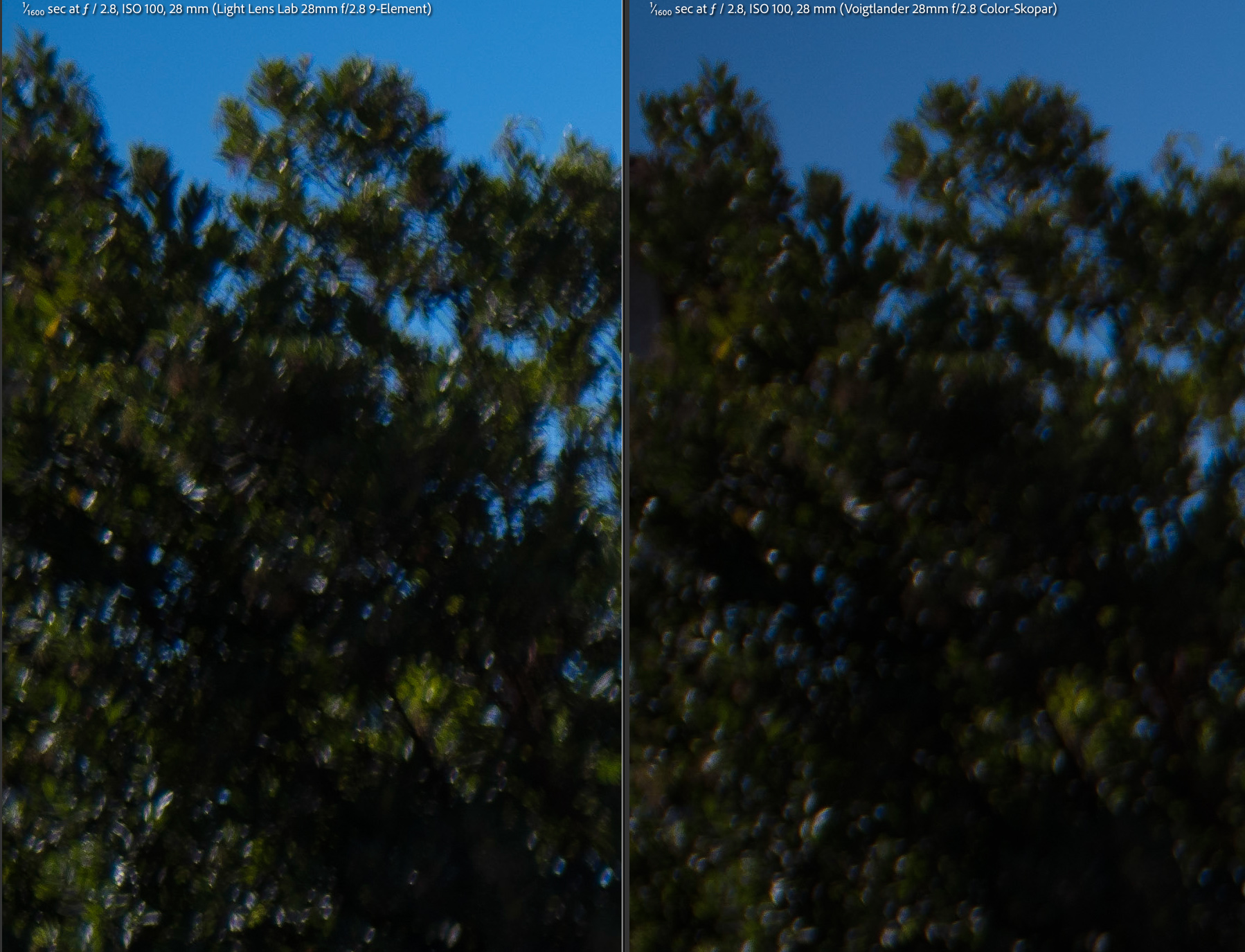
The Voigtlander crop shows more in-focus foliage at closer distances, highlighting the different field curvature of these lenses. We’ll explore this in greater detail later.


f/2.8


f/4


f/5.6


f/8


Nov 23, 2024 at 02:03 PM
Fred Miranda
Offline
Admin
Upload & Sell: On
p.1 #5 · Light Lens Lab 28mm f/2.8 9-Element Review


Back to Quick Links

Rendering compared to Voigtlander 28mm f/2.8


David vs. Goliath!

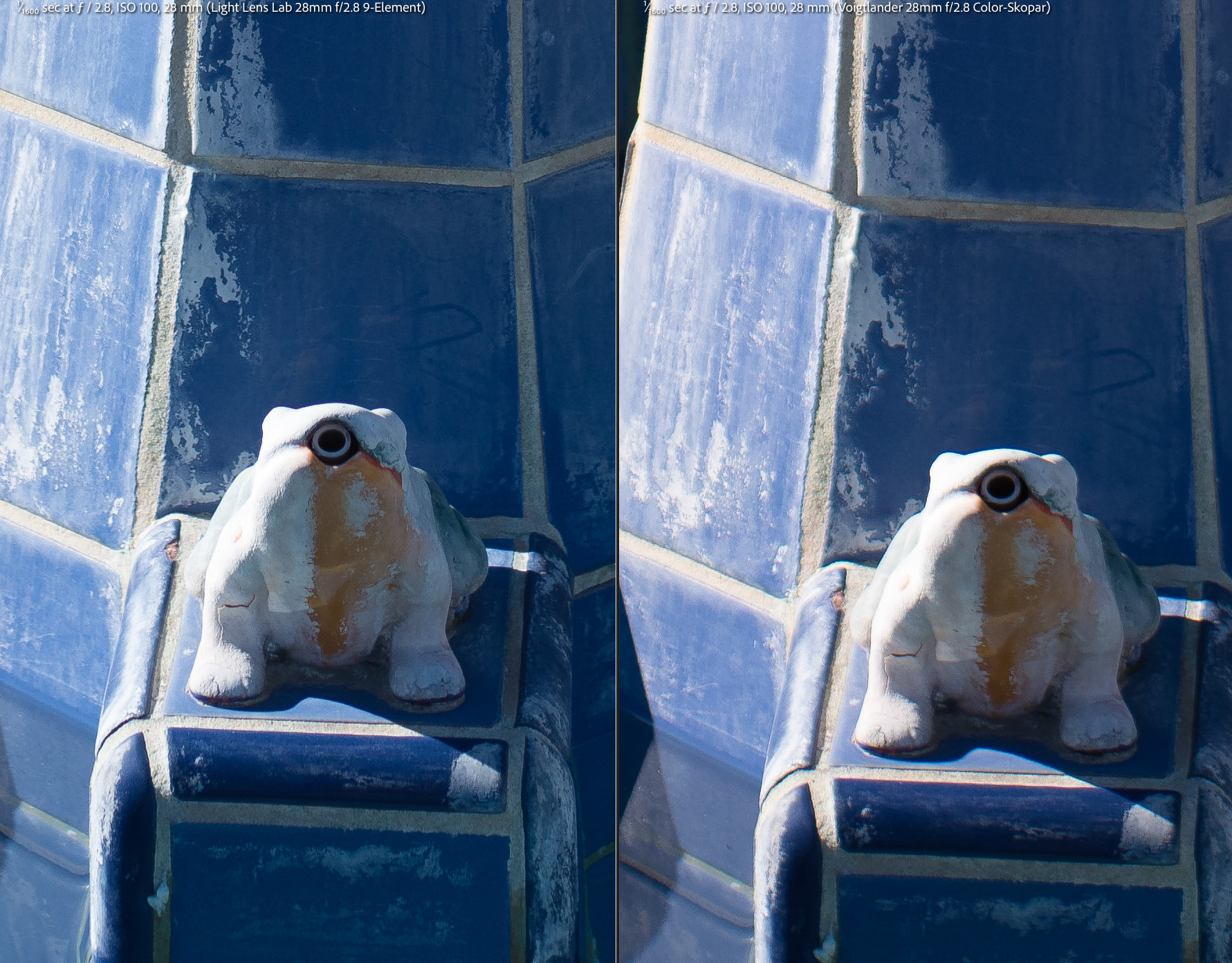
The Light Lens Lab lens is significantly larger and heavier than the Voigtlander 28mm f/2.8 Color-Skopar and is also equipped with an extra element. While we’ve already noted that it outperforms the Voigtlander in resolution at long distances when both are wide open, how do they stack up at closer ranges? And what about their unique rendering characteristics? In this section, I’ve compared both lenses side by side under identical lighting and framing conditions to highlight their differences.

First, we’ll evaluate resolution and contrast at both the center and off-center areas, focusing on close and mid-range distances. We’ll also examine how each lens handles optical vignetting and the shape of specular highlights. Also we’ll look at the rendering structure, including noticeable outlining, and how field curvature impacts the image towards the corners.

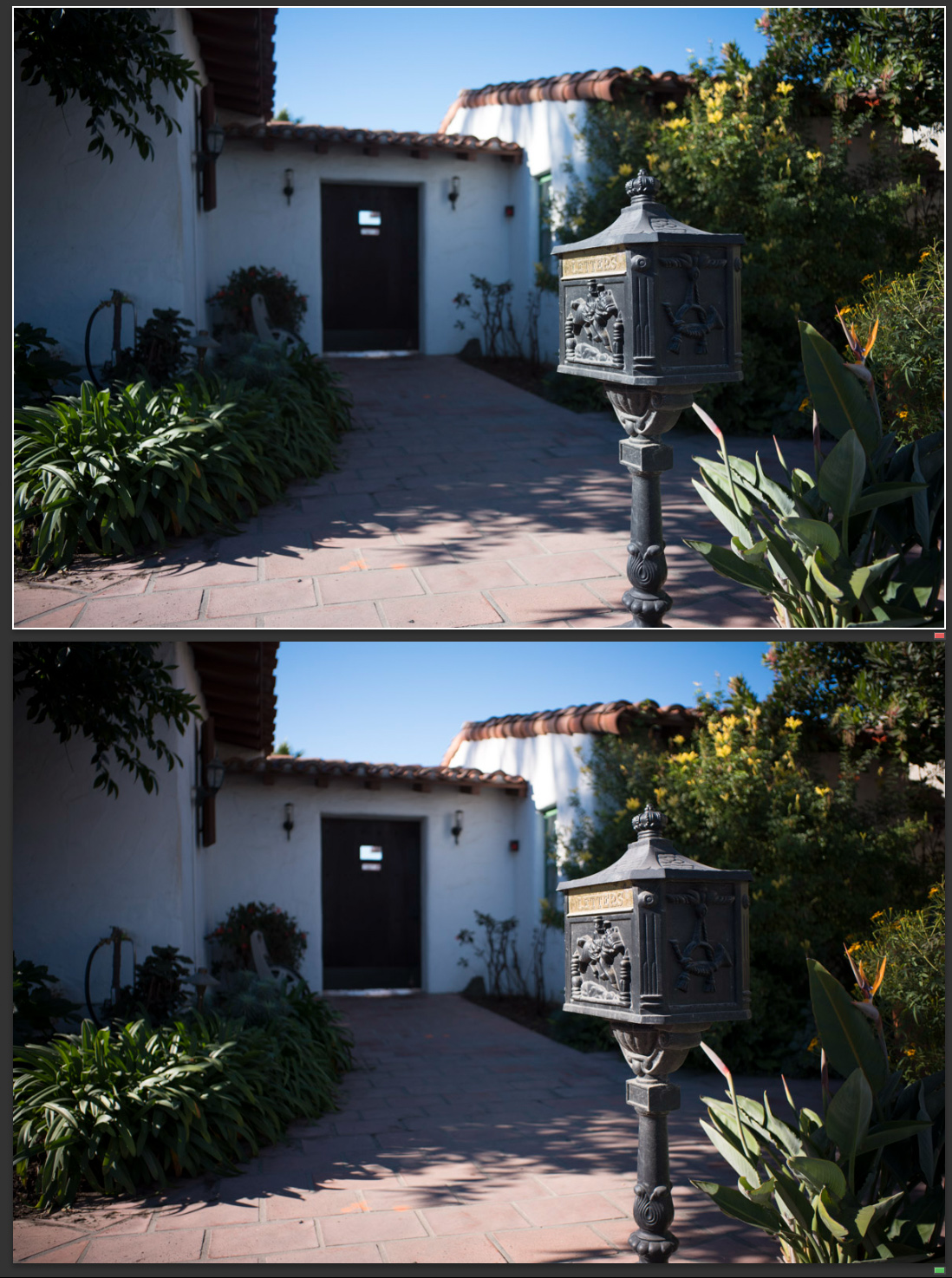
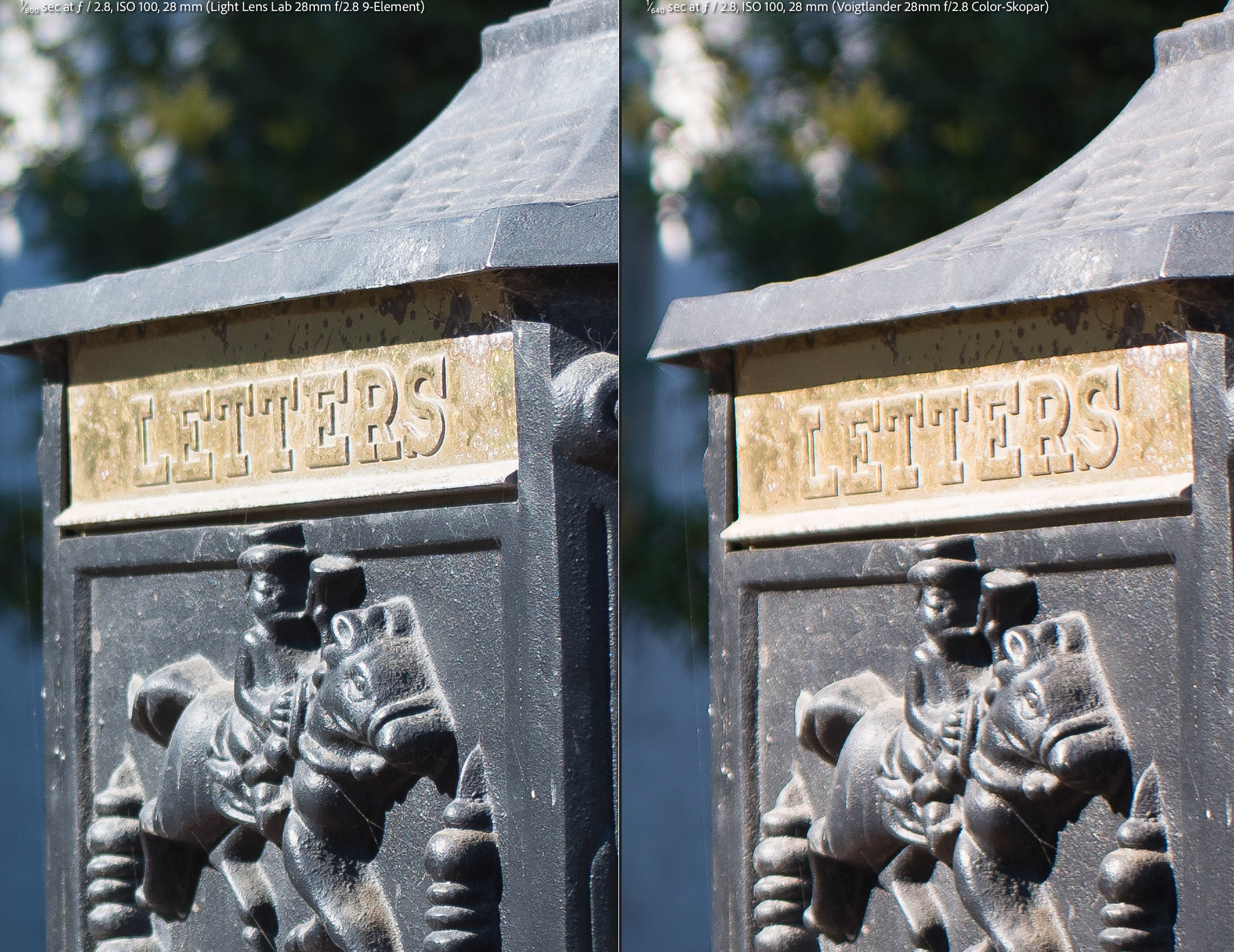
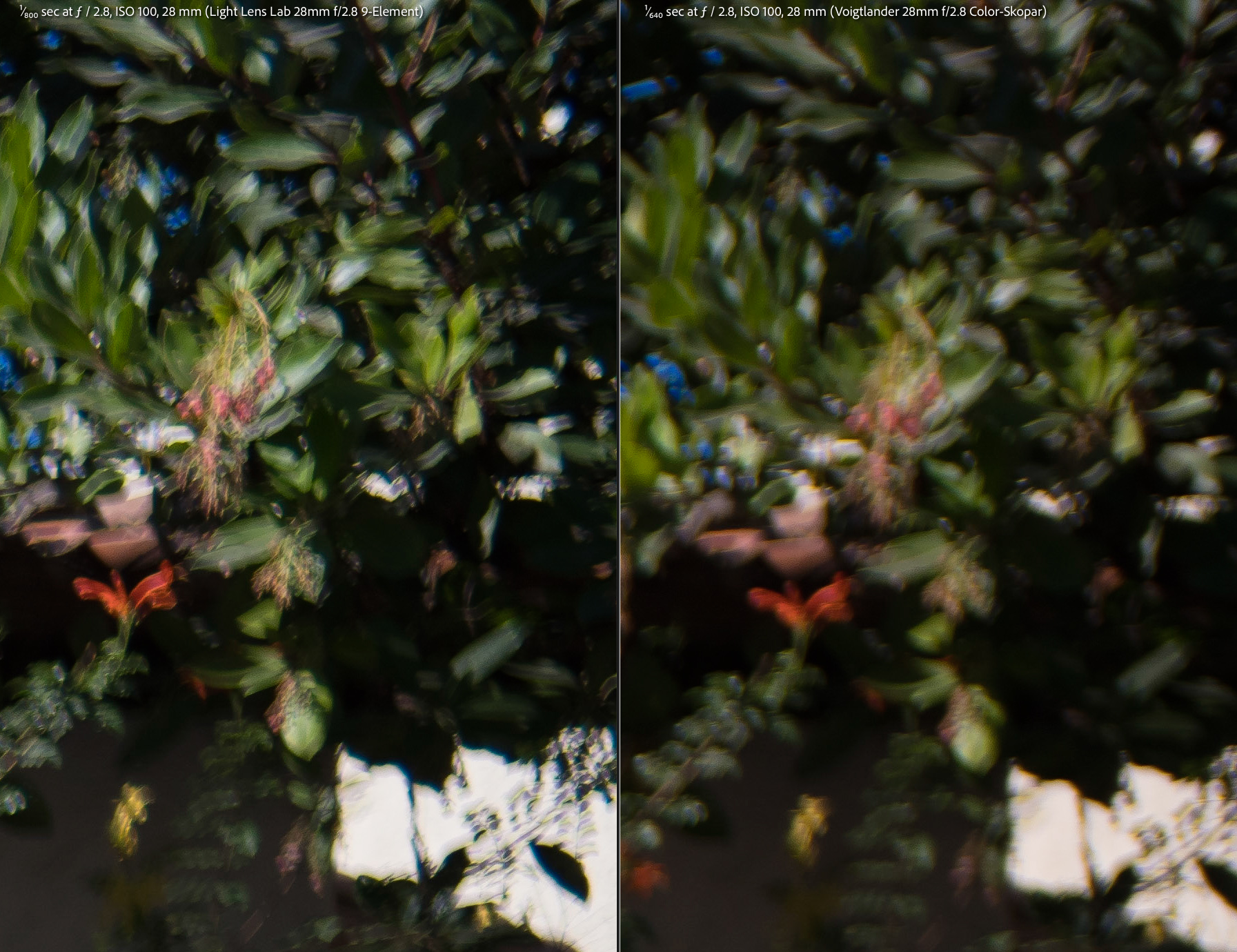
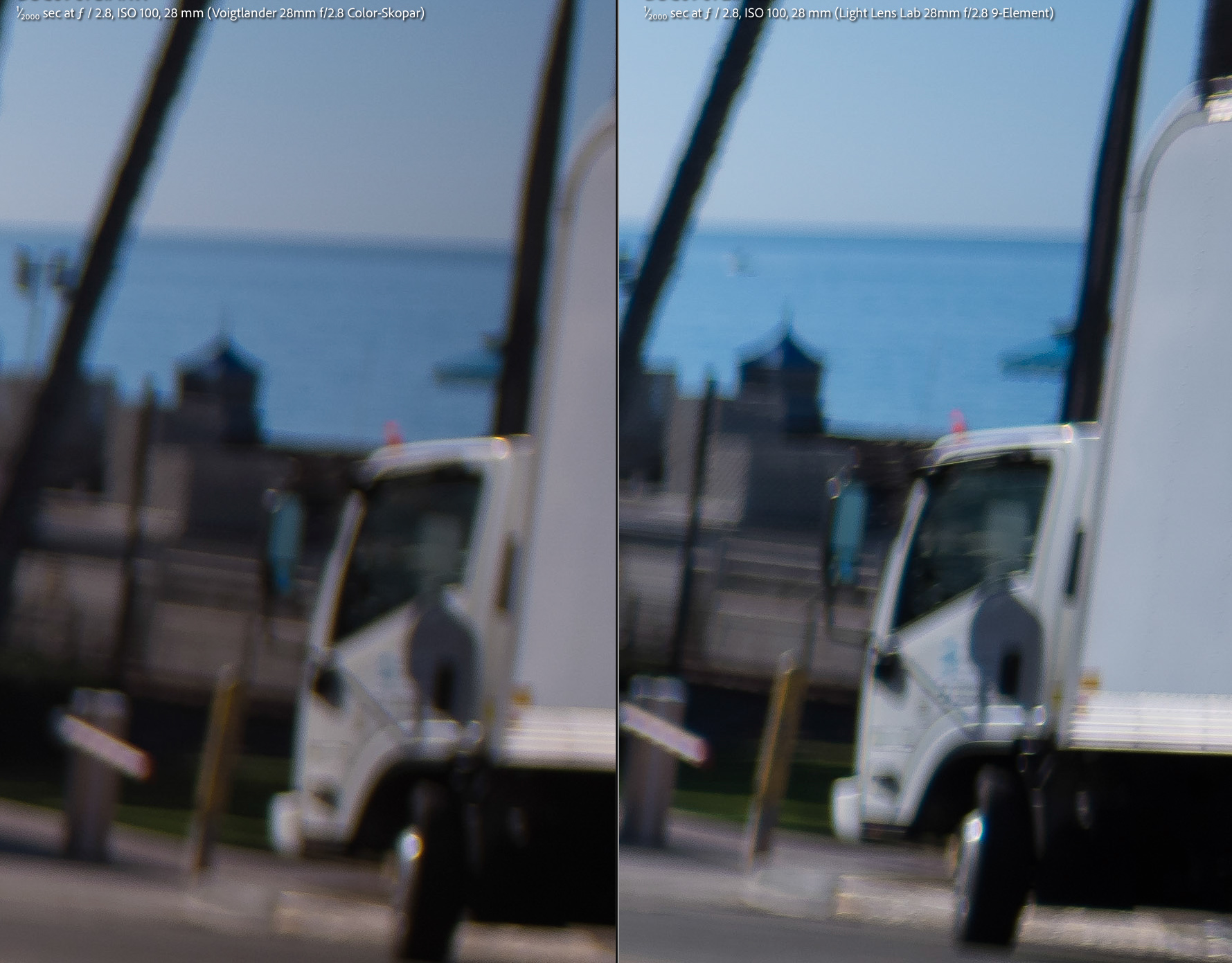
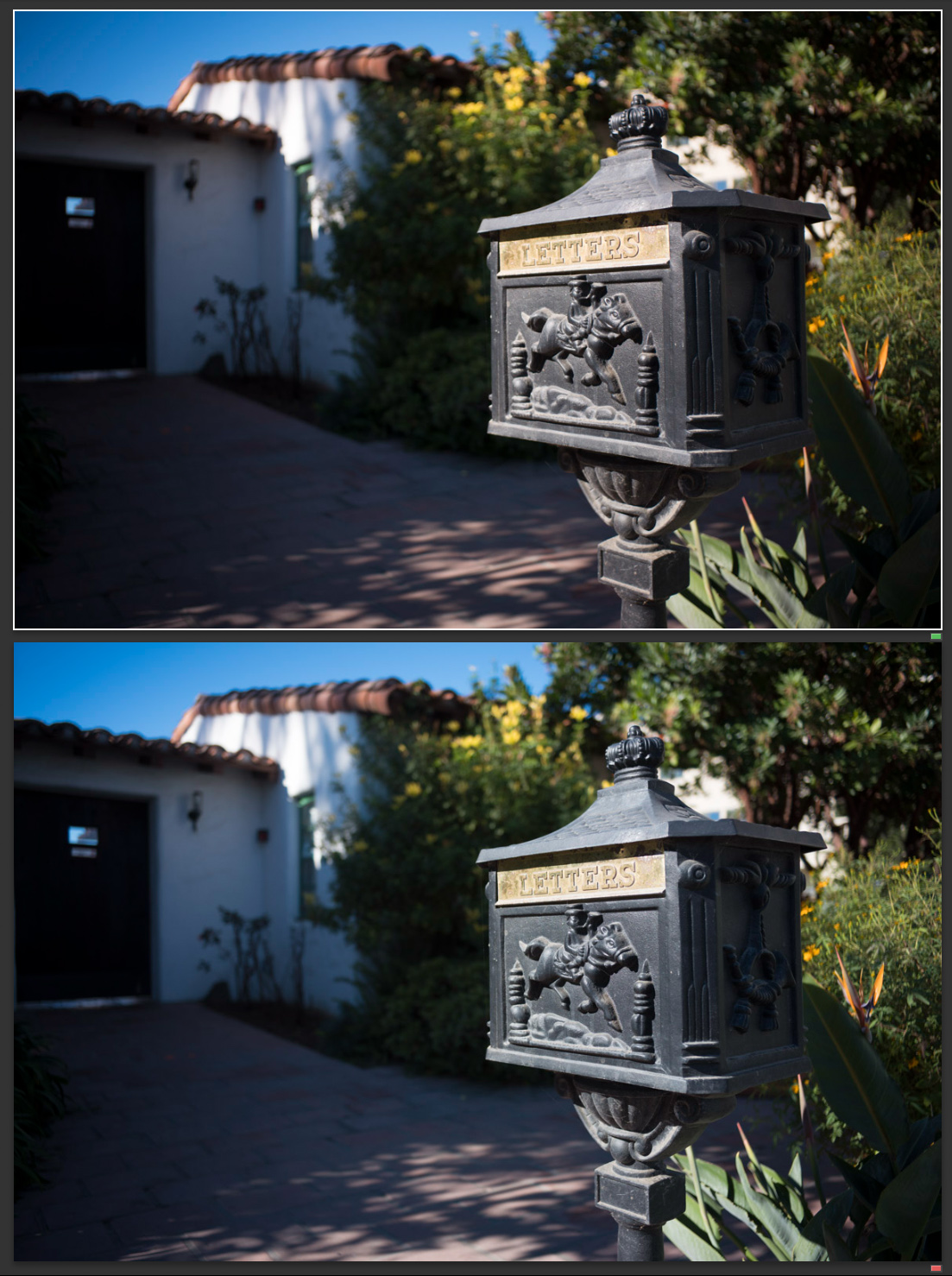
In my view, these lenses produce distinctly different renderings, even though they share the same focal length and maximum aperture. The Voigtlander has higher contrast, warmer tones, more pronounced outlining, which some might interpret as giving it more character. It’s also less sharp wide open, but starting around f/3.2, their performances become very similar. On the other hand, the Light Lens Lab lens offers lower contrast, cooler tones, smoother transitions, and more noticeable outward field curvature. This curvature distorts the focal plane, making elements that should be out of focus in the background appear sharper towards the corners. This effect is more noticeable when the subject is focused at mid or longer distances.


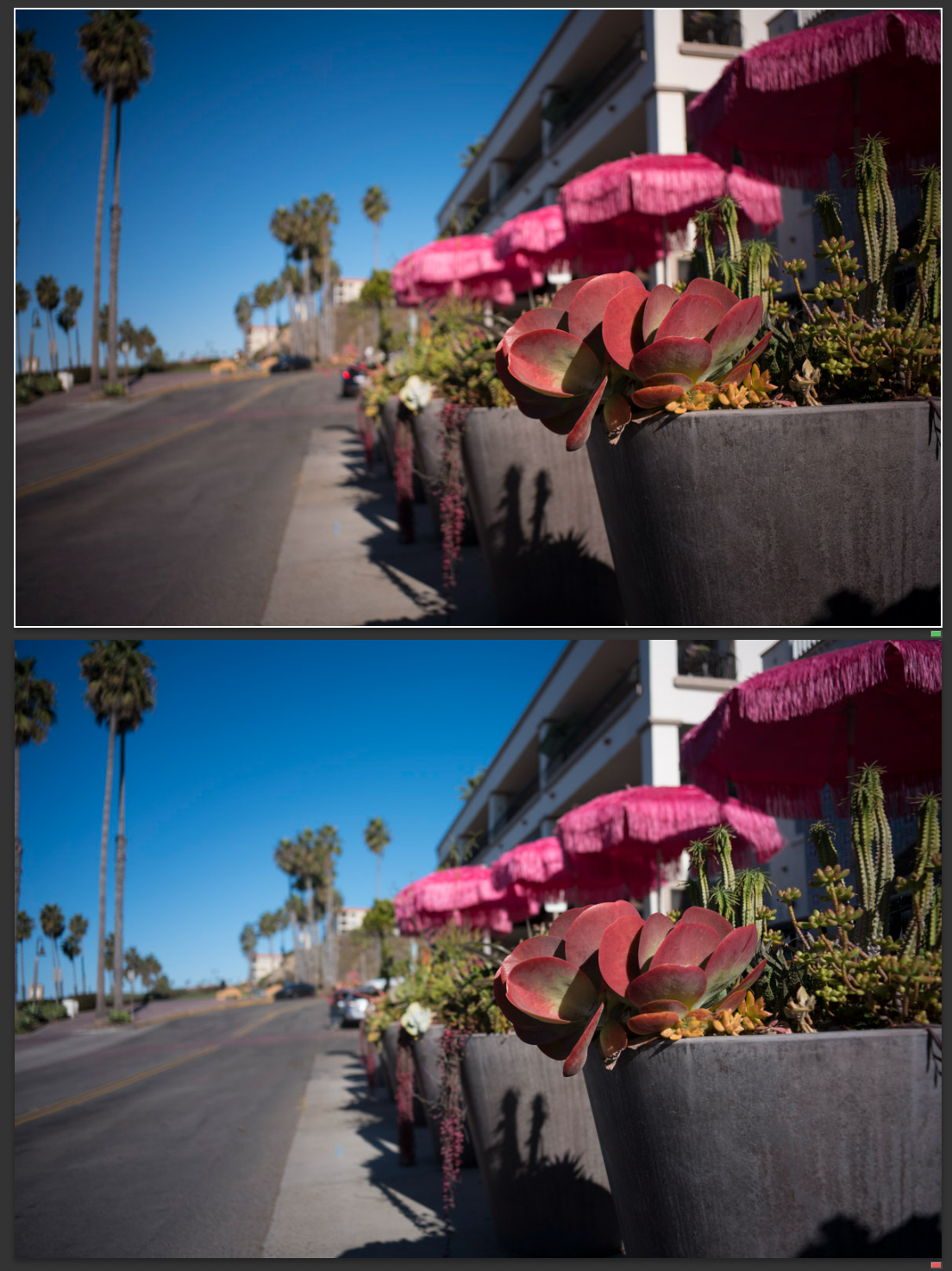
Sample 1:


LLL (TOP), Voigtlander (BOTTOM)


100% magnification (pixel level) displaying the focused area. Higher resolution at f/2.8 for the LLL


The LLL lens has lower contrast and smoother transitions, while the Voigtlander has higher outlining and more character.


The LLL lens shows more in-focus corners due to its field curvature. I personally prefer the more even field curvature of the Voigtlander.


The LLL lens shows more in-focus corners due to its field curvature. I personally prefer the more even field curvature of the Voigtlander.


Nov 23, 2024 at 03:01 PM
Fred Miranda
Offline
Admin
Upload & Sell: On
p.1 #6 · Light Lens Lab 28mm f/2.8 9-Element Review


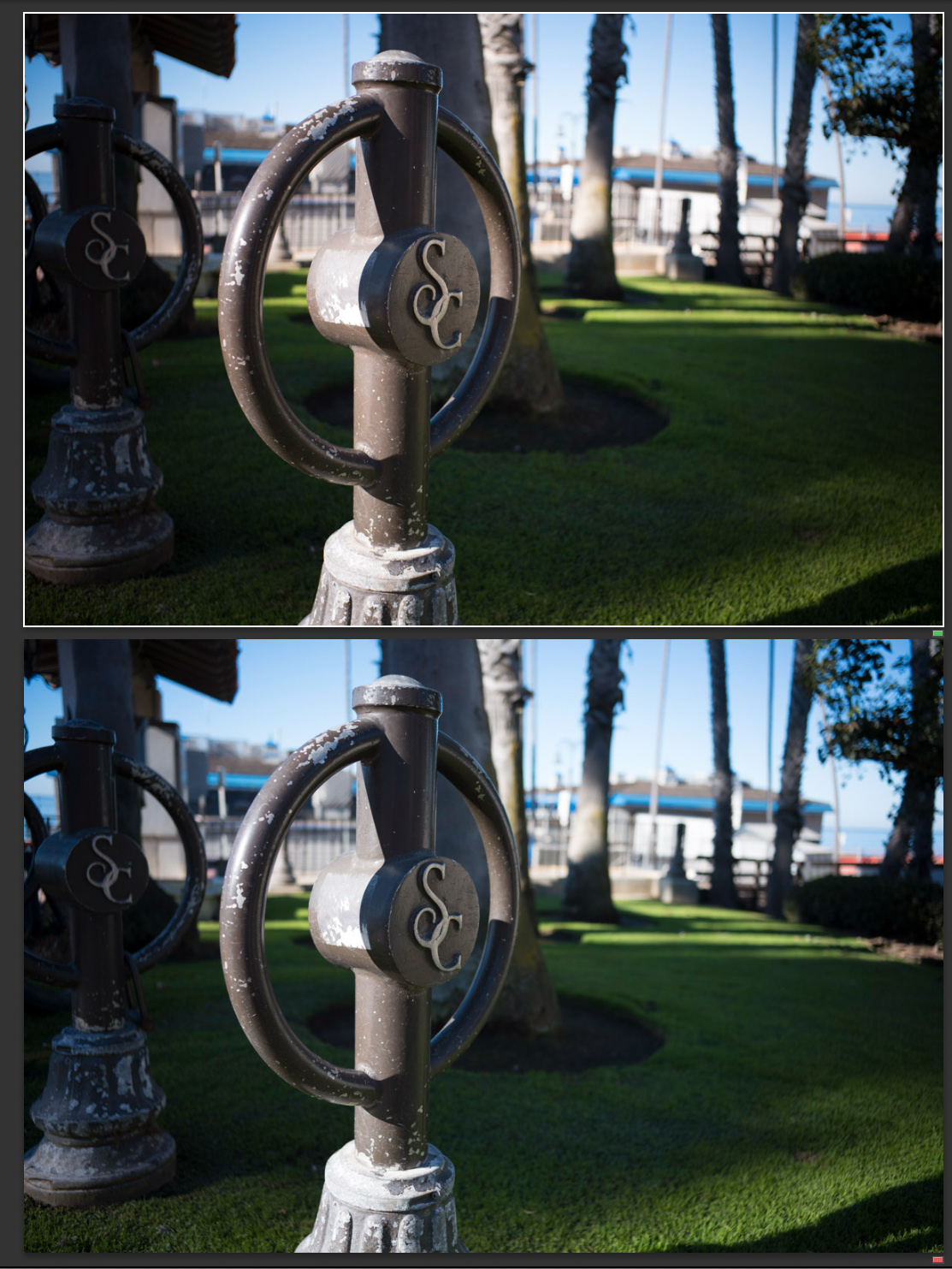
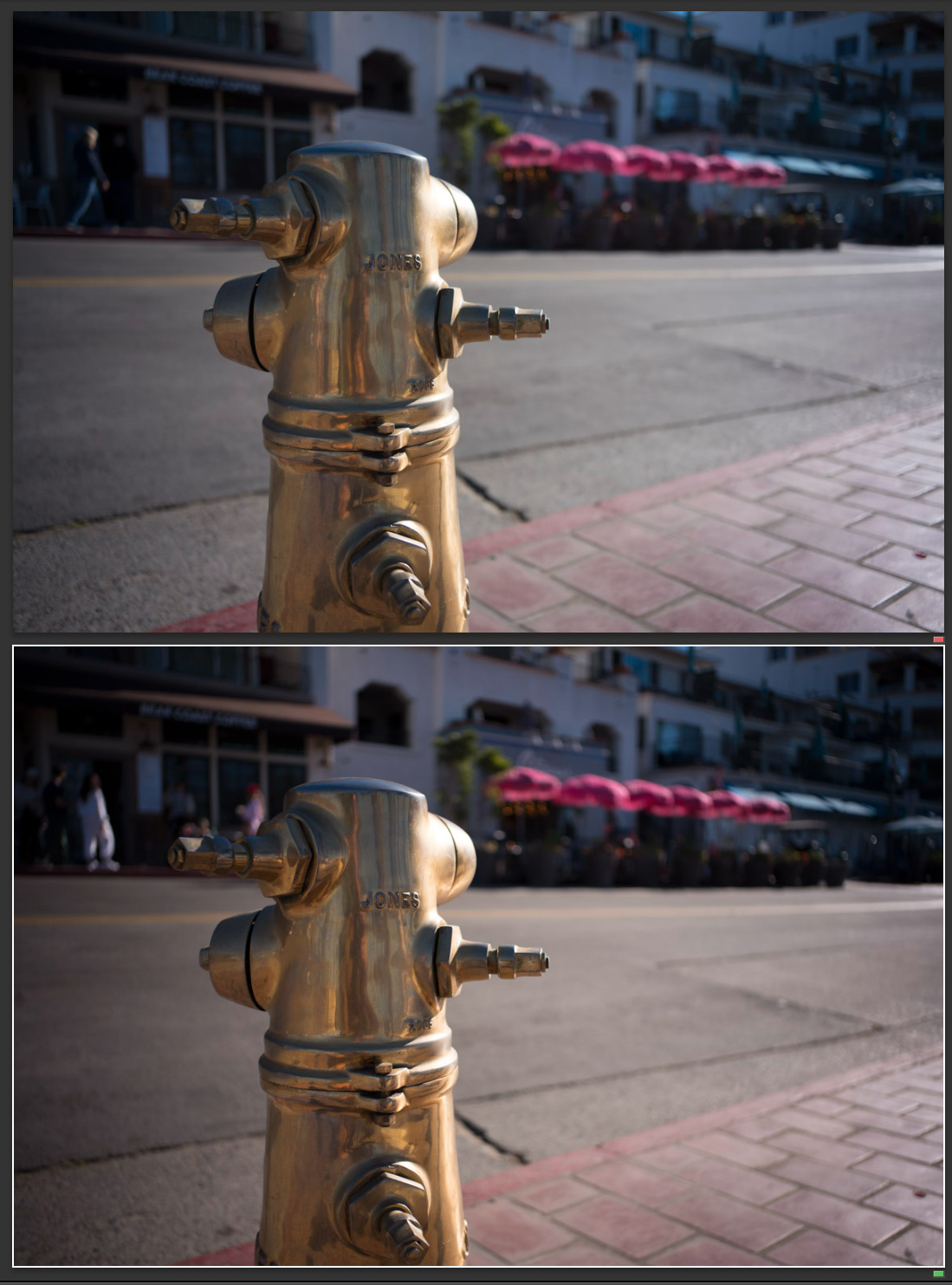
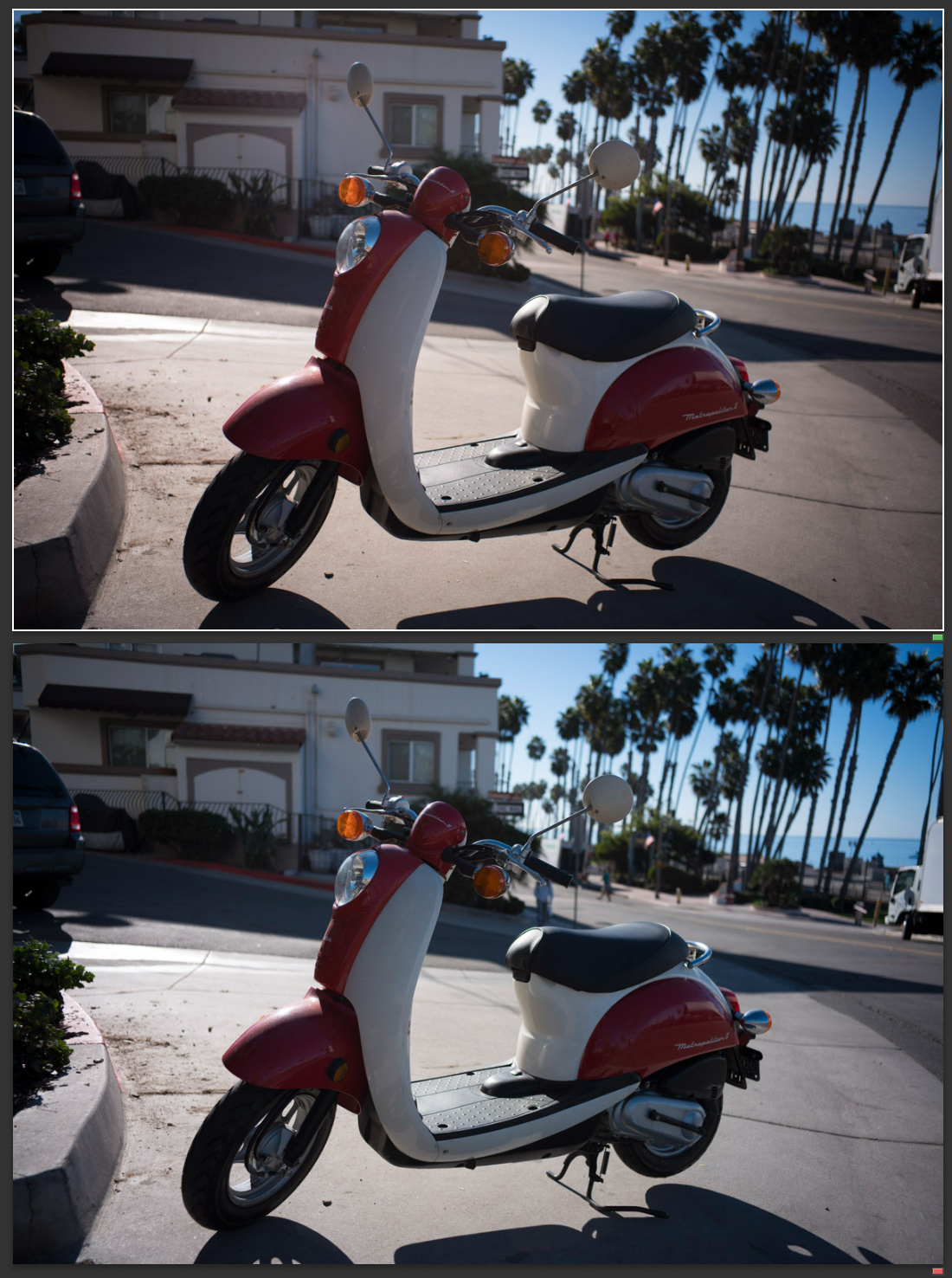
Sample 2:

Same subject as Sample 1 but at closer distance:


Voigtlander (TOP), LLL (BOTTOM)


100% magnification (pixel level) displaying the focused area.


Voigtlander shows more out of focus areas off-axis


More in focus corners for the LLL due to field curvature. I much prefer the more even FC on the Voigtlander.


Nov 23, 2024 at 03:02 PM
Fred Miranda
Offline
Admin
Upload & Sell: On
p.1 #7 · Light Lens Lab 28mm f/2.8 9-Element Review


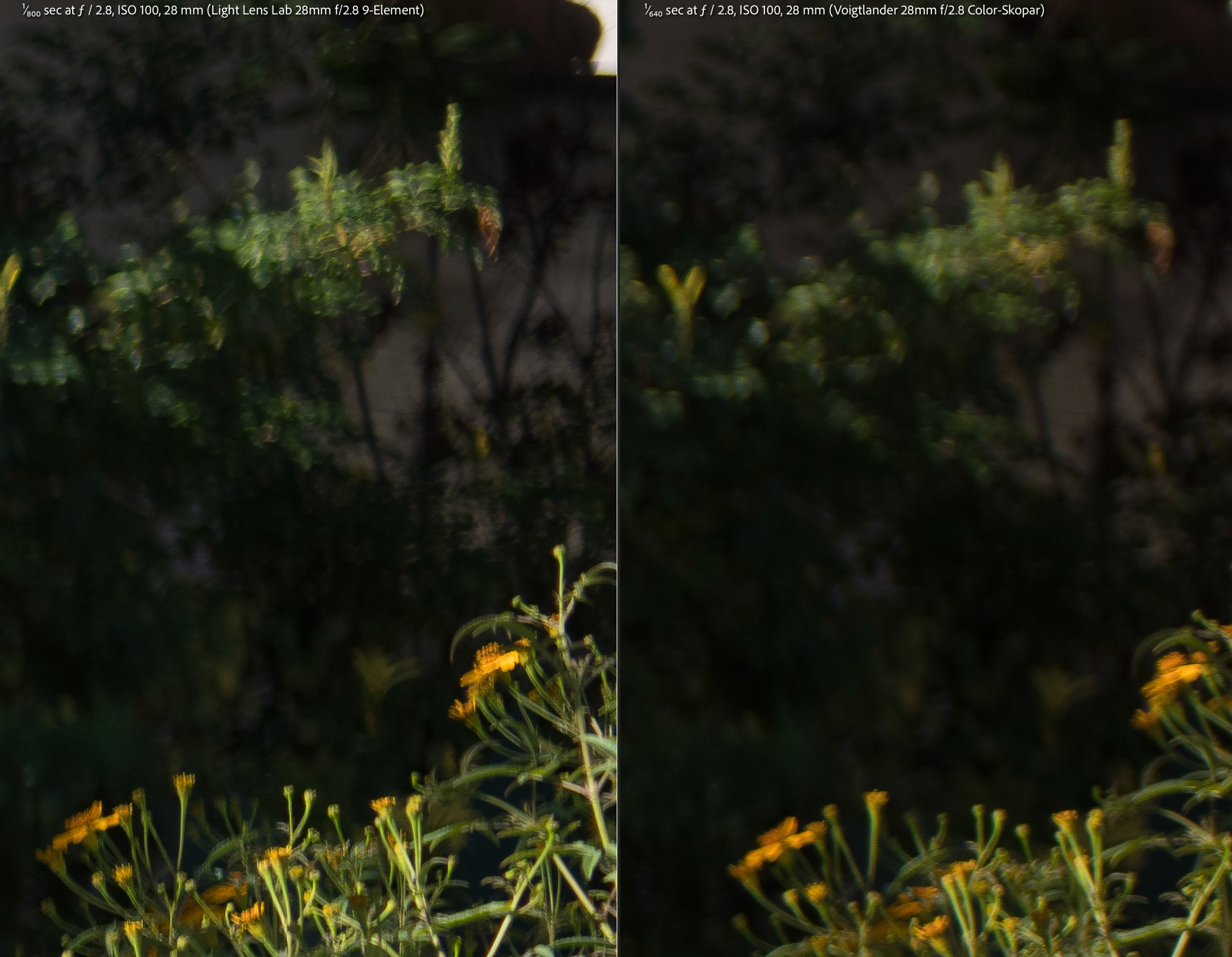
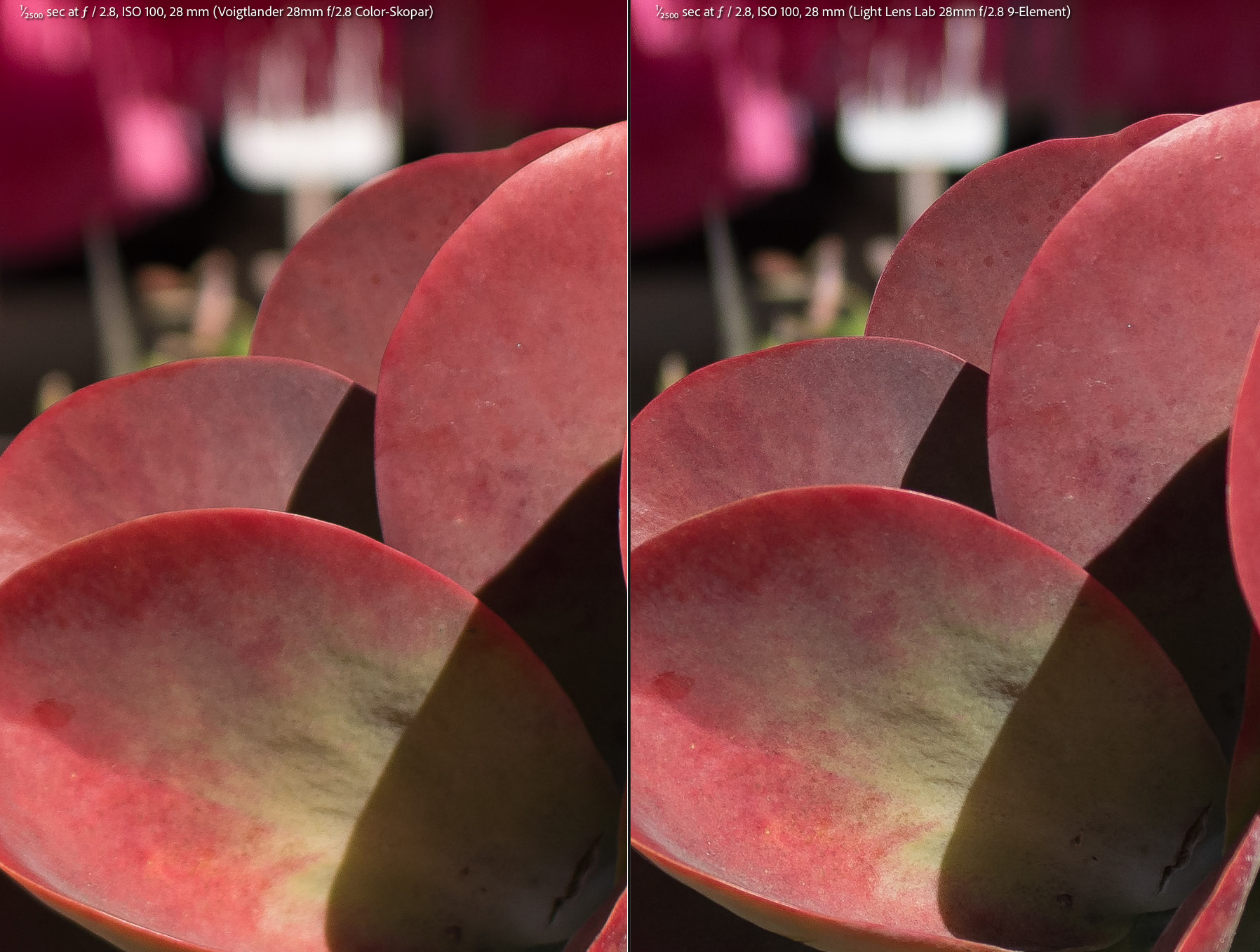
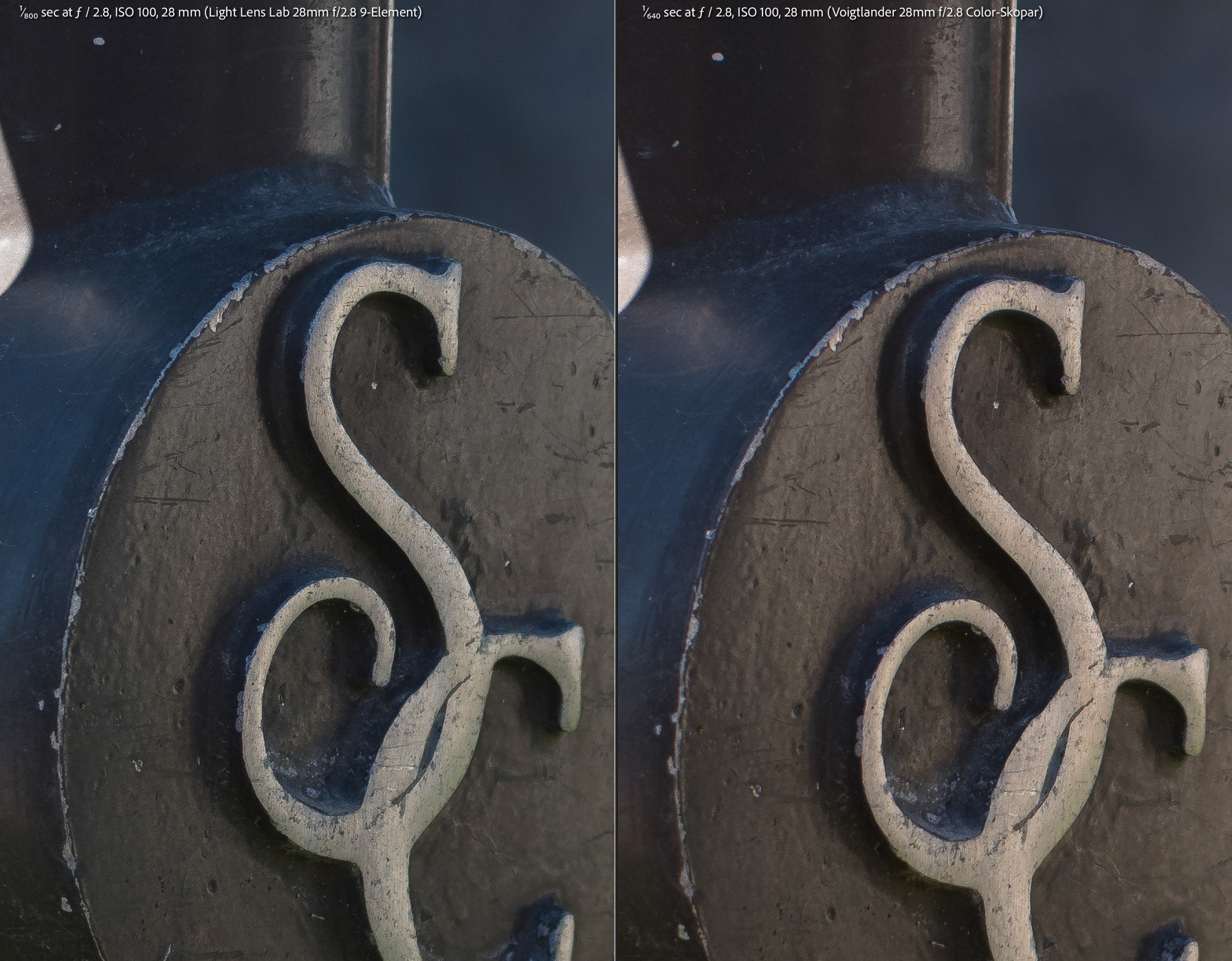
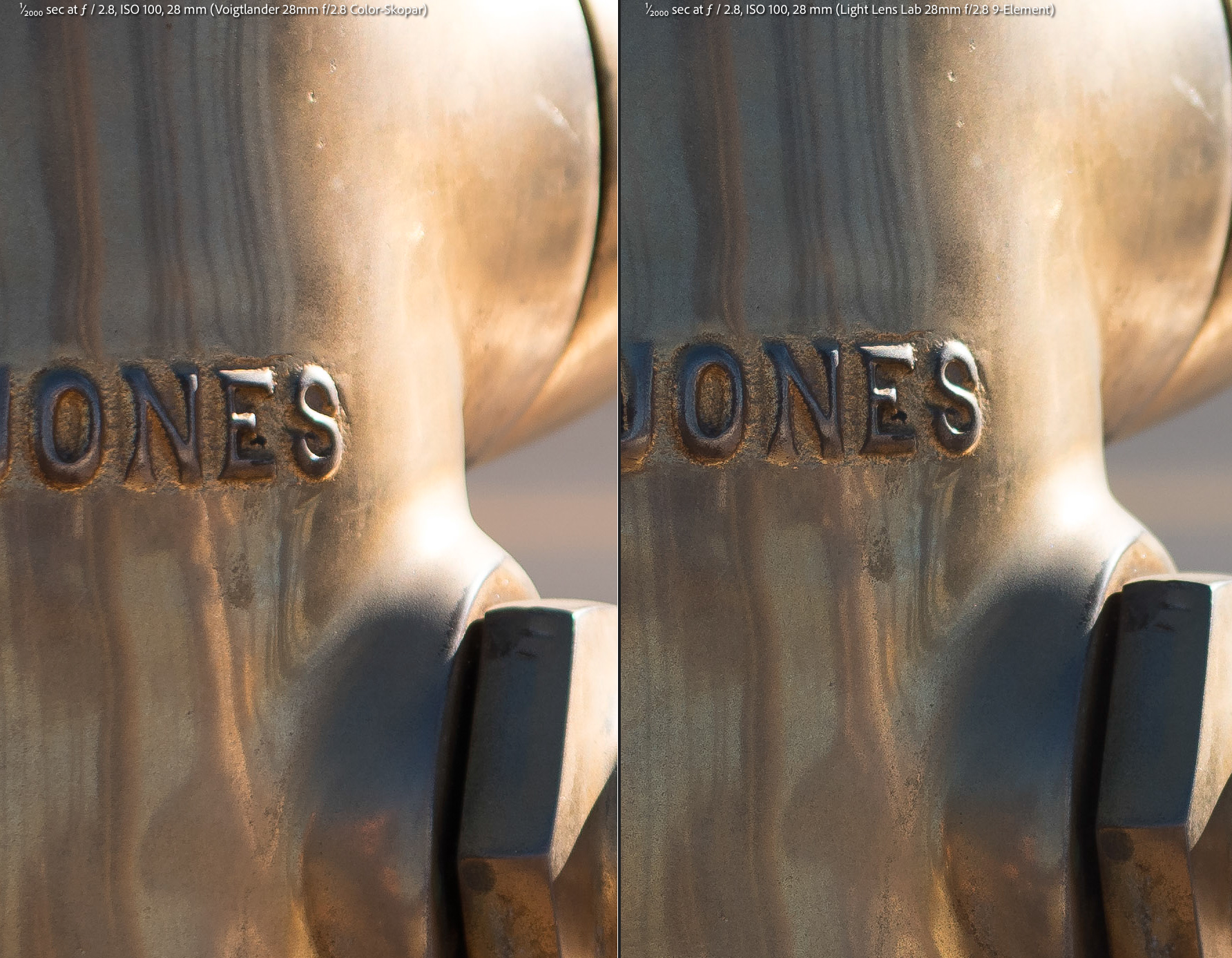
Sample 3:


LLL (TOP), Voigtlander (BOTTOM)


100% magnification (pixel level) displaying the focused area. (Noticeable higher resolution for the LLL on this area)


More in focus corners for the LLL due to field curvature. I much prefer the more even FC on the Voigtlander.


More in focus corners for the LLL due to field curvature. I much prefer the more even FC on the Voigtlander.


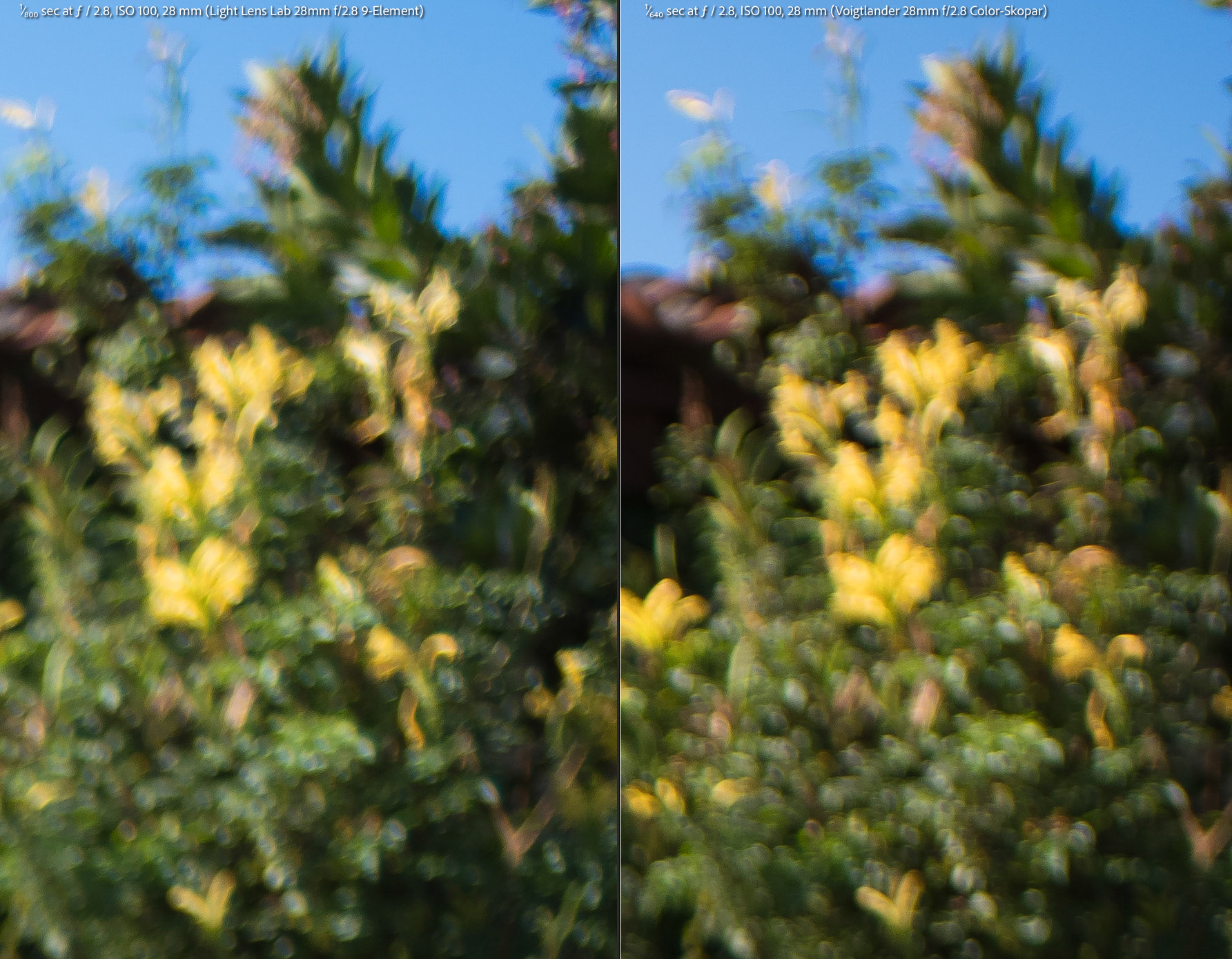
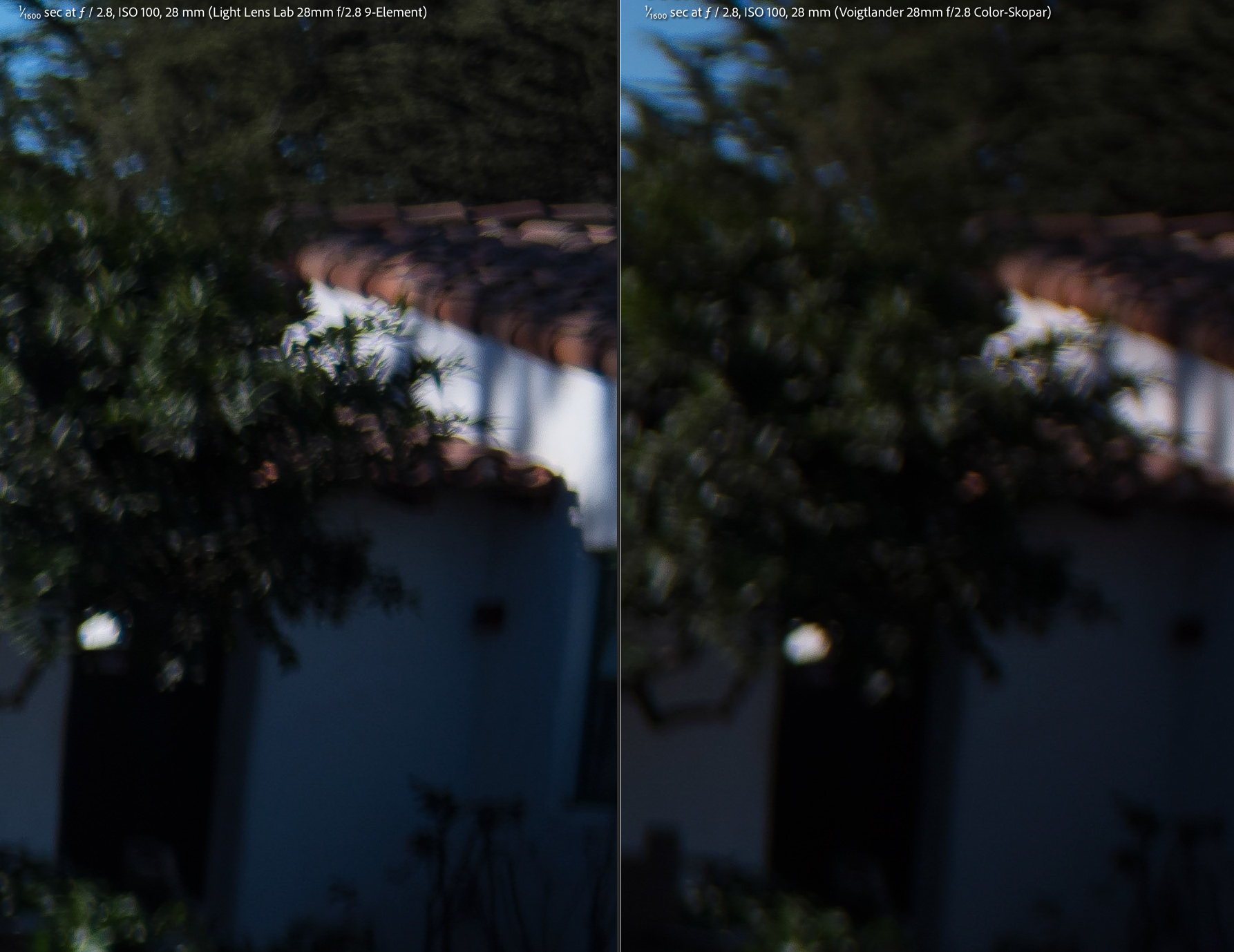
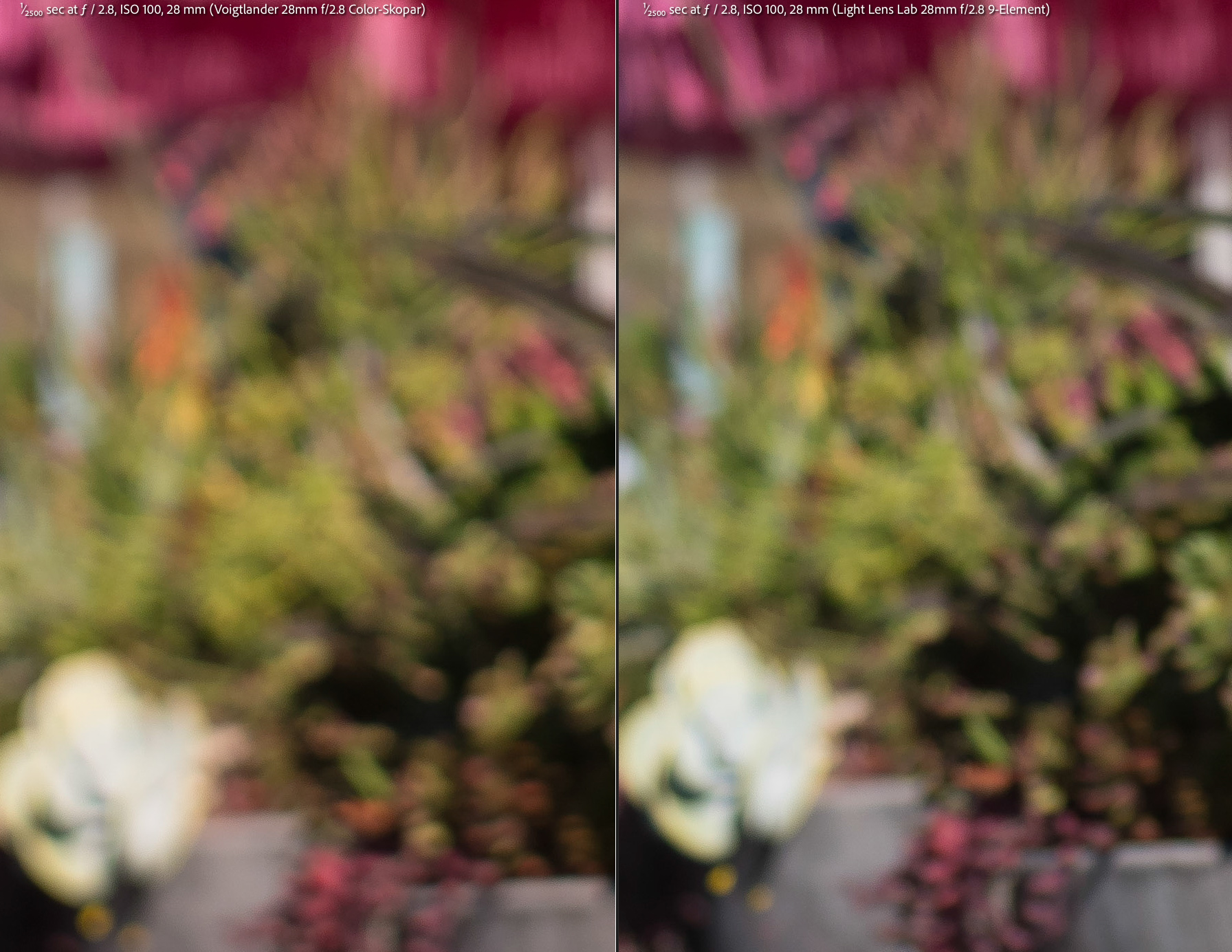
In the out-of-focus area near the center, both lenses produce similar blur. However, the LLL lens shows lower contrast and less outlining, while the Voigtlander offers higher contrast and more character.


Nov 23, 2024 at 03:03 PM
Fred Miranda
Offline
Admin
Upload & Sell: On
p.1 #8 · Light Lens Lab 28mm f/2.8 9-Element Review


Sample 4:


Voigtlander (TOP), LLL (BOTTOM)


100% magnification (pixel level) displaying the focused area.


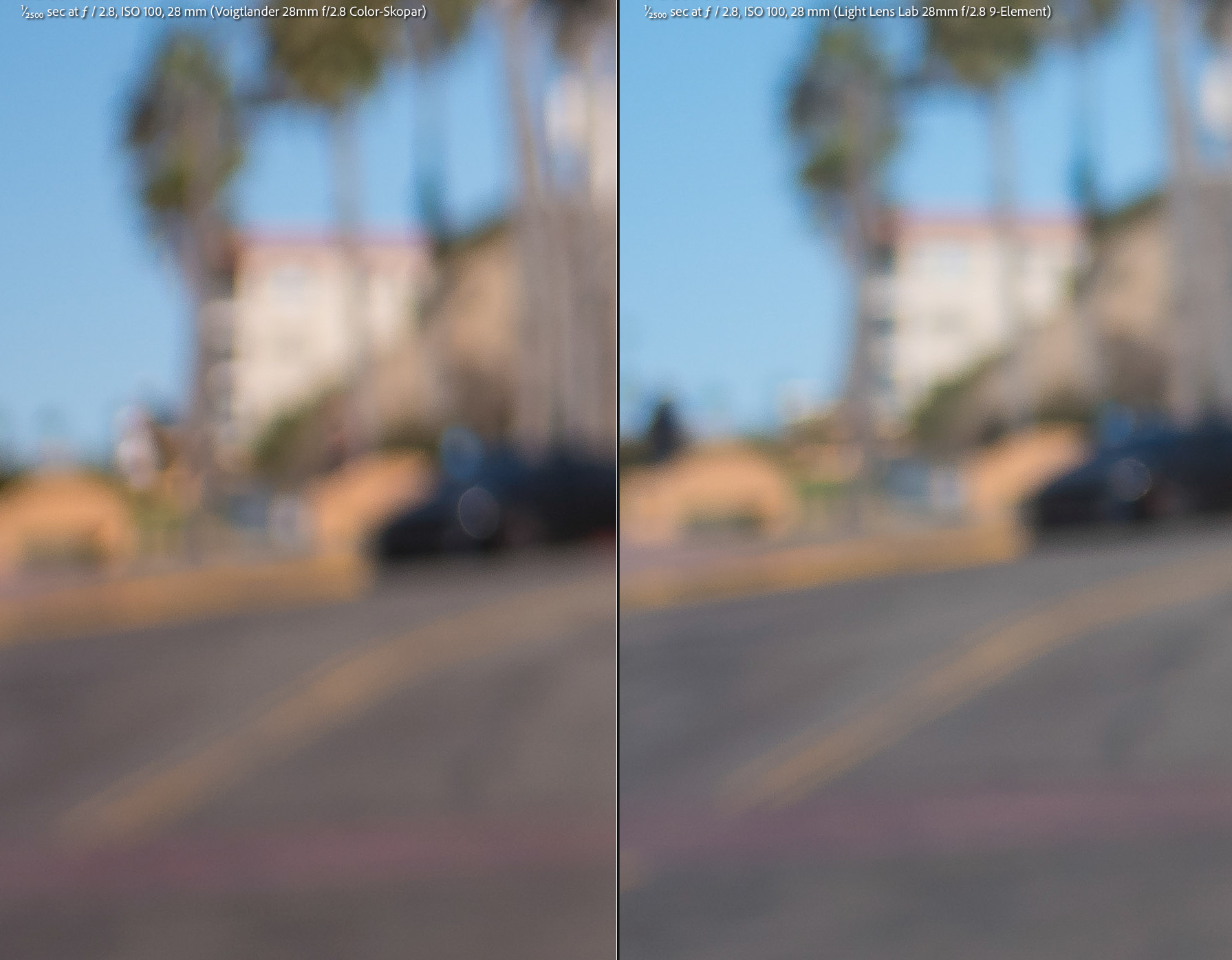
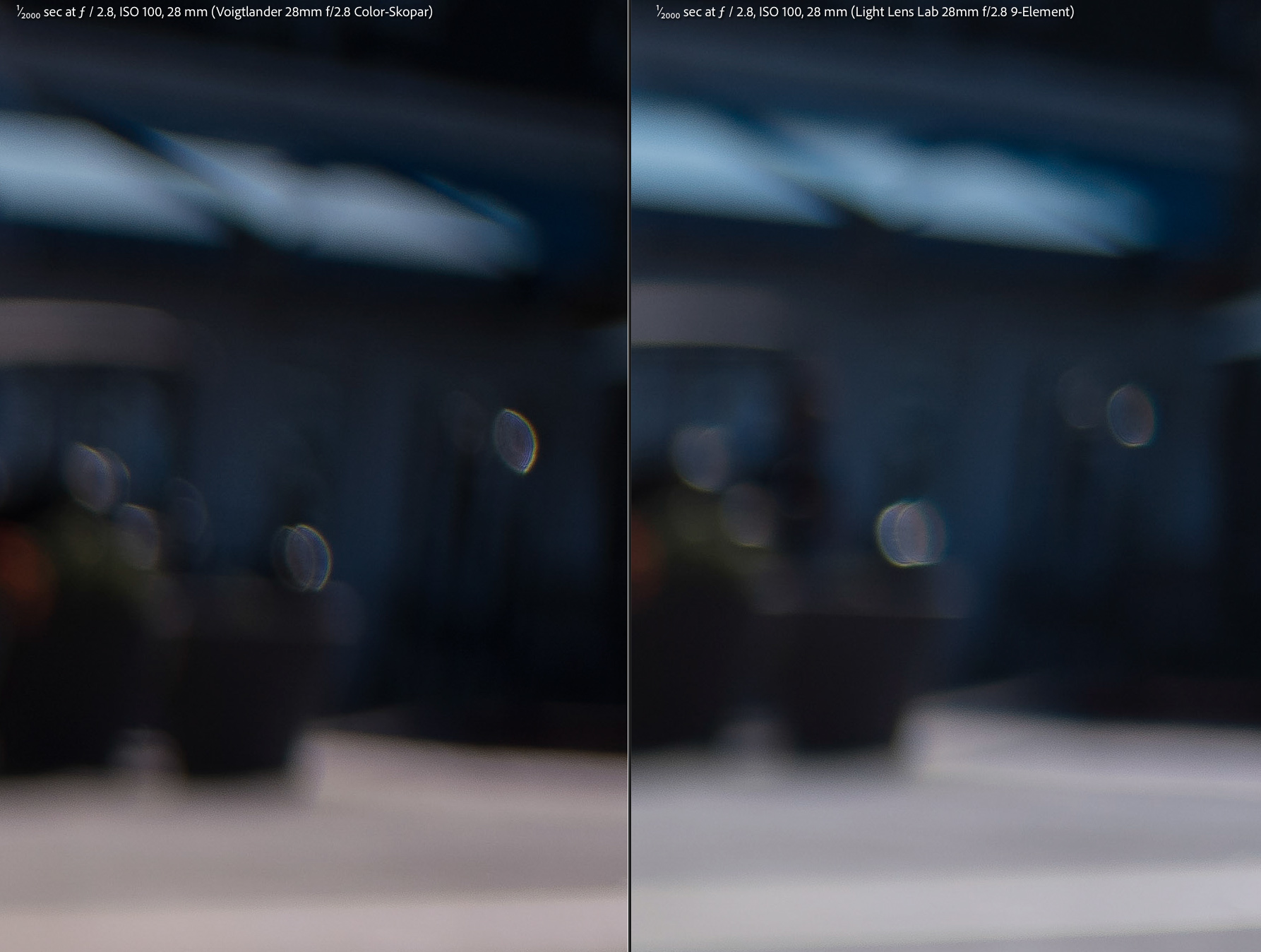
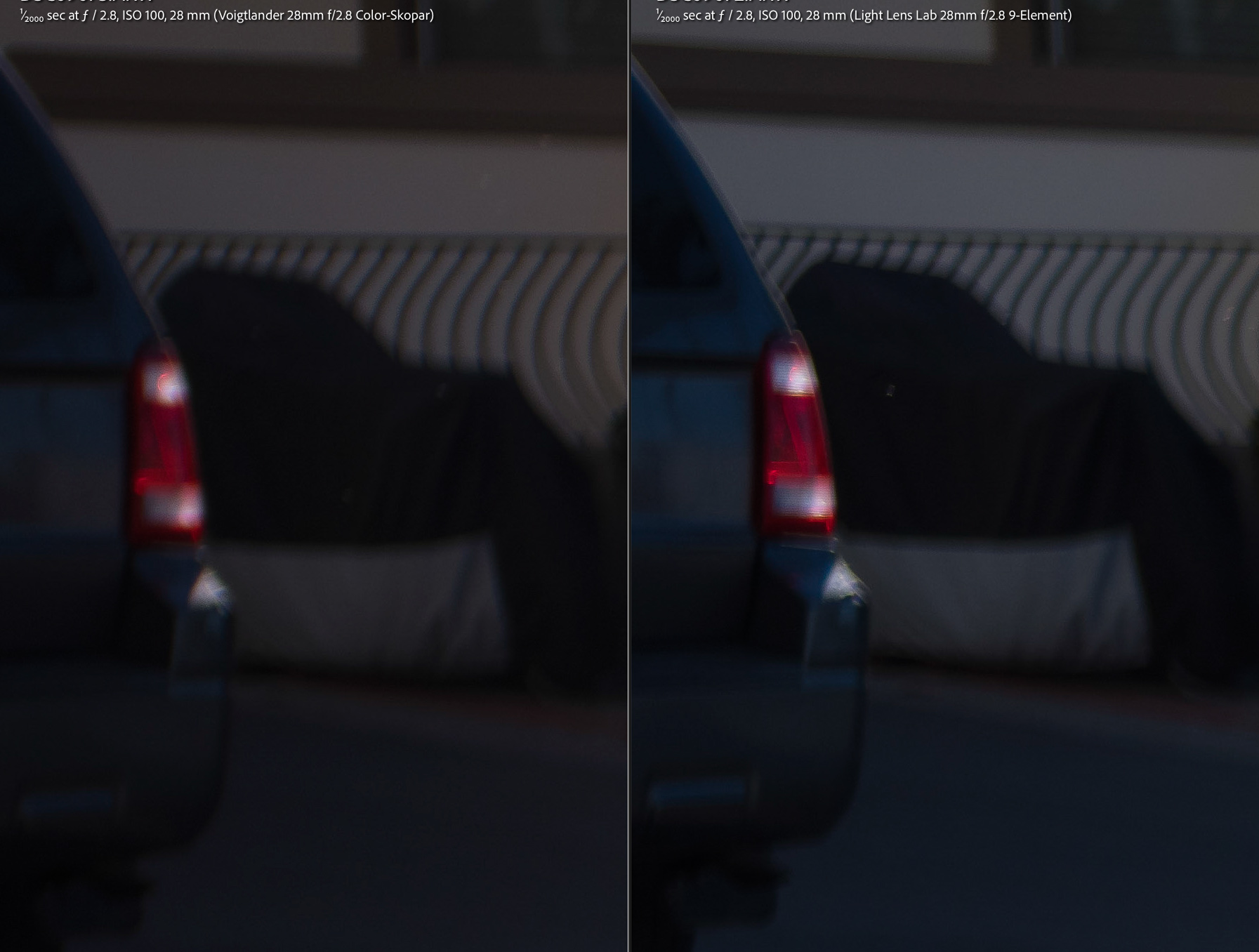
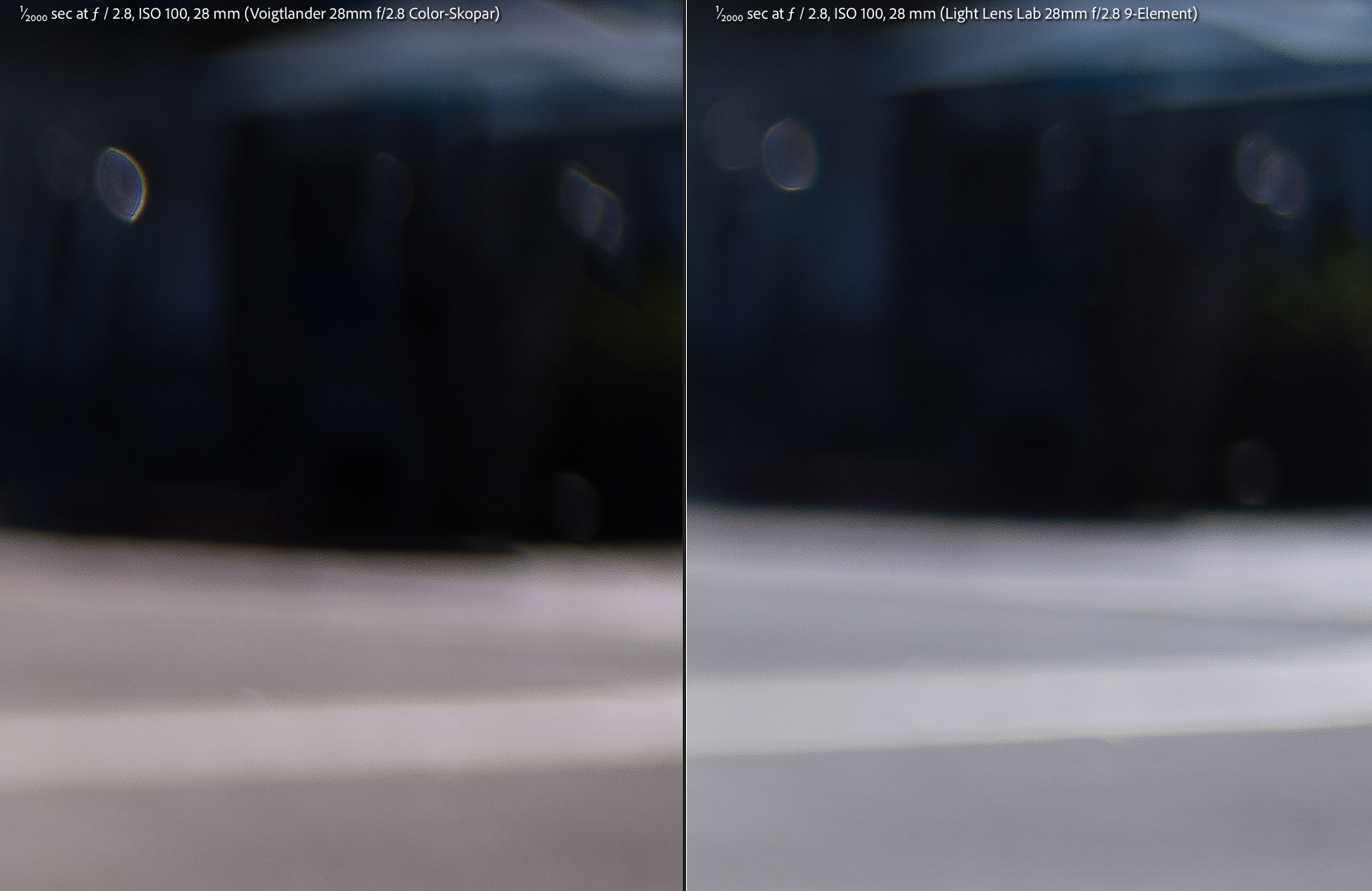
This section shows higher optical vignetting (cats-eye shape) specular highlights off-axis for the Voigtander.


Nov 23, 2024 at 03:04 PM
Fred Miranda
Offline
Admin
Upload & Sell: On
p.1 #9 · Light Lens Lab 28mm f/2.8 9-Element Review


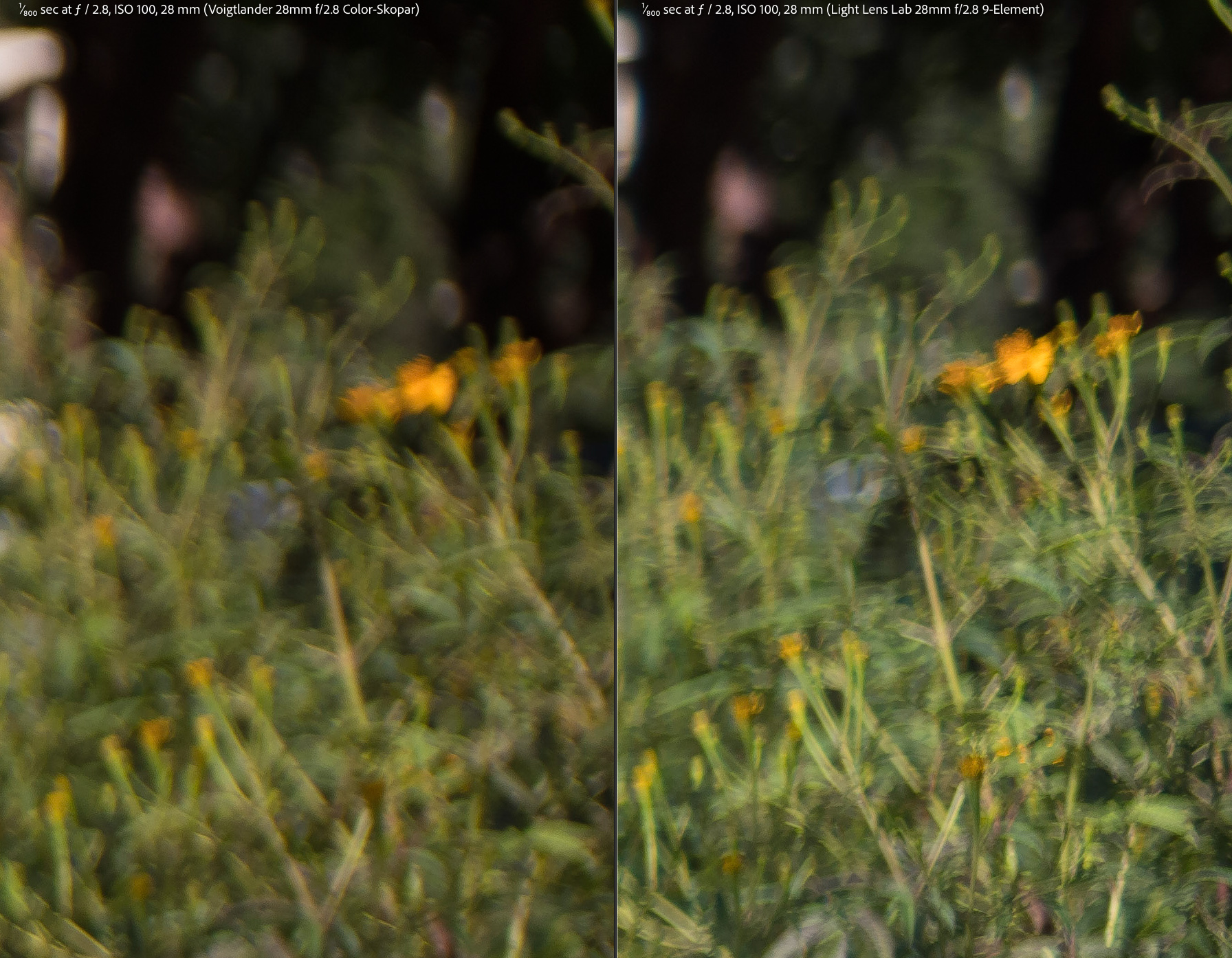
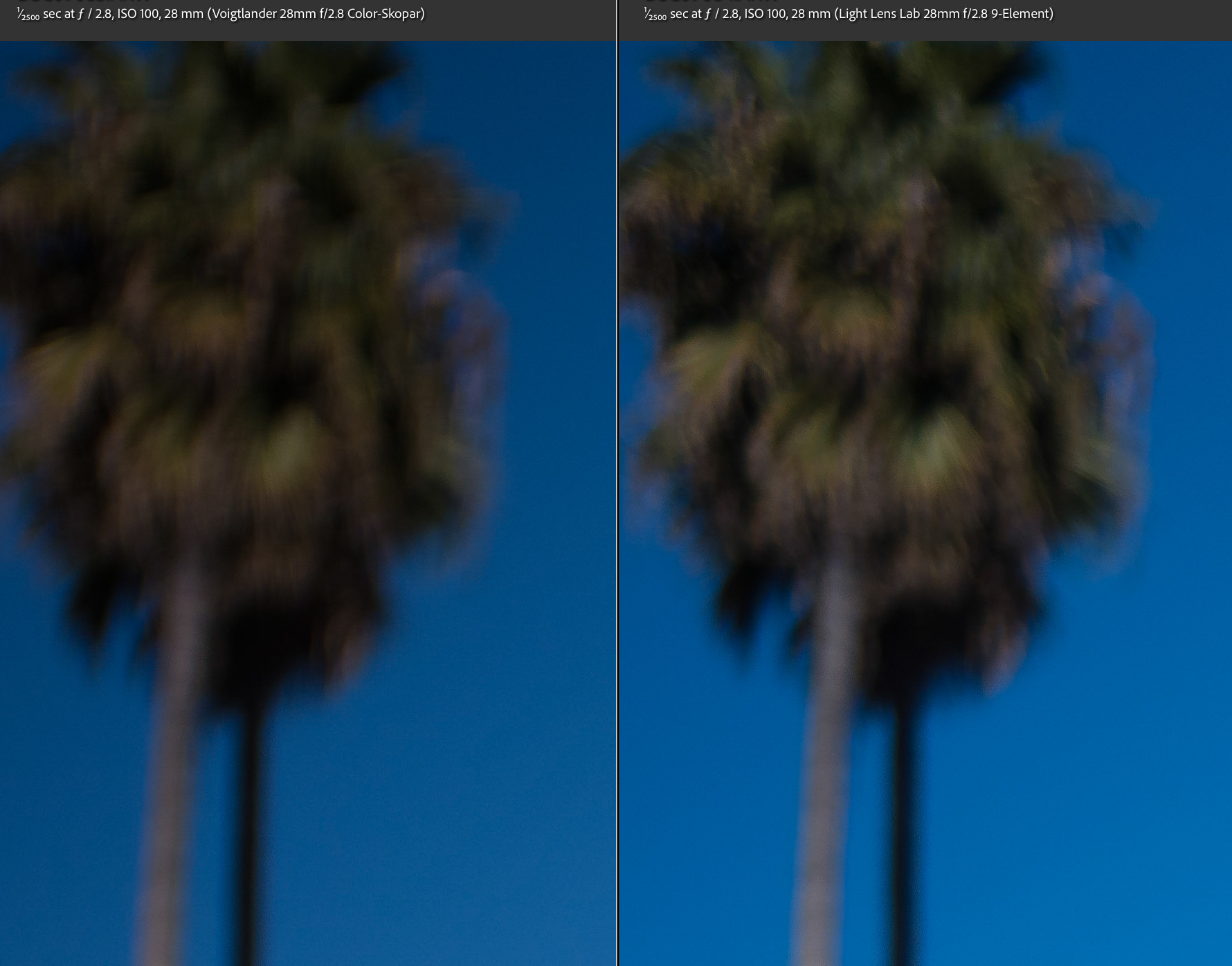
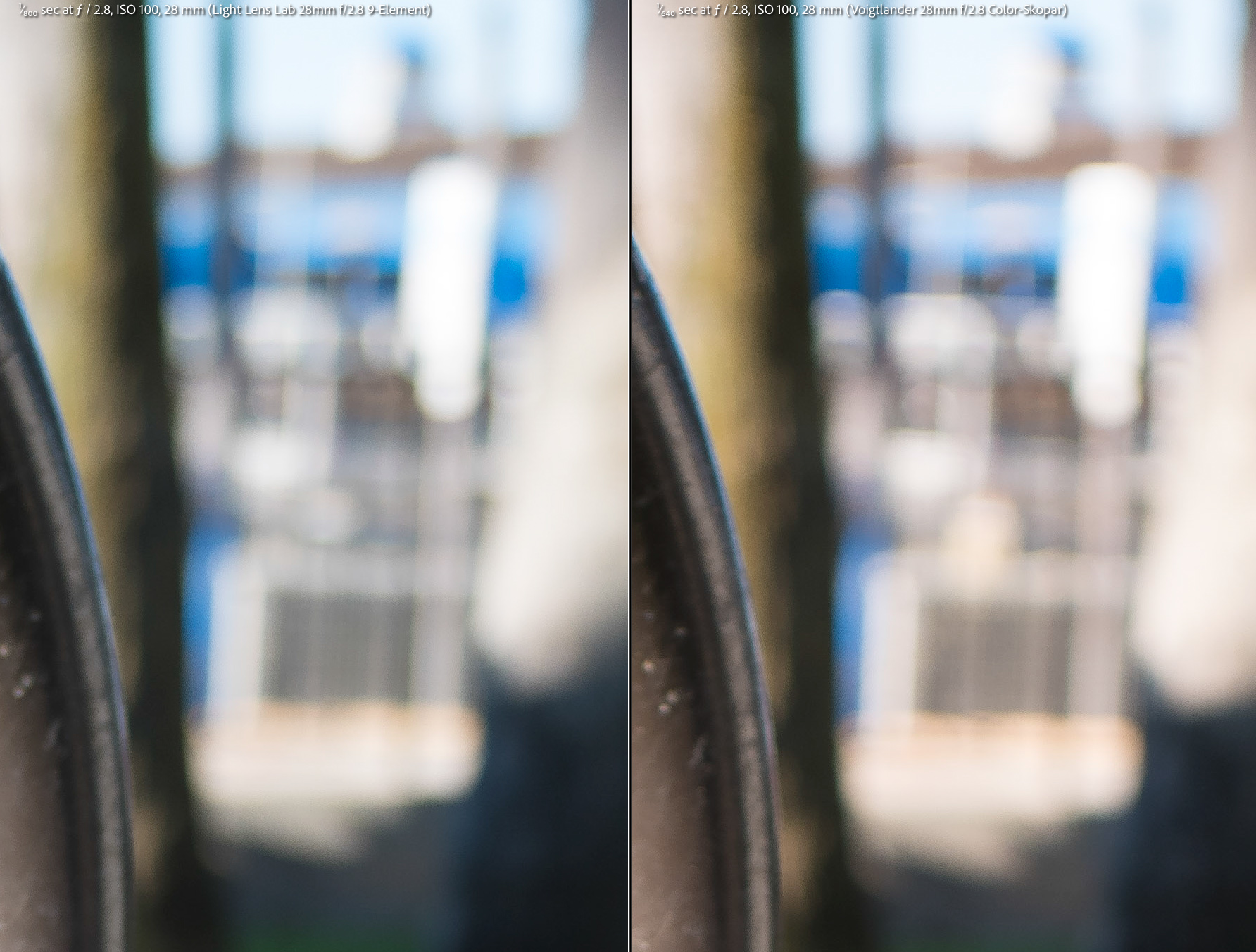
Sample 5:


Voigtlander (TOP), LLL (BOTTOM)


100% magnification (pixel level) displaying the focused area.


Nov 23, 2024 at 03:05 PM
Fred Miranda
Offline
Admin
Upload & Sell: On
p.1 #10 · Light Lens Lab 28mm f/2.8 9-Element Review


Sample 6:


LLL (TOP), Voigtlander (BOTTOM)


100% magnification (pixel level) displaying the focused area.


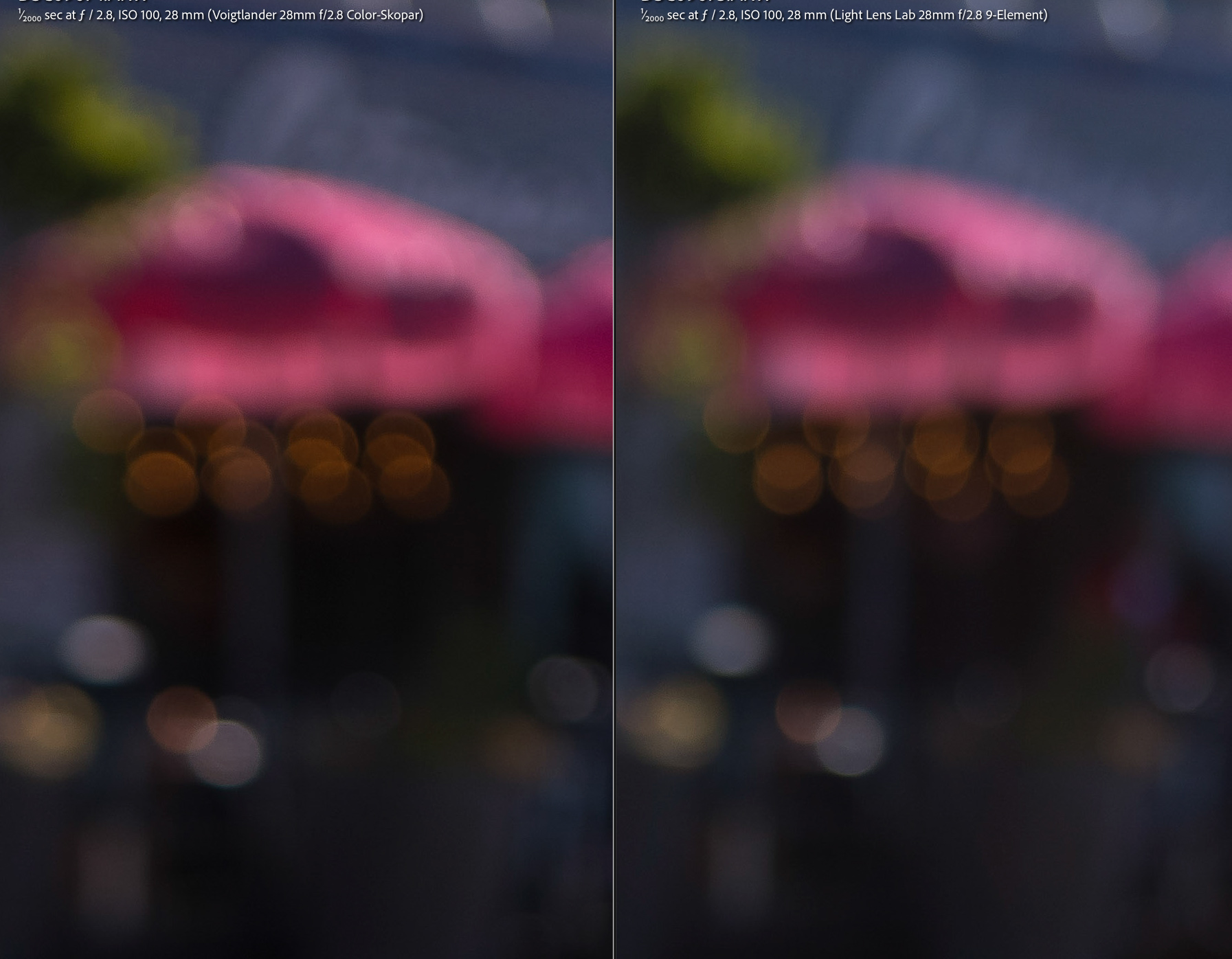
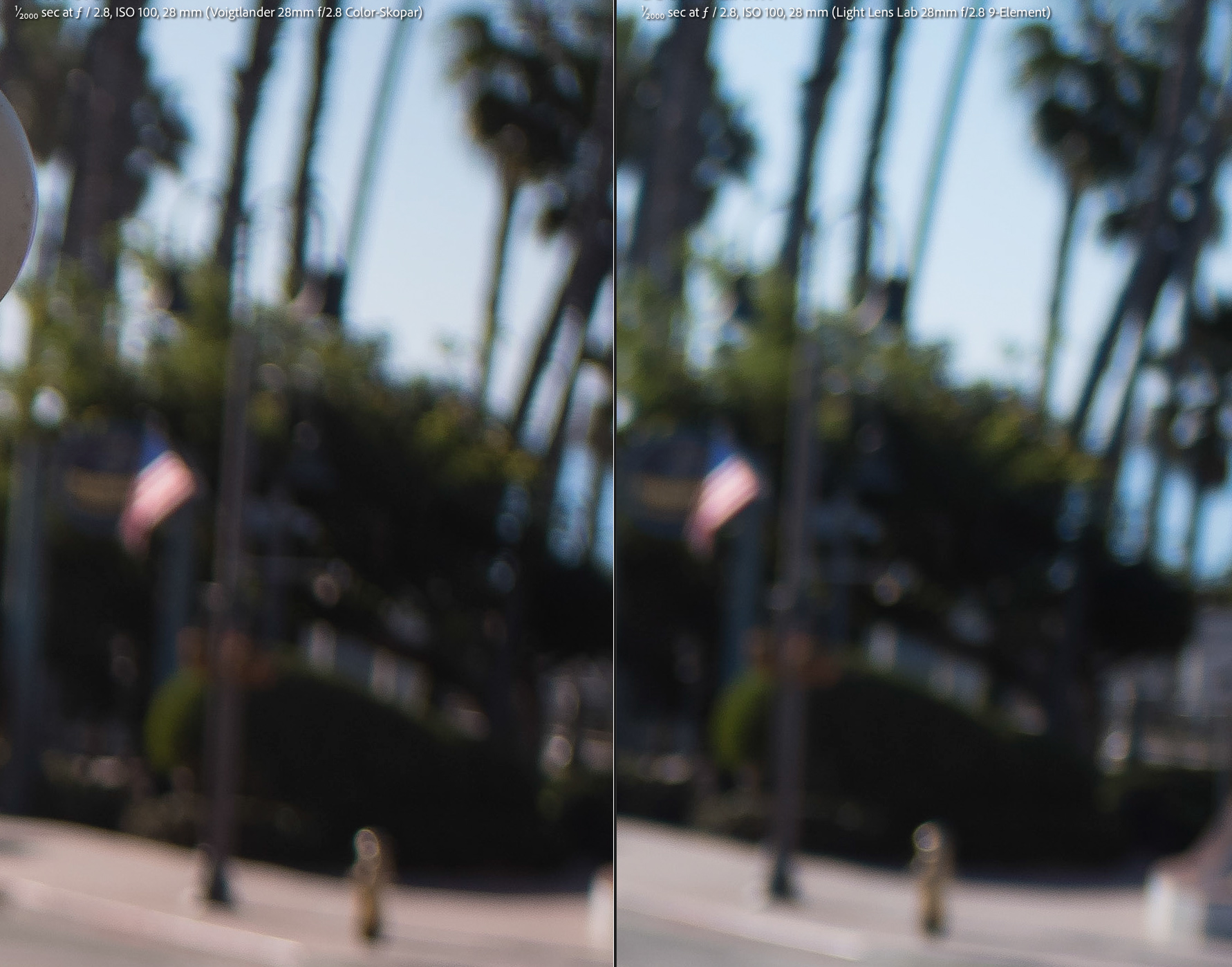
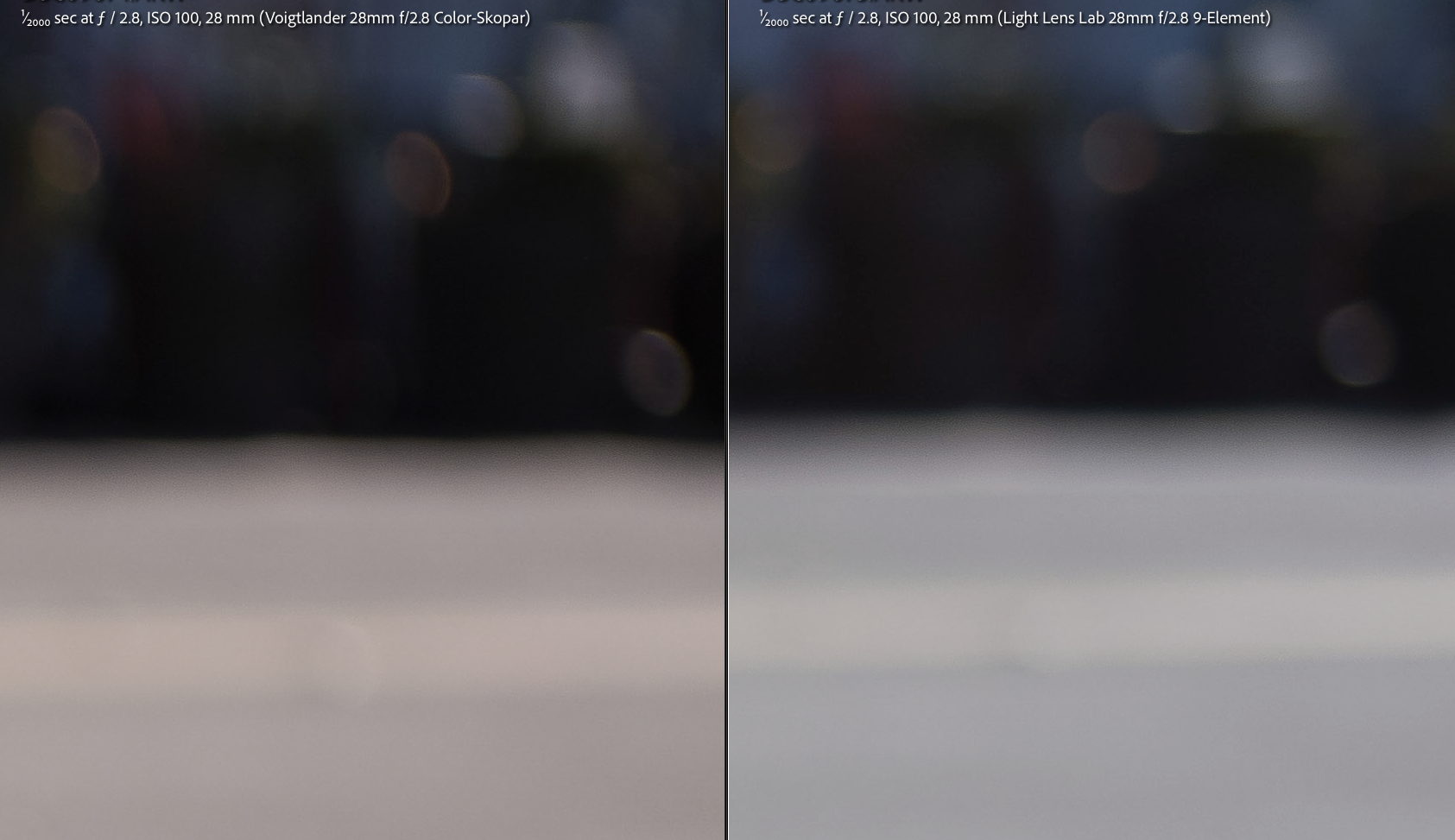
The Voigtlander has more optical vignetting, resulting in less rounded bokeh (specular highlights). On the other hand, the LLL lens has more rounded and cleaner inner structure in the specular highlights, likely due to the absence of aspherical elements.


Nov 23, 2024 at 03:06 PM


Search in Used Dept. 

Fred Miranda
Offline
Admin
Upload & Sell: On
p.1 #11 · Light Lens Lab 28mm f/2.8 9-Element Review


Sample 7:


Voigtlander (TOP), LLL (BOTTOM)


100% magnification (pixel level) displaying the focused area.


Nov 23, 2024 at 03:07 PM
rscheffler
Offline
• • • • • •
Upload & Sell: Off
p.1 #12 · Light Lens Lab 28mm f/2.8 9-Element Review


Fred, are you using the same WB for both lenses? The LLL is clearly cooler, to the point where it's pretty easy to pick it out in the comparison images. Cooler WB is also a trait of my LLL 35 8-element compared to all of my modern lenses.

But impressive sharpness performance from the LLL 28!


Nov 23, 2024 at 04:36 PM
Fred Miranda
Offline
Admin
Upload & Sell: On
p.1 #13 · Light Lens Lab 28mm f/2.8 9-Element Review


rscheffler wrote:
Fred, are you using the same WB for both lenses? The LLL is clearly cooler, to the point where it's pretty easy to pick it out in the comparison images. Cooler WB is also a trait of my LLL 35 8-element compared to all of my modern lenses.

But impressive sharpness performance from the LLL 28!


Hi Ron,
Yes, this is daylight WB for all samples with no adjustments in post. I wanted to highlight how much cooler the LLL renders the images.

I agree the LLL 28/2.8 performs admirably. At least the added heft and size are good for something!


Nov 23, 2024 at 04:43 PM
Fred Miranda
Offline
Admin
Upload & Sell: On
p.1 #14 · Light Lens Lab 28mm f/2.8 9-Element Review


Back to Quick Links

Field Curvature

As shown in the sample images from the rendering test, the Light Lens Lab 28mm f/2.8 9E exhibits a noticeable outward field curvature that extends from its closest focus distance to the mid-range. Beyond that, the field flattens as it approaches infinity, but the curvature remains slightly outward. In contrast, the Voigtlander lens features a more neutral field curvature that leans inward. This difference in curvature significantly impacts the overall rendering, as demonstrated in our comparison.

Here’s a GIF animation showing the focus transition from close distance to infinity in four stages, starting with the Light Lens Lab and followed by the Voigtlander.


Nov 23, 2024 at 04:58 PM
Fred Miranda
Offline
Admin
Upload & Sell: On
p.1 #15 · Light Lens Lab 28mm f/2.8 9-Element Review


Back to Quick Links

Distortion

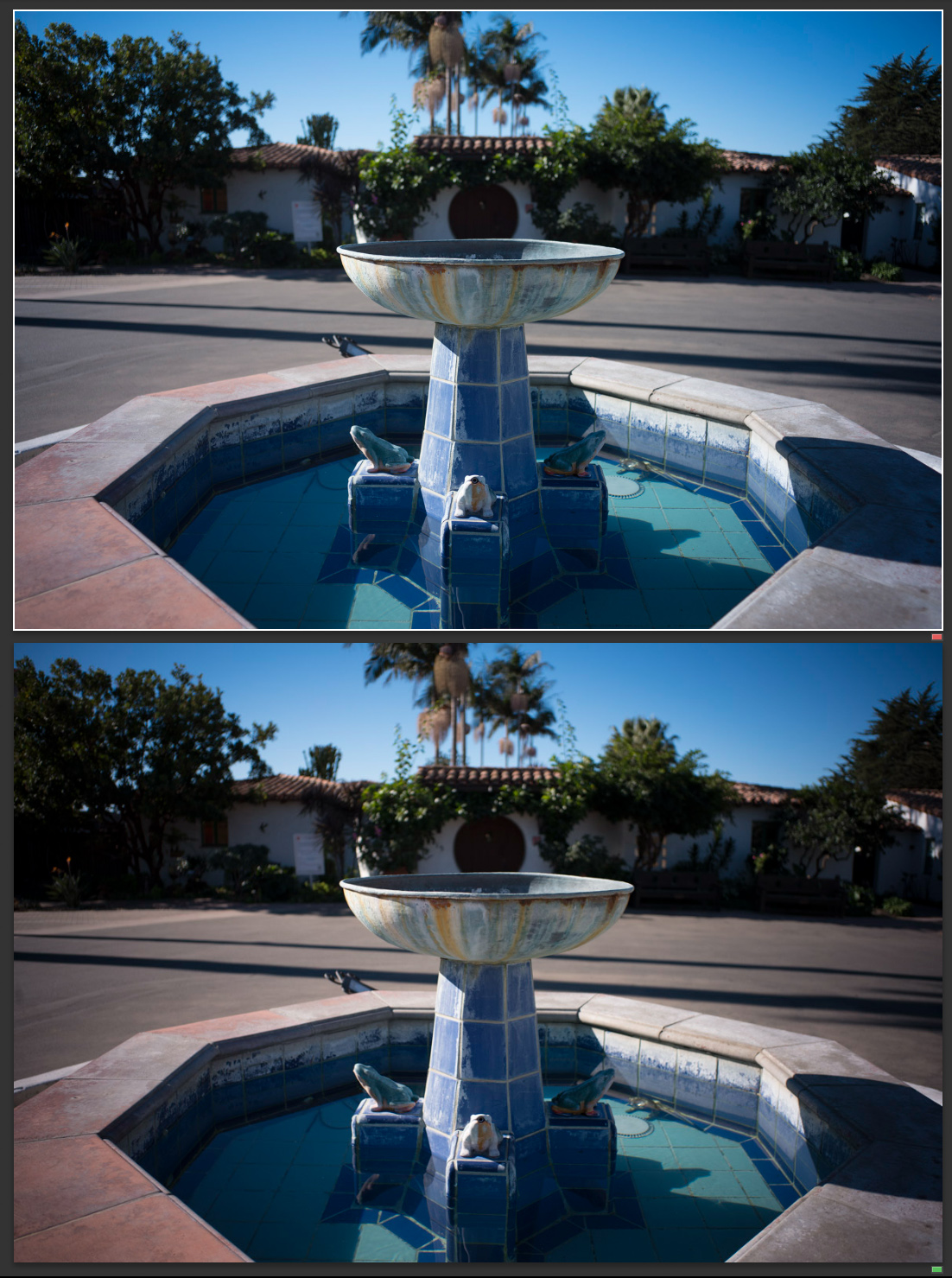
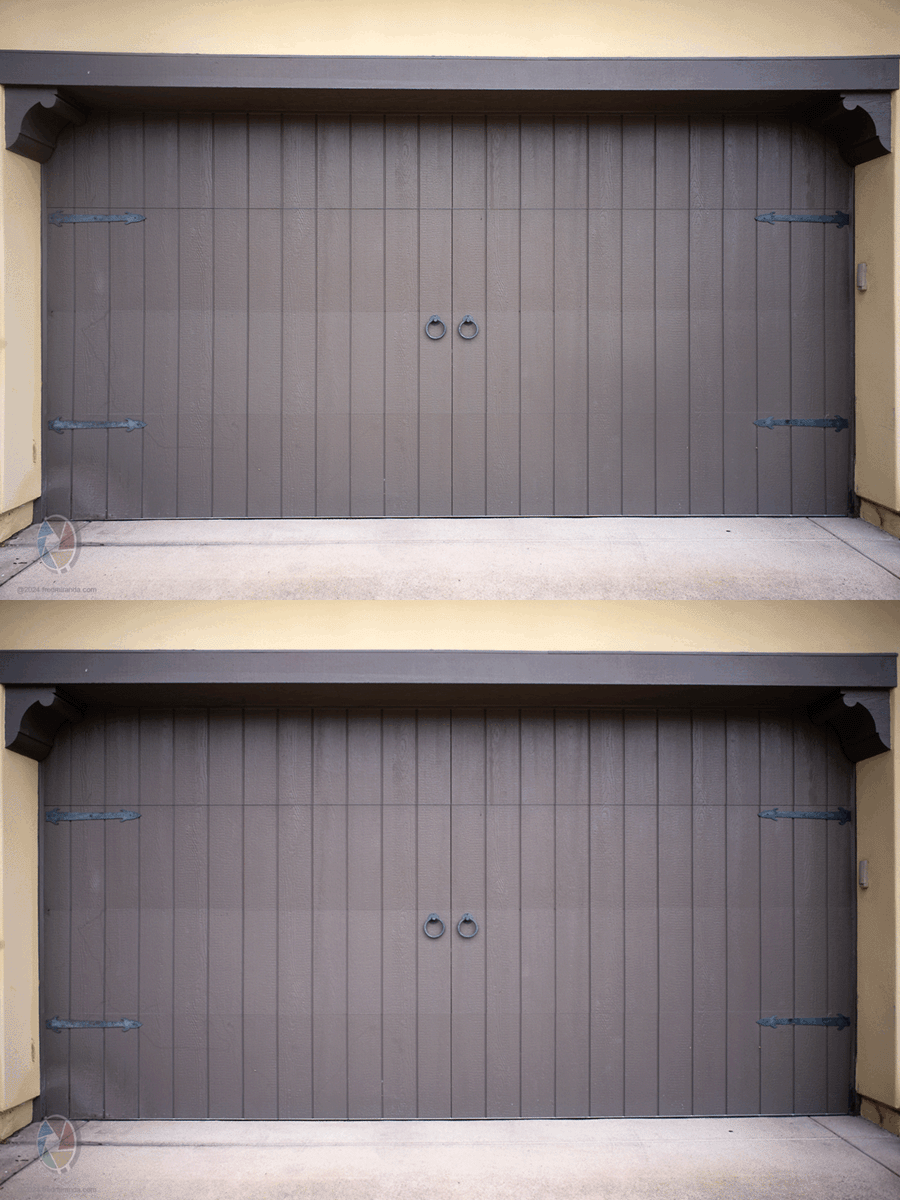
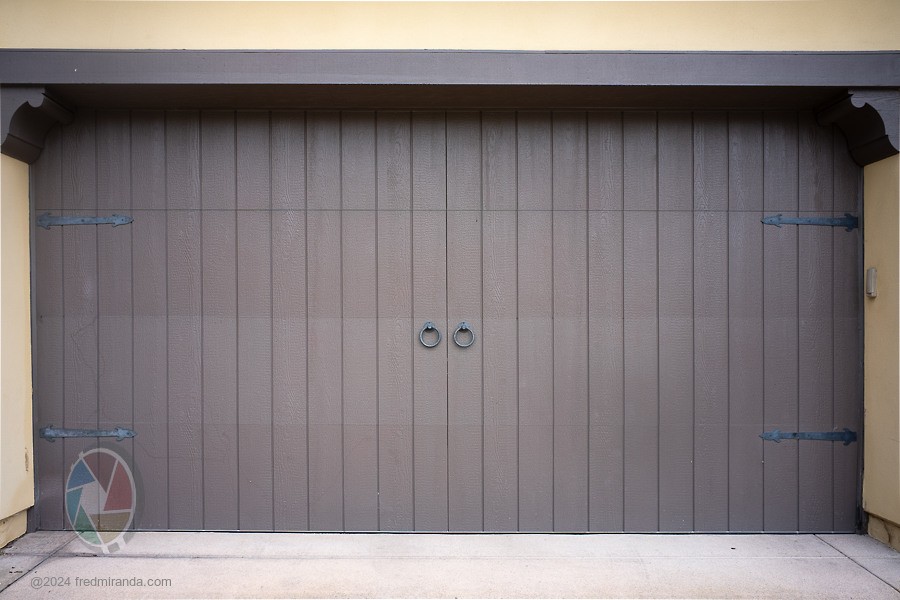
I've noticed quite a bit of distortion in the rendering comparisons. The Light Lens Lab 28mm f/2.8 9E has some noticeable pincushion distortion, whereas the Voigtlander shows minimal distortion.

Here's a quick GIF animation that shows the distortion characteristics of both lenses, starting with the LLL and then the Voigtlander. When editing in Lightroom, I found that a "-6" setting is needed to correct the pincushion distortion for the LLL lens.


Starts with Light Lens Lab 28mm f/2.8 9E followed by Voigtlander 28mm f/2.8.


LLL 28mm f/2.8 9E after distortion correction in post (Lightroom -6 pincushion)


Nov 23, 2024 at 05:18 PM
Fred Miranda
Offline
Admin
Upload & Sell: On
p.1 #16 · Light Lens Lab 28mm f/2.8 9-Element Review


Back to Quick Links

Sunstar Rendering and Flare Resistance

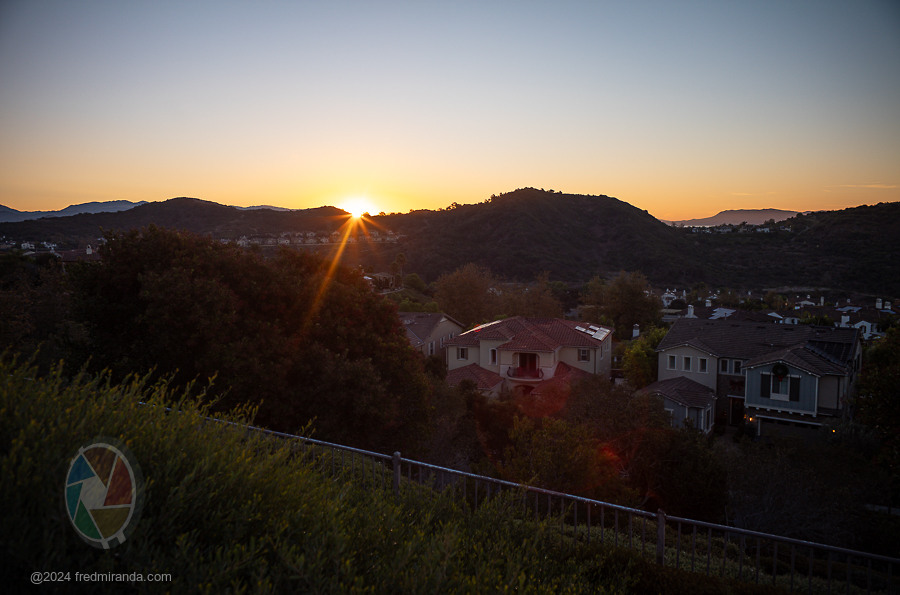
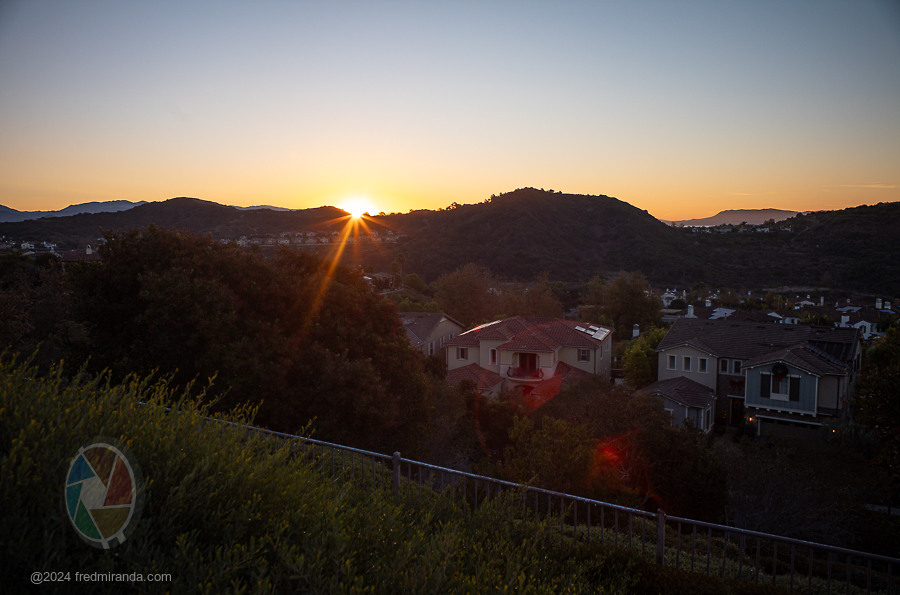
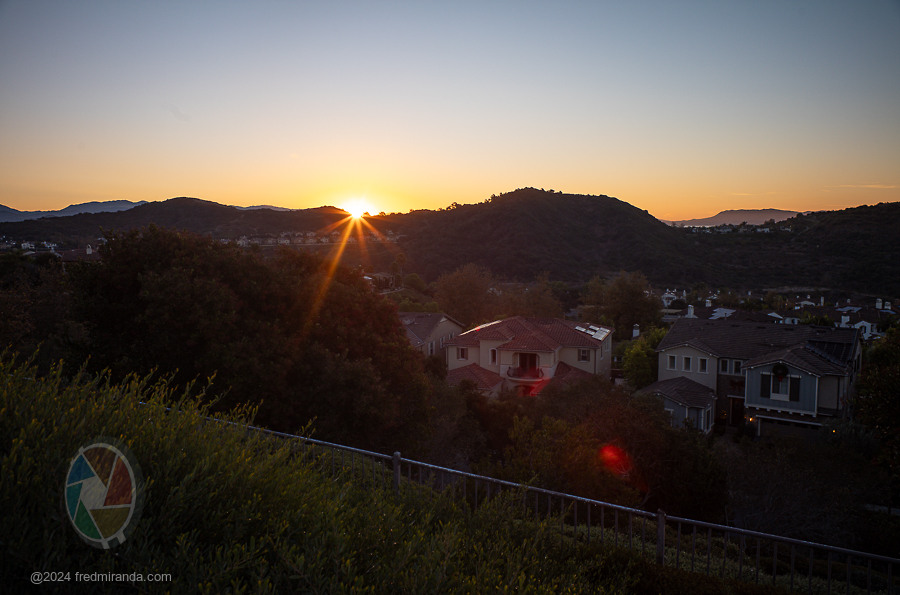
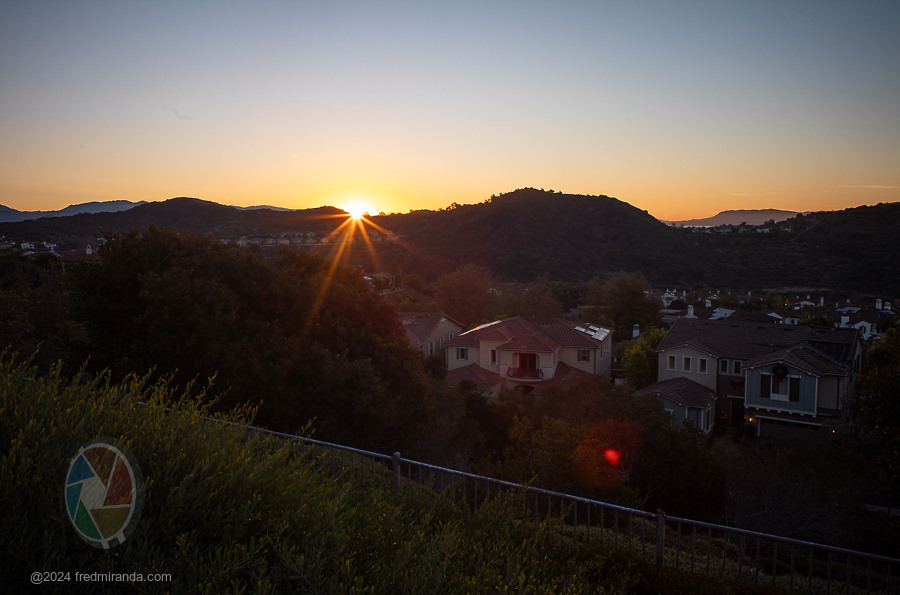
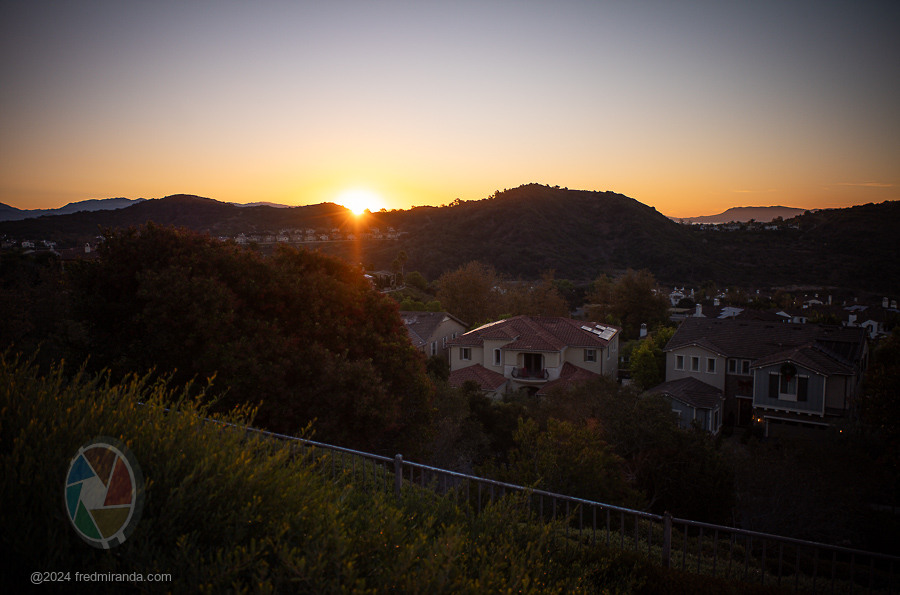
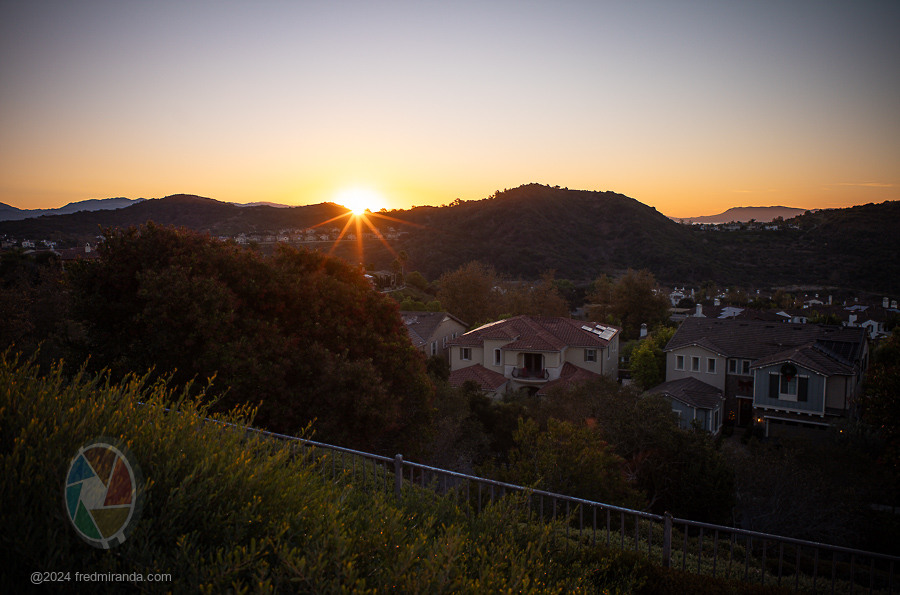
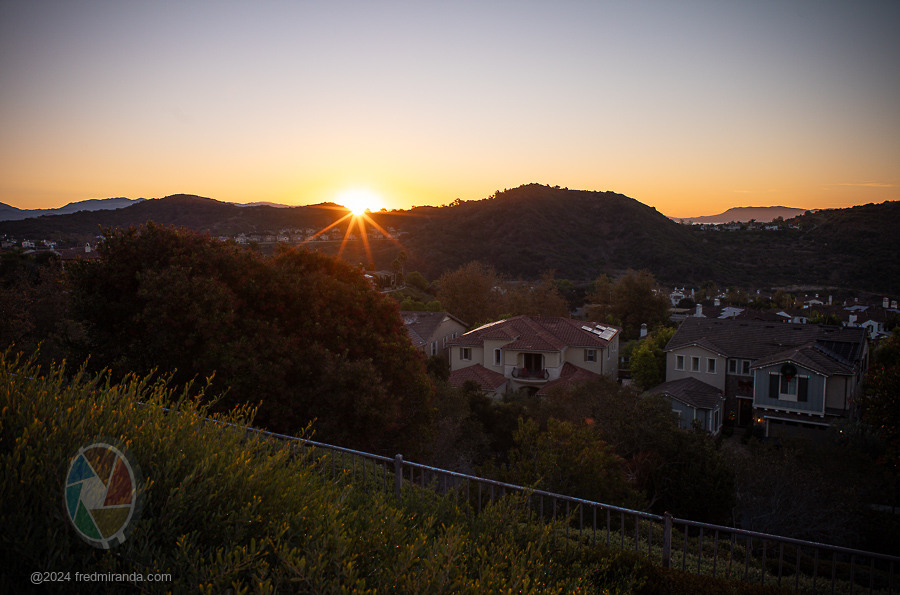
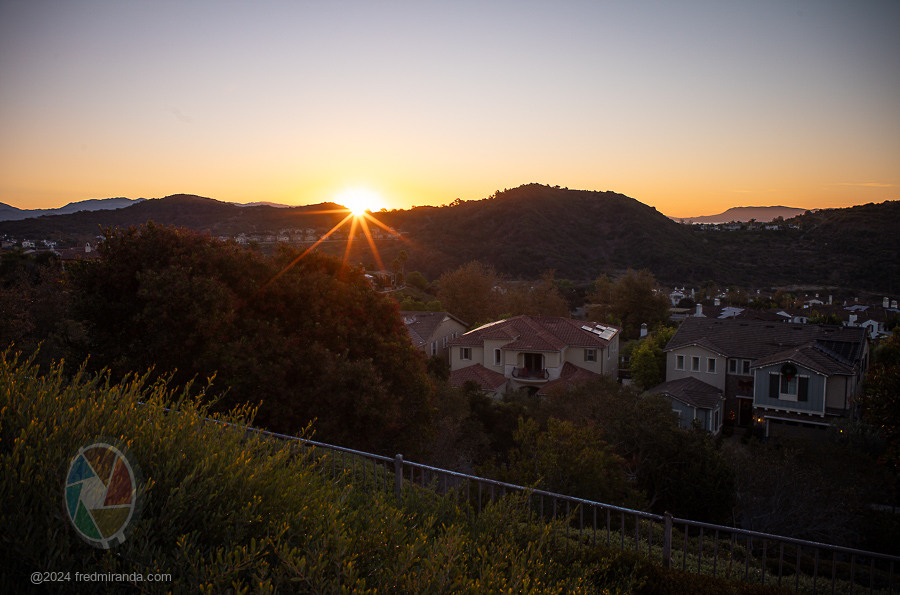
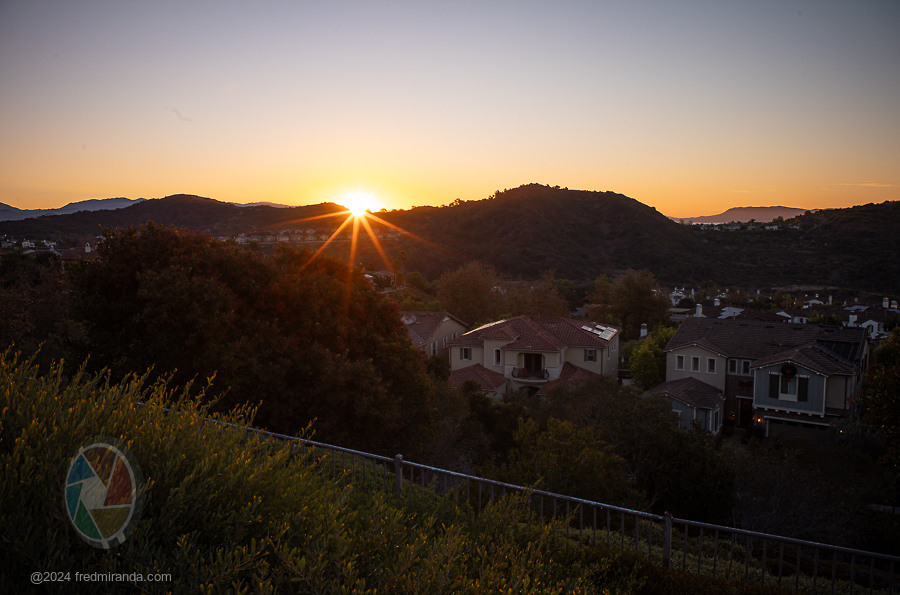
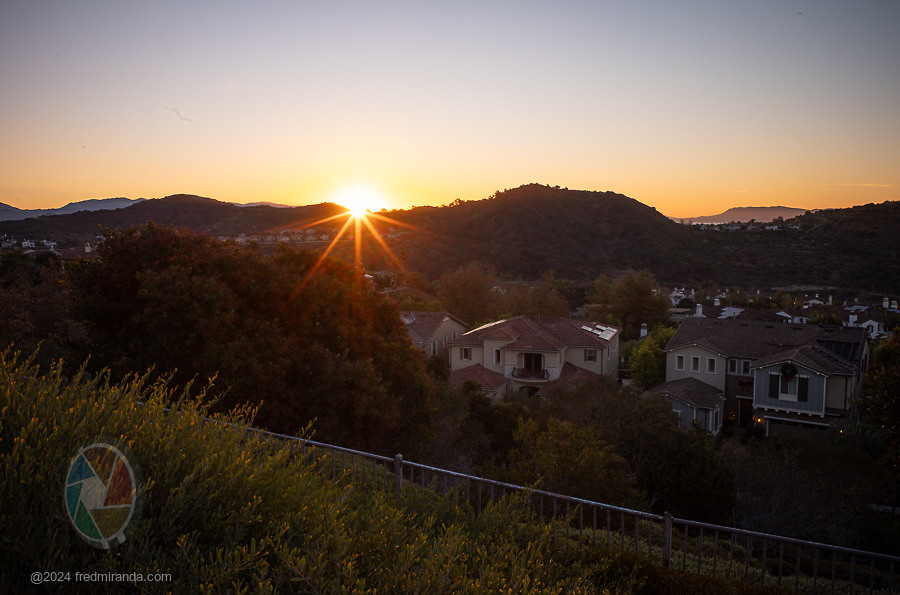
I was a bit disappointed with the sunstar performance of the Light Lens Lab 28mm f/2.8 9-Element. Despite having 10 straight blades intended to produce 10 rays, the rays are not symmetrical, and an inconsistent ray remains even when the lens is stopped down. I ensured my copy’s glass was clean, as fingerprints on the rear and front elements can affect these results. Although the lens can produce defined sunstars, I don’t find their appearance appealing. In contrast, the Voigtlander delivers well-defined, pleasant, and symmetrical sunstars starting at f/4. This test also highlights how both lenses handle flare with the sun in the frame, where the lens hood offers minimal help.

For comparison, I’ve included sunstar examples from the Voigtlander as well.


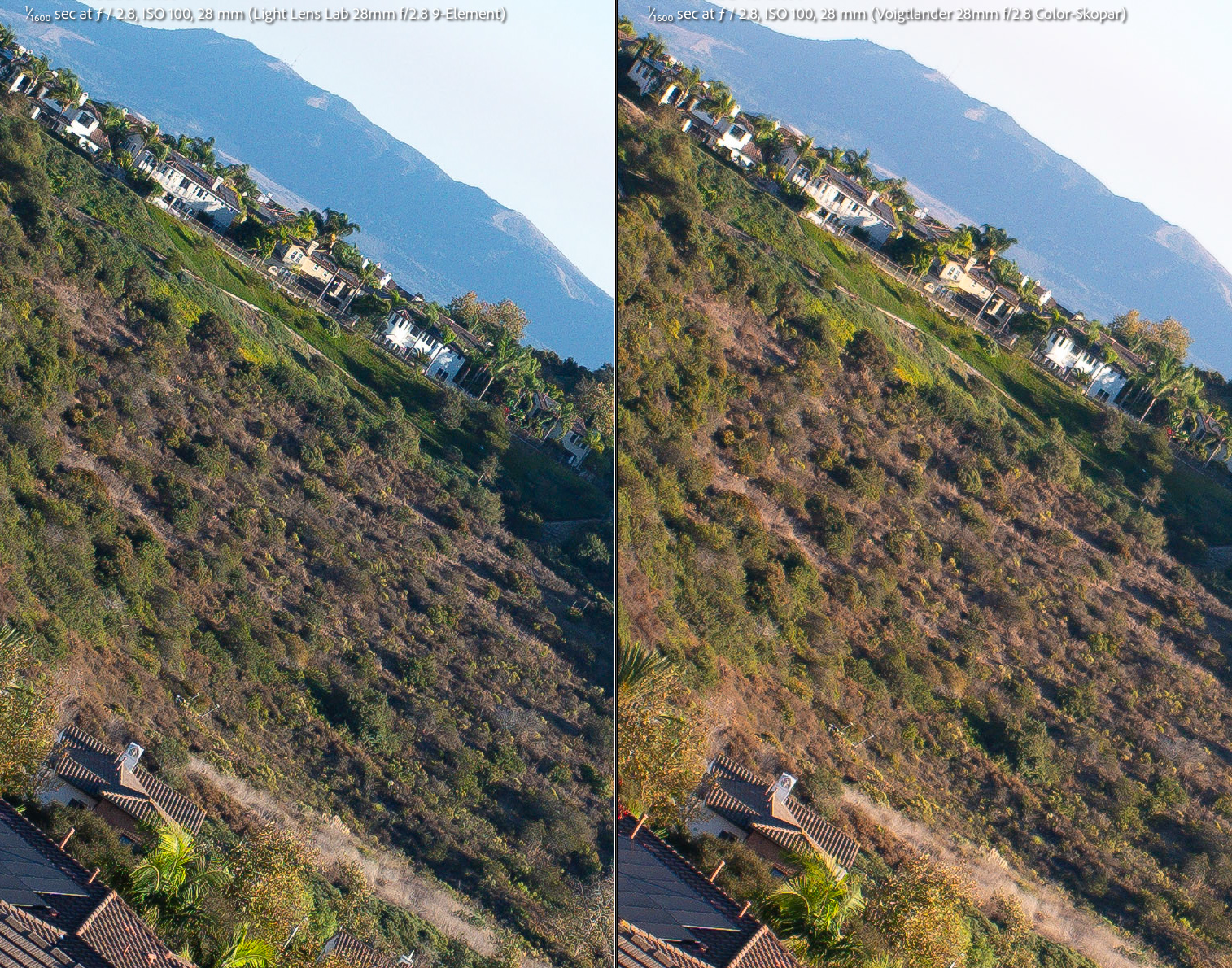
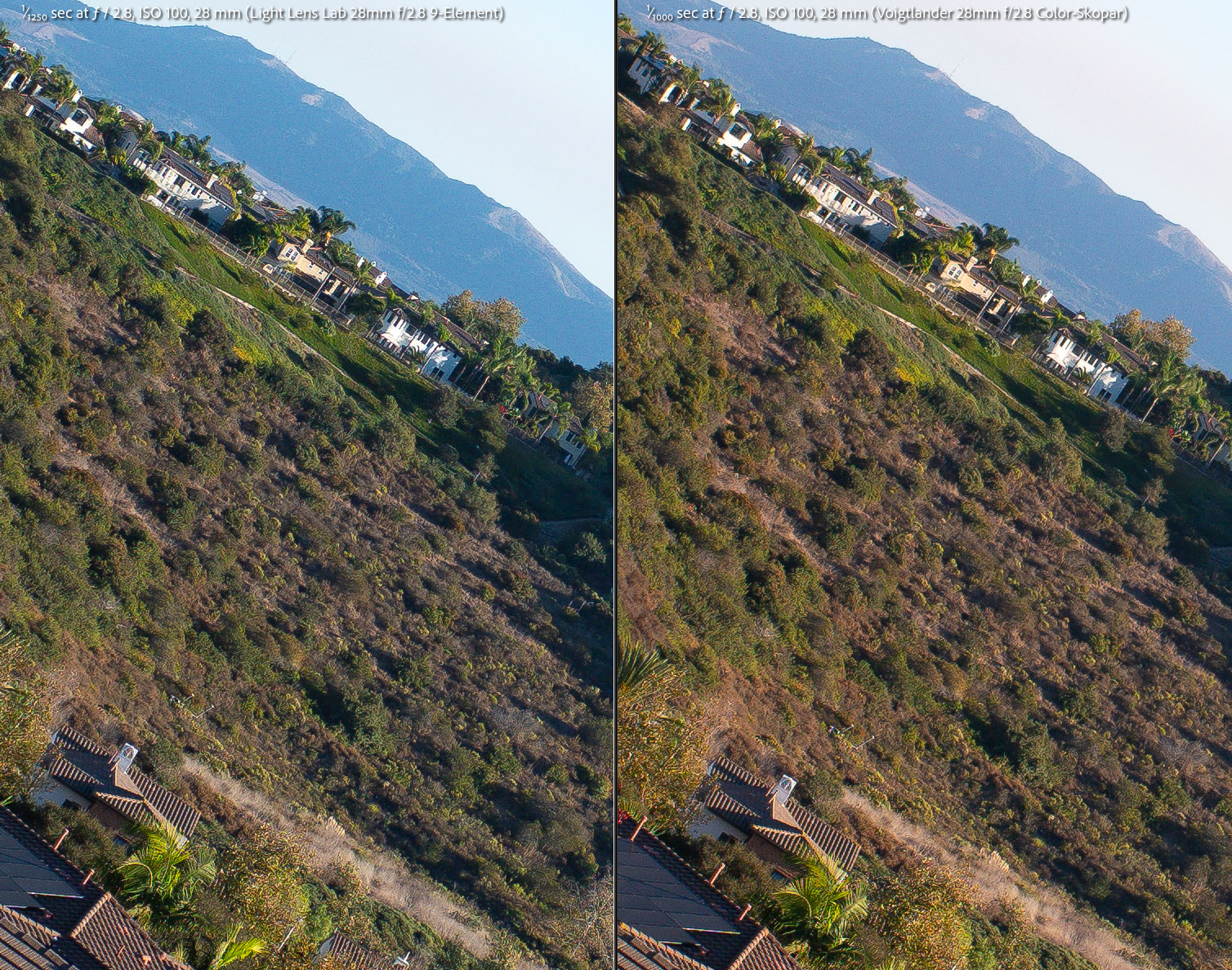
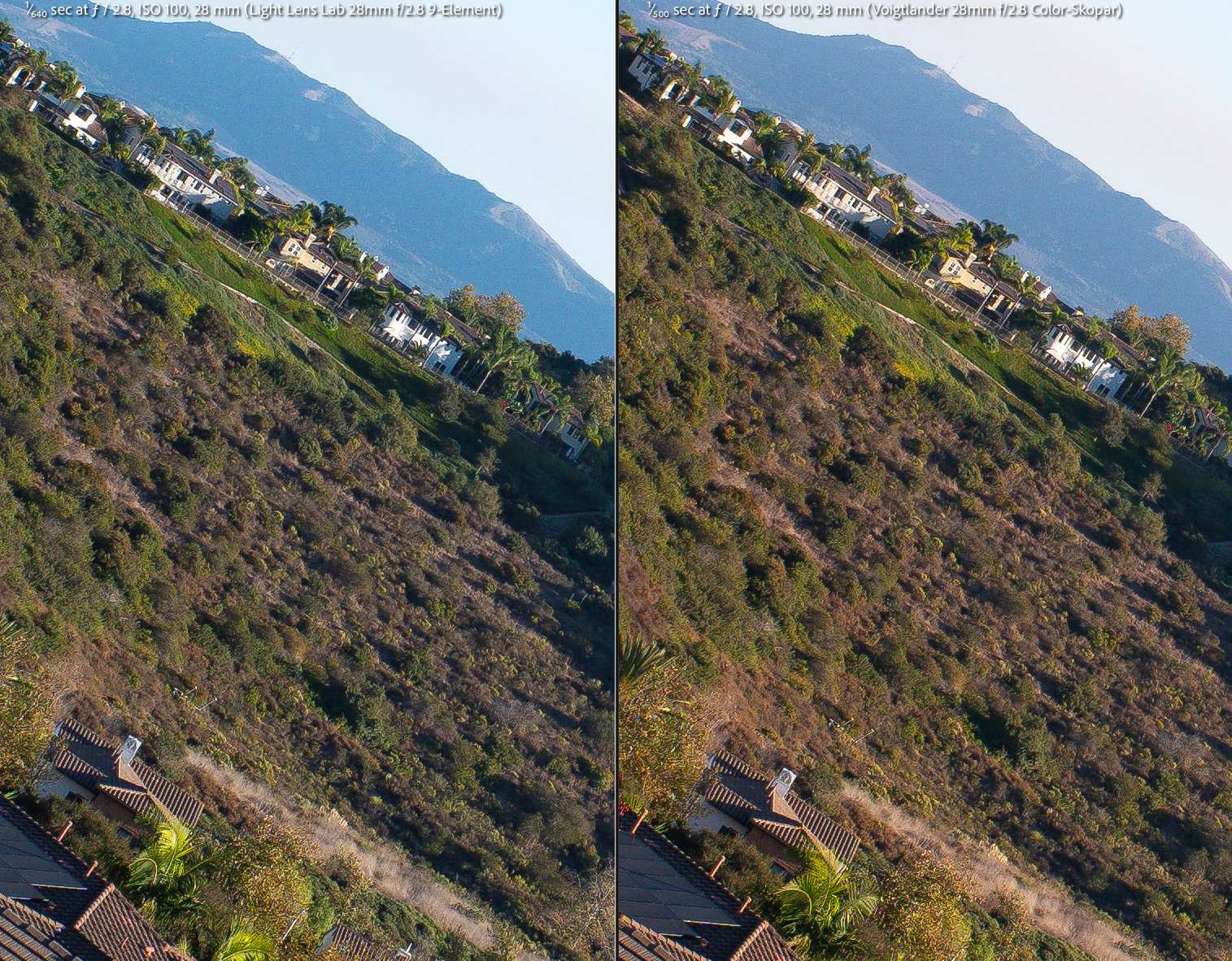
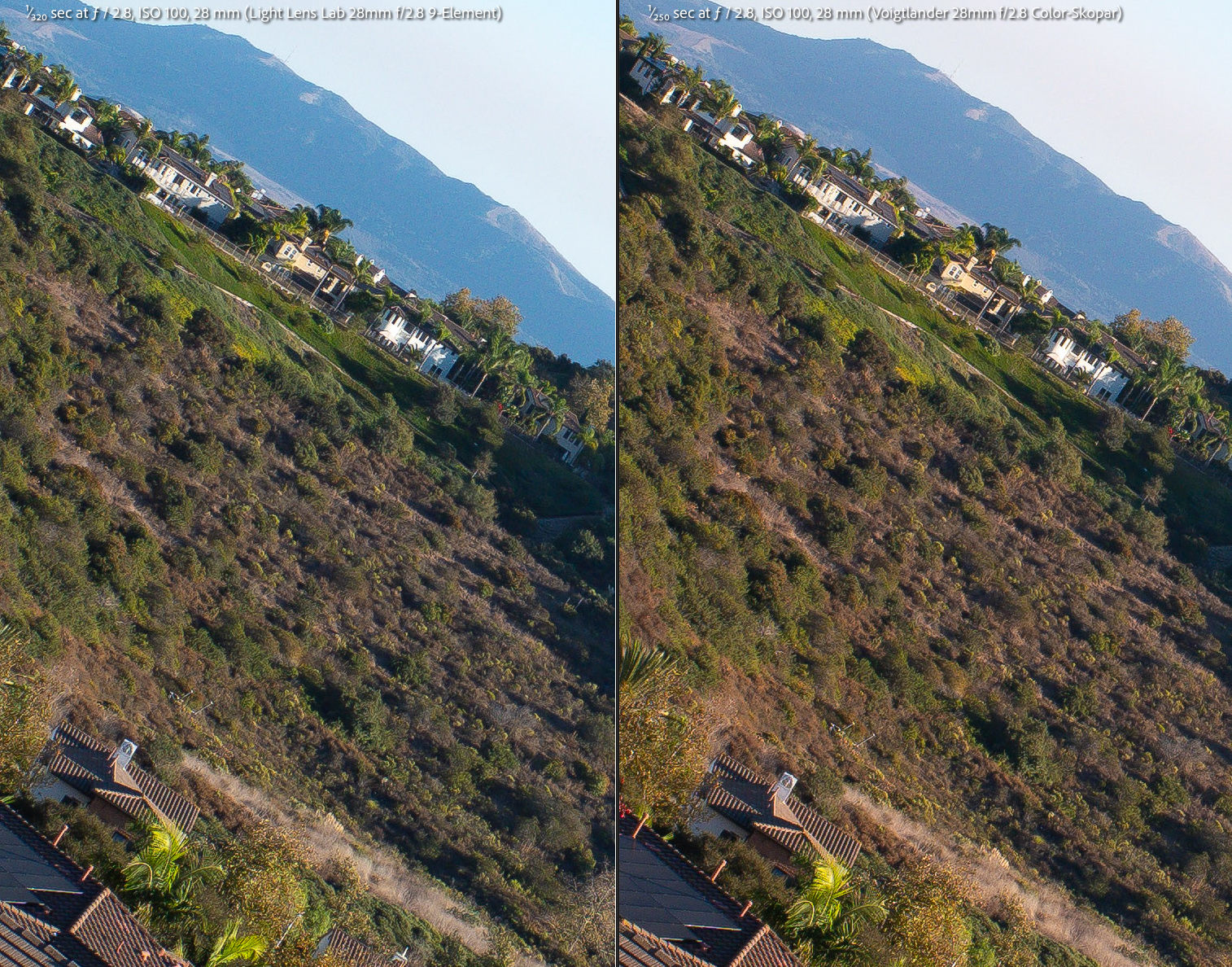
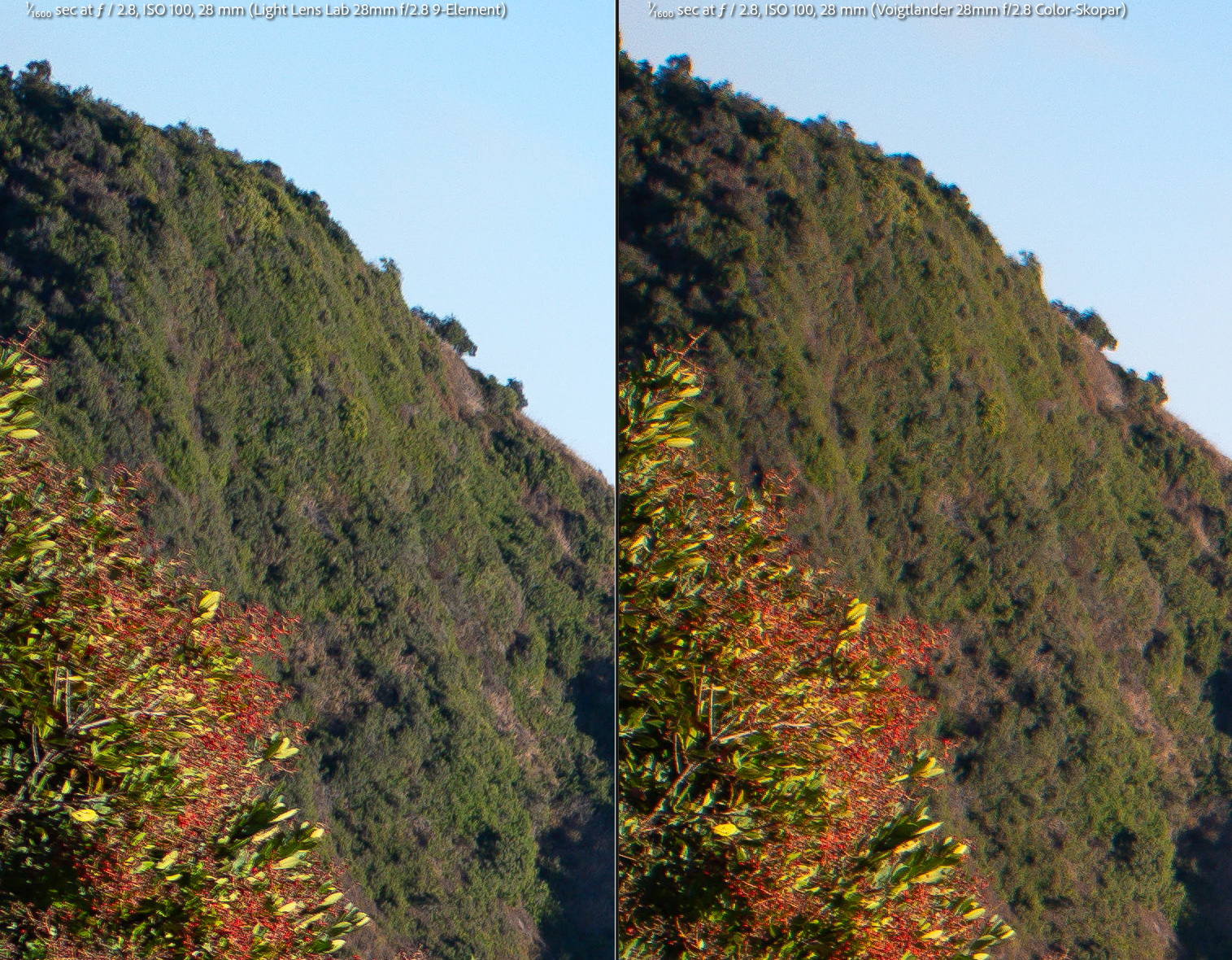
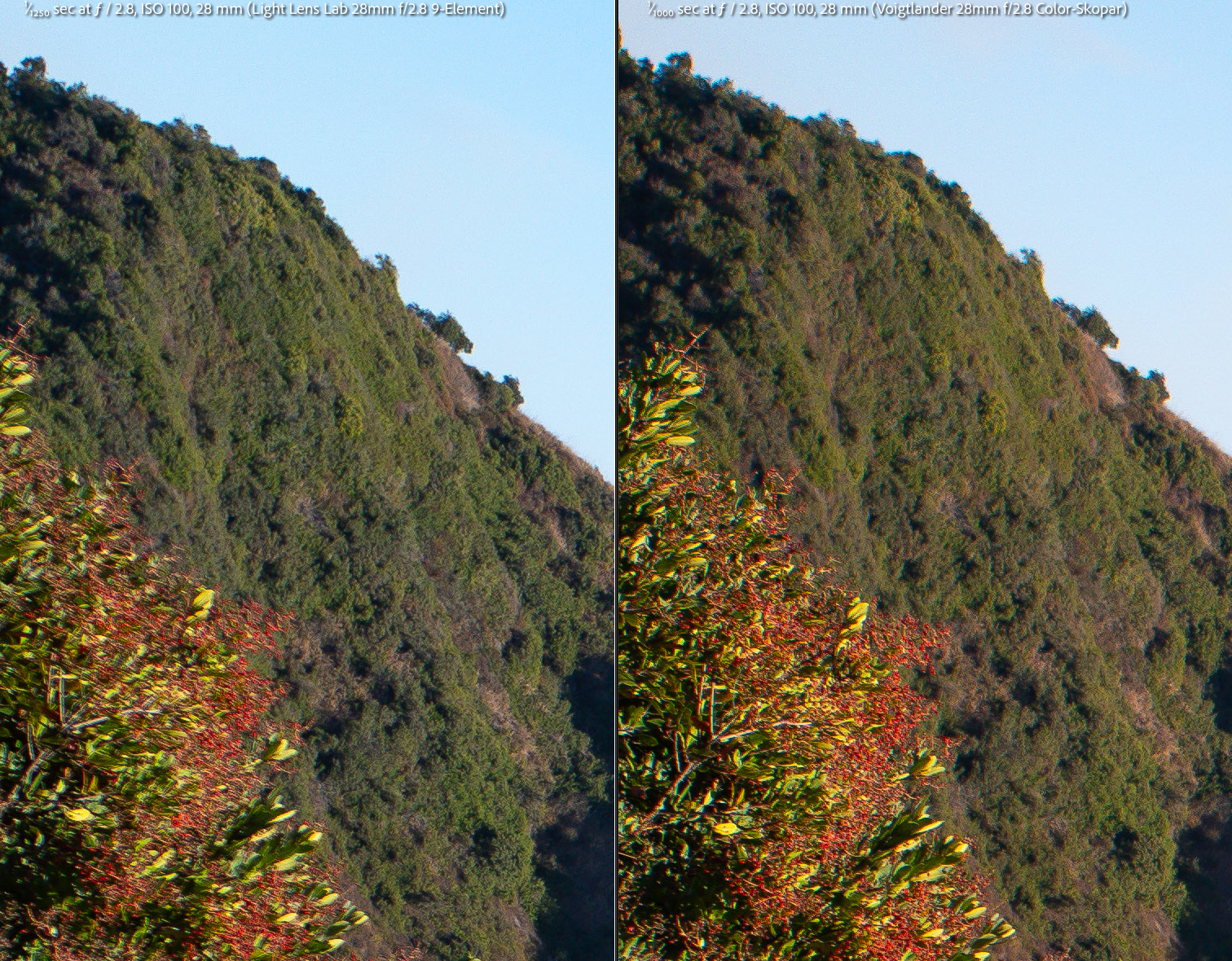
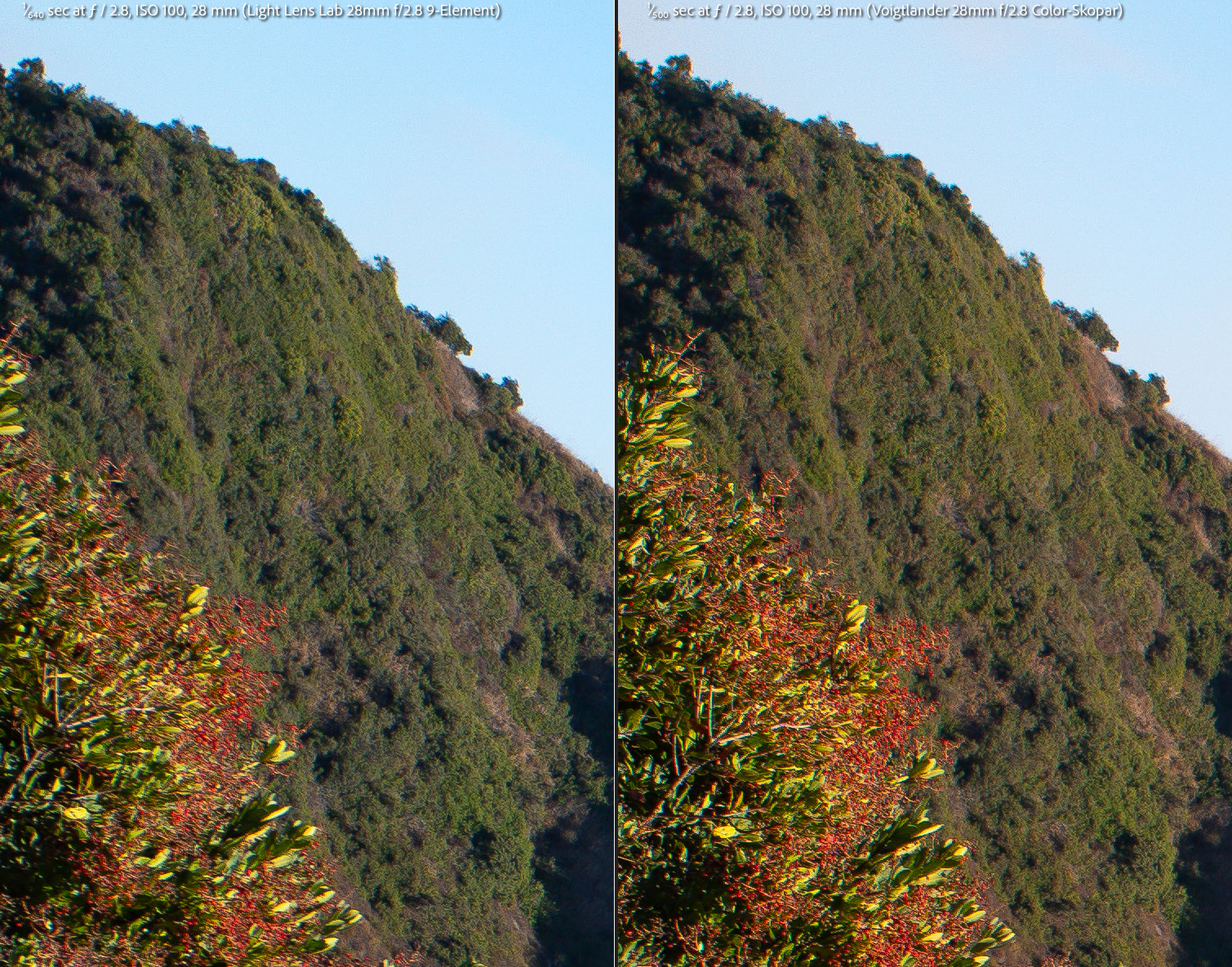
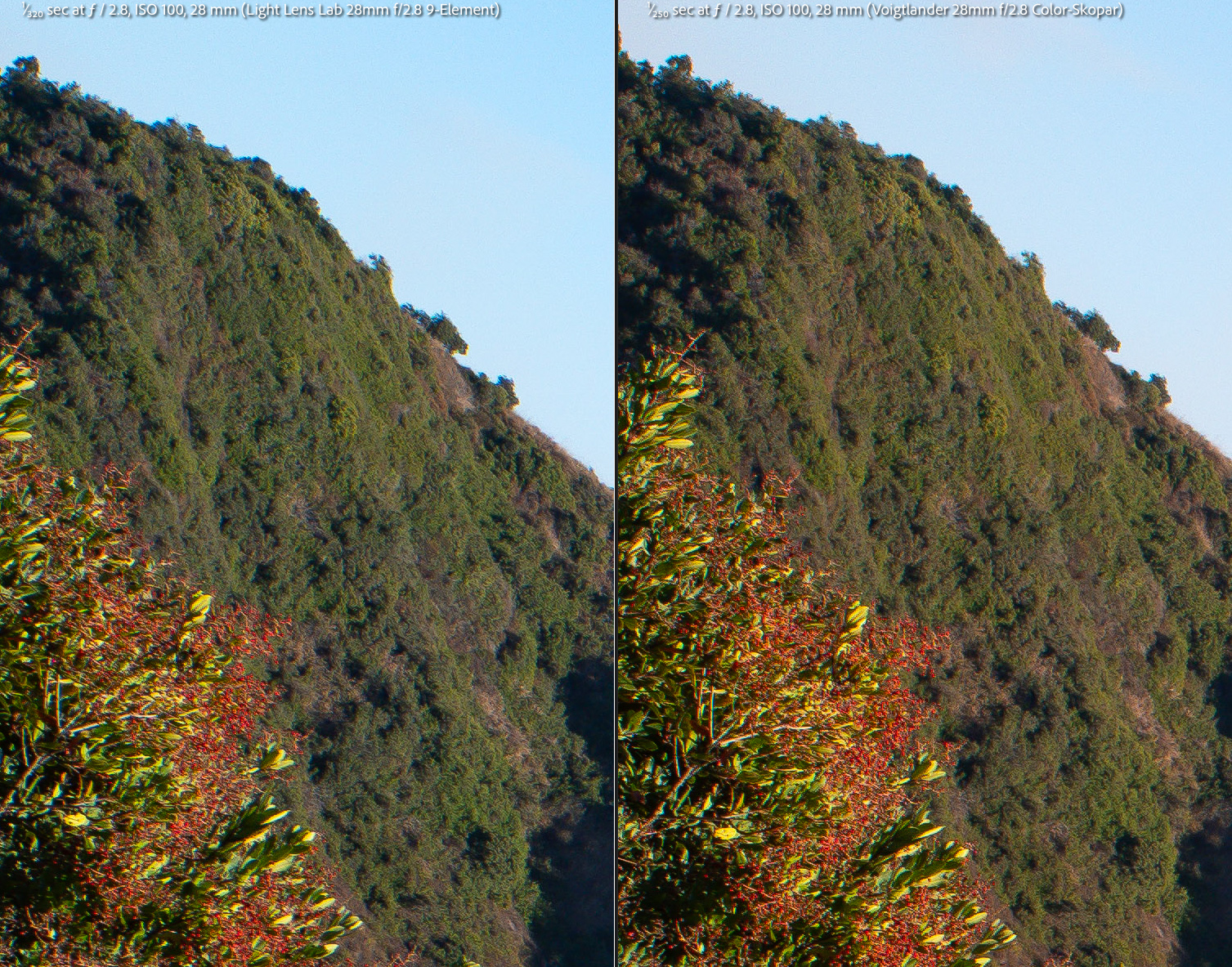
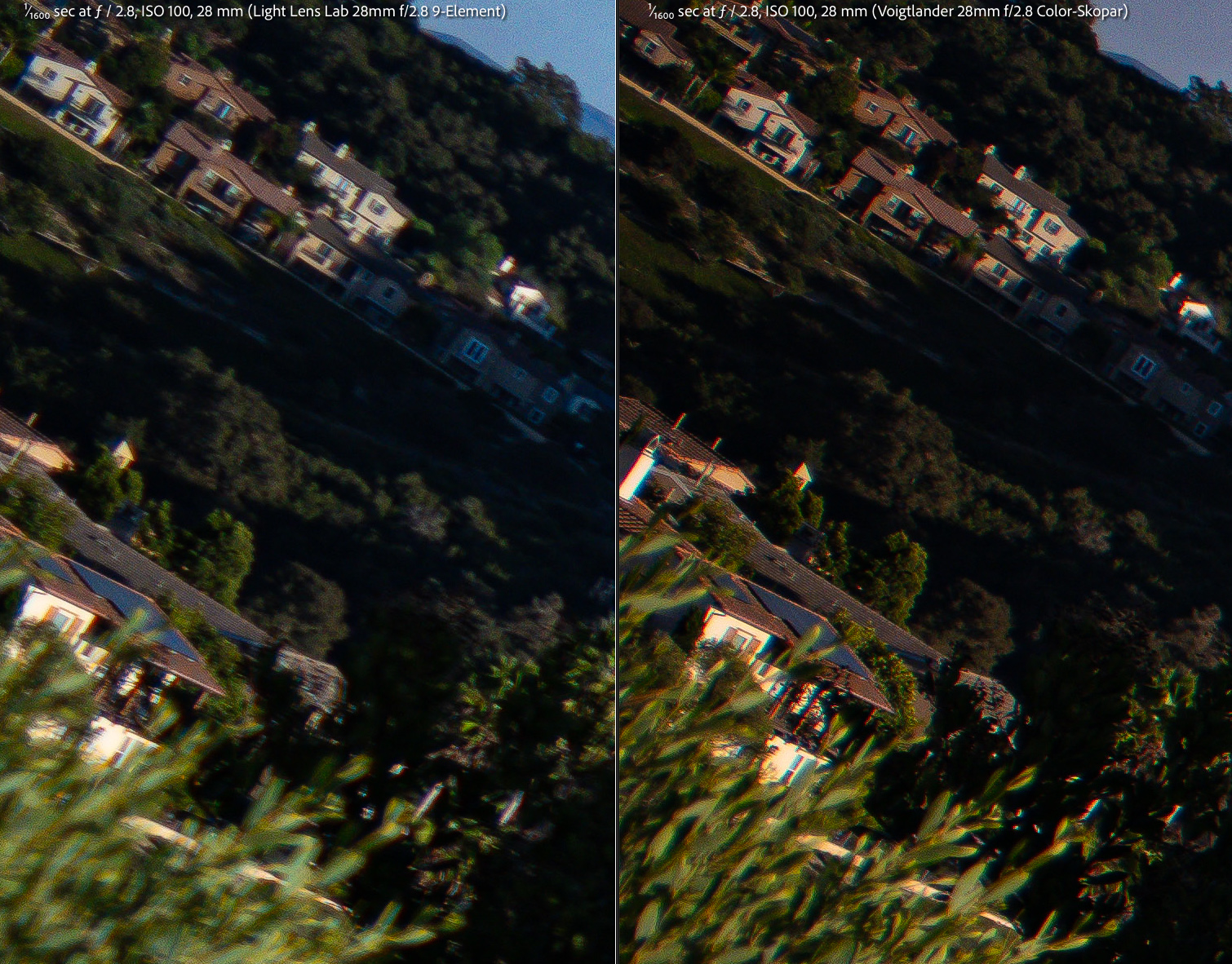
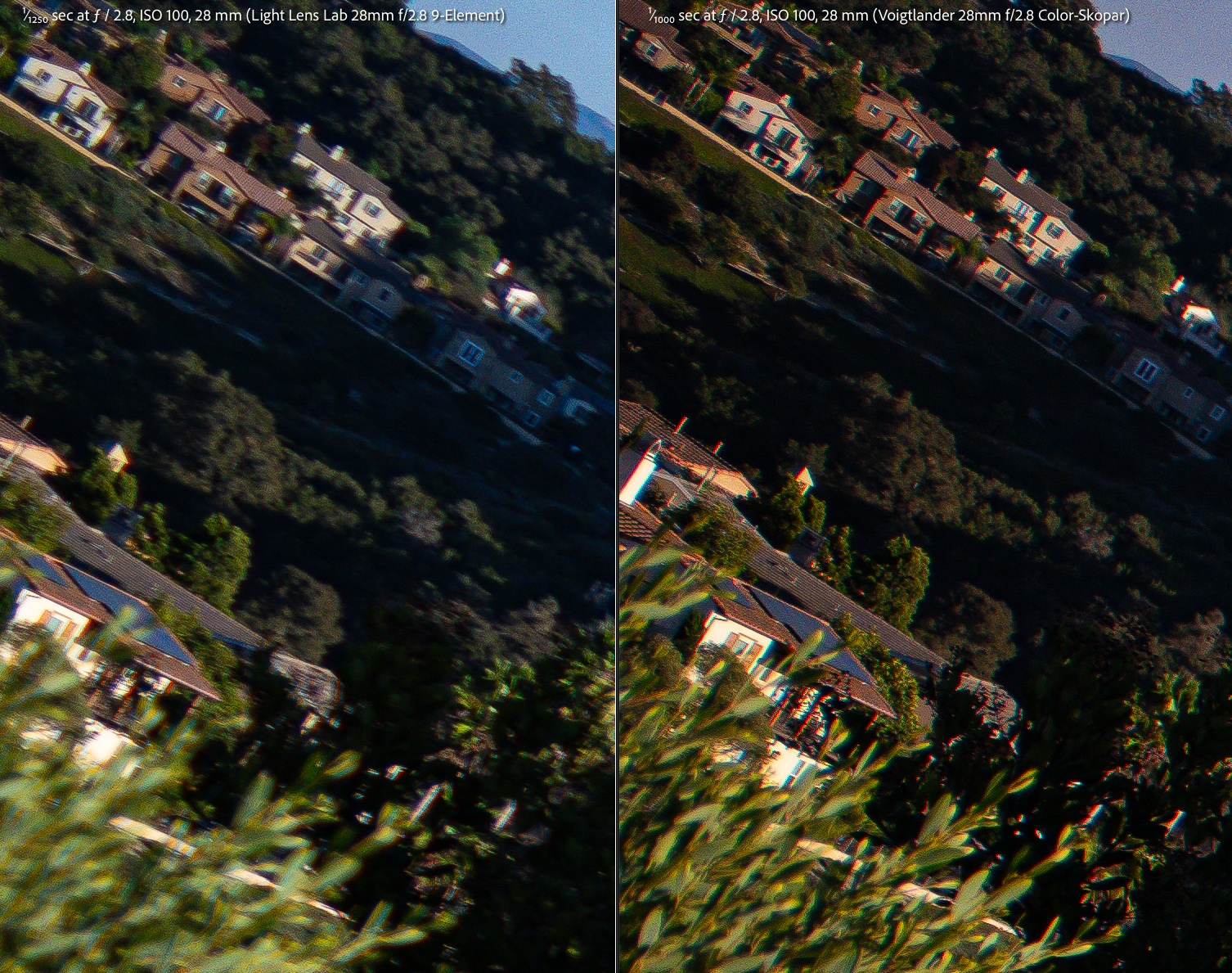
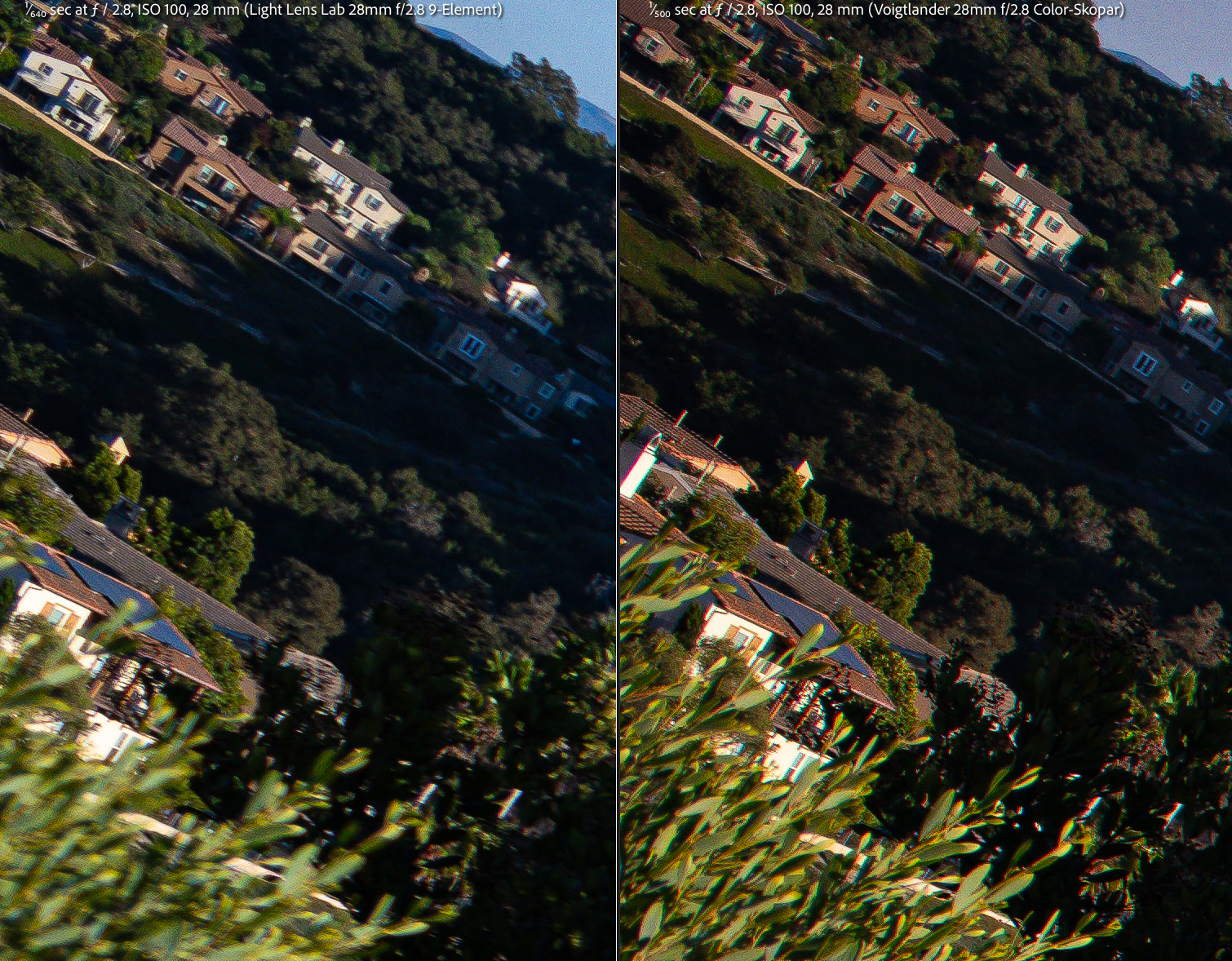
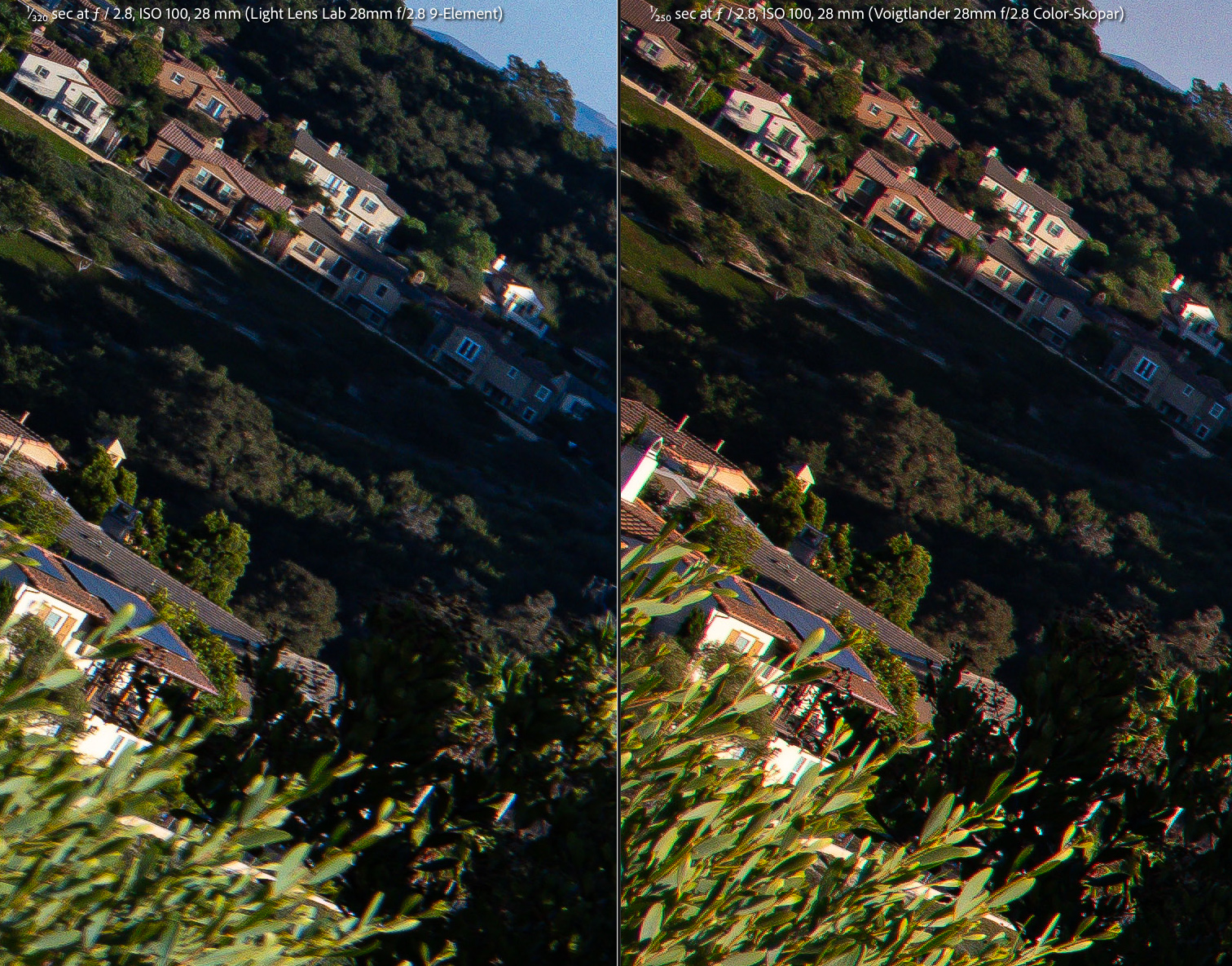
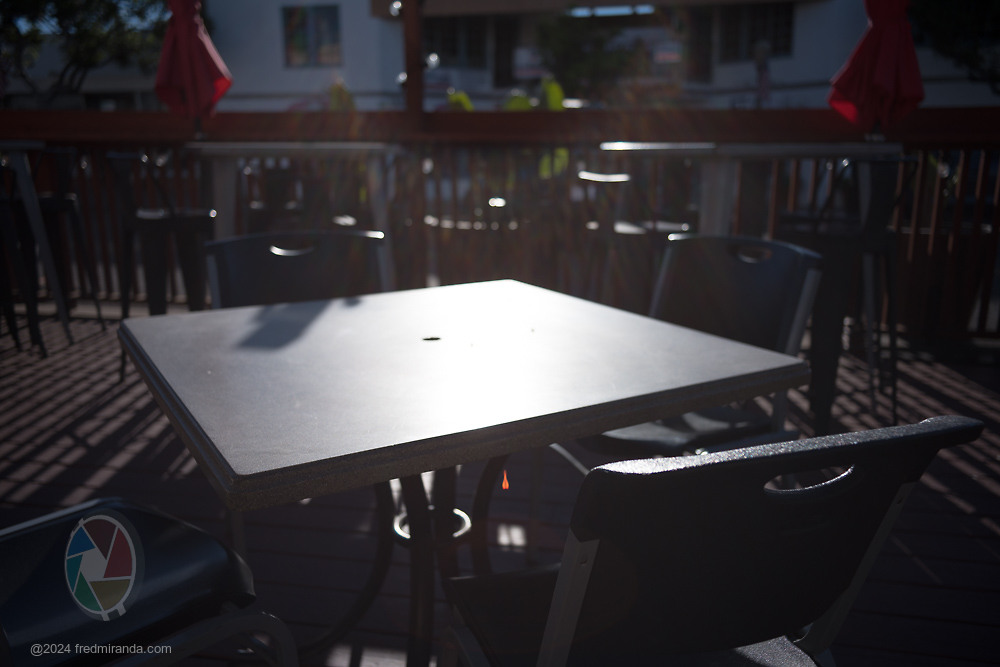
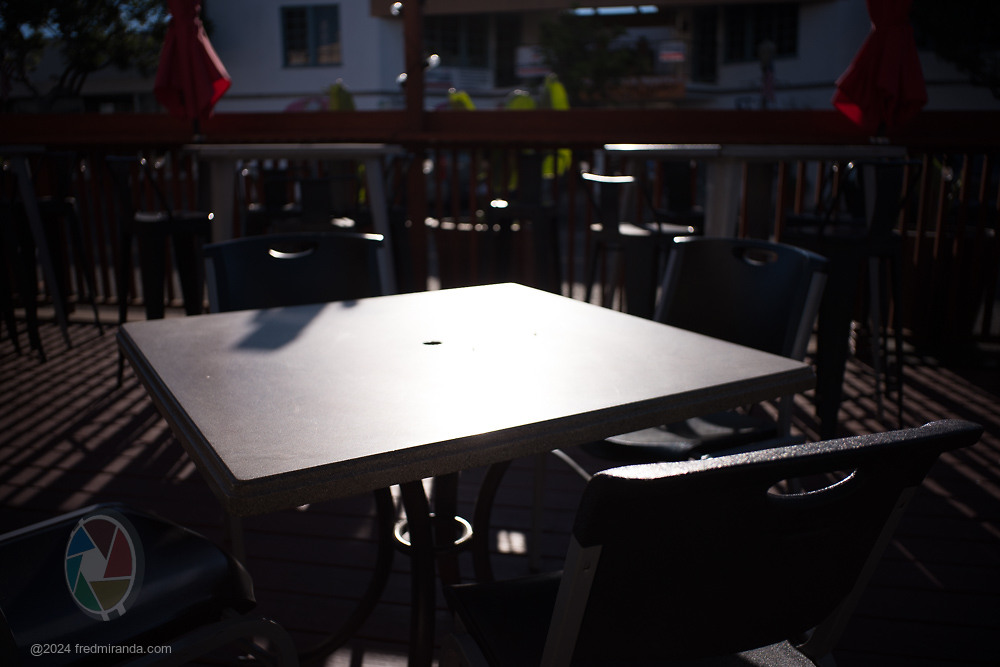
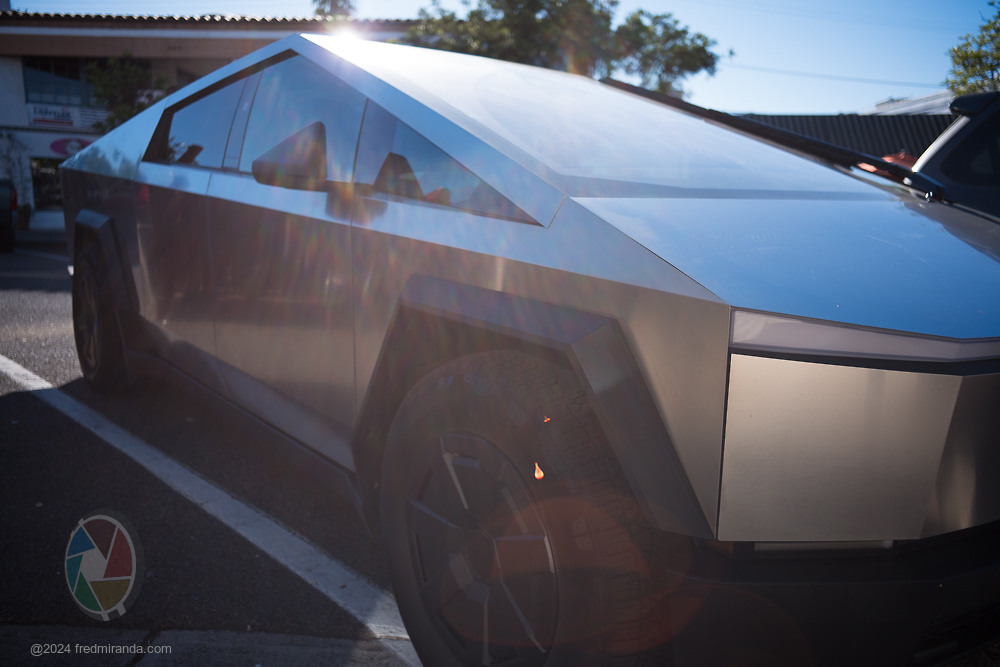
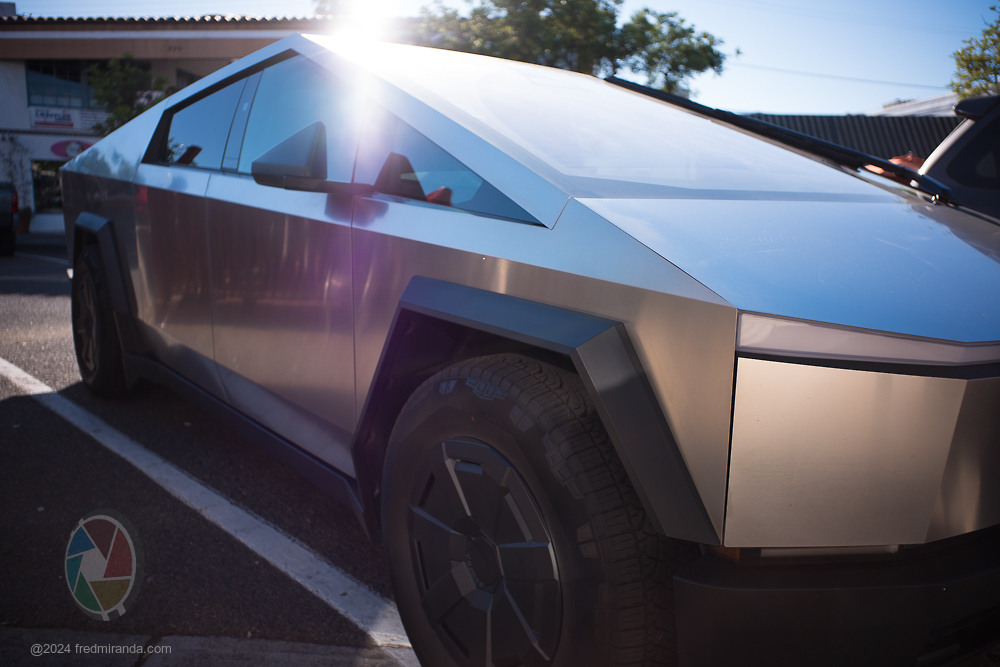
This test is also a great way to see the vignetting from wide open to stopped down for both lenses. Be sure to check out the flare performance, too, where Voigtlander lenses usually excel. The LLL 28/2.8 9E shows some veiling and ghosting flare, which is absent in the Voigtlander samples, even with the sun directly in the frame.

Speaking of flare resistance, I've added two more samples at the bottom of the post comparing their performance against the light.


Light Lens Lab 28mm f/2.8 9-Element sunstar rendering:

(from f/2.8 until f/22 in one stop increment)


f/2.8


f/4


f/5.6


f/8


f/11


f/16


f/22


flare resistance comparison: Light Lens Lab

  LEICA M11    Light Lens Lab 28mm f/2.8 9-Element lens    28mm    f/2.8    1/3200s    100 ISO    0.0 EV  


flare resistance comparison: Voigtlander

  LEICA M11    Voigtlander 28mm f/2.8 Color-Skopar lens    28mm    f/2.8    1/3200s    100 ISO    0.0 EV  


flare resistance comparison: Light Lens Lab

  LEICA M11    Light Lens Lab 28mm f/2.8 9-Element lens    28mm    f/2.8    1/1250s    100 ISO    0.0 EV  


flare resistance comparison: Voigtlander

  LEICA M11    Voigtlander 28mm f/2.8 Color-Skopar lens    28mm    f/2.8    1/640s    100 ISO    0.0 EV  


Nov 23, 2024 at 05:36 PM
Fred Miranda
Offline
Admin
Upload & Sell: On
p.1 #17 · Light Lens Lab 28mm f/2.8 9-Element Review


Voigtlander 28mm f/2.8 Color-Skopar sunstar rendering:

(from f/2.8 until f/16 in one stop increment)


f/2.8


f/4


f/5.6


f/8


f/11


f/16


Nov 23, 2024 at 05:37 PM
Fred Miranda
Offline
Admin
Upload & Sell: On
p.1 #18 · Light Lens Lab 28mm f/2.8 9-Element Review


Back to Quick Links

Minimal Focus Distance: Resolution and Contrast

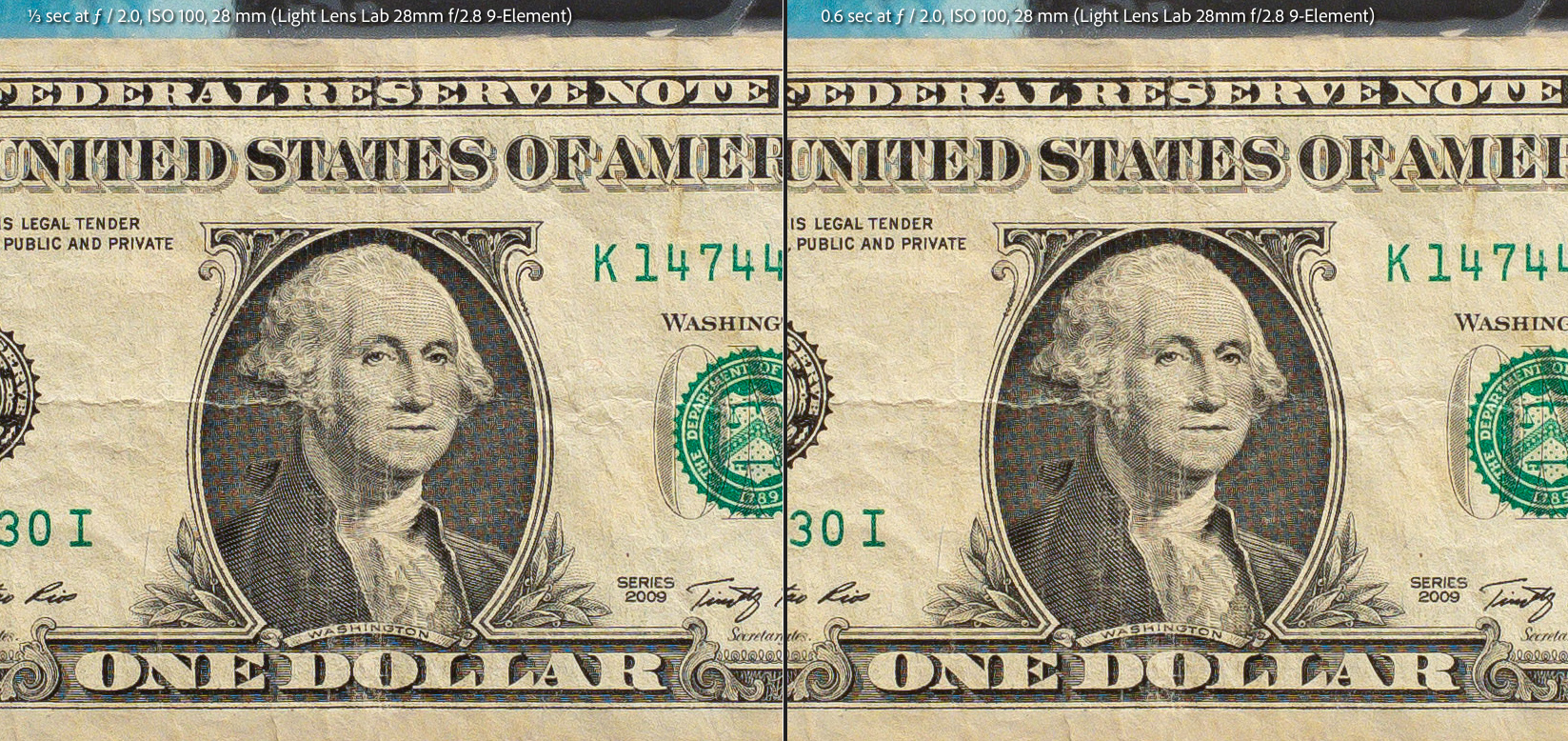
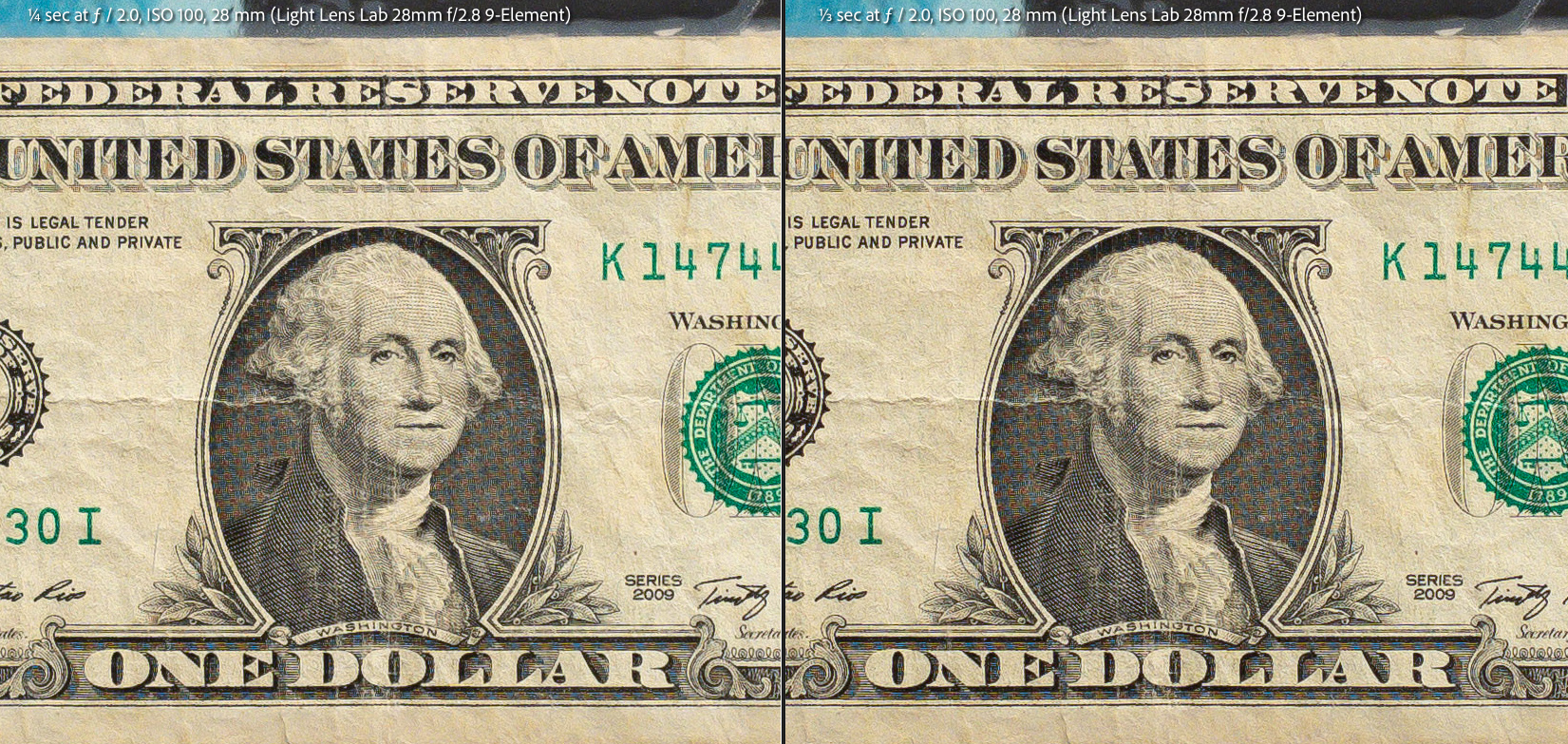
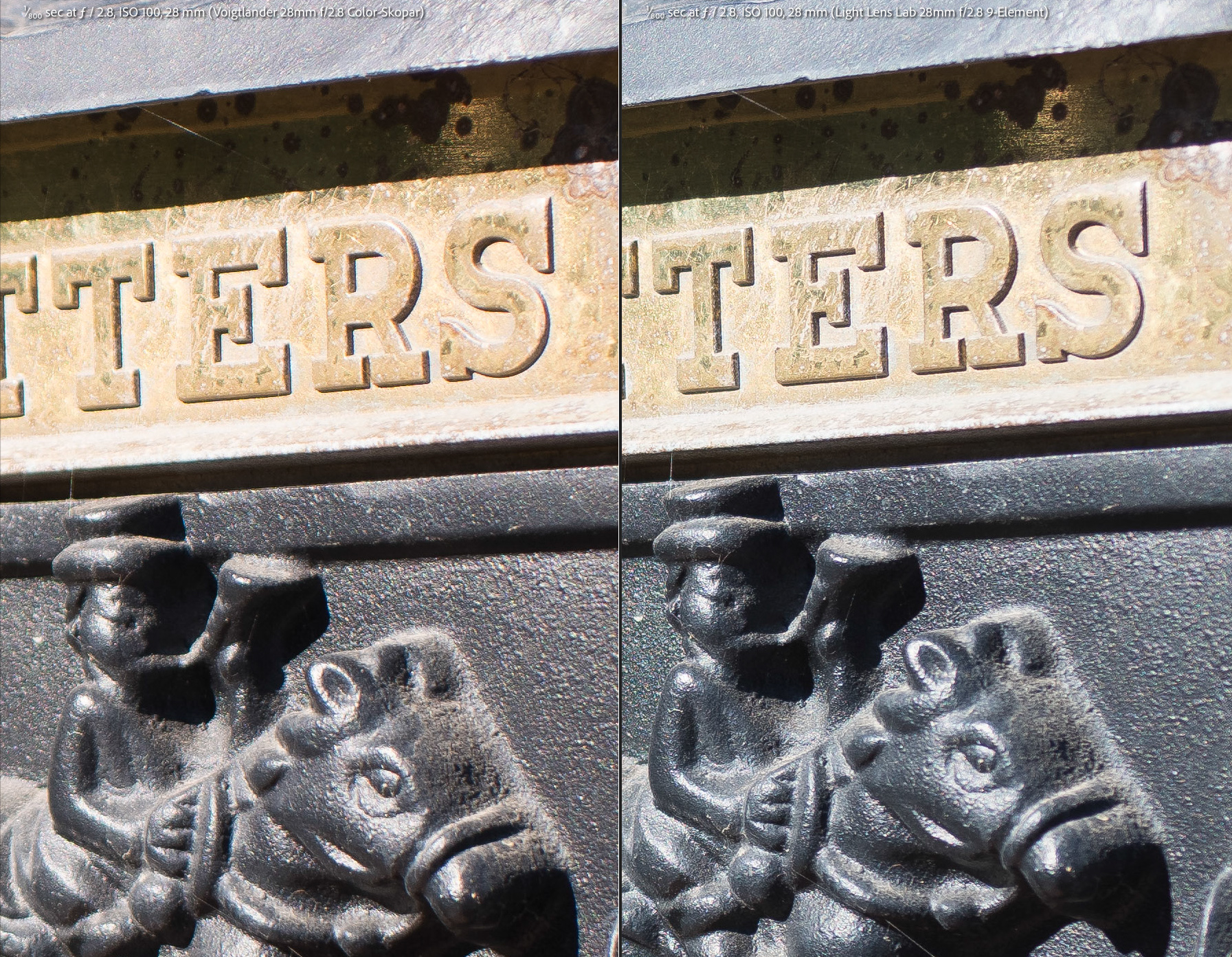
The Light Lens Lab 28mm f/2.8 9-Element lens focuses down to 0.7m, which is standard for rangefinder cameras. Given its vintage design with some modern glass improvements, I expected atrocious performance at close distances. However, just like at infinity, its performance at minimal focus distance is surprisingly impressive for a non-FLE design.

Here’s a comparison showing f/2.8 vs f/4 and f/4 vs f/5.6.

Note that while the lens offers great resolution wide open, stopping it down without refocusing diminishes performance at f/5.6, indicating focus shift.

At 0.7m MFD

***Expand the browser window to view the full image without any resizing.


LEFT (f/2.8) | RIGHT (f/4)


LEFT (f/4) | RIGHT (f/5.6)


Nov 23, 2024 at 06:18 PM
Fred Miranda
Offline
Admin
Upload & Sell: On
p.1 #19 · Light Lens Lab 28mm f/2.8 9-Element Review


Back to Quick Links

Optical Vignetting and Specular Highlights shape

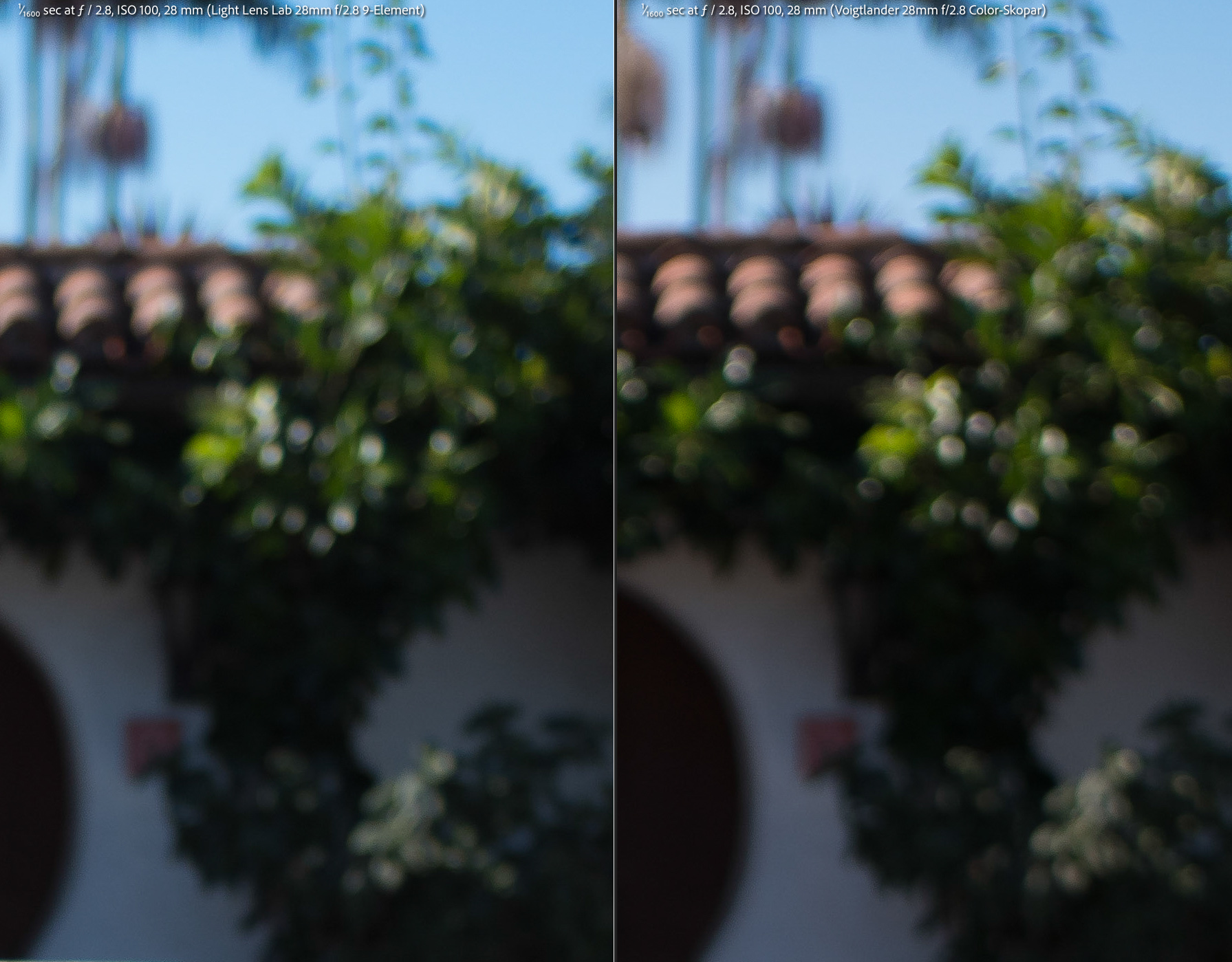
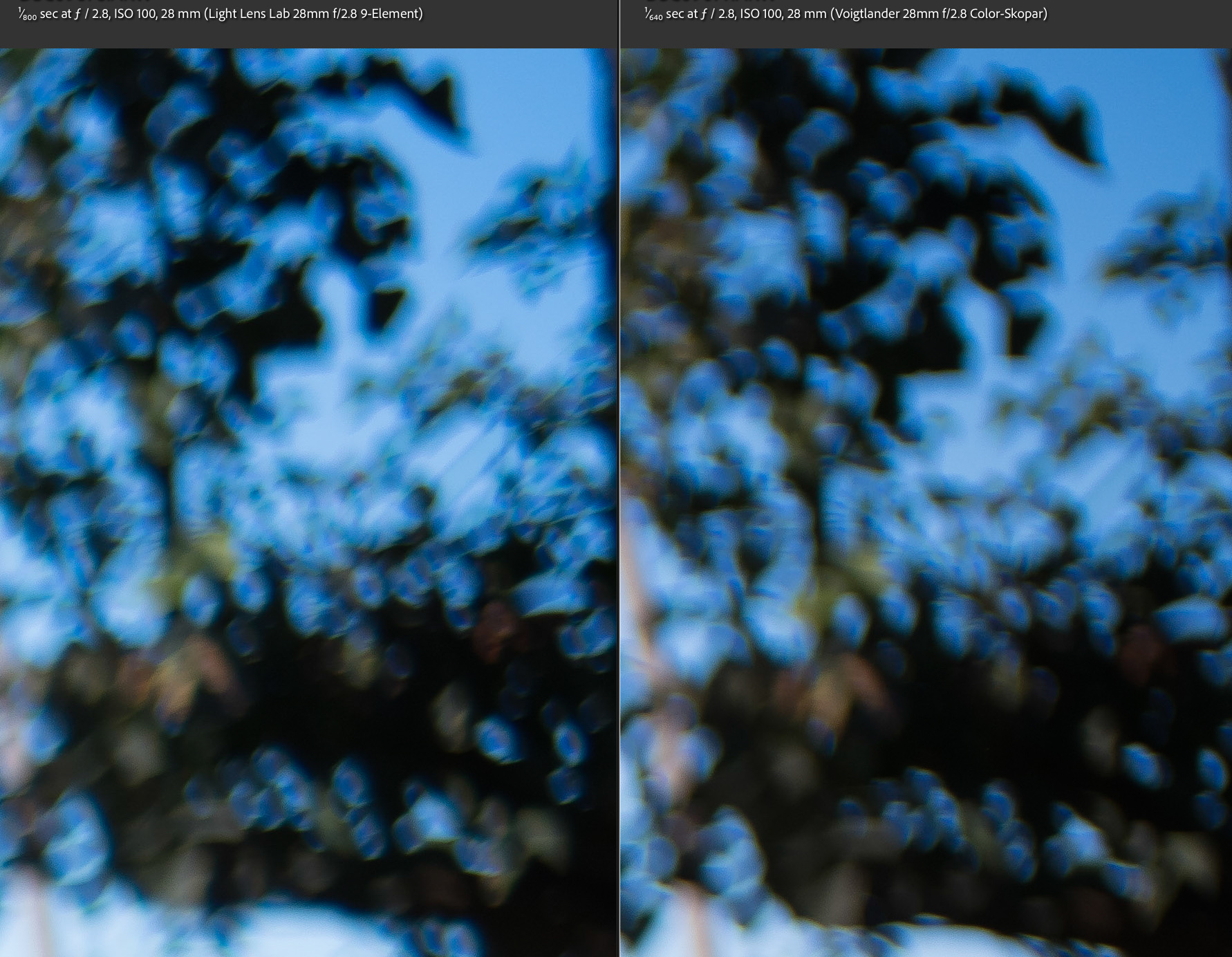
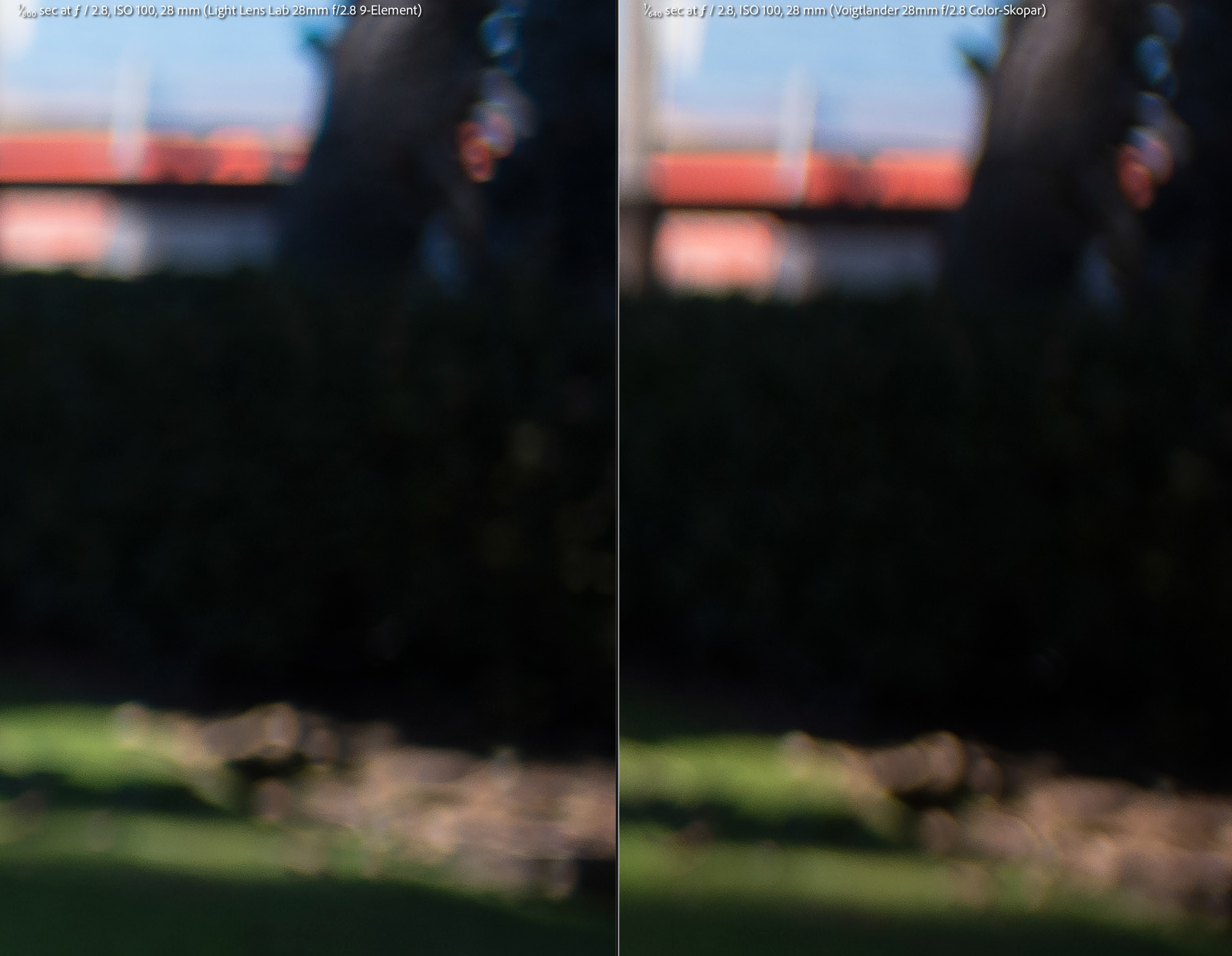
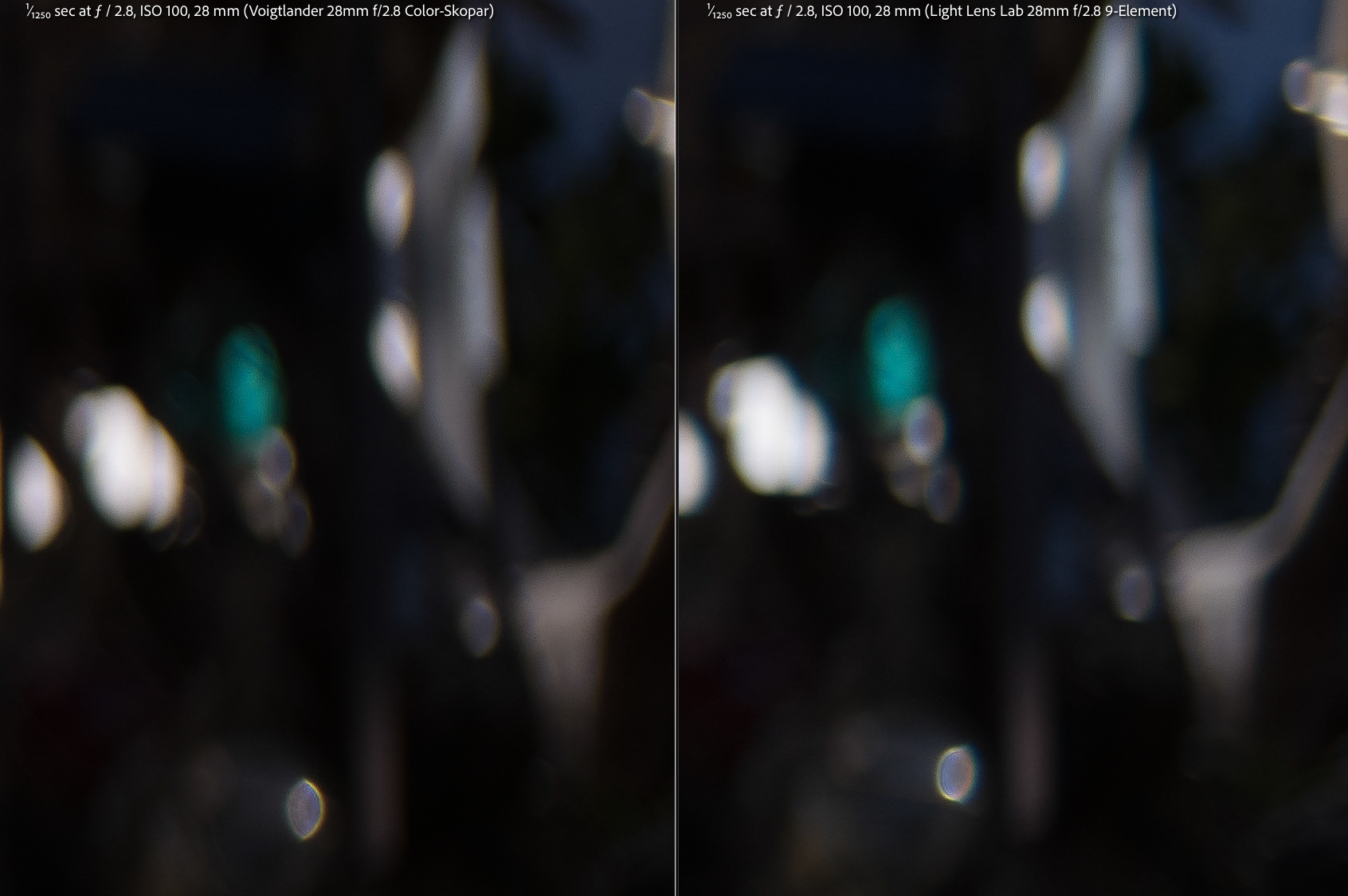
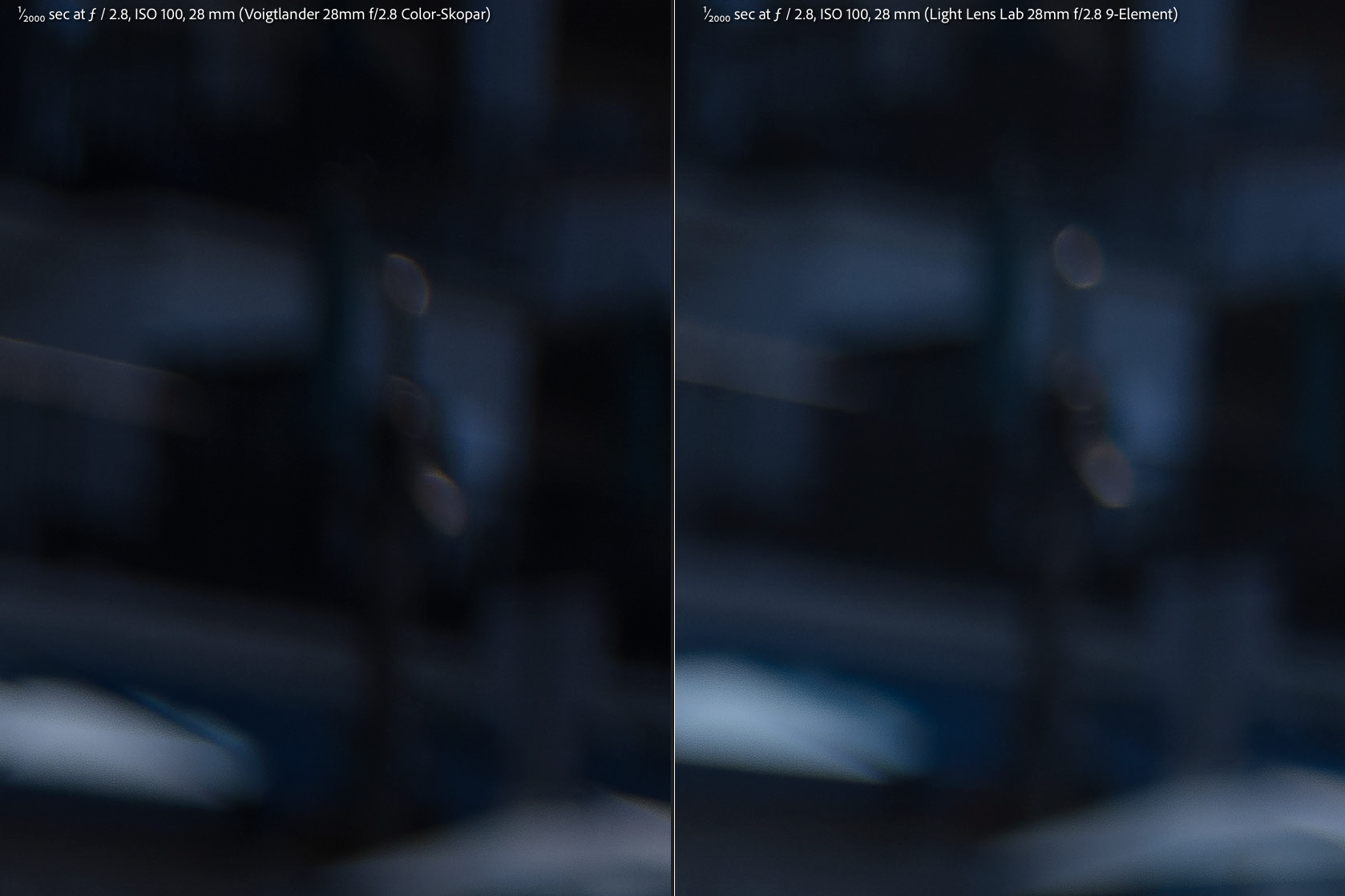
One of the standout features of the Light Lens Lab 28mm f/2.8 9-Element is its lower-than-average optical vignetting, which is a positive characteristic. This results in more rounded bokeh balls (specular highlights) compared to many other 28mm lenses I’ve tested. It also means you won’t see much swirling in the rendering, a quality many photographers appreciate.

Personally, I’m not a huge fan of optical vignetting and the cat-eye-shaped bokeh it often creates. However, there are times when it can add a creative touch to images, enhancing the composition when done right. Voigtlander lenses typically don’t correct for optical vignetting, often as a design compromise to keep the lens size down. As a result, this effect is very prominent in their lenses, including the Voigtlander 28mm f/2.8 Color-Skopar. This is evident in the samples below, where the bokeh balls in out-of-focus areas away from the center appear less rounded.

See the sample comparison crops below:


Nov 23, 2024 at 06:51 PM
Fred Miranda
Offline
Admin
Upload & Sell: On
p.1 #20 · Light Lens Lab 28mm f/2.8 9-Element Review


Back to Quick Links

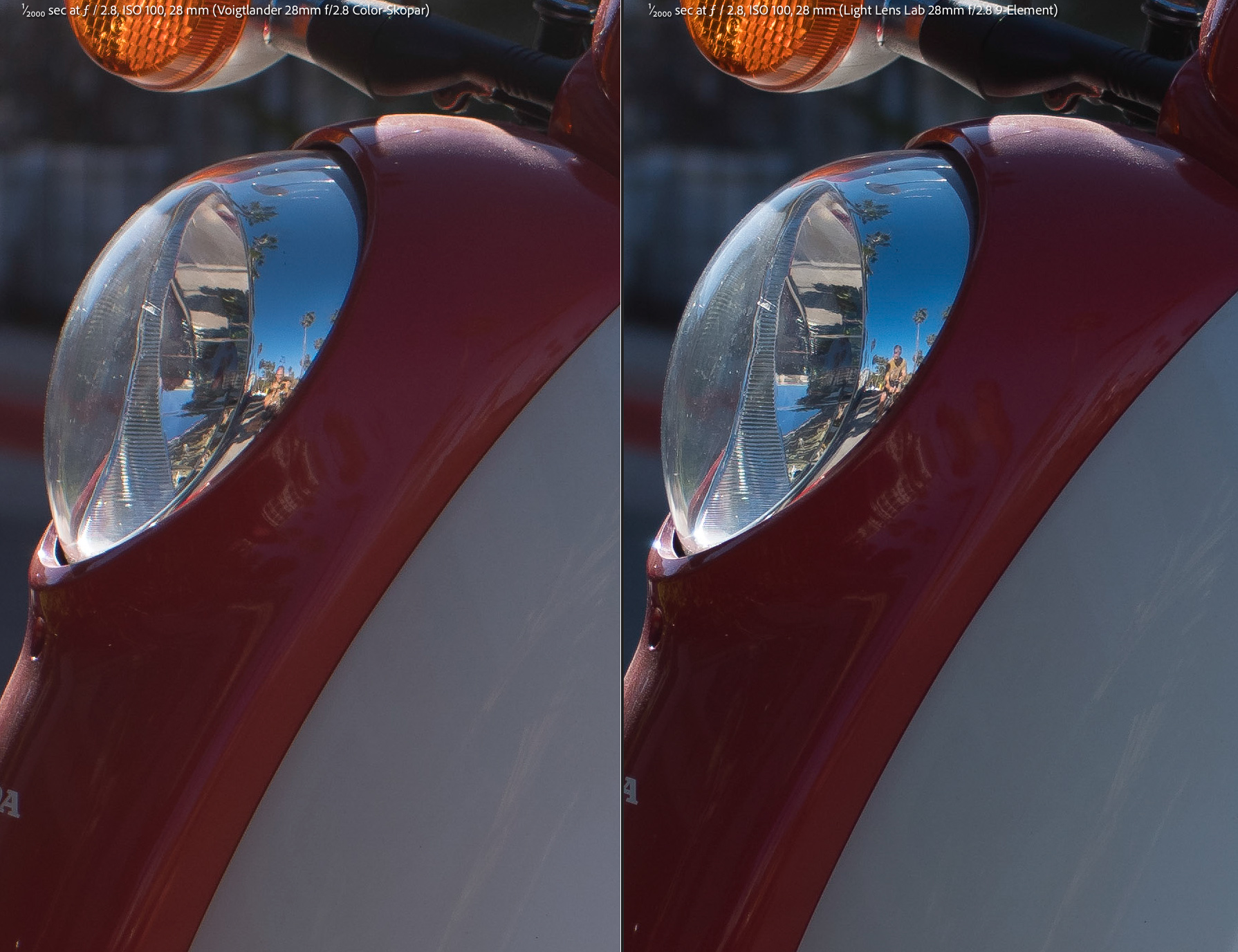
Chromatic Aberration Control

Axial CA:

Slower lenses with a maximum aperture of f/2.8 are usually pretty well corrected for axial chromatic aberration (CA), and thankfully, that’s the case with the Light Lens Lab 28mm f/2.8 9-Element. I didn’t notice any significant color fringing in my shots—it’s pretty much non-existent. If you look closely at the rendering tests, there’s a hint of fringing here and there, but it’s so subtle that it’s almost impossible to spot in real-world images. When you analyze at a pixel level, you might catch a glimpse of it, but it’s really nothing to worry about. Also, there’s no purple fringing to speak of.

Lateral CA:

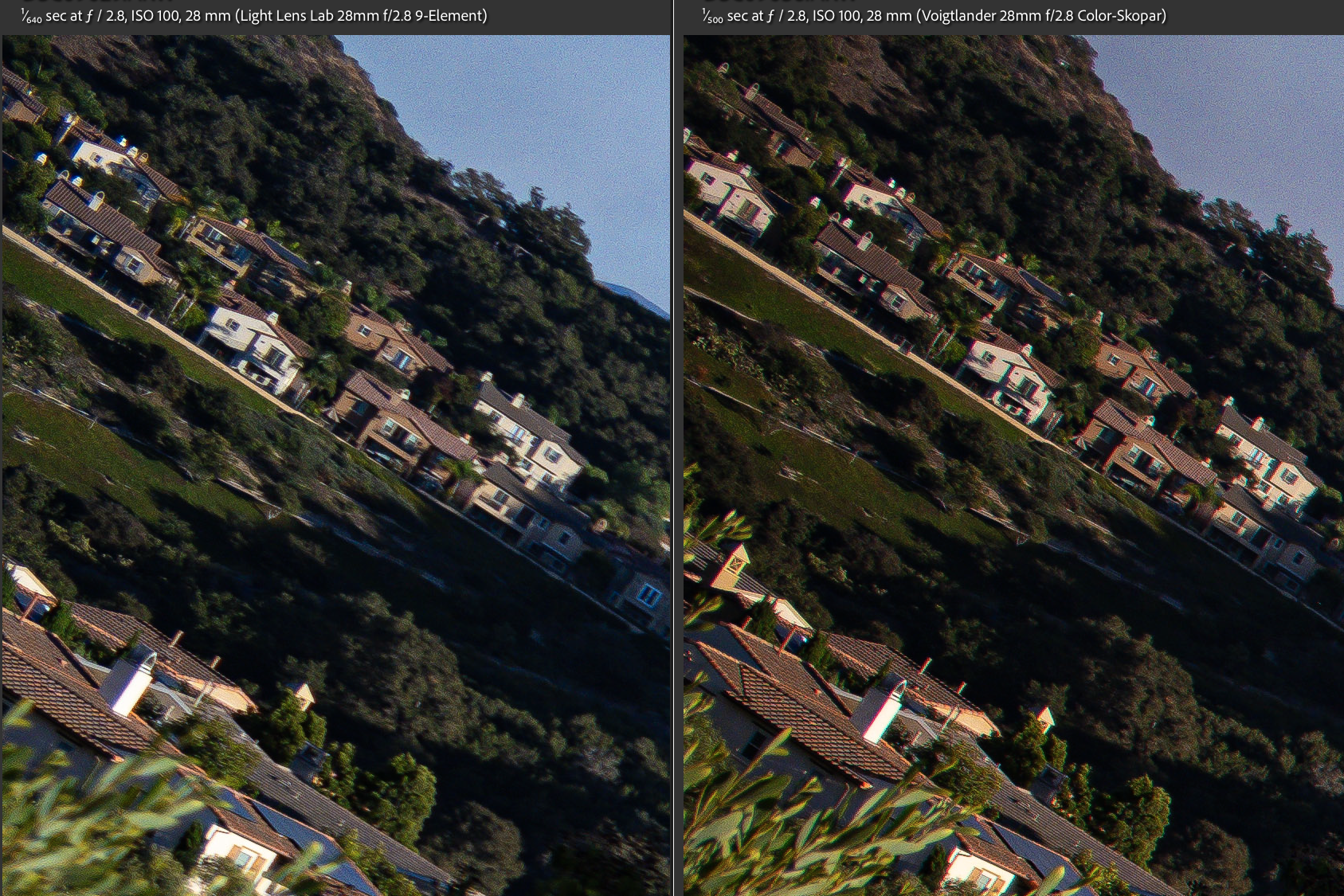
Now, let’s talk about lateral chromatic aberration (CA). This one’s trickier to correct, even in slower lenses, but the Light Lens Lab lens performs impressively well. There’s minimal lateral CA visible in my tests. On the other hand, the Voigtlander 28mm f/2.8 Color-Skopar, despite being a f/2.8 lens, shows a fair amount of lateral CA. Fortunately, this is an easy fix in Lightroom with almost no loss in quality.

For a clearer comparison, check out this crop showing the lateral CA performance of the Light Lens Lab 28mm f/2.8 9E versus the Voigtlander 28mm f/2.8. This section shows the very corners of the frame, where this aberration tends to be most noticeable. As you can see, the LLL lens handles it much better than the Voigtlander.


Nov 23, 2024 at 07:12 PM
       2       3       4       end


FM Forums | Leica & Alternative Gear | Join Upload & Sell
       2       3       4       end


Welcome back
Log in to your account