rscheffler
Online
• • • • • •
Upload & Sell: Off
|
 p.4 #8 · Pre-capture image thread... p.4 #8 · Pre-capture image thread... | |
chiron wrote:
yes, it would have been useful in Butler, PA.
Caleb Williams wrote:
If your photojournalist instincts kicked in soon enough, absolutely. Doug Mills of the NY Times captured one of the bullets in flight, though it was with a Sony camera, so it could have been their implementation of pre-capture. I wonder what the resulting image would have been if Mills was using 1/64000th instead of 1/8000th.
A shorter streak.
I feel a lot of it was right place at the right time and luck (what's the saying: you have to be good to be lucky?). Even at 60 or 120fps with the a9III, you could still miss a bullet. And that the bullet was probably supersonic, by the time you heard the actual gunshot (assuming it was the first shot), your body processed the sound and recognized it as a gunshot, it's already too late. So sure, here is when pre-capture could be useful, if you had the foresight to use it.
chiron wrote:
Did you ever use it for anything other than sports?
I have only used the R1 loaner I had access to for sports and it was the only pre-capture capable camera where I made the effort to use pre-capture during regular client work. I don't use it in the R6II because of the hassle it introduces into my non-Canon software based workflow and the other reasons I explained earlier. But yeah, if the R6II had pre-capture like the R1, I would use it for the example I described: talking heads at conferences and similar.
Here's another example: I photograph the local university's convocation ceremonies. They 'hood' each graduate when they are on-stage. Each 'hooder' has a different technique. Some are slow and it's easy to time with a single or two-shot burst. Others are fast and unpredictable. And depending on the shooting angle, might not be visible before they start their hooding motion. I prefer a low angle from the edge of the stage at the stage floor looking up so I can get the hood flowing over the graduate, but from this angle I usually can't see the hooder. Back when I was using my 1DXII, I could usually nail the 'peak hooding' moment in a single shot because the instant I saw the hood and released the shutter was fast enough to catch it at the ideal moment. Now with mirrorless, the moment I see the hood coming over the head, it's already too late half the time, so I have to anticipate and shoot a burst to be sure I get something that I like. And sometimes I still miss it. With pre-capture, I could wait until the hood is pretty much over the head and take one shot and gain all the pre-capture shots. Some grads also react unpredictably after they're hooded, which I sometimes miss because I wasn't expecting it, so again, with pre-capture, I could take a shot after the moment and still get a usable image or two out of the sequence if I had the shutter half-pressed and pre-capture running. Yes, I'd potentially have a burst of 10-20 frames for each grad depending on how long I had the shutter release half-pressed (this is with Canon's implementation) and I'd have the camera set to 10fps, so it could possibly go as far back as 2 seconds. But it should eliminate pretty much every miss and make the process a bit more relaxing behind the camera.
Here's a random example of the photo opp I described at one of the convocation ceremonies. This moment happens in around half a second and from this angle can be difficult to anticipate. Just to be clear, this was NOT a pre-capture image and just serves as an example for a non-sports scenario:
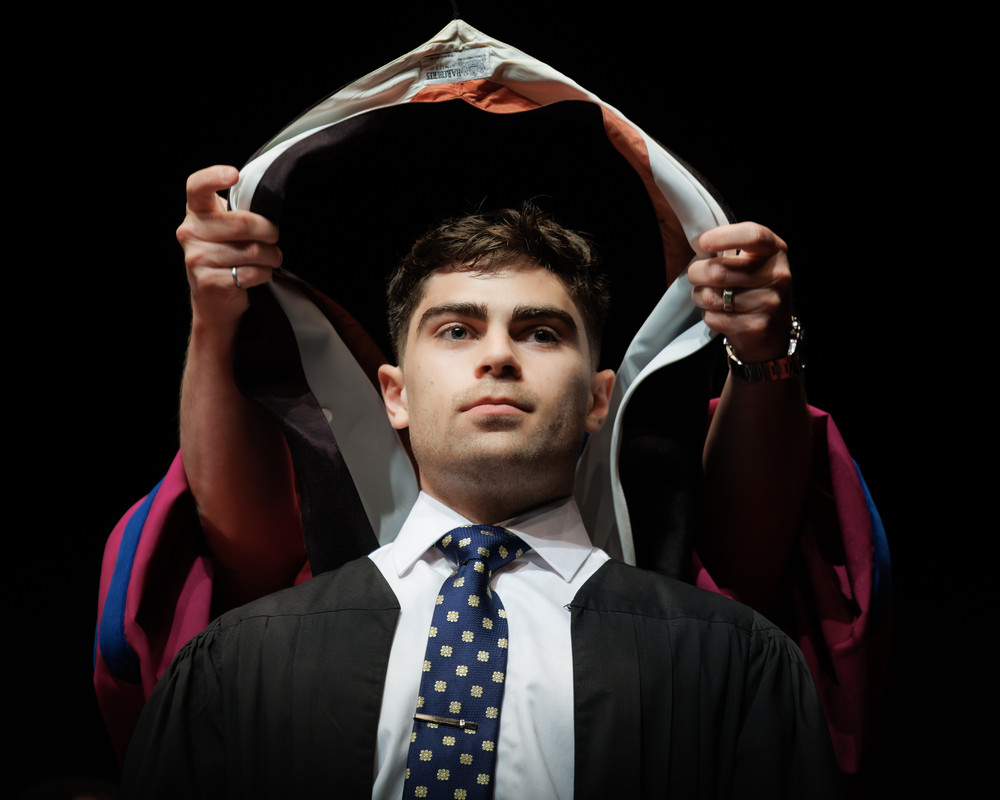
The downsides I envision to using pre-capture here: having upwards of 20 useless images in a pre-capture sequence, which if you multiply by 300-500 grads, adds up. I currently usually do a 3-5 image 12fps burst, but sometimes it might be 10+ if the hooder's timing is delayed by unpredictable movement/behavior by the graduate. Another downside is that it could make me lazy in respect to anticipation and timing for when it really counts, because I'd be even more accustomed to the camera covering my butt.
But I'll take that tradeoff because of how pre-capture potentially offsets a downside of mirrorless; its inherent lag due to the image being processed off the sensor and to the EVF, rather than direct line-of-sight through an optical viewfinder.
I think there can be a lot of uses for pre-capture but the most obvious are fast action and difficult to predict peak action situations that often occur in sports and wildlife scenarios. Which is why we're seeing a lot of those kinds of examples.
|


