p.1 #1 · Sony A9III CFE-a Memory Card Performance Data
In a prior post, A1 CFE-a Memory Card Performance Data, I showed memory card performance data for the Sony A1. This post includes data for four CFE-a memory cards in a Sony A9III for Compressed RAW data. The data and the formatting is similar to the prior post. The methods of making the measurement have been described before so I will not repeat that here.
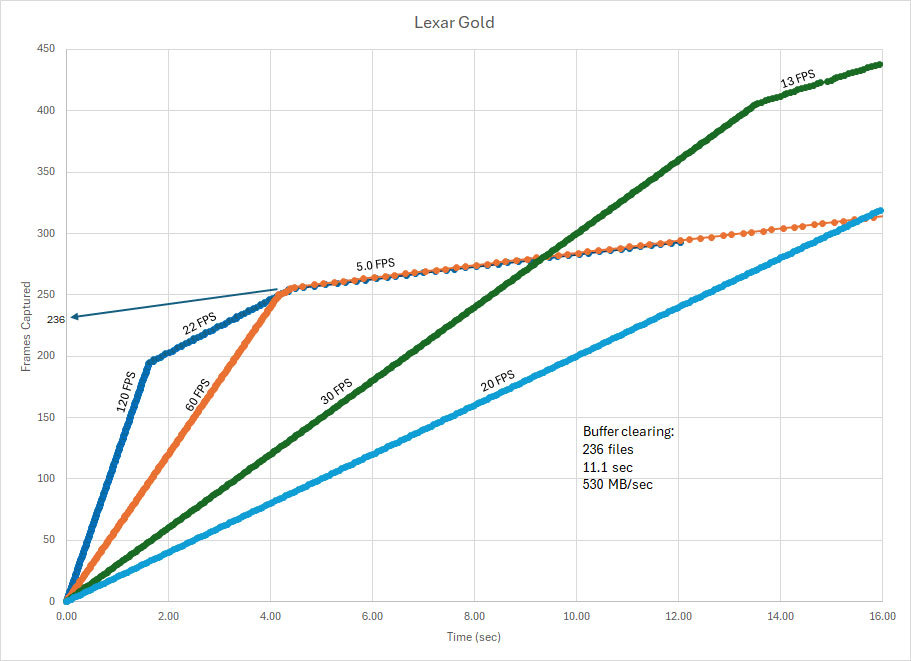
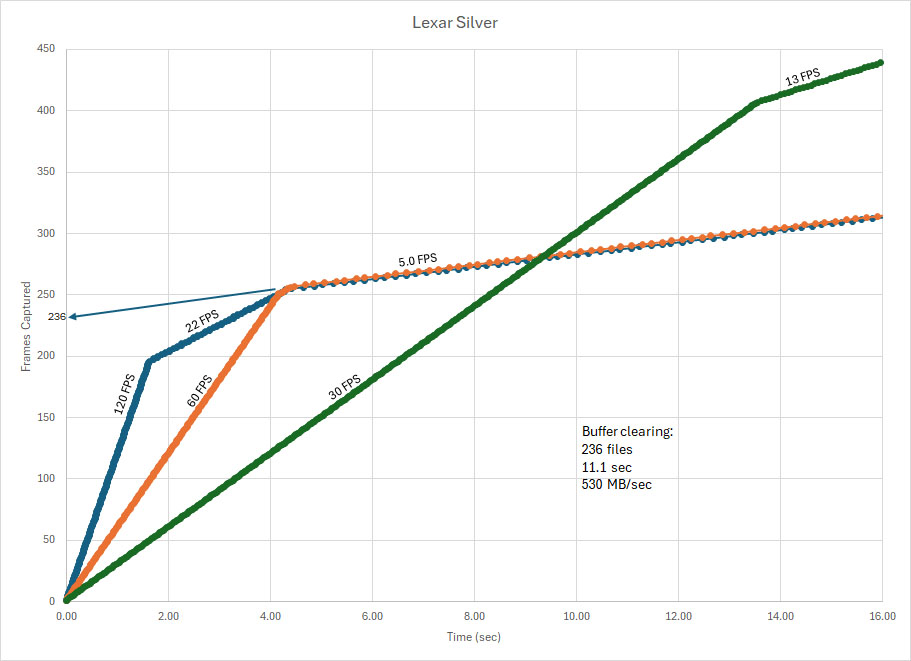
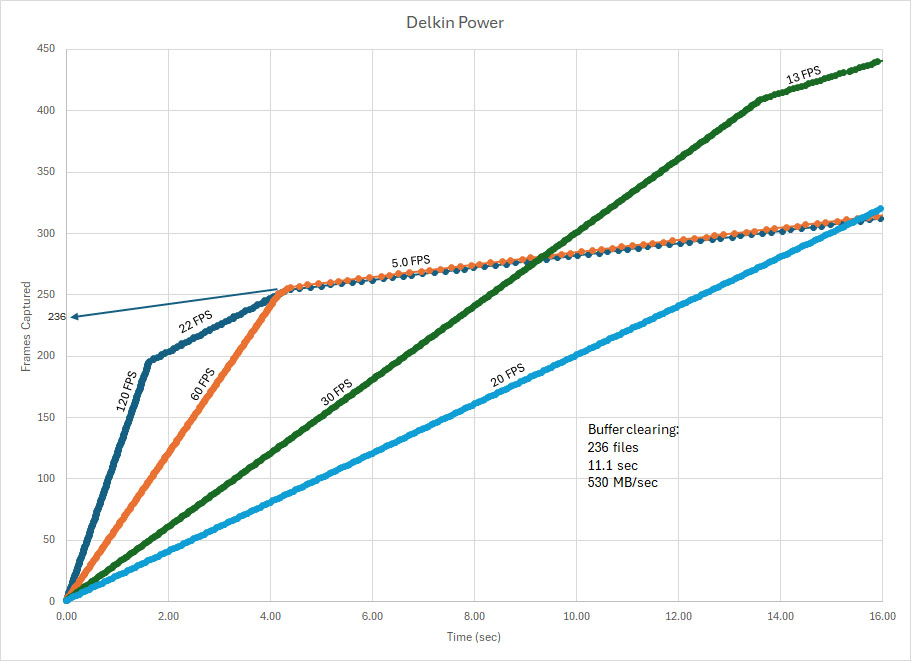
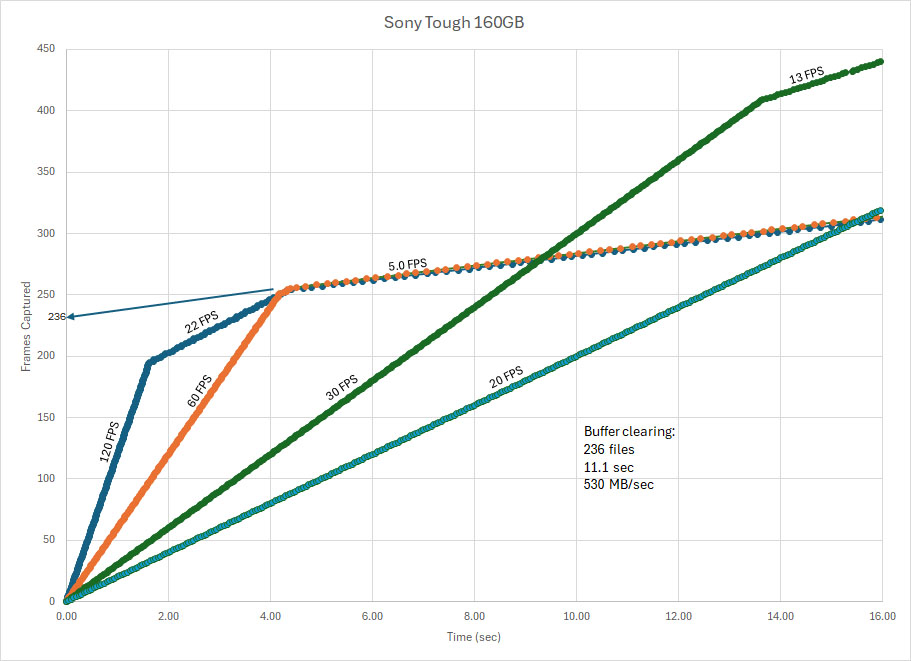
The first four charts are for the Lexar Gold, Lexar Silver, Delkin Power and Sony Tough cards, all 160GB. You may notice that they are all the same. I found no measurable difference in the cards. This implies that the performance is determined by the camera not the memory cards. It is possible that the cards are all essentially identical except for the branding (same source?), but the the fact that the Lexar Gold and Lexar Silver, which have different specs (and prices), have identical performance supports the idea that it is the camera, not the card, that is determining the performance.
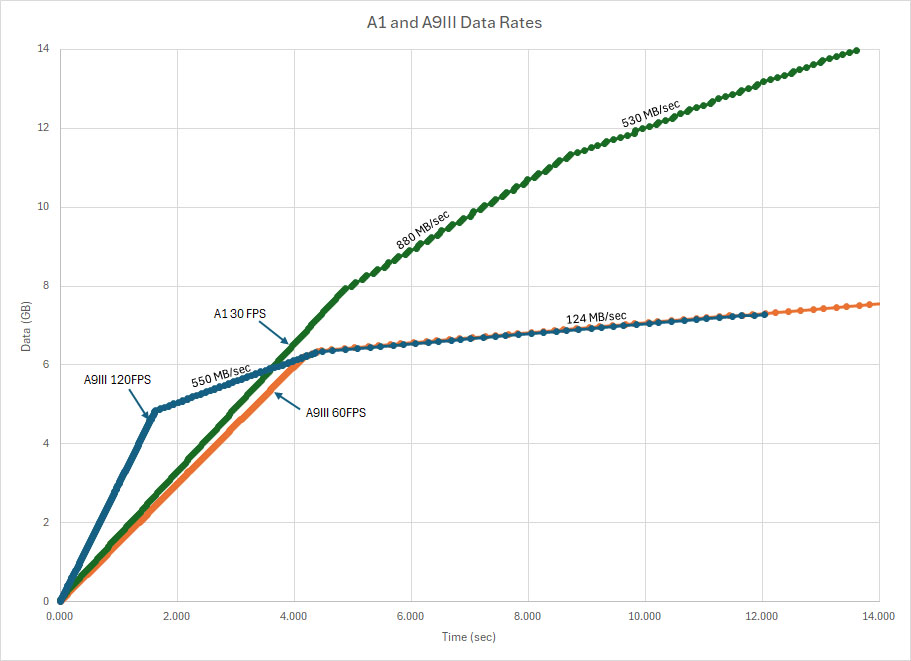
It is interesting to compare the A9III data with the A1 data in the prior post. IMO, the most surprising difference is that the A9III rate is 5 FPS when the buffer is full and the A1 rate is ~10 FPS, even though the A1 files average 54MB and the A9III files average ~25MB. The fifth chart shows the comparison in data rates for the A9III at 120 FPS and 60 FPS, along with the A1 rates for 30 FPS.
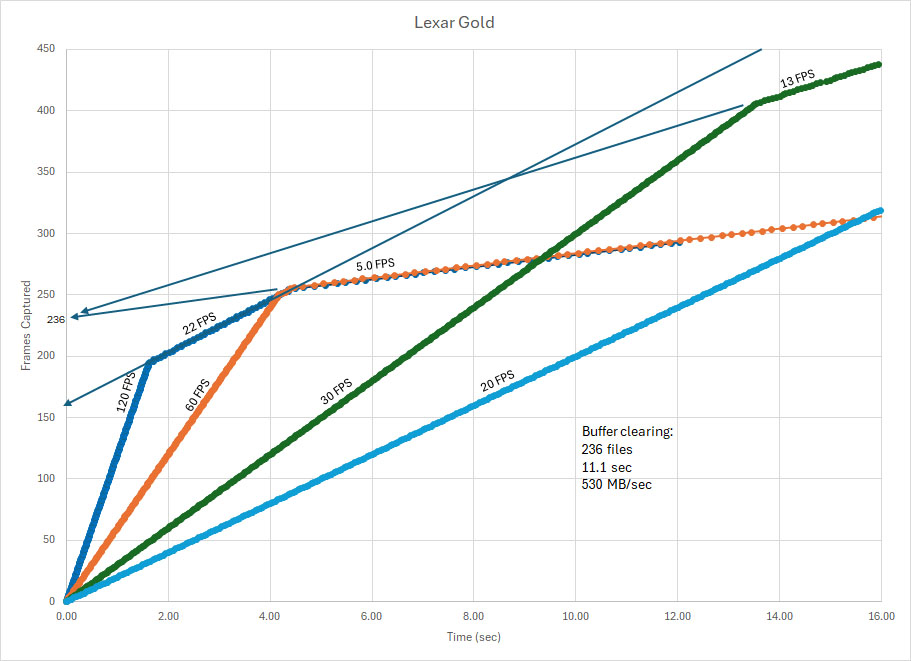
The buffer size is 127 frames for the A1 (~6.9GB), and 236 frames for the A9III (~5.9GB). The buffer clears in 11sec for both which is 617MB/sec for the A1 and 530MB/sec for the A9III. I had anticipated the A9III buffer might be larger and clear faster.
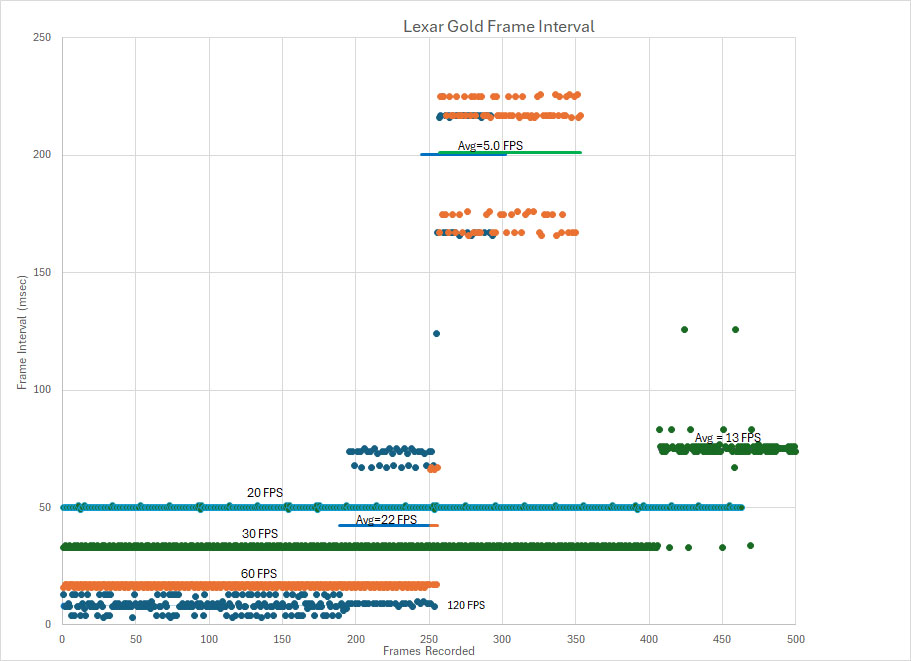
The last chart shows the frame intervals. As with the A1, they are not uniform. For example, the frame interval for 120 FPS bounce around among ~4, ~8, and ~12 msec, and they average 8.3 msec. When the frame rate slows to 22 FPS, the frame intervals bounce around among ~8, ~67, and ~78 msec and average 45 msec. There are similar variations in frame intervals for other frame rates.
As was the case for the A1, the performance data is a bit more complex than expected, and the "expert" data provided on various web sites and discussed in many forums is usually inaccurate and incomplete.
I did not make measurements for anything other than compressed RAW. I think that photographers that are concerned about performance are shooting in that mode. If you want to make measurements for a different memory card or data mode, send me a PM and I will try to help with the measurement method and analysis.
p.1 #2 · Sony A9III CFE-a Memory Card Performance Data
Thanks for the work. The link to the A1 thread is broken.
dclark wrote:
It is interesting to compare the A9III data with the A1 data in the prior post. IMO, the most surprising difference is that the A9III rate is 5 FPS when the buffer is full and the A1 rate is ~10 FPS, even though the A1 files average 54MB and the A9III files average ~25MB. The fifth chart shows the comparison in data rates for the A9III at 120 FPS and 60 FPS, along with the A1 rates for 30 FPS.
p.1 #4 · Sony A9III CFE-a Memory Card Performance Data
TimMunsey wrote:
With the camera determining performance we can conclude buying a cfexpress type 4 card will offer no in camera performance boost?
In order for a CFE-a type 4 memory card (i.e. a card with a PCIe-4 data lane) to provide any improvement, the camera would need to have PCIe-4 electronics, not PCIE-3 electronics.
So far as we know there are no Sony cameras with a PCIe-4 data lane, but we can't be certain about the A9III.
Someone needs to put a type 4 card in an A9III and make the measurements.
I will be surprised if it is faster, but pleasantly surprised.
p.1 #6 · Sony A9III CFE-a Memory Card Performance Data
This data raises some interesting questions about how the sensor/camera/memory electronics works. The most obvious question is the one raised by @randomguy, why does the buffer not fill and slow the frame rate to 5 FPS when running at 30 FPS or slower? In order to make this more clear I have added a couple of lines to the frames vs time chart. It seems that the buffer that can hold ~236 frames empties at a rate of 5 FPS when data is coming in at a rate of 120 FPS or 60 FPS, but empties at a rate of ~13 FPS when data is coming in at 30 FPS or slower. Consequently at 30 FPS the buffer does not fill at ~9.3 sec with ~280 frames but fills at ~13.5 sec and 406 frames.
There is also another buffer that fills when running at 120 FPS or 60 FPS. It has a capacity of ~156 frames and empties at a rate of ~22 FPS. When running at 30 FPS or slower it never fills. That buffer is first in the data flow.
Since Sony does not share any details with us we are left to speculate about exactly how the electronics works. But at least we can measure what the result is in terms of how data flows at various camera frame rates.
p.1 #8 · Sony A9III CFE-a Memory Card Performance Data
@dclark, Nice work! In every camera I've measured the buffer clearing performance is image ASIC-limited, ie it's based on how fast the ASIC can take the raw sensor frame data and convert it into a fully-formed image ready for writing. I described this in detail here. If the A9 III is clearing slower than the A1 in spite of its files being half the size then this is likely because the A9 III frames require more image processing vs the A1, provided the A9 III has a BIONZ that is equal to or greater in performance than the BIONZ in the A1.
p.1 #9 · Sony A9III CFE-a Memory Card Performance Data
snapsy wrote:
@dclark@, Nice work! In every camera I've measured the buffer clearing performance is image ASIC-limited, ie it's based on how fast the ASIC can take the raw sensor frame data and convert it into a fully-formed image ready for writing. I described this in detail here. If the A9 III is clearing slower than the A1 in spite of its files being half the size then this is likely because the A9 III frames require more image processing vs the A1, provided the A9 III has a BIONZ that is equal to or greater in performance than the BIONZ in the A1....Show more →
Good point, and why would the A9 III require more processing? The new built in raw NR probably.
So type B cards are actually pointless until Sony increases processing power again.
p.1 #10 · Sony A9III CFE-a Memory Card Performance Data
There may be some difference in the processing speed between the A1 and the A9III, but it does not seem that significant to me. IMO, the interesting difference is the change in how the A9III processes frames at 120/60 FPS and 30 FPS and slower. There appears to be a change in processing mode. The difference has operational implications for how I would choose to use the camera.
p.1 #11 · Sony A9III CFE-a Memory Card Performance Data
dclark wrote:
There may be some difference in the processing speed between the A1 and the A9III, but it does not seem that significant to me. IMO, the interesting difference is the change in how the A9III processes frames at 120/60 FPS and 30 FPS and slower. There appears to be a change in processing mode. The difference has operational implications for how I would choose to use the camera.
Determining the processing differences of the A9 III would likely require proprietary knowledge of Sony's imaging pipeline for the camera, above and beyond what can be induced by a deep analysis of the raw files.
Regarding the 120/60 fps clearing the buffer slower than 30 fps, I have a few theories but first I have a Q regarding the methodology. Are you measuring the clearing rate based on a single burst and waiting for it to clear, then extrapolating the sustained clearing rate from the knee after the buffer fills? Or are you allowing the shooting to continue beyond the initial fill of the buffer and then calculating the clearing-rate based on a sample later into the cycle? Your graphs imply the former but I wanted to be sure.
p.1 #12 · Sony A9III CFE-a Memory Card Performance Data
snapsy wrote:
Determining the processing differences of the A9 III would likely require proprietary knowledge of Sony's imaging pipeline for the camera, above and beyond what can be induced by a deep analysis of the raw files.
Regarding the 120/60 fps clearing the buffer slower than 30 fps, I have a few theories but first I have a Q regarding the methodology. Are you measuring the clearing rate based on a single burst and waiting for it to clear, then extrapolating the sustained clearing rate from the knee after the buffer fills? Or are you allowing the shooting to continue beyond the initial fill of the buffer and then calculating the clearing-rate based on a sample later into the cycle? Your graphs imply the former but I wanted to be sure....Show more →
Your question does not make sense to me. The charts are plots of the capture time of each frame, not something derived from clearing rates. The plots are made up of hundreds of points for each curve.
I agree that without more information from Sony anything is just speculation.
I think the data presented is what users need to decide how they want to operate the camera.
p.1 #13 · Sony A9III CFE-a Memory Card Performance Data
dclark wrote:
Your question does not make sense to me. The charts are plots of the capture time of each frame, not something derived from clearing rates. The plots are made up of hundreds of points for each curve.
I agree that without more information from Sony anything is just speculation.
I think the data presented is what users need to decide how they want to operate the camera.
Let me rephrase it then. There are two ways to measure the sustained fps rate of a camera:
1) Start a burst by holding down the shutter, wait for the buffer to fill (based on the camera slowing down), then release the shutter and plot out the time stamps of all the images saved to the card
2) Start a burst by holding down the shutter, wait for the buffer to fill (based on the camera slowing down), then continue to hold down the shutter for a period of time before releasing it (for example, long enough so the original buffer full of frames have been written), then plot out the time stamps of the later images.
On some cameras #2 will yield different results than #1 due to the hysteresis of handling the initial buffer full of images.
p.1 #14 · Sony A9III CFE-a Memory Card Performance Data
snapsy wrote:
Let me rephrase it then. There are two ways to measure the sustained fps rate of a camera:
1) Start a burst by holding down the shutter, wait for the buffer to fill (based on the camera slowing down), then release the shutter and plot out the time stamps of all the images saved to the card
2) Start a burst by holding down the shutter, wait for the buffer to fill (based on the camera slowing down), then continue to hold down the shutter for a period of time before releasing it (for example, long enough so the original buffer full of frames have been written), then plot out the time stamps of the later images.
On some cameras #2 will yield different results than #1 due to the hysteresis of handling the initial buffer full of images....Show more →
You do not need to fill the buffer to test the speed, as the the precise time of each capture is recorded in the EXIF with millisecond accuracy. Otherwise what most folks are concerned with is #1, as that reflects the speed of short bursts, rarely filling the buffer to its limit.
PS: On all Sony cameras I have used #2 is much slower than #1 as it is limited by write speed and/or encoding performance.
p.1 #15 · Sony A9III CFE-a Memory Card Performance Data
Daran wrote:
You do not need to fill the buffer to test the speed, as the the precise time of each capture is recorded in the EXIF with millisecond accuracy. Otherwise what most folks are concerned with is #1, as that reflects the speed of short bursts, rarely filling the buffer to its limit.
PS: On all Sony cameras I have used #2 is much slower than #1 as it is limited by write speed and/or encoding performance.
I'm not sure I follow you. You don't need a test to determine the non-filling fps rate of the camera - you can just look at the camera's specifications/manual to determine that. What these tests are designed to measure is how fast those frames can be evicted out of memory, ie the sustained fps rate once the buffer is exhausted.
p.1 #16 · Sony A9III CFE-a Memory Card Performance Data
dclark wrote:
The buffer size is 127 frames for the A1 (~6.9GB), and 236 frames for the A9III (~5.9GB). The buffer clears in 11sec for both which is 617MB/sec for the A1 and 530MB/sec for the A9III. I had anticipated the A9III buffer might be larger and clear faster.
Your methodology for determine buffer size and write rate does not appear to be correct based on the data you've presented. The camera is writing to the card the entire time. It doesn't fill a buffer and then start writing. 236*25MB is ~5.900MB.
However, it already wrote some amount of that data to the card when the buffer fills and the shooting rate slows. The camera doesn't write ~5900MB in 11.1 seconds at ~531.5MB/sec as you're estimating (based on your wording that it cleared the buffer in 11.1s meaning you also had 3.93seconds of shooting while it was writing to the card before that). It wrote ~5900MB in ~15 seconds which is ~392.5MB/sec. If the write speed is constant that would suggest the buffer is ~5900MB-(3.93s*392.5MB/s) = ~4356MB.
If it writes at 530MB/sec the buffer would clear from 236 shots in ~7.2sec, not 11.1
p.1 #17 · Sony A9III CFE-a Memory Card Performance Data
Stereodude wrote:
Your methodology for determine buffer size and write rate does not appear to be correct based on the data you've presented. The camera is writing to the card the entire time. It doesn't fill a buffer and then start writing. 236*25MB is ~5.900MB.
Yes it is writing the entire time. But dclark is aware of that and projected the <writing while full> speed line back to the Y axis. Which is at 236 frames. When 2 secs later the buffer hits, there are 236 in the buffer and 2s * 5fps = 10 frames already flushed, so the buffer hit after about 246 frames are shot.
p.1 #18 · Sony A9III CFE-a Memory Card Performance Data
Stereodude wrote:
Your methodology for determine buffer size and write rate does not appear to be correct based on the data you've presented. The camera is writing to the card the entire time. It doesn't fill a buffer and then start writing. 236*25MB is ~5.900MB.
However, it already wrote some amount of that data to the card when the buffer fills and the shooting rate slows. The camera doesn't write ~5900MB in 11.1 seconds at ~531.5MB/sec as you're estimating (based on your wording that it cleared the buffer in 11.1s meaning you also had 3.93seconds of shooting while it was writing to the card before that). It wrote ~5900MB in ~15 seconds which is ~392.5MB/sec. If the write speed is constant that would suggest the buffer is ~5900MB-(3.93s*392.5MB/s) = ~4356MB.
If it writes at 530MB/sec the buffer would clear from 236 shots in ~7.2sec, not 11.1...Show more →
@Daran has provided a partial answer to your comment.
I did not compute the time to clear the buffer or the number of frames in the buffer when clearing is started, I measured it. I record the video from the EVF and then observe the number of frames displayed to determine how many frames are in the buffer when it starts to clear (it was always 236) and then measure the time it takes to clear the buffer by noting the time and frame number when the clearing starts and then moving forward to the frame when the buffer has completed clearing and note the time and frame number (the video analysis is done using Davinci Resolve). Consequently time difference can be measured accurate to 1/30 sec (the frame rate of the video). That time was 11.1 sec for all the cards.
The graph of frame vs time can be used to determine the buffer size by projecting the line back to t=0, as is shown on the chart. The number of frames that have already been written to the card is the difference in frames at the time the buffer fills and the projection back to time zero.
p.1 #19 · Sony A9III CFE-a Memory Card Performance Data
Daran wrote:
Yes it is writing the entire time. But dclark is aware of that and projected the <writing while full> speed line back to the Y axis. Which is at 236 frames. When 2 secs later the buffer hits, there are 236 in the buffer and 2s * 5fps = 10 frames already flushed, so the buffer hit after about 246 frames are shot.
Well that explains where the 236 number came from. I still don't see how it's right though. If the camera can write to the card at 530MB/sec it can write ~85 images to the card in the ~4 seconds it takes for the shooting rate to drop from 60FPS to 5 FPS. Or are you saying that the camera can only write 125MB/sec to the card while shooting?
I mean the A7IV can shoot 6FPS nonstop writing uncompressed 33MP RAW files (70.3MB) to a CFe-A card. That's ~422MB/sec while shooting. It seems hard to believe that the A9III can only write 125MB/sec while shooting.
p.1 #20 · Sony A9III CFE-a Memory Card Performance Data
Stereodude wrote:
Well that explains where the 236 number came from. I still don't see how it's right though. If the camera can write to the card at 530MB/sec it can write ~85 images to the card in the ~4 seconds it takes for the shooting rate to drop from 60FPS to 5 FPS. Or are you saying that the camera can only write 125MB/sec to the card while shooting?
I mean the A7IV can shoot 6FPS nonstop writing uncompressed 33MP RAW files (70.3MB) to a CFe-A card. That's ~422MB/sec while shooting. It seems hard to believe that the A9III can only write 125MB/sec while shooting....Show more →
The camera can write from the buffer to the card at a faster rate if it is not also busy reading files from the sensor, compressing them, and then writing them to the buffer. I was a bit surprised to see it slow down to 5fps, but that is what is measured. That means the processor is almost fully occupied processing incoming files when in 120/60fps. At 30fps it is able to move from the buffer to the card at 13fps, and at 0fps at 21fps.