p.1 #1 · Help me understand 'pushing/pulling film'
I'm brand new to film photography, but I've been shooting digital for almost 20 years.
I have a Leica M10P that goes with me everywhere. For business travels to family vacations and weekend outings.
I recently purchased a 1957 M3 DS and enjoying the learning curve.
My question is what is the difference between pushing film at development versus doing it in post after you scan the files ( ie Lightroom.). Am I looking at this wrong?
I haven't done this step yet as I just first sent out my first two rolls of film to get developed as I continue to create my home kit
p.1 #2 · Help me understand 'pushing/pulling film'
From my understanding, pushing and pulling is done during development process. If you want to push, you’ll be developing longer (more grain, more contrast). If you want to pull, you’ll be developing shorter (less grain, less contrast…?)
But as someone coming to film from digital, here's the key difference to keep in mind:
When you're shooting film, it's more like shooting jpegs than it is like shooting raw. When you shoot raw, ISO is just metadata; you can adjust exposure in post. With film, ISO is "baked in." Each film has a different sensitivity to light. In a way, using different films in the same camera is like switching sensors on a digital camera, where each sensor has a different native ISO.
As a general rule, if you need to shoot ISO 400 film at a higher speed due to dark conditions or another reason, you need to develop the film longer. That's pushing. If you shoot ISO 400 film at ISO 1600, you have to develop for a longer time otherwise you won't get anything good from your scans; they'll be all dark and muddy. There are some exceptions, such as Ilford XP2, which you can shoot at anything from ISO 50 to ISO 1600 on the same roll and process normally, but that's because it has a very broad exposure latitude.
If you shoot your ISO 400 film at ISO 50, you'll have to "pull" it by developing for a shorter time.
Bottom line: film is a lot less flexible than digital. Even if you take raw scans of your film, your ability to adjust exposure in post is limited.
p.1 #5 · Help me understand 'pushing/pulling film'
RoamingScott wrote:
Why would you do this vs over/under exposing the actual film at the time of capture? That's what I've never wrapped my head around.
When you push/pull you have to do both. Under/over expose by shooting at a different iso AND lengthen/shorten development time to compensate.
p.1 #6 · Help me understand 'pushing/pulling film'
Let's say you have a film that is ISO 400.
For that 400 iso film there are 5 ways to use it. 5 scenarios;
1. You set your meter to 400 and develop the film as 400. You get BOX speed and whatever looks it corresponds to.
2. You set your meter to 200 and develop as it was 400. You overexposed one stop.
3. You set the meter to 800 and develop like 400. You underexposed one stop.
4. You set the meter to 200 and develop like 200. You PULL one stop.
5. You set the meter to 800 and develop like 800. You PUSH one stop.
So...so what? Well. They will all give you a different look. What is the difference?
2. Overexposed film will block the highlights (though film handles that very well). You get more saturation too.
3. Underexposed film will have more grain and shadows that look muddy.
4. Pulled film has lower contrast but you may get lower grain too.
5. Pushed film has higher contrast and probably more grain.
This is why say Delta 100 pushed 2 stops is not the same as Delta 400. It will have much higher contrast.
Portra 160 pushed has higher contrast and a more muted palette Vs Portra 400 at the same exposure.
Also note that once you go above 1 stop push, the colour balance shifts as the colours don't push at the same rate. This is why in dim light, ie artificial light at night, ie already bad colour balance, film looks crap. People push it thinking they just up the speed but they get shutter speed at the expense of increased contrast (which is already high in dim conditions with directional artificial light) and much shifted colour balance.
Pull can be useful with films like Delta 3200. Pull a stop or two and the grain is much nicer but you get very low contrast. Pulling colour muted the palette too. So maybe you have some high contrast high saturation film and youre in direct sunlight. Normal shooting will make everything look hot and over saturated. Pull the film a stop and you tame it a bit.
This all depends on the final output too. A professional scanner will deal with pushed/overexposed film (which is high contrast) much better than a flatbed. Optical printing gives you another level of control.
Note that Portra 400 basically looks the same when scanned competently 1 stop over/underexposed. That's scenarios 2 and 3. I'd argue with good light Portra 400 works like a 200-800 film, set your meter to whatever and develop normally and you won't know. As the light becomes more difficult you will start to see the differences.
It is sometimes a necessity to push to get the shutter speed but it can also be a stylistic choice. On a flat overcast day when everything is low contrast and boring, take a slow film and push it to spice it up a bit (for example).
p.1 #8 · Help me understand 'pushing/pulling film'
RoamingScott wrote:
Why would you do this vs over/under exposing the actual film at the time of capture? That's what I've never wrapped my head around.
The idea, as it was primarily (I believe) developed (no pun intended) by Ansel back in the 40's and 50' as his "Zone" System. was to use a combination of exposure and development to help force the tonal range the scene into the tonal range of the final negative to able to be printed on a #2 grade enlarging paper, and, at the same time, control how much and/or how important highlight, shadow and mid tone detail were for your printed image.
When I was at Art Center College in the early 1980's we had to do exhaustive exposure and development tests with 4x5 black and white film to learn exactly how to do this and Ansel writes about it in The Negative and The Print books which should still be a must read for current film photographers but probably isn't.
After I started making drum scans a quarter century ago, I realized that the Zone System didn't matter as much as it used to as long as you had a quality scanner that could capture every bit of tonal detail on the film from absolute black to the whitest highlights and if you did that you could fairly easily massage any negative scanned that way into whatever look you wanted and then either print it digitally or output it as we used to do, to a Kodak LVT black and white neg and print that new neg in the darkroom where it would print with minimal burning and dodging.
p.1 #9 · Help me understand 'pushing/pulling film'
It depends on many other factors. Let's assume we talk b/w and a digital workflow.
ISO 800 film, properly exposed at ISO 800 will give you a certain density for highlights and another for shadows. You scan it digitally and you get a nice file.
If you overexpose but still develop for ISO 800, your highlights will now have more density. If your scanner's light source is not bright enough, it will not transmit much light, and the highlights will appear noisy (digital grain from your scanner's analog to digital converter)
If you underexpose but still develop for ISO 800, your shadows will not have enough density, and your scanner will just record white, which gets converted to pitch black after inverting
The above is assuming that your scene is taking up a large part of the dynamic range your film. This is not always the case. For example, assume you have a film that can cover 10 stops of dynamic range which your scanner can record easily, but your scene only has a dynamic range of 3 stops between shadows and highlights. Suddenly you can over/underexpose without much of a penalty.
Now take that ISO 800 film, assume you have a high-dynamic range scene (full sun), you want to achieve a shallow depth of field (f/2.8), but your fastest shutter is 1/500 s. Let us assume that this means a 3 stop overexpose. If you develop this film as ISO 800, your scanner will not register the details in the highlights. So if you want to be able to separate the details in the highlights you should pull it by 3 stops in development.
A similar argument can be made for slow speed. Assume ISO 100, a high-dynamic range scene in low light, and you want a wide depth of field which requires you to use f/16. Also assume that there are moving subjects and you want to minimize motion blur, so you have to use 1/100 s. Pretend this gives you an underexpose of 3 stops. If you take this shot and develop the film as ISO 100 your shadows will be pitch black with zero detail. So if you want details in those shadows, you should push your film in development by 3 stops.
p.1 #10 · Help me understand 'pushing/pulling film'
" If you take this shot and develop the film as ISO 100 your shadows will be pitch black with zero detail. So if you want details in those shadows, you should push your film in development by 3 stops."
Ugh. This is so not right. You can never recover shadow detail that was not there to begin with by pushing your development by three stops. It does not work that way no matter how much you wish for it to be.
The basic rule of thumb for all black and white neg film (and I'm not including B&W transparency) is to expose for the shadows and develop for the highlights, more or less.
And even crappy flatbed scanners can usually capture the full range of a black and white neg where the density maxes out around 2.2 or 2.3, which is under their d-max capabilities coming in around 2.6-2.8, no matter what they might claim in their literature.
p.1 #11 · Help me understand 'pushing/pulling film'
Peter Figen wrote:
" If you take this shot and develop the film as ISO 100 your shadows will be pitch black with zero detail. So if you want details in those shadows, you should push your film in development by 3 stops."
Ugh. This is so not right. You can never recover shadow detail that was not there to begin with by pushing your development by three stops. It does not work that way no matter how much you wish for it to be.
The basic rule of thumb for all black and white neg film (and I'm not including B&W transparency) is to expose for the shadows and develop for the highlights, more or less.
And even crappy flatbed scanners can usually capture the full range of a black and white neg where the density maxes out around 2.2 or 2.3, which is under their d-max capabilities coming in around 2.6-2.8, no matter what they might claim in their literature. ...Show more →
I may have exaggerated the 3 stop bit, but you certainly can push film by 1 or 2 stops and get fine shadow detail. Many folks use HP5+ at ISO3200 with fine results.
Edit: And if you don't want to take my word for it (I admit I am a newbie) take a look at "Beyond the zone system" by Phil Davies, Fig. 3-22.
p.1 #12 · Help me understand 'pushing/pulling film'
Peter Figen wrote:
And even crappy flatbed scanners can usually capture the full range of a black and white neg where the density maxes out around 2.2 or 2.3, which is under their d-max capabilities coming in around 2.6-2.8, no matter what they might claim in their literature.
Point taken.
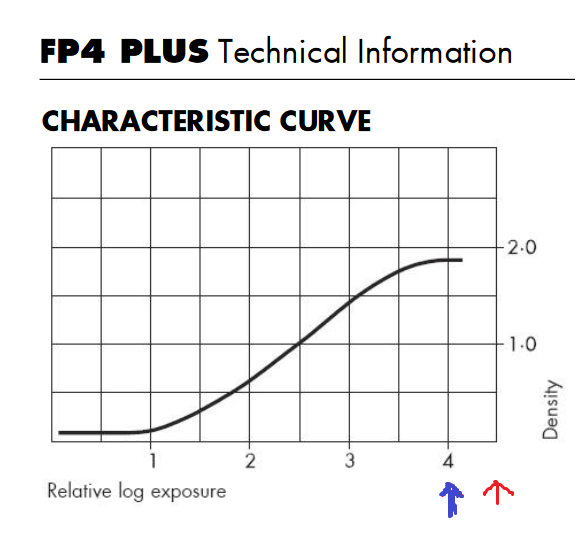
I should have added another case: Overexposure where highlight separation is important but you are using a film that flattens out fast. FP4+ for example. Assume you overexposed such that your whites fall on the red arrow but your highlights on the blue arrow. In this case, if you develop normal, they will have the same density, and it will be a bit tough to tell them apart. By adjusting your development, you can shift the curve to the right, thus putting the blue arrow on a part of the curve that gives it a different density than the red arrow.
p.1 #13 · Help me understand 'pushing/pulling film'
theHUN wrote:
I may have exaggerated the 3 stop bit, but you certainly can push film by 1 or 2 stops and get fine shadow detail. Many folks use HP5+ at ISO3200 with fine results.
Edit: And if you don't want to take my word for it (I admit I am a newbie) take a look at "Beyond the zone system" by Phil Davies, Fig. 3-22.
Pushing film development disproportionately adds density to the highlights (darker areas of the negative) and can only add some density to the shadows where there is some to begin with, but because of that disproportionality in densities, what you're really doing it just adding contrast. Go try it yourself. It's easier with sheet film as you don't have to do entire rolls at once but you can certainly do it with rolls as well. This is that we all did back in the day to dial in our exposure/development routines to produce negatives that printed how we wanted them to print. You find your own equilibrium and go with it, and by testing it yourself, you'll quickly see where the limitations lie.
p.1 #14 · Help me understand 'pushing/pulling film'
Peter Figen wrote:
Pushing film development disproportionately adds density to the highlights (darker areas of the negative) and can only add some density to the shadows where there is some to begin with, but because of that disproportionality in densities, what you're really doing it just adding contrast. Go try it yourself. It's easier with sheet film as you don't have to do entire rolls at once but you can certainly do it with rolls as well. This is that we all did back in the day to dial in our exposure/development routines to produce negatives that printed how we wanted them to print. You find your own equilibrium and go with it, and by testing it yourself, you'll quickly see where the limitations lie.
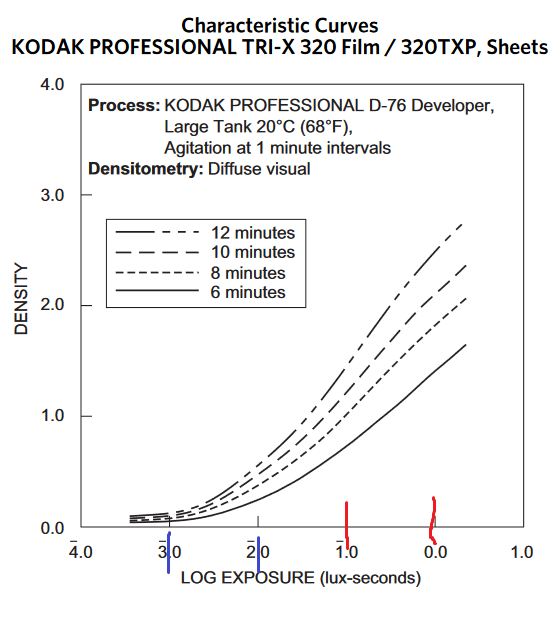
I understand that changing development changes many things, sometimes with unpleasant results. But I think the topic here is a situation where normal exposure (shown in red arrows) was not an option, so an underexposure happened (blue arrows) and the person is aware of it before developing. The question now is this: Do you adjust your development? This curve from the Tri-X spec sheet shows that some data can be salvaged by adjusting your development (time, concentration, agitation, temperature). Will this give best results? Probably not, I agree. But is it better than normal development. Probably yes.
p.1 #15 · Help me understand 'pushing/pulling film'
Exposure and previsualization is where this begins.
It is about the dynamic range of the scene, and what look you are going for. Ideally that thought process happens before you trip the shutter. (Tricky with roll film because how you develop the roll will affect every frame, regardless of whether they were all shot the same.)
Simplest way I can answer you is in the case of shadow detail, if you don’t have it in the negative, nothing you will do at the scanner will give it to you.
Imagine a cross section view of a piece of film that has been exposed and developed. The emulsion is thinnest in the shadows, medium thick in the mid tones, and thickest in the highlights.
Adjusting development times will affect the areas with more emulsion vs less. In a simple example-and not having a creative discussion about interpreting a scene-if you overexpose the film by 1 stop, you would pull the development by 1 stop. In that example, you are getting twice the density in the shadow area, thereby hopefully more detail, and by under developing by 1 stop you are keeping the highlights from getting too blocked up.
Having said that, in a 1 stop situation, you might be able to overexpose but develop normally because over exposing and under developing tends to compress contrast and maybe the scene can’t handle that, but you wanted to preserve shadow detail.
Have fun. This is going to be trial and error.
Apr 28, 2024 at 11:56 AM
AmbientMike Offline • • • • • • [X]
p.1 #16 · Help me understand 'pushing/pulling film'
ZdevilH1 wrote:
I'm brand new to film photography, but I've been shooting digital for almost 20 years.
I have a Leica M10P that goes with me everywhere. For business travels to family vacations and weekend outings.
I recently purchased a 1957 M3 DS and enjoying the learning curve.
My question is what is the difference between pushing film at development versus doing it in post after you scan the files ( ie Lightroom.). Am I looking at this wrong?
I haven't done this step yet as I just first sent out my first two rolls of film to get developed as I continue to create my home kit ...Show more →
The big problem on B&W print film , printed in the darkroom, is that if you have any underexposed negative you can't get the maximum black of the paper. I'd overexpose a stop or 2, just to avoid that, because you could just expose the paper longer to make up for the darker negative.
Interesting question, Something I've been thinking about though is it still true of scanned film? Picking up a raw a stop is no big deal, some recommend it to protect highlights, basically, and even jpegs can probably be picked up a stop in most situations.
Easier to pick it up in pp vs finding a lab to push process it
p.1 #17 · Help me understand 'pushing/pulling film'
AmbientMike wrote:
Interesting question, Something I've been thinking about though is it still true of scanned film? Picking up a raw a stop is no big deal, some recommend it to protect highlights, basically, and even jpegs can probably be picked up a stop in most situations.
Easier to pick it up in pp vs finding a lab to push process it
I think that gets at the original question in this thread. But if the details you're seeking to bring out aren't in the negatives to begin with, raising exposure of a raw scan of the negative isn't going to help.
p.1 #18 · Help me understand 'pushing/pulling film'
My simple answer is don't worry about it.
With C41 color film err on the side of over exposure. Which means box speed is always my max speed.
I would only ask a lab to push if I messed something up and I anticipated under-exposure.
Unless I REALLLLLLY needed the speed. Like pushing 800-1600. Which in that case I shoot digital. lol
With B&W and the many chemistry choices things get a bit more complex but also flexible. Some developers will result in different actual speeds so just knowing your starting point is half the battle.
And you are right - so much can be done in post that you just need a good even exposure so that you can make grade/print choices later. This is essentially what Hollywood does, either through an all analog process of an internegative or a digital scan.
For me that often means prioritizing shadow detail unless your scene is so wildly contrasty that you have to sacrifice either highlights or shadow. This is where knowing your film really comes into play.