fredmiranda.com
Login

Moderated by: Fred Miranda
  New fredmiranda.com Mobile Site
  New Feature: SMS Notification alert
  New Feature: Buy & Sell Watchlist
  

FM Forums | Leica & Alternative Gear | Join Upload & Sell

1       2       3       4              end
  

Archive 2024 · M glass on Leica SL3 (or SL SL2)


retrofocus
Offline
• • • • • •
Upload & Sell: Off
p.5 #1 · M glass on Leica SL3 (or SL SL2)


crf59 wrote:
And here is another explanation (from Canon) about Lens MTF (modulation transfer function) and how it affects image quality. And again, since image quality is the product of Lens MTF and Sensor MTF, an improvement (or degradation) in either affects output.

https://photo.stackexchange.com/questions/1686/how-do-i-interpret-an-mtf-chart

Another factor that is overlooked in many discussions is contrast ratio. Leica uses 50% for calculation of their lens performances, which is pretty conservative.


This is clear - older lenses have a much bigger falloff to the corners and borders of the lens but again this has nothing to do how a sensor outresolves the lens. It is also true that vintage lenses have lower contrast - this is definitely often visible in images no matter which sensor is used. But I am still not seeing an example of a photo which shows that a sensor outresolves any kind of lens attached to the camera.


Jul 16, 2024 at 08:12 AM
flash
Offline
• • • • •
Upload & Sell: On
p.5 #2 · M glass on Leica SL3 (or SL SL2)


crf59 wrote:
Completely untrue. Sensors can indeed out resolve lenses. Of course they're additive and cumulative in effect, but that's exactly the point. If the lens is the weakest performer in the "stack" the image will be limited by the resolving lines/mm of the lens. And vice versa if the sensor is the weak link. It's physics and no amount of hand waving will change that. It's no different than properly designed APO lenses outperforming non-APO lenses.

The whole picture is that lens MTF x sensor MTF results in overall "system" performance. So that's where Roger comes up with his argument. Meaning a
...Show more

Yes but the critical word here is *theoretical*. Same as MTF charts are usually a measurement of a theoretical maximum and not the actual lens you buy.

Can you name any examples of a photographic lens that’s been out resolved by any commercially available photographic sensor? Theoretically, I can have a Googal megapixel sensor. Commercially I can have 150MP in miniMF and 61MP in 135 format. Are there actually lenses that are resolution limited where you see it on a commercially available sensor? And if I use Fujifilm 400MP high res shot does any lens suddenly not resolve more than the straight 100MP mode (admittedly, mostly due to the reductions in aberrations that high res shot gives us)? If I strap my 80mm Zeiss planar from my 1980’s 501CM on the GFX100II is that not resolution limited by a modern sensor?

What we see in the real world is stuff like Fujifilm, stupidly, putting out a list of lenses that perform *best* on the 40MP sensor. Instantly you have muppets claiming the 40MP sensor out resolves the 35mm 1.4, which is rubbish. Or the usual claims that the M10R/M11 out resolves Mandler lenses. When I see comments that state things like *lens X only resolves 24MP* I throw up in my mouth a little bit. Theoretically, sure but I’ve not seen it in the real world.

Gordon


Jul 16, 2024 at 05:37 PM
crf59
Offline
• • •
Upload & Sell: On
p.5 #3 · M glass on Leica SL3 (or SL SL2)


Well, I don't know about specific lenses like the Fujis and I am sure differences are tiny on high grade lenses from any company. But it is a fact that high MP sensors can out resolve some lenses. My inability to give personal examples is because I don't buy cheap lenses. So in a quality lens the differences will be small but they are there. Again, it's not someone's opinion, it's fact. In one of my earlier posts, I clearly state that in most cases the differences are very small. You have me motivated to buy a cheap L mount lens and show folks. But, here's yet another article explaining why this is the case. Believe what you want, but it's hard to argue with proven math and physics.

https://www.cambridgeincolour.com/tutorials/lens-quality-mtf-resolution.htm


Jul 16, 2024 at 06:03 PM
philip_pj
Offline
• • • • • •
Upload & Sell: On
p.5 #4 · M glass on Leica SL3 (or SL SL2)


Much of the confusion (and obfuscation derived from received wisdom) flows from the use of inappropriate terminology, And the juxtapositioning of lenses and capture surfaces as competitors in an imaginary resolving competition.

Using language such as 'out-resolves' does not just imply this competitive arrangement, it explicitly defines it. It's particularly problematic when we know the relationship is multiplicative - an inescapable synergy. The language matters because it shapes your conceptual framework of the issue.

Probably, the limit in understanding here is the lack of an agreed method of hypothesis development leading to a sound methodology and method of examining results. This unfortunately moves us into more thorny confounding factors like: image prep, printing or forms of final image presentation. Do outcomes depend heavily on these and other output factors. My word they do, and I hope all can agree on this.


Jul 17, 2024 at 06:35 PM
philip_pj
Offline
• • • • • •
Upload & Sell: On
p.5 #5 · M glass on Leica SL3 (or SL SL2)


The investigation must be done in reverse, something that eludes many who think they are conducting these kinds of analyses these days. Most agree the final image for most uses and users is very acceptably sound at rather low levels of resolution - 24mp has been the standard for many years, with a little recent headroom to around 30mp.

There is very little applied intellectual interest in this industry, in many of the things we would like to know more about. I'm avowedly a final image oriented person, it's all that really matters to me. I want to see an experiment showing a complex deep natural scene, showing centres through to corners, shot on 12mp, 24mp, 42mp and 61mp sensors in cameras of the same generation, to control somewhat for extraneous factors.

Sony make these cameras yet no one has - to my knowledge - done this facile and infomative experiment. It would enable us to answer some very interesting questions, such as:

. how does Voigtlander's 35/2 APO-Lanthar interact with each sensor resolution in terms that are visible in output images processed identically?
. how do the output images differ in a typical 1500 x 1000 image that could be posted here?
. how do images wide open and f5.6 compare?

You would have to be interested in results though, rather than arcane forum chat with no reference to actual images, actual photography. Then, repeat the same experiment with a high quality last generation lens, such as the Zeiss 100mm f2 macro, on a good adapter.

In this connection, the next link shows Ming Thein opining that the (2009) 100MP is 'one of the few lenses that can keep up with the resolution of the Nikon D800E even at maximum aperture'. I can tell you this lens is not a particularly high resolving optic at f2, as shown by Zeiss's own MTF for it. Ming went from a 12mp D700 to a 36mp D800E, quite a leap at the time, and still today.

https://blog.mingthein.com/2012/07/27/revisited-and-reviewed-the-zeiss-zf-2-2100-makro-planar-t/

The experiment could then focus on in even older lenses, such as the (1980s) Zeiss Vario-Sonnar 35-70/3.4 at f8, where its MTF is as good as the 100MP at that one's best aperture of f4. Do its images look better, the same or worse in our 12-24-42-61 sensor set? What effect is visible?

You would learn more about the impact on photographic images of varying sensor MP counts with several well-regarded lenses in 48 hours than we have seen in 15 years. May questions would be answered, some listed above, others like; how do older lenses respond to high res cameras compared with the response of state of the art lenses?


Jul 17, 2024 at 07:35 PM
philip_pj
Offline
• • • • • •
Upload & Sell: On
p.5 #6 · M glass on Leica SL3 (or SL SL2)


We would shed light on questions such as:

'But I am still not seeing an example of a photo which shows that a sensor outresolves any kind of lens attached to the camera.'

But first, 'it is also true that vintage lenses have lower contrast' is not something you can be categorical about, and vintage refers to what years of release? Even if you use 10lpmm as a surrogate for 'lens contrast', which is fair enough, my CY 21/2.8 recorded around 97% on this measure - wide open. It's a 1993 lens, 31 years old.

The lenses I chose in the above post were not random choices, but all share the same design characteristics of very consistent cross-frame performance. The CV 35/2 loses 12% at best aperture from centre to corner. The 100MP loses 11%, and the venerable zoom loses 20% to the corner, and just 11% to the wide edge.

These figures correspond closely with Leica's latest two 35mm APOs (M and SL) but at reduced MTF levels, around 15-18% lower. The exception being the CV 35/2 APO, which is on parity with the M/SL lenses. (all MTF here = 40lpmm, unless stated otherwise.)

To finish, when Sony first released the a7r, many photographers rushed to see how their older lenses performed on this new versatile camera that enabled all manner of lenses to be used via adapters on its 36mp sensor. They were astonished to observe the dramatic change in these (not so wonderful) old film lenses that looked pretty decent on film prints. What happened? The outers were now progressively horrible, and the centres were amazing.

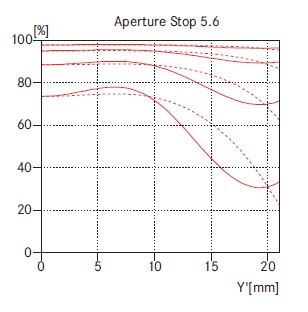
As an example, you would not need to look at say, Leica's Summilux-R80/1.4 on a high res camera at f5.6, because it loses 60% from near-axis to outer frames - with inevitable results!

The reason was the multiplicative relationship between sensor resolution and lens resolution, expressed across the image's real estate. We found that high res cameras heavily punish lenses with poor outer frames/corners while boosting the axial region disproportionately. It's the reason modern lenses have relatively flat MTF lines, designers realised they needed to fix the residual aberrations that were concentrated in outer frames, but had gone unnoticed in film and the early transition to low Mp digital.

So when we travel from the image backwards, the issue of 'out-resolving' matters recedes into abstract chat; and it matters much less than the perennial need for sound lens design and (I suspect) sensor Mp - lens performance harmony. But no one did that experiment, did they?

Finally, to support my contention see this graphic display of what happens to lens outer frame performance when transitioning to a 50mp sensor from a 21mp sensor, on a new Canon lens:

https://photozone.de/canon_eos_ff/964-canon35f14mk2?start=1

The bottom line is that lens design turns out to be very important to high resolution cameras, slip up and the images will look very different - caveat emptor! I think the actual cross-frame profile of output images is the secret 'third dimension' to the arguments surrounding 'resolving'. The devil is in the detail here. You need much more that 'this outresolves that'. Much more.

A good analogy for the products of sound lens design is 'a rising tide floats all boats': axis, midframes and far corners. I read the lens-sensor 'outresolve' arguments and thought: which part of the lens are they talking about?

Edited on Jul 17, 2024 at 09:01 PM · View previous versions


Jul 17, 2024 at 08:44 PM
retrofocus
Offline
• • • • • •
Upload & Sell: Off
p.5 #7 · M glass on Leica SL3 (or SL SL2)


We are still falling short seeing a real-world photo of a lens which was out-resolved by the sensor. I don't think it exists - what you see is lens specific characteristics like falloff towards borders and corners, and vignetting. Has noting to do with out-resolving - IMO a modern high MP sensor will always provide a better image even with an old lens attached to it from early film days compared to just taken on film. The sensor is simply not used to its fullest capability with such lens - but the photo created will still look great if lens-specific performance is also desired or at least accepted (which is subjective).


Jul 17, 2024 at 08:54 PM
philip_pj
Offline
• • • • • •
Upload & Sell: On
p.5 #8 · M glass on Leica SL3 (or SL SL2)


I'd like to agree with you, the analogy being a glass half full to getting topped up with newer/better lenses, but I cannot. The entire image and its rendering will change with large increases in resolution (MP count), commensurate with its cross-frame profile, as shown in many Optical Limits reviews.

The poorly designed lenses, and the ones that pushed to boundaries like some fast older Leica lenses, had their image profile changed dramatically with high res. What was unseen or barely visible had now become impossible to ignore. It's obvious and it's measurable, via MTF or Imatest procedures. The persuasive OL data tested 50mp and 21mp cameras (ratio 2.4), nowhere near the 12-24-42-61 disparities we see in Sony.

These lenses were simply not designed with high resolution output in mind. If your lens's centre was already much better than the rest of the frame, it stands to reason that it is heavily and disproportionately boosted by using a 61mp camera that does not so much for the outer frames in ACTUAL data. The disparities obviously grow more effectively than the percentage gain, which will remain constant across the frame.

Using the Summilux-R 80/1.4 as the example, if you boost the 10:4 ratio of the lens at f5.6 by a factor of three, the actual data goes from 10:4 to reach 30:12. The '12' is not much different to the '10' we had at the centre of the lower res camera's result, but the '30' in the new centre crosses many thresholds and will now unbalance the image for the focal plane data at least. The shallow mound becomes a pyramid shape.

The same phenomenon occurs with midfield curvature, where corners suddenly looked sharp with higher res. All data are accentuated. I'll include the example MTF to illustrate, and ask you to read the Optical Limits review I linked to above. They agree with me:

'In the image center, the quality is nothing short of breathtaking even at f/1.4. At f/2-f/2.8, it may even be able to outperform the 50mp monster sensor used in the EOS 5Ds R (used for testing). The outer image region is a different story though. At f/1.4 and f/2 they are somewhat soft although you should keep in mind again that this is at 50mp.'

There are other takes on the matter, like this one with a tangential view and disregarding the rendering effects of high res boosting performance, albeit unevenly:

'When comparing same size sensor cameras with different resolutions, you have to keep in mind that *the camera with more resolution will always put more strain on the lens* in terms of resolving power. A lens might do quite well on a 12 MP camera, but fail to resolve enough details on a 24 MP or a 36 MP camera, essentially throwing away the high resolution advantage.'

This is the pipeline theory, as I call it, where gains and losses accumulate rather than multiply. Dr Nasse showed that higher Mp will deliver gains for a given lens, always, on that we agree.


Jul 17, 2024 at 09:50 PM
philip_pj
Offline
• • • • • •
Upload & Sell: On
p.5 #9 · M glass on Leica SL3 (or SL SL2)


LEICA SUMMILUX-R 80 mm f/1.4, at f5.6 (landscape aperture). Will it stay the same or will it look very different, 24mp to 61mp? Put another way, 75-80% is a 2024 result, 25% takes us back to 1970. I doubt these kinds of lenses were ever intended to be used at middle apertures, even on film.


centre region 75% - wide edge 25% (40lpmm)


Jul 17, 2024 at 09:55 PM
RustyBug
Offline
• • • • • • •
Upload & Sell: On
p.5 #10 · M glass on Leica SL3 (or SL SL2)


retrofocus wrote:
We are still falling short seeing a real-world photo of a lens which was out-resolved by the sensor. I don't think it exists


The basic premise of "out-resolves" (for many) is when the size of the pixel is smaller than the airy disc of the optical projection. That is something that does occur, and by that prescribed definition, it does occur. There are also those who ascribe to outresolving a scenario that occurs relative to frequency and moire', et al. But, consider when the projection is supposed to be other than LL contrasts.

However ... I still find that the optical projection is a continuum of values. As such, no matter how small the sensor pixels become (i.e. smaller than the airy disc, etc.), they never achieve continuum. Thus, incapable of achieving continuum does not outresolve continuum. The best the sensor (theoretically) could do is present the full continuum of values, yet it does not.

And yes, I understand MTF's and LL, etc. ... which are also influenced by the amount and quality (specular vs. diffuse, etc.) of light illuminating a subject. While testing does offer a consistent reference point (within a given set), a lens can actually perform "above" it's advertised MTF with sufficient light amount / quality providing illumination greater than the "test standard".


We often look at the level of detail in lined pairs, but what about the tonality continuum in bokeh, fog or open sky (where no LL exists). Can a sensor outresolve the tonality of continuous tones projected by the lens? Even though I know that the sky or fog or bokeh, etc. is a continuous tone projected by the lens, pixel peeping will reveal the pixelation ... i.e. the sensor cannot outresolve the continuum.

So, depending on how you choose to "define" the term of "outresolve" (i.e. airy disc, frequency, moire', mtf from standardized light or tonality, the last of which rarely is spoken to), a person's stance on the matter may vary.

In the end, the lens provides a continuous optical projection, but the sensor provides a S/N response in the form of a sliced / diced matrix (i.e. not continuous).

And, yes ... the mathematical formula (can't find it right now) that is used to represent the system capability is a combination of both the limits of the lens and sensor in combination, where a rising tide lifts all boats, no matter whether it is the lens lifting the sensor or the sensor lifting the lens. Here again, the concept of the sensor "outresolving" the lens ... is kinda moot. A higher MP sensor doesn't outresolve the lens, it just does a better job (approaching, yet never achieving, continuum) of resolving the optical projection from the lens (whatever lens / light capability may be).


Just for fun ... here's one from the archives.

https://www.fredmiranda.com/forum/topic/504107/1/

Still trying to find the formula jcolwell provided us, many years back. If anyone has it ...


Jul 17, 2024 at 10:00 PM
retrofocus
Offline
• • • • • •
Upload & Sell: Off
p.5 #11 · M glass on Leica SL3 (or SL SL2)


RustyBug wrote:
The basic premise of "out-resolves" (for many) is when the size of the pixel is smaller than the airy disc of the optical projection. That is something that does occur, and by that prescribed definition, it does occur. There are also those who ascribe to outresolving a scenario that occurs relative to frequency and moire', et al. But, consider when the projection is supposed to be other than LL contrasts.

However ... I still find that the optical projection is a continuum of values. As such, no matter how small the sensor pixels become (i.e. smaller than the airy disc, etc.),
...Show more

I don't question all the formula-based description - but I question how it matters for a real-world photo. I still don't see one which shows that a sensor outresoved a lens independent on specific lens properties (light falloff, vignetting, low contrast etc).


Jul 18, 2024 at 07:06 AM
LBJ2
Offline
• • • • •
Upload & Sell: On
p.5 #12 · M glass on Leica SL3 (or SL SL2)


retrofocus wrote:
I don't question all the formula-based description - but I question how it matters for a real-world photo. I still don't see one which shows that a sensor outresoved a lens independent on specific lens properties (light falloff, vignetting, low contrast etc).


You might be able to create your own proof with one of your digital cameras that doesn't have an AA filter and one of your highly corrected lenses:

"The presence of aliasing is indisputable proof that the lens is out resolving the sensor." –Jim Kasson
https://www.dpreview.com/forums/post/65097368

But yes, it can be difficult to isolate and correlate the other associated artifacts you listed e.g., light falloff, vignetting, low contrast etc., real world because these same issues can be a result of other factors or a combination of factors as well.

FWIW: the importance of matching sensor and lens in the commercial world:

https://www.technexion.com/resources/matching-image-sensor-and-lens-the-what-and-the-how/


Jul 25, 2024 at 10:12 AM
retrofocus
Offline
• • • • • •
Upload & Sell: Off
p.5 #13 · M glass on Leica SL3 (or SL SL2)


LBJ2 wrote:
You might be able to create your own proof with one of your digital cameras that doesn't have an AA filter and one of your highly corrected lenses:

"The presence of aliasing is indisputable proof that the lens is out resolving the sensor." –Jim Kasson
https://www.dpreview.com/forums/post/65097368

But yes, it can be difficult to isolate and correlate the other associated artifacts you listed e.g., light falloff, vignetting, low contrast etc., real world because these same issues can be a result of other factors or a combination of factors as well.

FWIW: the importance of matching sensor and lens in the commercial world:

https://www.technexion.com/resources/matching-image-sensor-and-lens-the-what-and-the-how/


Taking lens differences out of the equation, I am not convinced at all that the best performance is only obtained using best sensor with best/latest/newest high performing lens. I still don't see an example photo where a more standard lens is outperformed by the sensor compared to high performing lens on the same sensor - none of the links here and earlier shows this. It seems to be more of a marketing hype to make users upgrade to the newer lens and camera system to get "best" performance - image quality might increase simply due to better lens performance itself independent on the sensor at all (even resolution differences play a role for details but this is different then "outresolving" a lens).


Jul 25, 2024 at 12:38 PM
szwayko
Offline

Upload & Sell: Off
p.5 #14 · M glass on Leica SL3 (or SL SL2)


Check this adapter for leaks with a flashlight. I returned mine – it let light through. I’m taking some photos with long exposure times of 1-2 minutes, and this is a problem with so-called stray light. So far, of the adapters I’ve tested, the good one is the adjustable 7artisans macro.


Dec 13, 2025 at 11:54 AM
1       2       3       4              end


FM Forums | Leica & Alternative Gear | Join Upload & Sell

1       2       3       4              end


Welcome back
Log in to your account