mark1958 wrote:
I have tested the 35mm M Apo Summicron on the SL2 and just a tad of smearing in the corners on the SL2 at the wide apertures
Hmm, interesting. This also happens with the 35/2 APO-Lanthar. If you try the 35/1.4 FLE, you will see no degradation. I wonder if apochromatic optical designs are the cause.
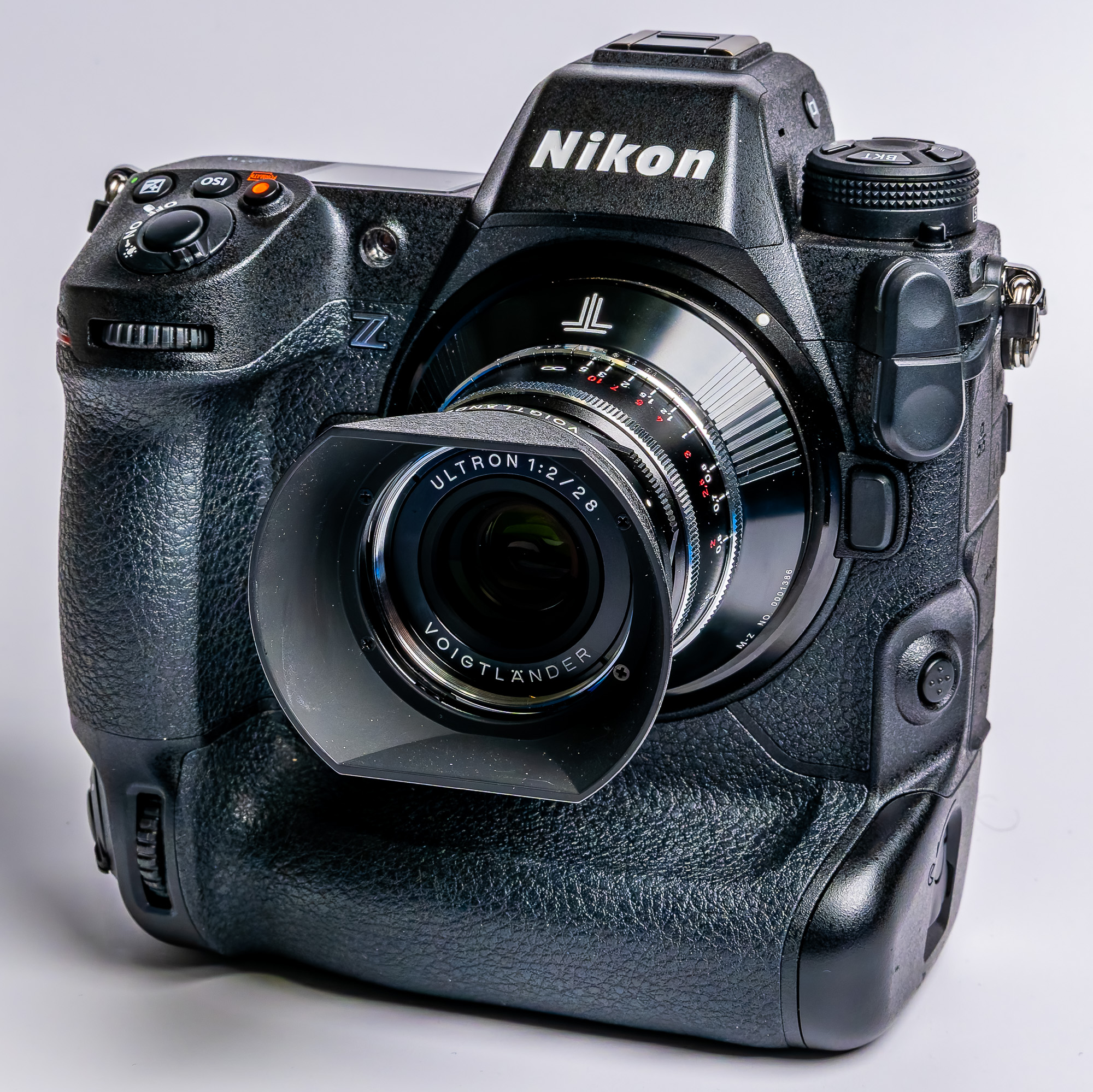
You guys were right! I have never had such good results from an M-Mount lens on any mirrorless (my SL2 included) until I tried it on my Nikon Z9. So far I have tried it only with my Voigtlander Ultra 28mm F2, but even the corners are tack sharp
NIKON Z 9Voigtlander VM 28mm f/2 Ultron Aspherical lens28mmf/2.81/160s64 ISO0.0 EV
NIKON Z 9Voigtlander VM 28mm f/2 Ultron Aspherical lens28mmf/2.81/160s64 ISO0.0 EV
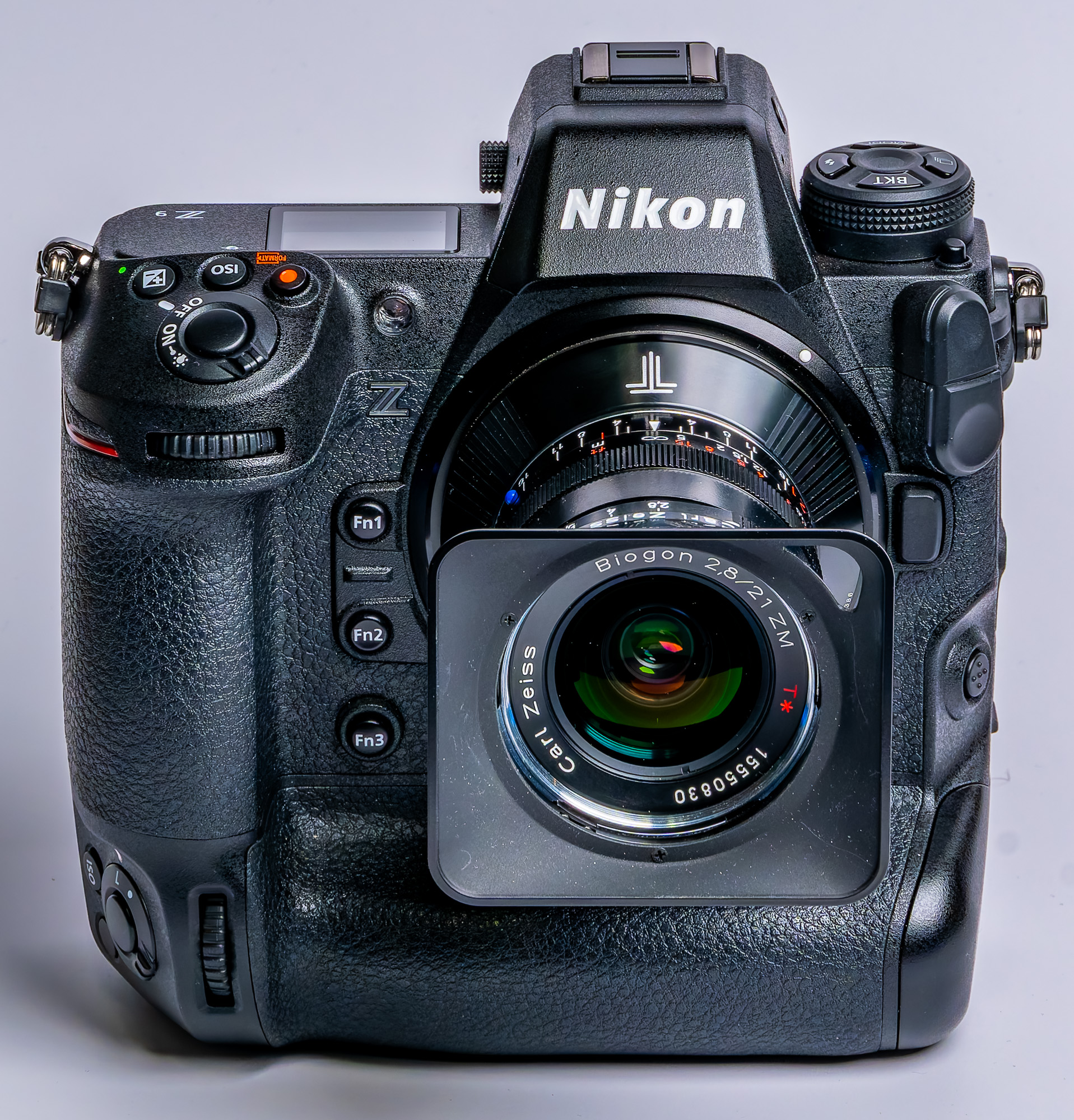
Next task: Try it with the Zeiss ZM Biogon 21mm F2.8. Being so wide, this is the ultimate test.... Apart from the center, it is horrible even in "mid-field" on any mirrorless camera. It is already mounted on my Z9 and ready!
Apr 27, 2024 at 12:28 AM
Mark Metternich Offline • • • • • • Upload & Sell: On
I have to agree here. They (especially the 35 and 50mm) have been outstanding on the SL2 and the Panasonic Lumix S1R as well.
I should be running that test (SL2 vs SL3) some time this year. Because I make gigantic world class enlargements for top end nature and landscape galleries (nationally and internationally) full time (for more than 15 years now) I am pushing the boundaries of what’s possible every single day. I also get to test (and process) many files from just about every camera/lens system out there. For me, the real acid test is when I am making a world-class 120”, 90”, 72”, 60”, 50”… or even far larger (the largest being 30’ and 40’ this year). I think of this almost like looking at the quality of the fine detail through a microscope. And it’s really where I see whether a camera/lens combination is truly a full 47 megapixels, 50 megapixels, or 60 megapixels (35mm). Or in the case of medium format, 50 megapixels, 60 megapixels, 80 megapixels, 100 megapixels and 150 megapixels (like the Phase One IQ4)…
This addition to standard resolution testing, I believe gives me a very unusual perspective on the reality of true quality detail/resolution. And all I can say is I’m beyond skeptical about any lens giving a 60 megapixel camera, a full 60 megapixels worth of ultra fine detail. Especially throughout the image.
I don’t want to start a controversy here so I’m not gonna debate about it, but I believe there’s only a couple of lenses on the planet (for 35mm) that might be giving the ultra sharp center of a lens at, or near 60 megapixels. I believe that we are in big need of a new breed of lenses for what some of these newest cameras could potentially resolve. Hopefully we will have breakthroughs in the technology and physics of lenses and glass for the raw potential of these amazing new cameras.
Abuttolph wrote:
I can’t answer specifically about the SL3 or the two luxes, but I have been very happy with the results of M lenses on my SL2.
Mark Metternich wrote:
I have to agree here. They (especially the 35 and 50mm) have been outstanding on the SL2 and the Panasonic Lumix S1R as well.
I should be running that test (SL2 vs SL3) some time this year. Because I make gigantic world class enlargements for top end nature and landscape galleries (nationally and internationally) full time (for more than 15 years now) I am pushing the boundaries of what’s possible every single day. I also get to test (and process) many files from just about every camera/lens system out there. For me, the real acid test is when I am making a world-class 120”, 90”, 72”, 60”, 50”… or even far larger (the largest being 30’ and 40’ this year). I think of this almost like looking at the quality of the fine detail through a microscope. And it’s really where I see whether a camera/lens combination is truly a full 47 megapixels, 50 megapixels, or 60 megapixels (35mm). Or in the case of medium format, 50 megapixels, 60 megapixels, 80 megapixels, 100 megapixels and 150 megapixels (like the Phase One IQ4)…
This addition to standard resolution testing, I believe gives me a very unusual perspective on the reality of true quality detail/resolution. And all I can say is I’m beyond skeptical about any lens giving a 60 megapixel camera, a full 60 megapixels worth of ultra fine detail. Especially throughout the image.
I don’t want to start a controversy here so I’m not gonna debate about it, but I believe there’s only a couple of lenses on the planet (for 35mm) that might be giving the ultra sharp center of a lens at, or near 60 megapixels. I believe that we are in big need of a new breed of lenses for what some of these newest cameras could potentially resolve. Hopefully we will have breakthroughs in the technology and physics of lenses and glass for the raw potential of these amazing new cameras.
Discussions need not evoke more heat than mere intellectual exchange - as interests of the mind, a getting closer to the truth that can be shared and agreed upon, in the dialectic.
'I believe there’s only a couple of lenses on the planet (for 35mm) that might be giving the ultra sharp center of a lens at, or near 60 megapixels.'
Readers may be interested in the identity of these optics in your work.
'I believe that we are in big need of a new breed of lenses for what some of these newest cameras could potentially resolve.'
Yours is an unusual circumstance, existing at the edge of the usual marketing issues associated with lens production as generally understood. Indeed, on-axis performance is very hard to sustain across the 43mm diagonal, yet many MTF charts (albeit with their own issues in most cases) indicate a fair number of the better APO lenses do manage this feat, some even at very wide apertures. Many lose under 5% of IQ from axis to corner. I'd have thought image quality in a reasonably faithful process chain would be linear or close to it. thanks for your comments.
While I own both M and SL lease, they are not equal. The SL APO lenses are superior to the M lenses no matter what body they're on. It's true and it's physics. Peter Karbe at Leica (lens designer, has said as much in a few videos). Go to about 1:15 here:
He indicated the SL APO lenses resolved 3 times the lines/mm compared to the M APO lenses. It's physics and no amount of effort will make an M lens with the same design factors perform as well as an SL lens. Being much smaller, the M lenses depend on much more curvature in lens elements and tighter spacing to maintain size. That's Snell's Law and you can't change that with glass optics. Flange diameter further limits M lens performance. A 35mm APO M is very expensive because of the heroic attention to build that it requires to perform well - high tolerances, careful centering, etc.
So if you want to resolve the most detail possible on an SL series camera, it will be with the SL lenses. No escaping that. The 35mm APO SL is exceedingly sharp. BUT, I also have a Canon R5 and the 50mm 1.2 RF lens. I think, though I don't spend any time really investigating, that lens is just as good.
Lots of people argue about which determines the most in resolution, but the reality is a 60mp sensor is VERY demanding of lenses to get the ultimate resolution from them. So if I were trying to print huge from any file, I'd pair the native, best lenses from any system with the high resolution cameras.
Ultimately though I think we get too wrapped up in all this sensor and resolution talk. The only reason I use high MP count bodies is simply to allow me to crop more. I was always happy with 24 MP from an IQ perspective. Nobody ever complained about Ansel Adams image resolution. Nor did anyone say the old film cameras produced crappy images. What I do see as a major advantage in the new 60 MP Leicas is their much lower high ISO noise and the increased dynamic range. That's more useful to me.
Sorry for the long post - I'm an engineer and we deal with this all the time on optical perception systems for unmanned boats and ships. Resolution at range is a big deal for us in seeing small craft on the horizon, so we have to be very careful to optimize the lens/sensor "system".
crf59 wrote:
Lots of people argue about which determines the most in resolution, but the reality is a 60mp sensor is VERY demanding of lenses to get the ultimate resolution from them.
I often hear that new high MP sensors "out-resolve" older lenses. I have never experienced this other than getting more vignetting and maybe some corner blur from old vintage lenses which they do with every sensor no matter of resolution. How does an image look like when a lens is out-resolved by a sensor? From my experience it is actually best to use vintage/older lenses with modern higher resolution sensors and use higher resolving lenses on lower resolution receiver - for example film.
Some Leica lens bigwig (I believe it was Peter Barber) said that the SL cameras are - save for the M cameras - the best ever made for M lenses. I shoot almost exclusively M lenses on 2s and love the results.
sjberg444 wrote:
Some Leica lens bigwig (I believe it was Peter Barber) said that the SL cameras are - save for the M cameras - the best ever made for M lenses. I shoot almost exclusively M lenses on 2s and love the results.
Peter Karbe. Leica’s legendary Chief Lens Designer.
retrofocus wrote:
I often hear that new high MP sensors "out-resolve" older lenses. I have never experienced this other than getting more vignetting and maybe some corner blur from old vintage lenses which they do with every sensor no matter of resolution. How does an image look like when a lens is out-resolved by a sensor? From my experience it is actually best to use vintage/older lenses with modern higher resolution sensors and use higher resolving lenses on lower resolution receiver - for example film.
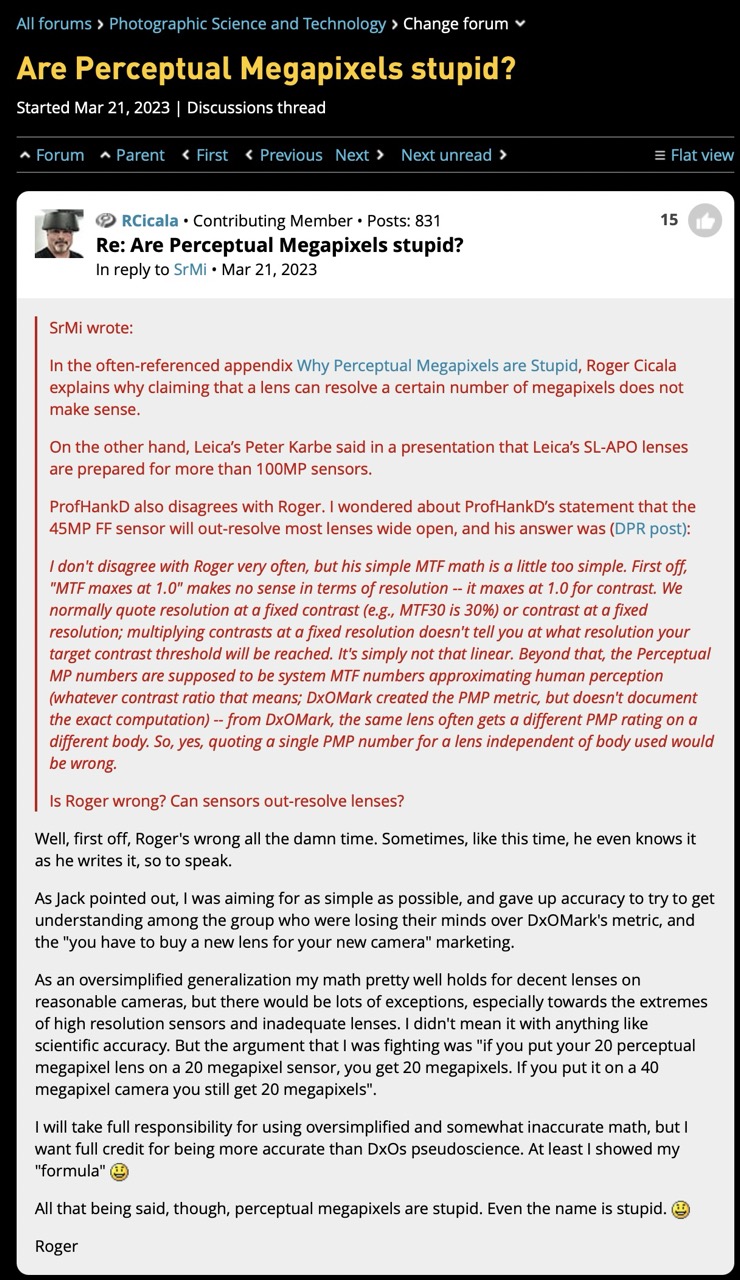
Roger Cicala (of Lens Rentals) explained quite clearly why this is a myth. Lens MTF and sensor resolution are additive/cumulative not exclusive. Improve one and the system benefits. His advice was to pick the one that would benefit the system most. Anyone who’s compared medium format to 135 format will get this.
Some older lenses don’t play nice with micro lenses and FSI sensor wells but as the wells move closer to the front of the sensor this becomes less and less of an issue with every new generation of cameras. Hence the new Nikon Z8/9.
flash wrote:
Roger Cicala (of Lens Rentals) explained quite clearly why this is a myth. Lens MTF and sensor resolution are additive/cumulative not exclusive. Improve one and the system benefits. His advice was to pick the one that would benefit the system most. Anyone who’s compared medium format to 135 format will get this.
Some older lenses don’t play nice with micro lenses and FSI sensor wells but as the wells move closer to the front of the sensor this becomes less and less of an issue with every new generation of cameras. Hence the new Nikon Z8/9.
flash wrote:
But sensors out resolving lenses? Not really.
Gordon
+1
The projected image of an M lens will be what it is the same on an M, as it is on an SL. Microlens / thickness issues, notwithstanding the projected image is the same.
SL lenses being such as they are, project a different image ... i.e. much more glass to work with. So, it kinda depends on how you are asking / comparing things.
I'll gladly shoot my M lenses on either of my M bodies or my SL2-S ... mounting them on different bodies has no significant impact on the projected image. Come on in, the water is fine.
Now, if you're asking if the M is the best resolving lens projection available to the SL mount ... then, the answer is no, the SL lenses are designed with more glass, different optical design, etc. and can achieve levels different from M lenses.
I mean, a 1/4 ton pickup can carry so much load. a 1/2 ton pickup can carry more. Both can get groceries just fine.
flash wrote:
Roger Cicala (of Lens Rentals) explained quite clearly why this is a myth. Lens MTF and sensor resolution are additive/cumulative not exclusive. Improve one and the system benefits. His advice was to pick the one that would benefit the system most. Anyone who’s compared medium format to 135 format will get this.
Some older lenses don’t play nice with micro lenses and FSI sensor wells but as the wells move closer to the front of the sensor this becomes less and less of an issue with every new generation of cameras. Hence the new Nikon Z8/9.
Completely untrue. Sensors can indeed out resolve lenses. Of course they're additive and cumulative in effect, but that's exactly the point. If the lens is the weakest performer in the "stack" the image will be limited by the resolving lines/mm of the lens. And vice versa if the sensor is the weak link. It's physics and no amount of hand waving will change that. It's no different than properly designed APO lenses outperforming non-APO lenses.
The whole picture is that lens MTF x sensor MTF results in overall "system" performance. So that's where Roger comes up with his argument. Meaning a better sensor results in a better picture and a better lens results in a better picture. But the theoretical maximum performance can be limited by either. Resolving power is also not fixed. If the lines/mm is say 1000, divide by the aperture, and multiply by 2 to get the pixel pitch needed to out resolve the lens. All sensors have a fixed pixel pitch. And for lenses, look at DXOMARK - for the description they use for the stack. There is even a published standard for measuring the combined performance - ISO 12233. Either the lens or the sensor can impact performance. The Leica APO SL 50mm for example is still not limited up to a 100 MP sensors in 35mm format. The Canon 50mm f1.2 RF is also a great performer.
But I don't know why people get so worked up over it. You'd likely not see the different on any modern lens and most older ones. Simply watch Karbe's video that I posted. One of the world's best lens designers discusses the topic. But where you will see this is where the lens aperture results in diffraction - narrow apertures with high resolution sensors will indeed show visible change as diffraction sets in. And in the extreme corners.
crf59 wrote:
Completely untrue. Sensors can indeed out resolve lenses. Of course they're additive and cumulative in effect, but that's exactly the point. If the lens is the weakest performer in the "stack" the image will be limited by the resolving lines/mm of the lens. And vice versa if the sensor is the weak link. It's physics and no amount of hand waving will change that. It's no different than properly designed APO lenses outperforming non-APO lenses.
Do you have an example image/photo showing this? I would be very interested! All nice in theory but let's see the practical impact if possible.
I have seen better examples and more scientific setups - will look for those later.
This shows more a test scenario of a modern Fuji MF camera with GF lens - not sure what this is telling me how a sensor out-resolves for example a vintage lens. This seems more a test and PP scenario.
And here is another explanation (from Canon) about Lens MTF (modulation transfer function) and how it affects image quality. And again, since image quality is the product of Lens MTF and Sensor MTF, an improvement (or degradation) in either affects output.
Another factor that is overlooked in many discussions is contrast ratio. Leica uses 50% for calculation of their lens performances, which is pretty conservative.