I think it is mainly because 20g do not has the build in corrections when you use it on Nikon body. THe build in corrections is different from the Lightroom corrections or so. And I think it cannot be turned off.
BowenC wrote:
I think it is mainly because 20g do not has the build in corrections when you use it on Nikon body. THe build in corrections is different from the Lightroom corrections or so. And I think it cannot be turned off.
Built in corrections on the 20G are for CA. LR has its own for distortion/vignette that can be toggled.
tsdevine wrote:
If you modify the Sony stack, like with Kolari, it can hurt the performance of some native lenses. Full disclosure I don't have first hand experience, but I don't think I'm going out on a limb there.
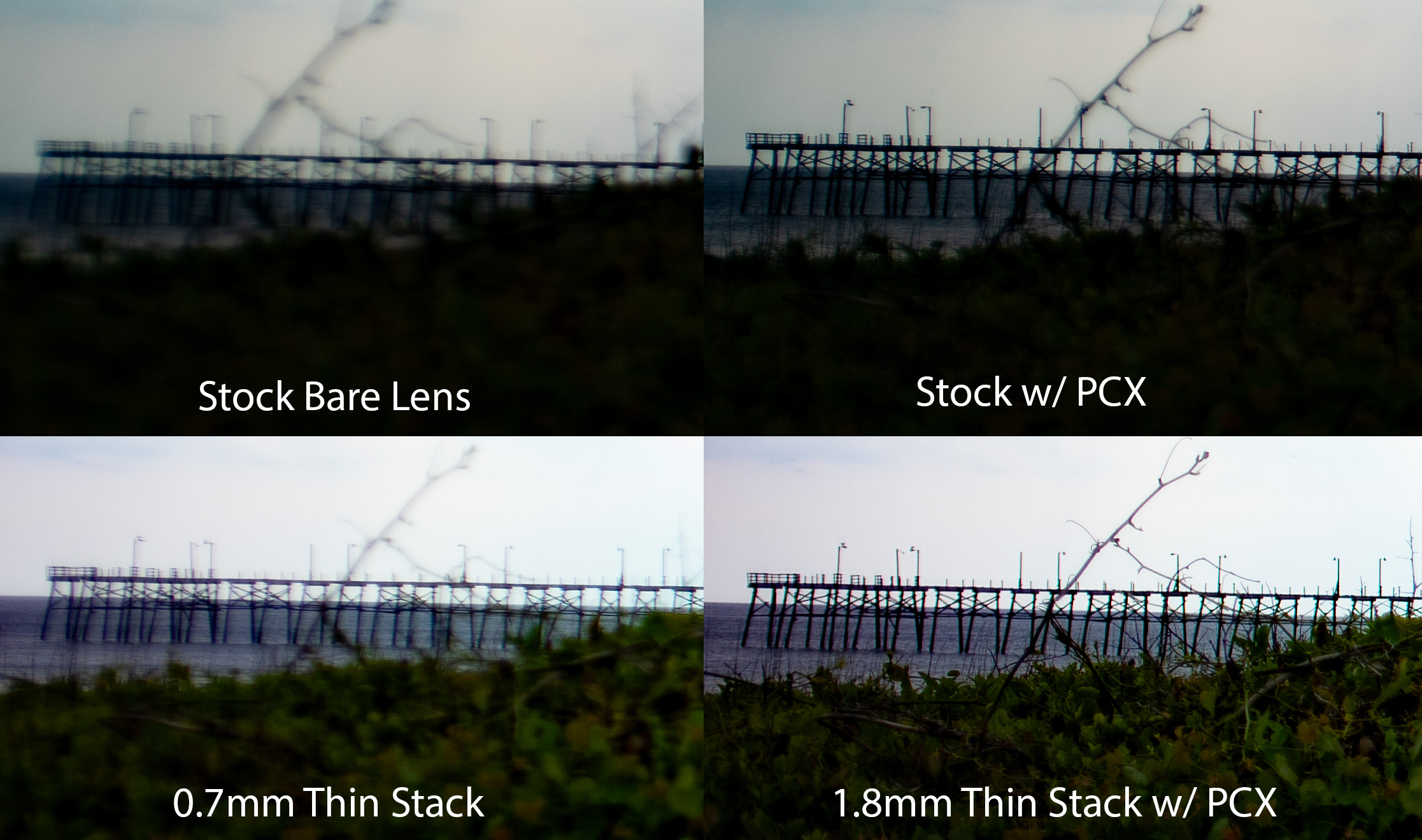
Somehow I missed this months ago. All the suspicious are correct, I’ve used a variety of cover glass thickness and discussed with various people. The type of cover glass and its refractive index can play a role as well. Sony is tailored to its 2.5mm cover glass. Consensus of Nikon seemed to be 2.3mm. It absolutely can basically change field curvature of the lens resulting in loss of sharpness. It’s related to the PCX lenses that were occasionally used for rangefinder corrections, those would vary by cover glass too. Effects could also be seen in some E lenses like the Loxia 35 between Nikon and Sony, Midfield would degrade but corners would improve on Nikon. Basically the field curvature would shift. I’ve got old samples somewhere showing a Contax G28 did better in a 1.8mm stack with a PCX lens than even a 0.8mm bare sensor without PCX. Especially if you’re pixel peeping a couple 1/10 of a mm is plenty.
Edit: Found it. Far corner samples of Contax G 28mm
Some interesting data to add to this thread. For me the issues with corner performance seem to be very lens dependent, perhaps even more so than focal length. I didn't notice huge issues with the 20mm when I used it adapted on Nikon, but in that particular case I was using it with an Astro modded Z7 so it's not a good test bed for normal nikon performance. I have used the 14mm GM on a Nikon and had no issues with corner degradation. Last night, however, I was testing out some adapted lenses for stars on a Z8 and found that my 50mm APO Lanthar f/2 Voight really suffered on the star field when adapted. This lens on an A7rV is absolutely flawless. Conversely, I tested the Sigma 15mm 1.4 Diagonal fisheye on the Z8 and it was absolutely flawless. That lens is crazy impressive as it is, but it loses absolutely nothing adapting to Nikon. So, I don't know that it is inherently just adapting wide angle lenses that produces issues, but more the design of certain lenses that plays nice, and certain lenses that don't. Obviously, past 135mm lenses become a lot more tolerant of backfocus and sensor glass issues, but I was surprised to see the voigt 50mm take such a hit adapted when it is so good native. In contrast, my 50mm 1.2 GM adapts absolutely perfectly.
nhmorgan wrote:
Some interesting data to add to this thread. For me the issues with corner performance seem to be very lens dependent, perhaps even more so than focal length. I didn't notice huge issues with the 20mm when I used it adapted on Nikon, but in that particular case I was using it with an Astro modded Z7 so it's not a good test bed for normal nikon performance. I have used the 14mm GM on a Nikon and had no issues with corner degradation. Last night, however, I was testing out some adapted lenses for stars on a Z8 and found that my 50mm APO Lanthar f/2 Voight really suffered on the star field when adapted. This lens on an A7rV is absolutely flawless. Conversely, I tested the Sigma 15mm 1.4 Diagonal fisheye on the Z8 and it was absolutely flawless. That lens is crazy impressive as it is, but it loses absolutely nothing adapting to Nikon. So, I don't know that it is inherently just adapting wide angle lenses that produces issues, but more the design of certain lenses that plays nice, and certain lenses that don't. Obviously, past 135mm lenses become a lot more tolerant of backfocus and sensor glass issues, but I was surprised to see the voigt 50mm take such a hit adapted when it is so good native. In contrast, my 50mm 1.2 GM adapts absolutely perfectly. ...Show more →
Thanks for sharing. It's definitely design-dependent rather than focal length, likely related to the backfocus distance. For example, the Sony 20G performed quite poorly but the Sony 20-70 f/4 quite well, even at common apertures.
Oct 08, 2024 at 10:44 AM
Steve Spencer Online • • • • • • • Upload & Sell: On
snapsy wrote:
Thanks for sharing. It's definitely design-dependent rather than focal length, likely related to the backfocus distance. For example, the Sony 20G performed quite poorly but the Sony 20-70 f/4 quite well, even at common apertures.
If you read the articles on sensor glass thickness from lens rentals blog there are at least 2 factors in lens design that they demonstrate make a difference. First, there is exit pupil length. The longer the exit pupil the less issues that will emerge when adapting. This factor likely is pretty highly correlated with focal length of the lens (but not perfectly so) and no doubt plays a role in the general rule that longer lenses adapt better than shorter lenses. If you read the lens rentals blog posting you will see in their description that this factor has more impact the farther you move away from the center of the frame.
Second, aperture matters. There are more problems at wide aperture than at narrow apertures and this problem affects the whole frame and we do generally see that slower lenses (and when lenses are stopped down) we see less issues with adapting.
These issues of lens design certainly matter, but in my experience I think one other is important and that is how much the lens needs an exact distance from the sensor or not. Some lenses perform a lot more poorly with adapter that are a little too short (i.e., thin) than adapters that are the exact right thickness. Most adapters (but not all) are too thin. If a lens is sensitive to the adapter thickness people often mistake that issue with cover glass issues (and floating element lenses are designed to have an exact distance to the sensor and some of these lenses can be very sensitive to adapter thickness). A good example of a lens that fits this description is the Voigtlander 21 f/1.4. Jman13 recently demonstrated the lens didn't work well on his Nikon Z8 with a too thin adapter, but worked well with an adapter of the right thickness. My experience of this lens was similar.
So if you are going to adapt know that longer exit pupils are better, narrower apertures are better, and make sure you get an adapter with the right thickness or shim a thinner adapter especially if you are experiencing problems with a lens with floating elements. I think this threads makes a good case that software correction is another possibly important problem when adapting lenses.
I suspect this does not exhaust all the ways lens design can affect adapting, but it is a good place to start and then test the specific lens you want to use to make sure that it works up to the standards that you need for your photography. Adapting can provide some really nice solutions but you really won't know if it will work for you until you adapt the lens you want to use and work with it for awhile to see how it performs.
Steve Spencer wrote:
If you read the articles on sensor glass thickness from lens rentals blog there are at least 2 factors in lens design that they demonstrate make a difference. First, there is exit pupil length. The longer the exit pupil the less issues that will emerge when adapting. This factor likely is pretty highly correlated with focal length of the lens (but not perfectly so) and no doubt plays a role in the general rule that longer lenses adapt better than shorter lenses. If you read the lens rentals blog posting you will see in their description that this factor has more impact the farther you move away from the center of the frame.
Second, aperture matters. There are more problems at wide aperture than at narrow apertures and this problem affects the whole frame and we do generally see that slower lenses (and when lenses are stopped down) we see less issues with adapting.
These issues of lens design certainly matter, but in my experience I think one other is important and that is how much the lens needs an exact distance from the sensor or not. Some lenses perform a lot more poorly with adapter that are a little too short (i.e., thin) than adapters that are the exact right thickness. Most adapters (but not all) are too thin. If a lens is sensitive to the adapter thickness people often mistake that issue with cover glass issues (and floating element lenses are designed to have an exact distance to the sensor and some of these lenses can be very sensitive to adapter thickness). A good example of a lens that fits this description is the Voigtlander 21 f/1.4. Jman13 recently demonstrated the lens didn't work well on his Nikon Z8 with a too thin adapter, but worked well with an adapter of the right thickness. My experience of this lens was similar.
So if you are going to adapt know that longer exit pupils are better, narrower apertures are better, and make sure you get an adapter with the right thickness or shim a thinner adapter especially if you are experiencing problems with a lens with floating elements. I think this threads makes a good case that software correction is another possibly important problem when adapting lenses.
I suspect this does not exhaust all the ways lens design can affect adapting, but it is a good place to start and then test the specific lens you want to use to make sure that it works up to the standards that you need for your photography. Adapting can provide some really nice solutions but you really won't know if it will work for you until you adapt the lens you want to use and work with it for awhile to see how it performs....Show more →
Agreed. I was thinking of exit pupil distance when I wrote my post but for some silly reason I wrote 'back focus' instead.
Steve Spencer wrote:
If you read the articles on sensor glass thickness from lens rentals blog there are at least 2 factors in lens design that they demonstrate make a difference. First, there is exit pupil length. The longer the exit pupil the less issues that will emerge when adapting. This factor likely is pretty highly correlated with focal length of the lens (but not perfectly so) and no doubt plays a role in the general rule that longer lenses adapt better than shorter lenses. If you read the lens rentals blog posting you will see in their description that this factor has more impact the farther you move away from the center of the frame.
Second, aperture matters. There are more problems at wide aperture than at narrow apertures and this problem affects the whole frame and we do generally see that slower lenses (and when lenses are stopped down) we see less issues with adapting.
These issues of lens design certainly matter, but in my experience I think one other is important and that is how much the lens needs an exact distance from the sensor or not. Some lenses perform a lot more poorly with adapter that are a little too short (i.e., thin) than adapters that are the exact right thickness. Most adapters (but not all) are too thin. If a lens is sensitive to the adapter thickness people often mistake that issue with cover glass issues (and floating element lenses are designed to have an exact distance to the sensor and some of these lenses can be very sensitive to adapter thickness). A good example of a lens that fits this description is the Voigtlander 21 f/1.4. Jman13 recently demonstrated the lens didn't work well on his Nikon Z8 with a too thin adapter, but worked well with an adapter of the right thickness. My experience of this lens was similar.
So if you are going to adapt know that longer exit pupils are better, narrower apertures are better, and make sure you get an adapter with the right thickness or shim a thinner adapter especially if you are experiencing problems with a lens with floating elements. I think this threads makes a good case that software correction is another possibly important problem when adapting lenses.
I suspect this does not exhaust all the ways lens design can affect adapting, but it is a good place to start and then test the specific lens you want to use to make sure that it works up to the standards that you need for your photography. Adapting can provide some really nice solutions but you really won't know if it will work for you until you adapt the lens you want to use and work with it for awhile to see how it performs....Show more →
Thanks for this awesome response. Since so many people use the ETZ21 adapter, it might be helpful to create a running list of lenses that do and don't work well when adapted to Nikon.
Probably also relevant from Kolari's website:
"One additional concern regarding modifying Sony full frame mirrorless cameras, in particular, comes from the design choices Sony made in these cameras early on. Sony originally designed the E-mount for an APS-C-sized sensor and only later added full frame options. They tasked their engineers to fit the full frame sensor in the existing E-mount to maximize lens compatibility, and they were just barely able to squeeze the sensor behind the mount. The fit was so tight that the sensor’s corners reached beyond the lens mount opening. You can see a stark difference to the RF-mount, which was designed for full frame from the start.
As a result of this design constraint, Sony FE lenses must first narrow the light through a smaller mount and then project the image out at a wide angle to resolve over the whole sensor. You can see this narrowing in many of the FE lenses, and the result is that Sony lenses have a wide incident angle of the light leaving the lens. Unfortunately, this pairs poorly with Sony’s design choice to use an exceptionally thick UV/IR cut filter over their sensor. Thick glass does not play well with wide incident angles of light and causes a field curvature, leaving the corners of the images soft.
Of course, Sony has excellent optical engineers, so when designing their lenses, they can work around these two constraints and optimize the lens to project an inverted field curvature that the sensor glass deflects back to a flat field for sharp images. In the modification world, this presents a challenge, as any changes to the filter thickness throw off this optimization. The problem can’t simply be solved by matching the filter thickness, as the mix of wavelengths changes and the apochromatic corrections are skewed after modification. If you add a clip-in filter to the equation, the sensor glass thickness changes, and the camera can never be optimized for shooting both with or without a clip-in. The overall effect can be slight, but stars are a perfect subject to observe even the slightest differences. Sony lenses are often the most sensitive to sensor modifications. Nikon and Canon lenses handle camera modifications better as they aren’t limited by these same constraints."