p.41 #3 · Nikon Zf as a platform for adapted/native manual focus lenses
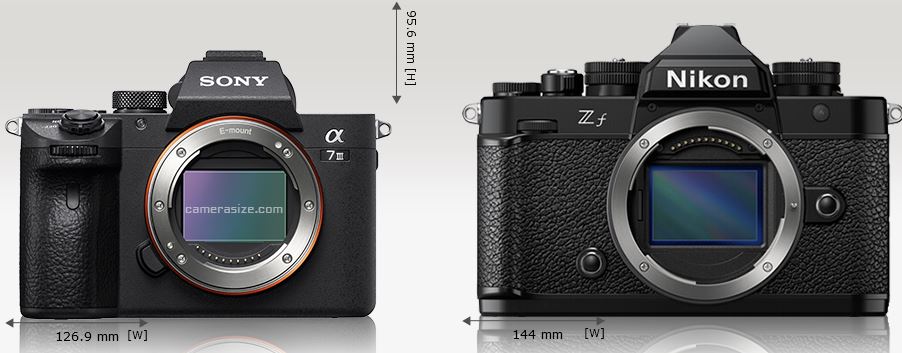
The fast 21mm looks good on the Zf. It's broader than the 35/2 by far, and so fits the mount well. The camera looked very different to the Sonys, so I checked it out - see below.
Nice! I realy hope they release the Nokton 21mm i Z-mount. My Voigtländer quadrinity consists of 15mm, 35mm, 50mm & 75mm in (full frame) Z-mount and I want something in the 20-25mm range without using adaptors.
p.41 #5 · Nikon Zf as a platform for adapted/native manual focus lenses
Jepser wrote:
Nice! I realy hope they release the Nokton 21mm i Z-mount. My Voigtländer quadrinity consists of 15mm, 35mm, 50mm & 75mm in (full frame) Z-mount and I want something in the 20-25mm range without using adaptors.
Yeah, if they released it for Z mount I’d probably trade out the E mount version. It’s very picky when it comes to adapter thickness, and while this one is just about perfect, and so I’m getting very good performance with the lens, it still isn’t quite up to how it performs on the sensor stack it was designed for. For my uses, those updates aren’t that big of a deal, as it’s tack sharp across the frame by f/4 and good enough where I would want it to be at wide apertures, but it’d be nice to unlock that last little bit of performance.
p.41 #6 · Nikon Zf as a platform for adapted/native manual focus lenses
Jepser wrote:
Nice! I realy hope they release the Nokton 21mm i Z-mount. My Voigtländer quadrinity consists of 15mm, 35mm, 50mm & 75mm in (full frame) Z-mount and I want something in the 20-25mm range without using adaptors.
Exactly. Even if they release f3.5 Color Skopar, I would be over the moon
p.41 #12 · Nikon Zf as a platform for adapted/native manual focus lenses
theopwildebeest wrote:
Love the orange glow/flare. And the colors in general. May I ask how you process these?
Thank you! The orange flares/artefacts and the glow are traits of that lens. I just compose with those in the viewfinder thanks to the liveview. For the colors, I edit the photos with VSCO and Lightroom.
p.41 #13 · Nikon Zf as a platform for adapted/native manual focus lenses
Understand the character comes from the lens. It’s the specific orange hue of the flare and the hues of the greens and yellows in your processed photos that are attractive. They’re like very vivid pastels.
Sonnar-7 wrote:
Thank you! The orange flares/artefacts and the glow are traits of that lens. I just compose with those in the viewfinder thanks to the liveview. For the colors, I edit the photos with VSCO and Lightroom.
p.41 #14 · Nikon Zf as a platform for adapted/native manual focus lenses
theopwildebeest wrote:
Understand the character comes from the lens. It’s the specific orange hue of the flare and the hues of the greens and yellows in your processed photos that are attractive. They’re like very vivid pastels.
The flares are orange with that lens without processing, it’s the single coated version, the multi-coated version produces more defined magenta arc like artefacts I believe, somebody who owns that version should know better than I do maybe.
For the other hues and colors, it’s a mix of presets and personal settings, I never use exactly the same formula, I tend to look what works for me for each photo.
p.41 #15 · Nikon Zf as a platform for adapted/native manual focus lenses
I'm looking at picking up Z8 camera and some voigtlander lenses. Are there any advantages to getting the Z version vs getting e versions (and using an adapter, I already have some e glass). Specifically, will the e version with an adapter prevent me from using any of the MF tools in Nikon or are there any other downsides I should consider. The advantage of the e version is I can use them on a Sony body as well should I decide to get one later..
p.41 #16 · Nikon Zf as a platform for adapted/native manual focus lenses
Picture This! wrote:
I'm looking at picking up Z8 camera and some voigtlander lenses. Are there any advantages to getting the Z version vs getting e versions (and using an adapter, I already have some e glass). Specifically, will the e version with an adapter prevent me from using any of the MF tools in Nikon or are there any other downsides I should consider. The advantage of the e version is I can use them on a Sony body as well should I decide to get one later..
Well for me I like for focus and aperture rings to turn the same way on all my lenses, which is not the case with sony lenses.
p.41 #17 · Nikon Zf as a platform for adapted/native manual focus lenses
Thanks, if that's the only difference I'm willing to trade that with the flexibility of using the lenses on two platforms (Z and e). Any other differences in functionality on the Z ? If I use an adapter e lens on lets say the zf will I still get the eye focus assist ?
The "peace of mind solution" is only available natively, as a Z-mount version.
What makes it problematic is that not every adapted lens reacts identically to the different filter stacks, and the effects diverge greatly.
Wide angles/super wide angles are definitely the most sensitive, but I am also aware of reports from this forum where a Voigtlander 50/2 Apo Lanthar E.mount version adapted to Nikon Z showed slight field curvature, which was not present natively with the matching Sony filter stack.
So you never have absolute certainty and, depending on the lens, you have to reckon with performance losses.
In this forum there are excellent reviews of the Voigtlander lenses and often also corresponding assessments by Fred Miranda on the adaptation to E-mount, e.g. also on the E-mount versions, so there is a certain basic knowledge in this area, but with the Z-mount we are fishing much more in the dark.
If dual mount use is required in one way or another, then this will be tolerated, but as a Nikon user I would definitely buy the native Z-mount versions, only then can I be sure that the lens harmonizes completely with my filter stack.
I can't answer the other questions concretely enough, as I don't adapt E-mount lenses for the reason mentioned, but I'm also not a dual mount user,
I have no interest in spending four-figure sums on high-performance lenses such as the Apo Lanthar optics, only to end up with losses due to filter stack divergences, no matter how subtle.
p.41 #20 · Nikon Zf as a platform for adapted/native manual focus lenses
Adapting lenses is not for everyone. But sometimes the search for perfection can be a serious handicap, if a particular lens is otherwise outstanding for your work in areas that do not require the impossible-to-attain state. It can be compared to finding CA in some Otus images.
Some need extreme corner IQ, others understand that even with native mounts these searching inspections are very often chimeric and can work against photographic goals, and the joy of it all. Not much satisfies the standards of some. And there is copy variation to consider as well. These are not $25,000 cine lenses.
So there are often large differences of opinion on what constitutes 'acceptable performance' in lens adapting. Bear in mind that Cosina has long adopted the stance that many of their lenses are suitable for adapted use on alternative mounts:
'Not only can this lens be used on rangefinder-coupled cameras, but design-wise it also balances very nicely when mounted on mirrorless digital cameras with a mount adapter.'
They said this of the VM 75/1.5 (as just one example) and they are right, for E-mount at least. It's baked into their business model in a way, because all CV lenses appear first in VM form these days. Some never appear in other mounts.
It's certainly true that it takes time for us all to assemble enough intelligence for new cameras. Sony had a five year head start - late 2013 compared to 2018, and yet we are still learning. Some (like me) have been adapting/ remounting lenses (Leitax) for almost 20 years.
I've certainly found Fred's research to be highly accurate in my subsequent experience of lenses reviewed. It's best seen as a matter of balance and individual judgement.