p.3 #1 · New: Canon RF 10-20mm f/4 L IS STM Lens - $2299
Gochugogi wrote:
If the focusing group is internal, rather than front barrel, STM will be plenty fast.
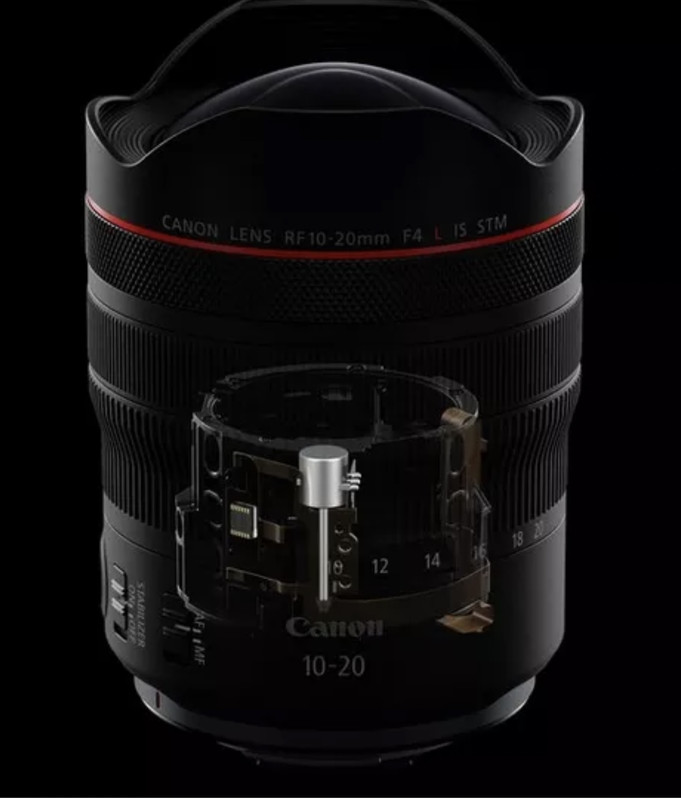
Focus is performed by the single central element to the right (mount side) of the aperture. Indeed this would be light and easy for a lower power motor to move.
And this image is from the Canon Europe 10-20/4 page:
burningheart wrote:
Have not used a filter on the 14-35. Come to think of it I haven't used a polarizer for over a year on any lens. As to wrattans I have Wrattens galore which I use in the old Canon Gelatin holders 3 and 4 inch size) when doing Full Spectrum photography with my Full Spectrum Modified R5. Heck I even got a bunch of Rosco's and cut them to size. Though all my wratten use is on the front of the lens. Thankfully a lot of my Wratten's I got off of eBay when nobody wanted them. Got some rare ones before demand set in and prices skyrocketed. One of the reasons I still like the 11-24 is I can use the drop in EF-RF adapter but the polarizer drop in did show some interesting skies with the polarizer as some images should a pattern of changing blues due to the UWA....Show more →
I like using a polarizer for removing glare from foliage, water, etc. Though sometimes removing all glare is too much. I think I still have one of those Canon gelatin filter holders that goes on the front. It also had metal screw on hood sections, IIRC. The EF-RF adapters with drop in filter are certainly a compelling argument for adapting certain EF lenses, like the 11-24, 17 TS-E, fisheye, etc.
p.3 #2 · New: Canon RF 10-20mm f/4 L IS STM Lens - $2299
I don’t know about you, but I tend to own my lenses longer than bodies. The longest I’ve owned a digital camera body was my 5Ds/5dsr combo and that was around 5 years. I’ve owned lenses for over 10 years.
If you are shooting with R bodies, there really aren’t any 3rd party options that are equal to the RF lenses.
Having said that, this lens isn’t on my priority list despite how much I liked the 11-24. The RF 14-35 meets my needs and I’m more interested in waiting for the RF tilt shift lenses - which I expect will make the 10-24 seem priced cheap.
TomSchriefer wrote:
Granted, none of the 3rd party stuff is a good as Canon. I use 3rd party 24-70 2.8 and 70-200 2.8 BECAUSE they are less expensive, and the IQ works for me. I use some 3rd party stuff because Canon doesn't make an equivalent. In the UW-angle range, where I'm shooting f/8-16 for as much DOF as I can get, I'm not convinced Canon is enough-better (at those apertures) to justify the 10X price premium. Then again, I am cheap. I do prefer Canon to other brands of bodies, and dSLR to mirrorless. I'm never going to pay $2000+ for a lens, though....Show more →
p.3 #3 · New: Canon RF 10-20mm f/4 L IS STM Lens - $2299
I use a glass slide in ND filters and ND grads a lot with the 14-35 (Kase k9 system holder with thr 3, 6, 10 Stop 4x6 size glass ND filters, as well as glass ND grads. I have used the Kase polarizer, but usually more to control glare when the sky isn’t in the photo - it’s not a good lens to use a polarizer with the sky as with most UWA lenses.
I’ve been thinking a lot of a linear fixed polarizer would be an option with UWA lenses I wish I could slide a fixed polarizer that would give me the same contrast and clarity as my prescription Maui Jim sunglasses. It’s an often a letdown not being able to get the same polarization on an ultra-wide lens as I can with my sunglasses and I’ve been thinking more and more if a fixed linear polarizer would be an option for UWA lenses
rscheffler wrote:
Do you use filters much on the 14-35? For me that could potentially be a deciding factor. Polarizer use with such an UWA could create odd effects with a lot of blue sky in the image, but ND use for longer exposures, for example. Are there decent optical quality gelatin ND filters available? Looks like you can still buy some Kodak Wratten gels at B&H. Could this also be a video use concern where variable NDs are very popular?
Back in the B&W film days I used gelatin filters with a bunch of my UWA EF zooms (such as 17-35/2.8, IIRC), but back then it was also easy to buy the Kodak Wratten gel filters, and not that costly. Just wonder what, if any impact the gel filters have on image quality now with high MP digital sensors (compared to the old film days)?...Show more →
p.3 #4 · New: Canon RF 10-20mm f/4 L IS STM Lens - $2299
I don’t think the type of polarizer will fix the UWA uneven sky polarization problem due to the simple physics of how it works. Polarization is most effective 90 degrees from the light source. But UWAs have such a wide angle of view that a much broader range of the sky is in the image, including areas where polarization is less effective.
p.3 #5 · New: Canon RF 10-20mm f/4 L IS STM Lens - $2299
Polarizers on UWA lenses are much more useful on cloudy days, for taking glare off water, foliage and rocks, etc. As others have noted, blue sky will generally ruin a shot if you use a polarizer on an UWA lens.
However there is a typo "RF28mm F2.8 STM Instructions" that you can click on that actually takes you directly to the link for the Canon RF 10-20mm f/4 L IS STM pdf manual I posted above.
I was curious as Canon's USA site Features list and Technical Specifications for this lens did not give any information on the button on the side of the lens. the lens reviewers just said it was used for customizable features with no further detail.
To me it looks like the good old fashion focus stop button on the telephoto lenses to me however seems odd on a wide angle lens. After taking a gander at the manual I see that I was right!
p.3 #7 · New: Canon RF 10-20mm f/4 L IS STM Lens - $2299
Jesse Evans wrote:
The RF 10-20 f/4L has a leadscrew type STM motor. This is a form of linear motor. It is near silent and can be extremely fast depending on the design. It is capable of focusing faster than the ring type USM of the older EF lenses and will be similarly accurate as Nano USM.
Nikon employs leadscrew type focusing motors in most of their Z mount lenses. Notably,leadscrew type their stepping motors in their 50/1.2 and 85/1.2 are DRAMATICALLY quieter and are just as fast if not faster than Canons RF equivalents.
These are not the same type of STM motor as is in the RF 1.8 macros, those are all gear type STM which are more compact, slower, and louder. ...Show more →
But once I did, I recognised it as the troublesome mechanism that used to be in floppy drives, and indeed the article explains why at least some types of them jam. I remember how my father’s woodworking vice was easy to tighten down but could be fiendishly hard to undo.
Perhaps Canon’s leadscrew has no problems. How would I know? Ring USM, on the other hand, was a known quantity.
Given the high prices Canon asks for RF mount L lenses, their policy of outright refusing to work on lenses that are only a few years old, and that the main (only big) independent camera and lens repairer here no longer works on Canon, I will be steering well clear of this lens until it has established a reputation for reliability – and that will take 5 to 10 years. Likewise, I am somewhat put off Nikon lenses given what you say, but at least the techs I have always used still repair those.
But once I did, I recognised it as the troublesome mechanism that used to be in floppy drives, and indeed the article explains why at least some types of them jam. I remember how my father’s woodworking vice was easy to tighten down but could be fiendishly hard to undo.
Perhaps Canon’s leadscrew has no problems. How would I know? Ring USM, on the other hand, was a known quantity.
Given the high prices Canon asks for RF mount L lenses, their policy of outright refusing to work on lenses that are only a few years old, and that the main (only big) independent camera and lens repairer here no longer works on Canon, I will be steering well clear of this lens until it has established a reputation for reliability – and that will take 5 to 10 years. Likewise, I am somewhat put off Nikon lenses given what you say, but at least the techs I have always used still repair those....Show more →
This is incredibly silly reasoning. Leadscrew has nothing to do with the reason for something jamming. They are a technology that can be designed poorly or designed well, just like anything else. There is nothing about a leadscrew that would lead it to cause jamming other than being designed poorly. In the case of inexpensive floppy disk drives of old it was not the screw that was the problem, but that it was used to drive a thin flexible plastic housing that held the read head.
They were used commonly for dvd drives which required precise placement of a laser head at high speeds, and cd roms as well.
They have been used by Canon for over 10 years and by Nikon for a similar amount of time.
Of course the problem with Canons repair policy and not wanting to support them is up to you, but there is no reason to expect a leadscrew to be more prone to failure than ring USM.
Also, even in floppy drives it was not the read head or anything connected to the leadscrew that would jam in 99.9% of cases. It was the disk itself due to an under designed ejection mechanism. The disk would get stuck when trying to eject it.
p.3 #9 · New: Canon RF 10-20mm f/4 L IS STM Lens - $2299
Jesse Evans wrote:
They were used commonly for dvd drives which required precise placement of a laser head at high speeds, and cd roms as well.
While the coarse placement is done by a leadscrew, the laser head on these optiical drives floats on the end of that, and is itself servo-controlled so that it can follow the track, e.g. due to warping of the disc. You can see this if you take a drive apart. (Caution: do NOT power it up if it is this far apart – you can blind yourself.)
They have been used by Canon for over 10 years...
In their cheaper lenses. Canon are asking A$4200 for this lens in Australia. Canon L lens prices are higher than the other two systems, and much of the justification for that is that they are still made in Japan and the reputation of L lenses being so robust and lasting for decades. Canon have pushed USM as the gold standard for 35 years, and 10 years is not old for one of the ring USM lenses.
If I look inside a car differential I see the gears cut in a complex shape to reduce friction, which will also reduce binding and wear. And it is immersed in an oil bath. So yes, I think it would be possible to build a nice leadscrew focus mechanism. Did Canon? It’s up to them to explain.
p.3 #10 · New: Canon RF 10-20mm f/4 L IS STM Lens - $2299
This lens is a landscape photographer’s dream. So many people I know shoot at 12 mm or wider and either use Canon for the 11-24 or adapt it to other systems. Expanding that to 10 mm is even more amazing! They will see quite a few of these lenses to landscape and architecture photographers as well as event photographers looking for a unique perspective. I will be buying one for sure. I have been adapting the 11-24 to my R5 and it has performed well but will gladly shed a pound and get 1 mm wider.
p.3 #11 · New: Canon RF 10-20mm f/4 L IS STM Lens - $2299
Has anyone had their 10-20 ship to them yet? I was apparently slow missing the ordering time by hours, so it looks like I am in the penalty box and waiting still.
p.3 #12 · New: Canon RF 10-20mm f/4 L IS STM Lens - $2299
BrianP wrote:
Has anyone had their 10-20 ship to them yet? I was apparently slow missing the ordering time by hours, so it looks like I am in the penalty box and waiting still.
Mine is "out for delivery," which given it's FedEx makes me worried.
p.3 #14 · New: Canon RF 10-20mm f/4 L IS STM Lens - $2299
That vignetting in the corners is crazy. It’s amazing how much correction they are applying to lenses these days in camera or in post. Will be interesting to see how it does with stuff close in the foreground.
p.3 #15 · New: Canon RF 10-20mm f/4 L IS STM Lens - $2299
I am very curious to see a frame filled with a big building shot leveled at 10-12mm to evaluate corners and distortion. Or even a house at very close range.
p.3 #16 · New: Canon RF 10-20mm f/4 L IS STM Lens - $2299
stanj wrote:
Yup. It's small. And wide. I wonder how we survived without it so far.
The last one is without LR profile correction. DXO doesn't have support yet.
Question: is the third (unprocessed) image exactly the same shot as the preceding corrected one? If so it seems that the corrected one is cropping the picture and thus taking out a lot of the really dark vignetting. This would be similar to the 14-35 L or the 24-240, which at the wide end actually go wider (I think I recall 13mm for the 14-35) and then crop the image to replicate the field of view of 14mm, or something like that. So here the 10-20 may be going to 9 mm actual but cropping to 10mm?
p.3 #17 · New: Canon RF 10-20mm f/4 L IS STM Lens - $2299
stanj wrote:
Yup. It's small. And wide. I wonder how we survived without it so far.
The last one is without LR profile correction. DXO doesn't have support yet.
Rivermist wrote:
Question: is the third (unprocessed) image exactly the same shot as the preceding corrected one? If so it seems that the corrected one is cropping the picture and thus taking out a lot of the really dark vignetting. This would be similar to the 14-35 L or the 24-240, which at the wide end actually go wider (I think I recall 13mm for the 14-35) and then crop the image to replicate the field of view of 14mm, or something like that. So here the 10-20 may be going to 9 mm actual but cropping to 10mm?
Correct. It's the exact same file, just the profile processing turned off. And yes - I have the 14-35 and 24-240, too, and it's the exact same behavior.
p.3 #18 · New: Canon RF 10-20mm f/4 L IS STM Lens - $2299
Uarctos wrote:
I am very curious to see a frame filled with a big building shot leveled at 10-12mm to evaluate corners and distortion. Or even a house at very close range.
Your wish is my command. I used the level in the camera, so it's not perfect. I have only so much time.


 I wish I could slide a fixed polarizer that would give me the same contrast and clarity as my prescription Maui Jim sunglasses. It’s an often a letdown not being able to get the same polarization on an ultra-wide lens as I can with my sunglasses and I’ve been thinking more and more if a fixed linear polarizer would be an option for UWA lenses

