Nope, looked them up. The A1 is slower, but I am not sure if that one is accurate and CINED has the numbers for Video. The point is, if you want the speed there are more options out there.
Alistair1 wrote:
If you have never used a camera and don't even have access to one to evaluate, what advice can you offer and who benefits from it?
If it is almost identical to the Z body I have used, plenty. I have ordered a Z8, but they’re a little scarce at the moment. If it is better than my experience with the earlier Z bodies then I will look into seeing if I can adjust to the differences fairly easy.
Alistair1 wrote:
The A1 is a lot faster than that. I didn't realize the X-H2S was so slow. That is slower than an R5 in FF equivalent terms.
It isn’t, but nice try.
The read out speed of the X-H2S is 1/180 @ 26 MP, where the Z8 is 1/270 @ 46 MP, that means they’re fairly close in real world performance where the Fuji would actually appear faster in many situations because the other parts of the camera have to keep up too. Also, it has been tuned to be better with Video, where it’s faster than any other hybrid out there (Most people don’t care about that).
Look there are at least 7 cameras built for speed like this, it’s okay to accept that and acknowledge that there’s value in other brands too.
R3
Z-8/9
X-H2S
A9/II
OM-1
Jun 02, 2023 at 06:44 AM
Steve Spencer Offline • • • • • • • Upload & Sell: On
amci4 wrote:
Nope, looked them up. The A1 is slower, but I am not sure if that one is accurate and CINED has the numbers for Video. The point is, if you want the speed there are more options out there.
I don't know where you looked them up, but the number you got for the A1 is wrong as Geoff (arbitrage) noted on the previous page. The numbers are:
A1 - 1/260
X-H2S - 1/180
Z8/9 - 1/270
And the XH2S is about the same as the A9. These would all allow in almost all instances the use of an electronic shutter without any movement distortion. Higher sync speeds are still useful for fringe cases and flash synchonization, but all of these cameras do well.
These sensor scan speeds do not need to be corrected for the size of the sensor. They are simply how fast the sensor is scanned when taking an image. Of course smaller sensors can be scanned faster than bigger sensors.
The read out speed of the X-H2S is 1/180 @ 26 MP, where the Z8 is 1/270 @ 46 MP, that means they’re fairly close in real world performance where the Fuji would actually appear faster in many situations because the other parts of the camera have to keep up too. Also, it has been tuned to be better with Video, where it’s faster than any other hybrid out there (Most people don’t care about that).
Look there are at least 7 cameras built for speed like this, it’s okay to accept that and acknowledge that there’s value in other brands too.
What exactly are you trying to do here by getting the A1 sensor readout speed wrong by factor 1/2 and misrepresenting it as one of the slowest bodies in this regard?
Literally every review since its release quotes a readout speed of around 250 fps at 14 bit
Jun 02, 2023 at 07:20 AM
Steve Spencer Offline • • • • • • • Upload & Sell: On
The read out speed of the X-H2S is 1/180 @ 26 MP, where the Z8 is 1/270 @ 46 MP, that means they’re fairly close in real world performance where the Fuji would actually appear faster in many situations because the other parts of the camera have to keep up too. Also, it has been tuned to be better with Video, where it’s faster than any other hybrid out there (Most people don’t care about that).
Look there are at least 7 cameras built for speed like this, it’s okay to accept that and acknowledge that there’s value in other brands too.
In relation to the current thread and the OP, the R5 does have movement distortion for fast moving targets in electronic shutter mode. In my view it is enough to be concerned about for the types of things I shoot. This can be fixed by using the mechanical shutter, but that isn't silent and substantially drops the frames per second. The Z8, in my view, has a clear advantage in being able to shoot 20 fps without worries about movement distortion and it can do so silently. It is after all, things that tend to move fast for which many people want to shoot at high frames per second and in my experience shooting silently can really be useful for things like wildlife. The R5 is quite capable with it mechanical shutter at shooting things that move fast, but the Z8 with its electronic shutter that captures even quite fast movements without distortion is in my view substantial more capable.
amci4 wrote:
Nope, looked them up. The A1 is slower, but I am not sure if that one is accurate and CINED has the numbers for Video. The point is, if you want the speed there are more options out there.
Video scan speeds have no relation to stills scan speeds in these high end stacked sensors. The stills speed is always significantly faster than the video scan.
The read out speed of the X-H2S is 1/180 @ 26 MP, where the Z8 is 1/270 @ 46 MP, that means they’re fairly close in real world performance where the Fuji would actually appear faster in many situations because the other parts of the camera have to keep up too. Also, it has been tuned to be better with Video, where it’s faster than any other hybrid out there (Most people don’t care about that).
Look there are at least 7 cameras built for speed like this, it’s okay to accept that and acknowledge that there’s value in other brands too.
I see you've planted your flag and aren't going to budge. Here is just one more reference among many out there showing the A1 is around 1/260 scan in stills.
"The super-fast readout that enables 30 fps shooting is also key to the camera's electronic shutter being usable for almost all applications. At a measured 1/260s, the e-shutter is just as fast as many mechanical shutters, fast enough that it can sync with flashes at up to 1/200 sec exposures. You'll need to use a Sony TTL-compatible flash or flash trigger to reach this maximum speed, but it shows how quick the sensor is able to operate. If you crop in to APS-C mode, it takes even less time to read out the active area of the sensor, allowing a sync speed of 1/250 sec."
I agree that all the stacked sensor cameras you've listed should be in the conversation when looking to shoot fast action in ES.
The A1 and Z9/Z8 lead the pack for scan speed.
The A9II from 2017 can scan a FF sensor height as fast as the 2022 H2S can scan an APS-C height. So let's not get too excited about that camera's scan speed. That said, 1/180 on an APS-C sensor is probably enough for most things and is still scanning 2x faster than a Canon R5.
the A1 to shoot 30fps- You need to be shooting in Compressed RAW, JPEG or HEIF file format.
Focus mode should be set to AF-C and drive mode to Hi+.
Electronic shutter speed between 1/250 – 1/32000 sec.
Priority Set in AF-C set to ‘Release’. The default is ‘Balanced Emphasis’. With it set to ‘Release’ the shutter will be released even if the subject is out of focus. With ‘Balanced Emphasis’ the camera tries to achieve a balance between focus and shutter release, however this reduces the maximum FPS slightly.
Use a lens that supports 30 FPS. View my Sony A1 Lenses Guide.
Have the latest lens firmware version installed.
Image Type Hi+ Hi Mid Low
Uncompressed RAW 20 20 15 5
Compressed RAW 30 20 15 5
Lossless Compressed RAW 20 20 15 5
JPEG Extra Fine 30 20 15 5
Uncompressed RAW + JPEG Extra Fine 20 20 15 5
Compressed RAW + JPEG Extra Fine 30 20 15 5
Lossless Compressed RAW + JPEG Extra Fine 20 20 15 5
HEIF (4:2:0) Extra Fine 30 20 15 5
HEIF (4:2:2) Extra Fine 30 20 15 5
Some slow read time sensors continue to have slightly higher dynamic range at low ISO than the A1. Examples include D850, A7RIV. See dxomark.com for details.
When Nikon went with a design that has iso 64, they lost a bit of dynamic range at mid to higher ISO in measurements. But it may be due to different color filters that are less peaky, i.e. a design choice to improve color reproduction and not necessarily a technological flaw or disadvantage. QE was reduced slightly in the D850 compared to the D500 but this may be due to the different CFAs used and not necessarily indicative of differences in the photodetection or electronics.
molson wrote:
And AFAIK, the A1 has the only sensor that can achieve such a high scan speed without a corresponding loss in dynamic range.
ilkka_nissila wrote:
Some slow read time sensors continue to have slightly higher dynamic range at low ISO than the A1. Examples include D850, A7RIV. See dxomark.com for details.
When Nikon went with a design that has iso 64, they lost a bit of dynamic range at mid to higher ISO in measurements. But it may be due to different color filters that are less peaky, i.e. a design choice to improve color reproduction and not necessarily a technological flaw or disadvantage. QE was reduced slightly in the D850 compared to the D500 but this may be due to the different CFAs used and not necessarily indicative of differences in the photodetection or electronics.
Good post. Another important point is some sensors are designed to increase MTF by reducing fill factor and thus reduce sensitivity to light, ie reducing the angles of light allowed to reach the sensor in order to increase acuity. Jack Hogan did a great write-up about this regarding his observations with the Z7:
ilkka_nissila wrote:
Some slow read time sensors continue to have slightly higher dynamic range at low ISO than the A1. Examples include D850, A7RIV. See dxomark.com for details.
Neither of those cameras has a stacked sensor, which is what I thought we were discussing...
Jun 02, 2023 at 03:22 PM
Steve Spencer Offline • • • • • • • Upload & Sell: On
molson wrote:
And AFAIK, the A1 has the only sensor that can achieve such a high scan speed without a corresponding loss in dynamic range.
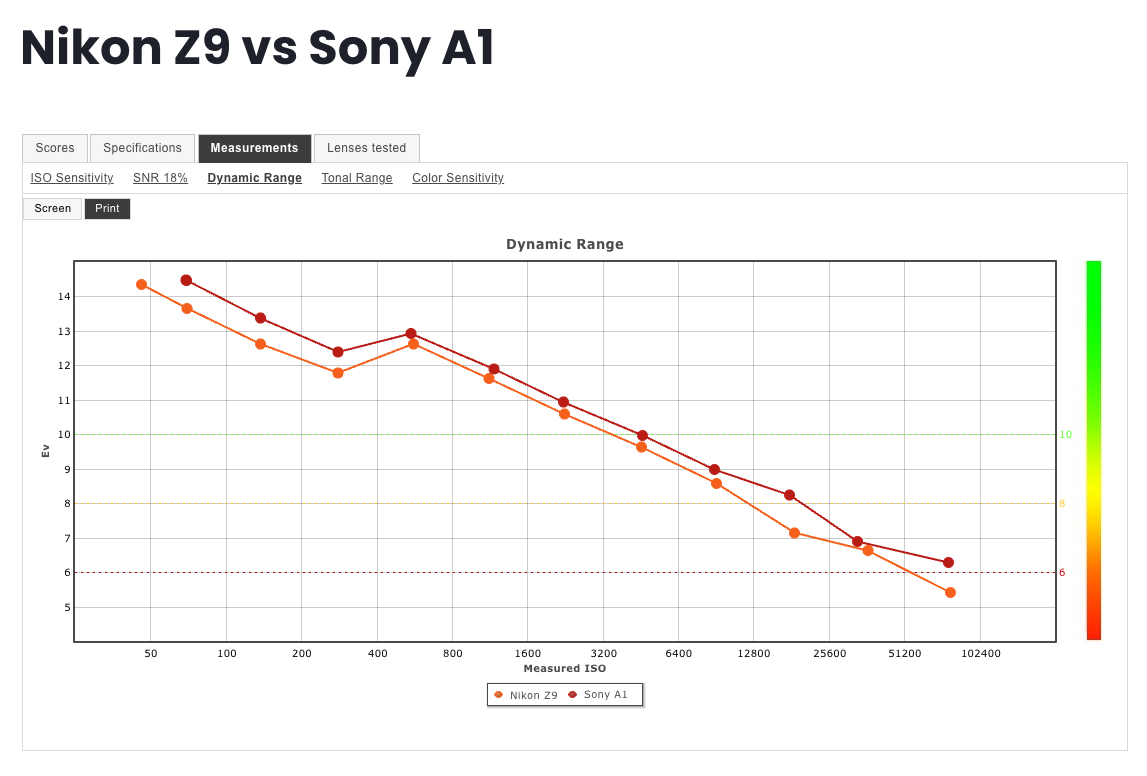
No the A1 and the Z9 have very similar dynamic range. At base ISO (100 for the A1 and 64 for the Z9), they are nearly identical (11.34 for the A1 vs. 11.27 for the Z9 as measured by Bill Claff's photons to photos) and at ISO 500 and above the A1 has only about a third of a stop advantage. In between the advantage is a bit bigger, but still not large. Here is a link to a chart comparing the photographic DR of the two cameras at photons to photos:
Both cameras have about a third of a stop less DR than the best non-stacked sensor cameras from the same brand. (Sony A1 11.34 vs. Sony a7rV 11.69; Nikon Z9 11.27 vs Nikon Z7 II 11.6). So both cameras have a small but not very relevant, IMO, loss in DR compared to non-stacked sensor cameras of the same brand.
None of this should be too surprising as the sensor in the A1 and Z9 are pretty similar and likely both made by Sony.
Steve Spencer wrote:
No the A1 and the Z9 have very similar dynamic range. At base ISO (100 for the A1 and 64 for the Z9), they are nearly identical (11.34 for the A1 vs. 11.27 for the Z9 as measured by Bill Claff's photons to photos) and at ISO 500 and above the A1 has only about a third of a stop advantage. In between the advantage is a bit bigger, but still not large. Here is a link to a chart comparing the photographic DR of the two cameras at photons to photos:
Both cameras have about a third of a stop less DR than the best non-stacked sensor cameras from the same brand. (Sony A1 11.34 vs. Sony a7rV 11.69; Nikon Z9 11.27 vs Nikon Z7 II 11.6). So both cameras have a small but not very relevant, IMO, loss in DR compared to non-stacked sensor cameras of the same brand.
None of this should be too surprising as the sensor in the A1 and Z9 are pretty similar and likely both made by Sony....Show more →
Bill isn't measuring dynamic range; he's just measuring noise on a black frame.
molson wrote:
Bill isn't measuring dynamic range; he's just measuring noise on a black frame.
Here are some actual measurements:
No, he is testing full well capacity AND noise levels of a black frame which is dynamic range. Also, those DR numbers for DXO are very similar, just shifted to the left for Nikon at low ISOs.
Jesse Evans wrote:
No, he is testing full well capacity AND noise levels of a black frame which is dynamic range. Also, those DR numbers for DXO are very similar, just shifted to the left for Nikon at low ISOs.
As interesting as it may be to some, that information tells you little or nothing about a camera's dynamic range.
molson wrote:
As interesting as it may be to some, that information tells you little or nothing about a camera's dynamic range.
"Sensor dynamic range quantifies the ability of a sensor to adequately image both high lights and dark shadows in a scene. It is defined as the ratio of the largest nonsaturating input signal (photocurrent) to the smallest detectable input signal"
molson wrote:
Bill isn't measuring dynamic range; he's just measuring noise on a black frame.
Here are some actual measurements:
And these measurements tell the same thing that the photons to photos measurement do. At base ISO the cameras have near identical dynamic range, below ISO 500 the A1 has a small advantage, in between the advantage is a little larger.
In relation to the current thread and the OP, the R5 does have movement distortion for fast moving targets in electronic shutter mode. In my view it is enough to be concerned about for the types of things I shoot. This can be fixed by using the mechanical shutter, but that isn't silent and substantially drops the frames per second. The Z8, in my view, has a clear advantage in being able to shoot 20 fps without worries about movement distortion and it can do so silently. It is after all, things that tend to move fast for which many people want to shoot at high frames per second and in my experience shooting silently can really be useful for things like wildlife. The R5 is quite capable with it mechanical shutter at shooting things that move fast, but the Z8 with its electronic shutter that captures even quite fast movements without distortion is in my view substantial more capable....Show more →
And just to add a bit more on the R3 -- it has a 195 fps stills mode that lasts for 50 shots and is FF with full 14b RAW (I use it for baseball to try to catch the ball off the bat). This means the readout is at least 1/195s if not faster.
All of this is getting a bit off topic. I do find the R5 to be one of the best all around bodies there is. Action shooting is extremely good in ES mode but can certainly result in rolling shutter artifacts at times. However in EFCS, it is as good as it gets with relatively high res and DR that is equal to or better than almost all FF MILCs. Pretty much the best there is from a non-BSI sensor. Fast action AF (both EFCS and ES) with the R5 is certainly way better than my A7R5 (unsurprisingly) which is the other all around body in the top tier.
My only pause vs a Z8 would be AF accuracy and DR. I got turned off of the Z series by the bad AF system of the Z7 and Z6. I know they are much better now but have now invested a lot in Canon and Sony so am not personally interested in revisiting the Nikon line even though the AF issues may very well be resolved. Assuming the AF is world class with the Z8, it seems like the most cost effective way to get a stacked sensor. The DR hit makes it slightly less appealing if one wants to use it for travel and landscape shooting but otherwise you are potentially getting action performance at the price of an all arounder.