This topic is in the 2022 archive. You can read it and like its posts here. It is read only.
Archive 2022Sony A1 CFE-a Memory Card Performance Data
p.1 #1Sony A1 CFE-a Memory Card Performance Data
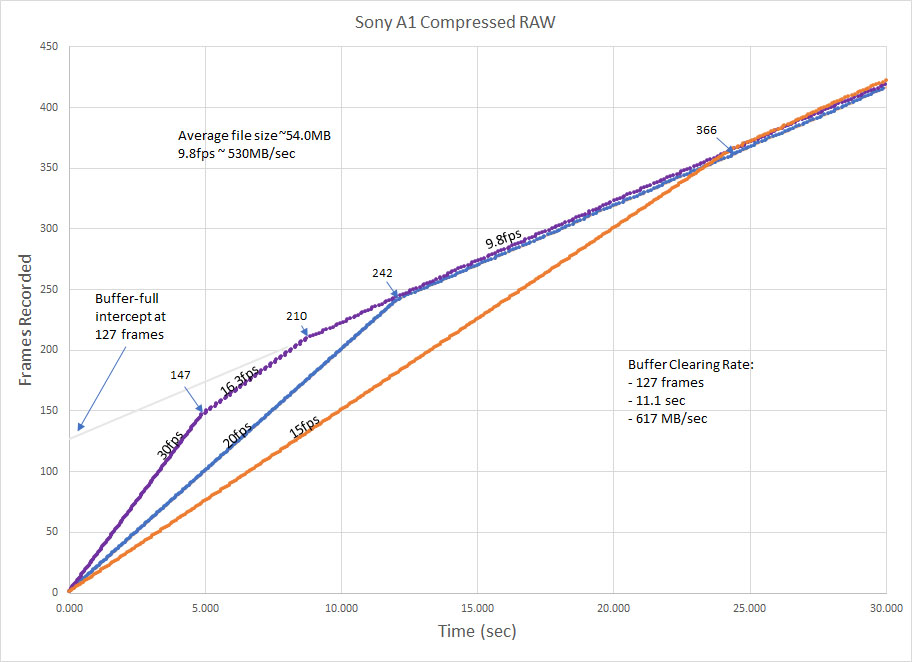
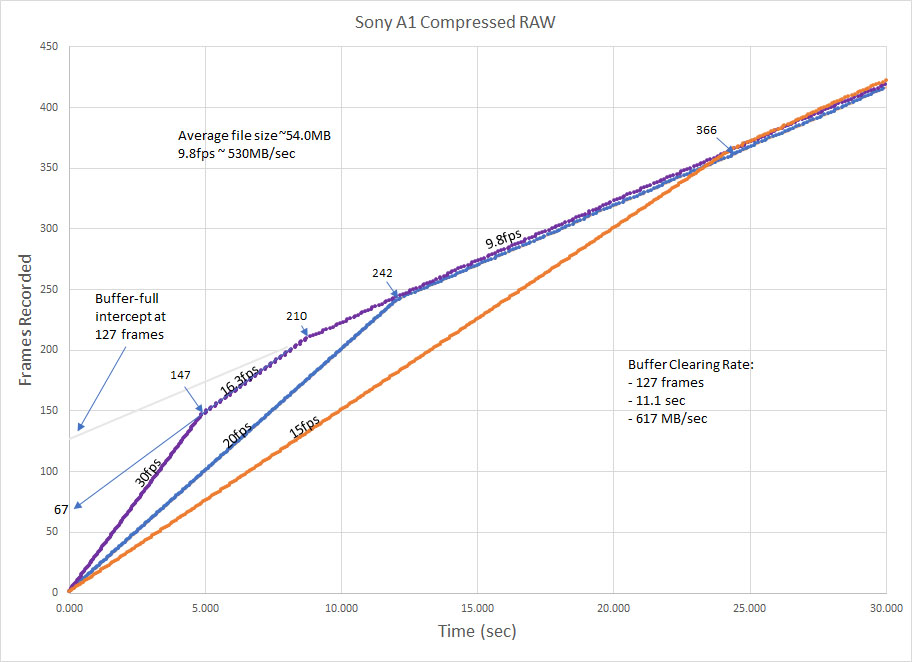
In a prior post, A1 Buffer Clearing Rates, data was presented on the A1 with CFE-a and UHS-II memory cards. This post supplements that data with more precise measurements and measurements for other frame rates and compression modes. This data makes use of the more precise time metadata extracted using a method similar to what is described here. I also make measurements of buffer clearing rates by recording camera viewfinder display using the HDMI output of the camera, and then examining the camera display frame by frame as the buffer clears using Resolve. Most of the results are shown in the annotations on the charts below.
The first set of data, shown in charts 1 and 2, is for Compressed RAW at 30, 20 and 15 fps. 30fps data was presented before and this data is consistent with that data but more precise. In the prior post it was noted by @Holger that the break from the 30fps slope to the buffer-full slope was very abrupt for the UHS-II measurements, but seemed to roll over more gradually for the CFEa data. It was not clear why that was the case. We can see from the data in chart 1 that there is a transition from 30fps to 16.3fps before the buffer-full rate of 9.8fps is reached. Why Sony implemented the intermediate rate is not clear, but without that intermediate rate the 30fps rate would have continued until ~180 frames were captured and then the buffer would have been full, and the rate slowed to 9.8fps. My preference would be that the intermediate rate not be there.
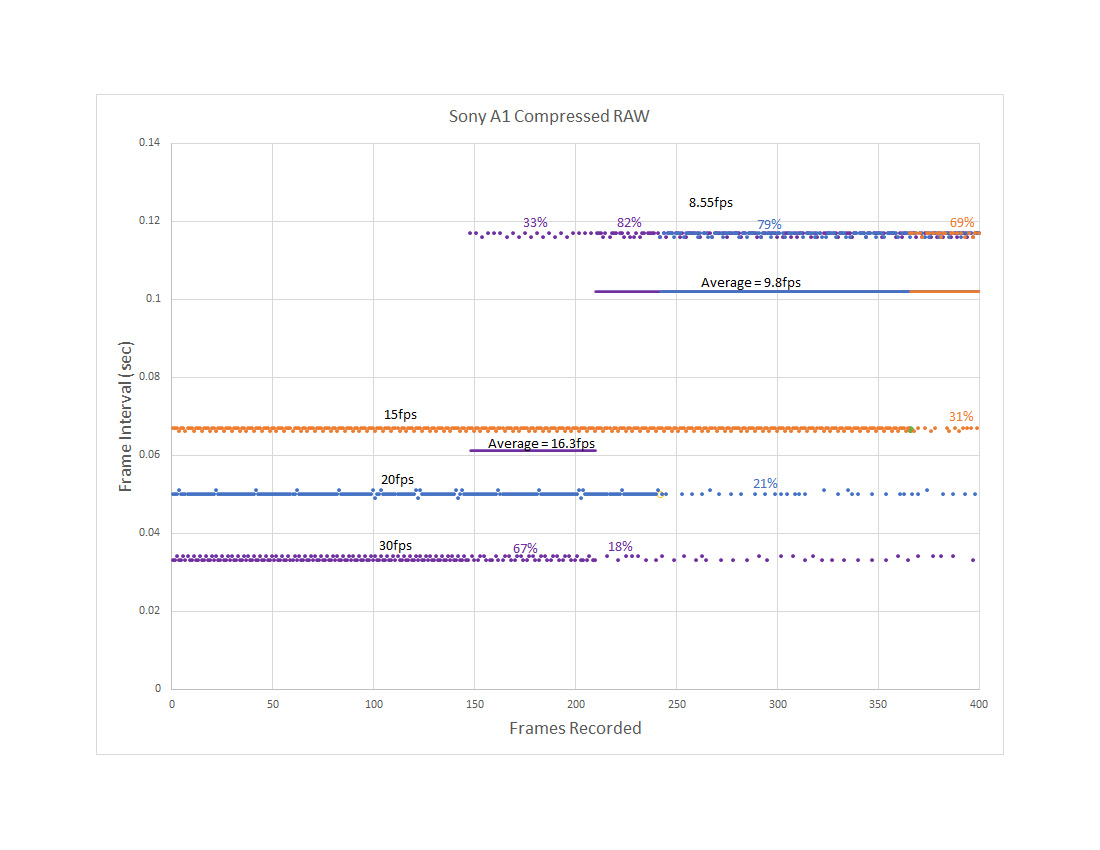
The other new information is that when the frame rate is reduced to 16.3fps and then 9.8fps, the time interval between frames is not unform. This can be seen in the second chart. For example, at 30fps the time interval between frames is uniformly 0.033 sec up until 147 frames have been captured, then the interval between frames becomes bi-modal, with about 33% of the intervals being 0.117 sec and the remaining 67% being 0.033 sec. This means that frames are captured at an interval of 0.117 sec and if space is available for more frames, they are captured with an interval of 0.033 sec. Typically when a frame is captured after an interval of 0.117 sec, two more are captured at 0.033 sec intervals, so frames usually come in triplets. They are not uniformly spaced at the average of 16.3fps which would be 0.061 sec. Once 210 frames have been captured, the bi-modal distribution changes to 82% at 0.117 sec interval and 18% at 0.033 sec interval, which averages 9.8fps. You can see the other bi-modal timings that are used for 20fps and 15fps once the buffer-full condition is reached.
Once the buffer is full, the capture frame rate must slow to the rate frames are removed from the buffer. If the capture of new frames were synchronous with the removal of frames from the buffer as they are written to the memory card, the capture of frames would slow to 9.8fps and be uniformly spaced at 0.102 sec. The asynchronous method Sony uses results in bi-model frame intervals with most frames intervals at 0.117 sec, sometimes followed by one or more additional frames at a rate of 30fps, 20fps or 15 fps.
The operational impact of the bi-model frame intervals is not significant in most cases, but it is a bit bizarre. Very few photographers would be aware of it or care. Regardless, the ideal would be for frames to be uniformly spaced in time.
As noted in the prior post, the actual rate at which data is written to the memory card is below the spec write speed for the CFEa card. In this case I used two memory cards, a Sony Tough 160GB CFEa card and a Delkin Power 160GB CFEa card. The results were identical so far as I could tell. The specs for the Sony card are “up to” 700/800 MB/sec write/read speeds. The Delkin card specs are 790/880 MB/sec. Delkin Black cards have the same spec. The somewhat higher write speed rating of the Delkin card made no measurable difference in actual write speed.
The other item of interest is the size of the buffer and the time to clear the buffer. In the case of compressed RAW, the buffer holds 127 frames. Once the buffer is full and frame capture stops, the buffer clears in 11.1 sec, which is 617MB/sec write speed to the memory card. That is faster than the 530MB/sec write rate to the card while frames are being captured. The difference is presumably due to sharing access to the buffer while both filling and clearing the buffer compared to full access while clearing the buffer.
Edited on May 09, 2024 at 03:25 PM · View previous versions
The first set of data, shown in charts 1 and 2, is for Compressed RAW at 30, 20 and 15 fps. 30fps data was presented before and this data is consistent with that data but more precise. In the prior post it was noted by @Holger that the break from the 30fps slope to the buffer-full slope was very abrupt for the UHS-II measurements, but seemed to roll over more gradually for the CFEa data. It was not clear why that was the case. We can see from the data in chart 1 that there is a transition from 30fps to 16.3fps before the buffer-full rate of 9.8fps is reached. Why Sony implemented the intermediate rate is not clear, but without that intermediate rate the 30fps rate would have continued until ~180 frames were captured and then the buffer would have been full, and the rate slowed to 9.8fps. My preference would be that the intermediate rate not be there.
The other new information is that when the frame rate is reduced to 16.3fps and then 9.8fps, the time interval between frames is not unform. This can be seen in the second chart. For example, at 30fps the time interval between frames is uniformly 0.033 sec up until 147 frames have been captured, then the interval between frames becomes bi-modal, with about 33% of the intervals being 0.117 sec and the remaining 67% being 0.033 sec. This means that frames are captured at an interval of 0.117 sec and if space is available for more frames, they are captured with an interval of 0.033 sec. Typically when a frame is captured after an interval of 0.117 sec, two more are captured at 0.033 sec intervals, so frames usually come in triplets. They are not uniformly spaced at the average of 16.3fps which would be 0.061 sec. Once 210 frames have been captured, the bi-modal distribution changes to 82% at 0.117 sec interval and 18% at 0.033 sec interval, which averages 9.8fps. You can see the other bi-modal timings that are used for 20fps and 15fps once the buffer-full condition is reached.
Once the buffer is full, the capture frame rate must slow to the rate frames are removed from the buffer. If the capture of new frames were synchronous with the removal of frames from the buffer as they are written to the memory card, the capture of frames would slow to 9.8fps and be uniformly spaced at 0.102 sec. The asynchronous method Sony uses results in bi-model frame intervals with most frames intervals at 0.117 sec, sometimes followed by one or more additional frames at a rate of 30fps, 20fps or 15 fps.
The operational impact of the bi-model frame intervals is not significant in most cases, but it is a bit bizarre. Very few photographers would be aware of it or care. Regardless, the ideal would be for frames to be uniformly spaced in time.
As noted in the prior post, the actual rate at which data is written to the memory card is below the spec write speed for the CFEa card. In this case I used two memory cards, a Sony Tough 160GB CFEa card and a Delkin Power 160GB CFEa card. The results were identical so far as I could tell. The specs for the Sony card are “up to” 700/800 MB/sec write/read speeds. The Delkin card specs are 790/880 MB/sec. Delkin Black cards have the same spec. The somewhat higher write speed rating of the Delkin card made no measurable difference in actual write speed.
The other item of interest is the size of the buffer and the time to clear the buffer. In the case of compressed RAW, the buffer holds 127 frames. Once the buffer is full and frame capture stops, the buffer clears in 11.1 sec, which is 617MB/sec write speed to the memory card. That is faster than the 530MB/sec write rate to the card while frames are being captured. The difference is presumably due to sharing access to the buffer while both filling and clearing the buffer compared to full access while clearing the buffer.
Edited on May 09, 2024 at 03:25 PM · View previous versions
Aug 30, 2022 at 06:32 PM
p.1 #2Sony A1 CFE-a Memory Card Performance Data
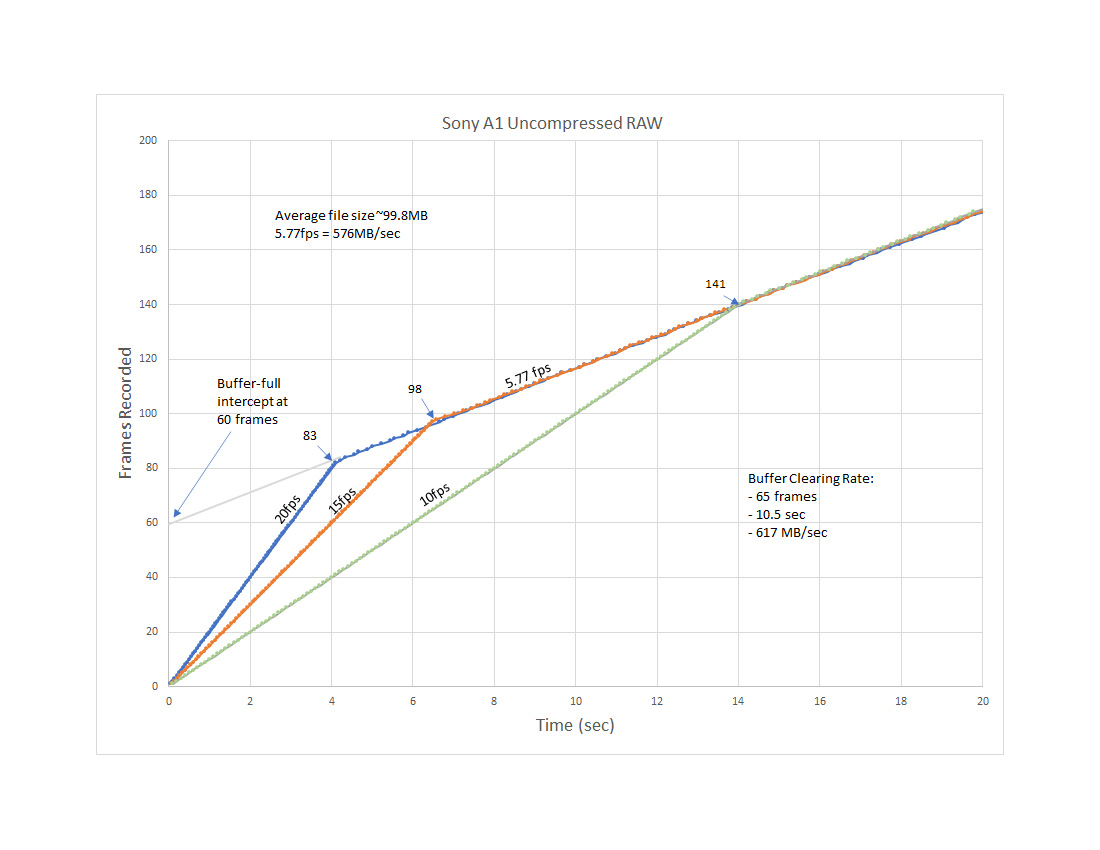
The second set of data shown in charts 3 and 4 is for uncompressed RAW. There is no 30fps mode for uncompressed or lossless compressed modes. Data for 20, 15 and 10fps are shown. Note that the buffer size intercept is 60 frames, but the buffer starts clearing with 65 frames. 65 frames uncompressed fill the buffer, but 127 compressed frames fit, which confirms that compression occurs before storage in the buffer. The buffer clearing rate is 617 MB/sec, essentially identical to uncompressed RAW.
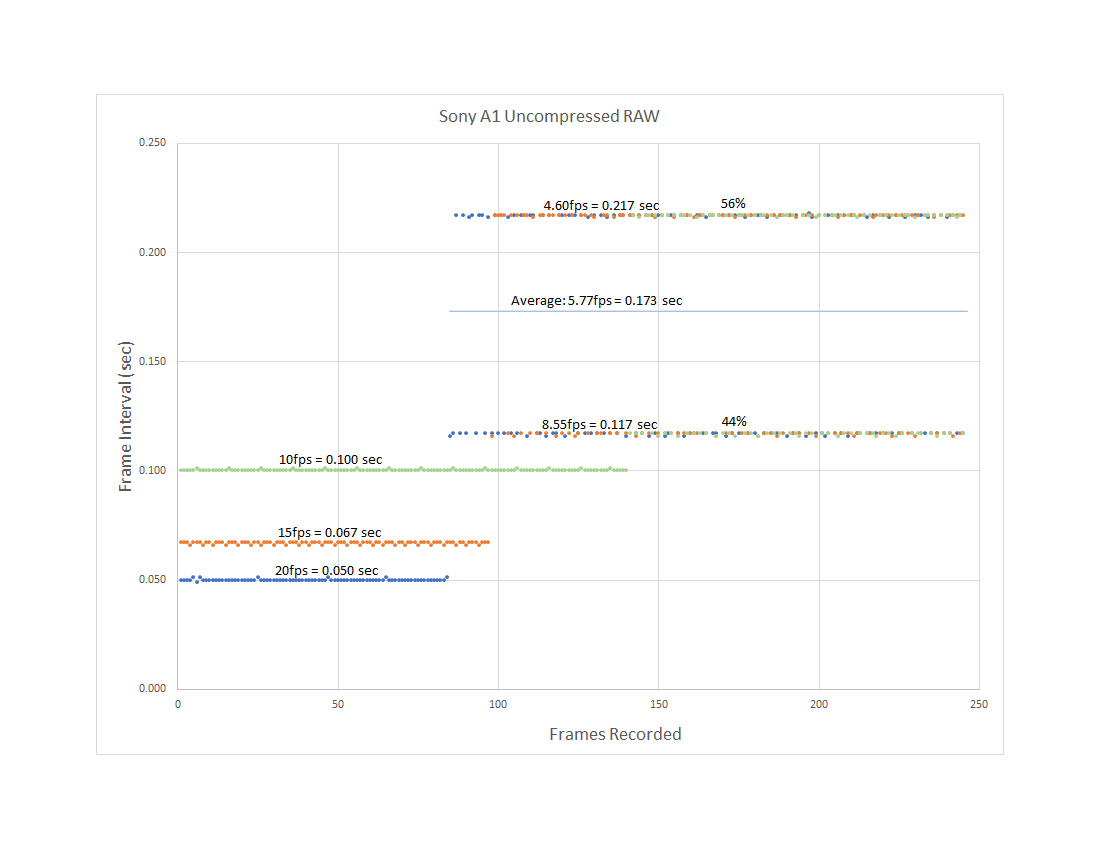
When the buffer is full, frame intervals are again asynchronous with longer intervals due to the large file size and low frame rate to the memory card.
Edited on Aug 30, 2022 at 06:34 PM · View previous versions
When the buffer is full, frame intervals are again asynchronous with longer intervals due to the large file size and low frame rate to the memory card.
Edited on Aug 30, 2022 at 06:34 PM · View previous versions
Aug 30, 2022 at 06:32 PM
p.1 #3Sony A1 CFE-a Memory Card Performance Data
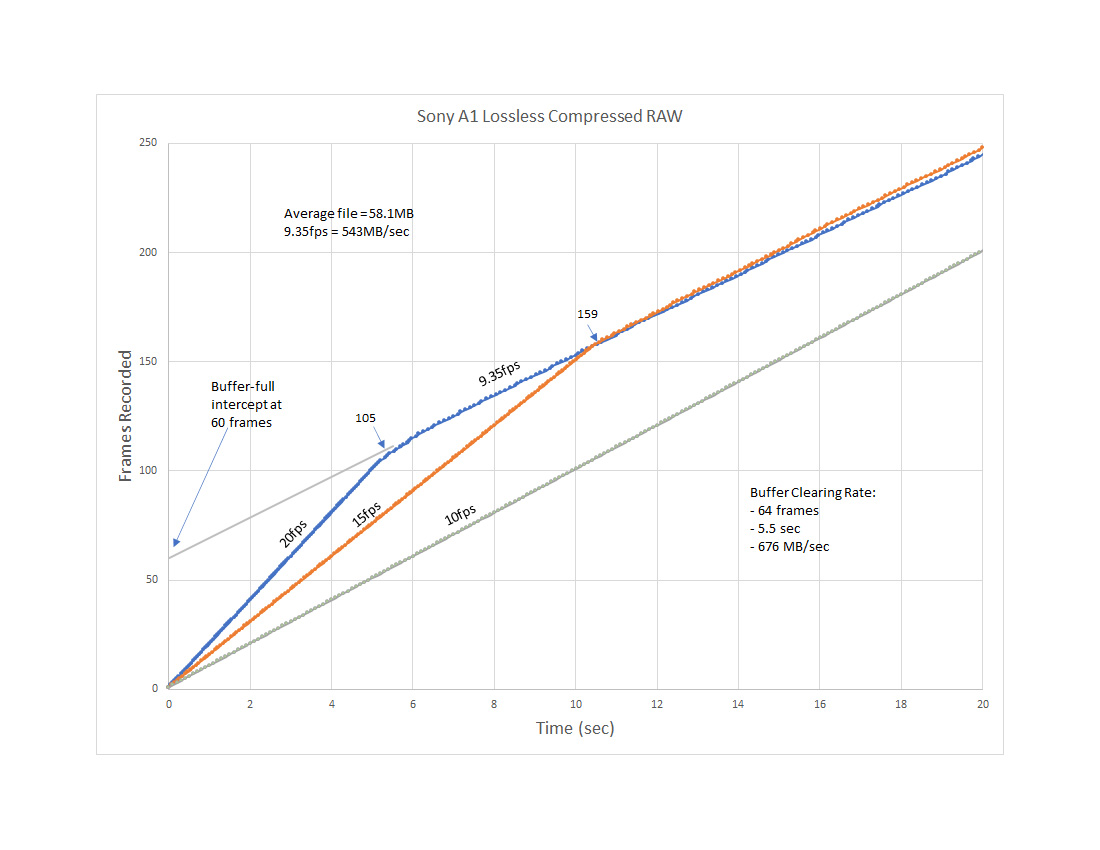
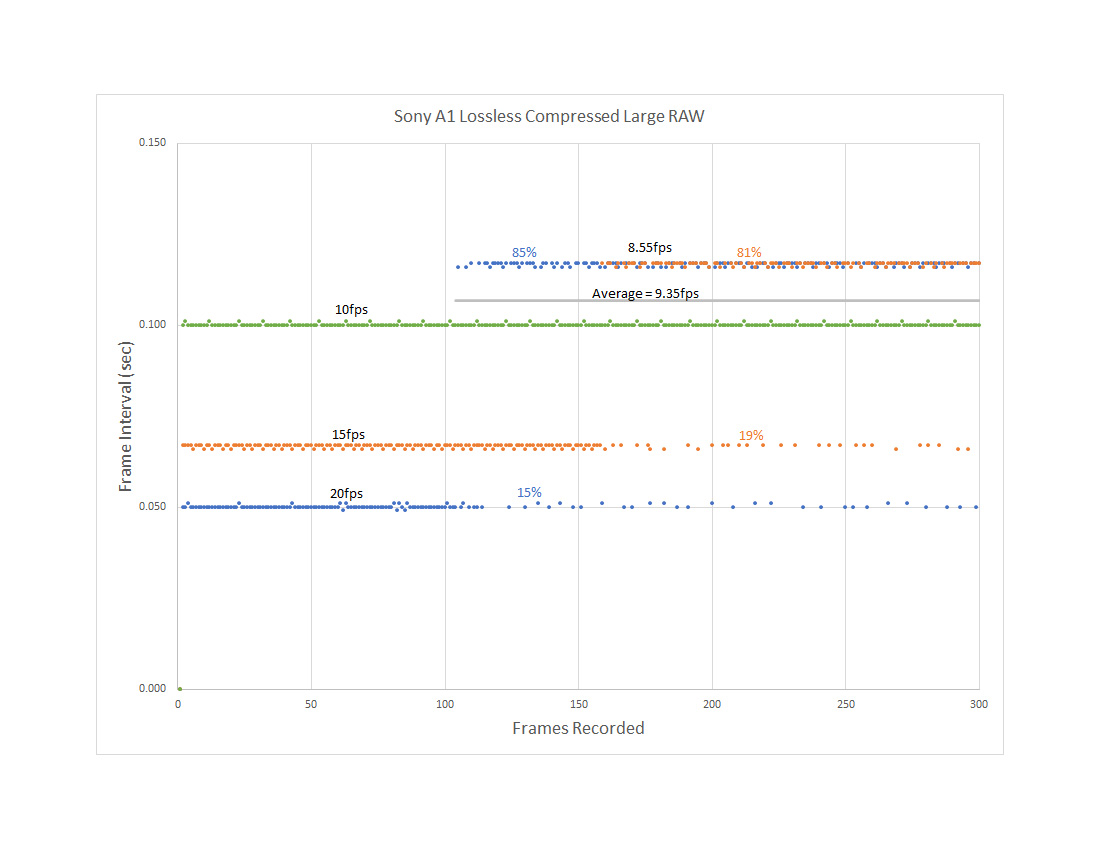
The third set of data, charts 5 and 6, is for large lossless compressed RAW. The buffer holds ~65 frames, which indicates that the files are written into the buffer uncompressed. The buffer clearing rate is higher at 676 MB/sec and the 64 frames in the buffer clear in ~5.5 sec. Since the buffer clears quickly, that indicates that the time to compress the files does not slow down the storage onto the memory card. Given the high speed file compression, it is not clear why the frames are not compressed prior to storage in the buffer, which would nearly double to file capacity of the buffer, and consequently nearly double the number of files captured before the buffer fills. That means there is a big difference between compressed, 242 frames before the buffer fills, and lossless compressed, 102 frames before the buffer fill, at 20fps. That big difference is regrettable. It would be nice to have better performance at 20fps with no compression image artifacts.
Aug 30, 2022 at 06:33 PM
p.1 #4Sony A1 CFE-a Memory Card Performance Data
Great info Dave!
Thanks for putting in so much effort and sharing it with everyone!
Great post!
The intermediate frame rate during 30fps compressed raw is interesting. I don’t think I’ve ever noticed this in the field. Although I rarely use 30fps. And even more rare that I hit the buffer while doing so. It is a little strange that Sony did this though.
Aug 30, 2022 at 07:57 PM
p.1 #6Sony A1 CFE-a Memory Card Performance Data
Thanks Fred.
I asked that this post be unarchived so I can correct an error in the first chart. The label 366 was erroneously labeled 266 frames.
Normally I would not bother to correct and old post but this one is linked to a current active thread.
I asked that this post be unarchived so I can correct an error in the first chart. The label 366 was erroneously labeled 266 frames.
Normally I would not bother to correct and old post but this one is linked to a current active thread.
May 09, 2024 at 02:49 PM
p.1 #7Sony A1 CFE-a Memory Card Performance Data
wonderful EXCEPT!: :"As noted in the prior post, the actual rate at which data is written"
Data R
(data always are)
Thank You from the Bronx, NYC
Data R
(data always are)
Thank You from the Bronx, NYC
May 10, 2024 at 06:23 AM
p.1 #8Sony A1 CFE-a Memory Card Performance Data
In another thread, A9III Data , there is some discussion about how the camera processing load is the limiting factor in how fast and how long the camera can capture frames, and in particular there was some discussion about file compression and the need to create JPEG images for the completed file. That got me a bit curious about how fast the camera can capture and process purely JPEG files. I have never looked at how the camera and card performed with JPEG files because I never shoot JPEG. In fact, until I did these tests my 3.5 year old A1 had never shot a JPEG.
The first chart below shows several curves for different levels of compression of full-size JPEGs (Fine, Standard, Light) shot with the lens cap on and off. The reason for the lens cap is to see if the amount of image entropy makes a difference in the capture rates and durations, since it makes a significant difference in the achieved compression and final file size. Looking at the chart you may be thinking "I only see one curve", which is true, but the reason is that all the curves lie on top of each other. It makes no discernible difference to change the size of the JPEG. It is also interesting to compare this chart with the first one in post #1 of this thread. You see that the 30fps curve for compressed RAW and the curve for JPEGs are nearly identical except that the JPEGs do not experience the second break. Projection of the curve back to t=0 shows that the buffer is ~70 frames for all the JPEG file sizes. I have modified the original uncompressed RAW chart to show the projection back to t=0 and the buffer size there to be ~67 frames, which is similar to the JPEG buffer size.
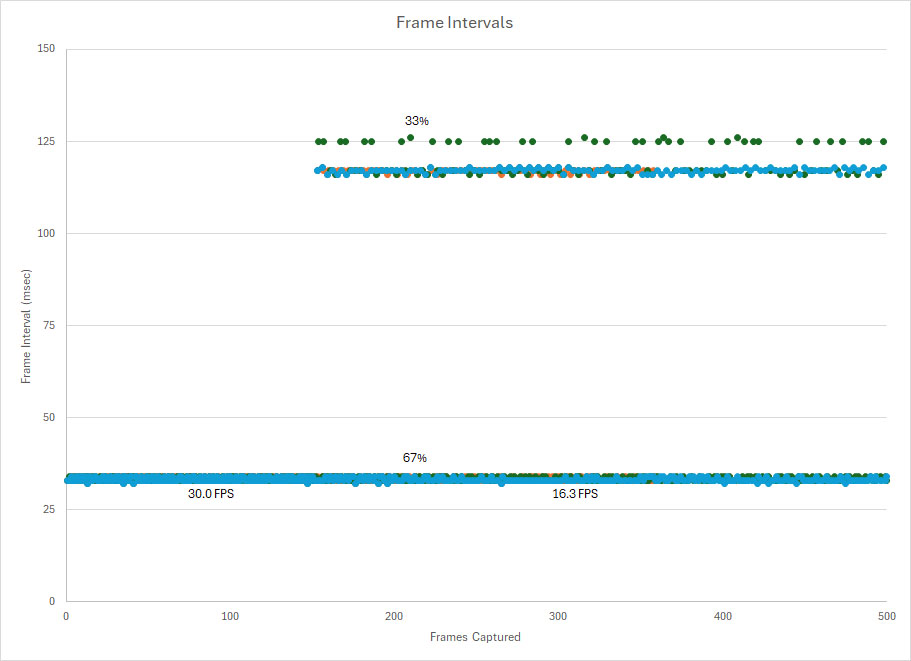
The second chart shows the frame intervals. Again, the results are the same for all the JPEG sizes and compressions and identical to the compressed RAW data.
The size of the JPEG files varies from ~4MB to ~21MB. Since all the rates and durations are independent of the JPEG file size that means the data rates vary ~5X and are small compared to the rate specs of the card.
I did not record the EVF video to extract a precise measurement of the buffer clearing time. I did eyeball the EVF as the buffer was clearing and saw a consistent 83 files (a few 82 and 84) at the beginning and about 5-6 sec to clear the buffer. I do not know why the beginning number files to clear does not agree with the buffer size of 70 frames.
This is a further example of the camera electronics determining the capture rates and durations, not the memory card write speed specification. What conclusions can be reached about the relative load of compression of RAW files and production of the JPEG to embed in the RAW file metadata is subject to discussion.
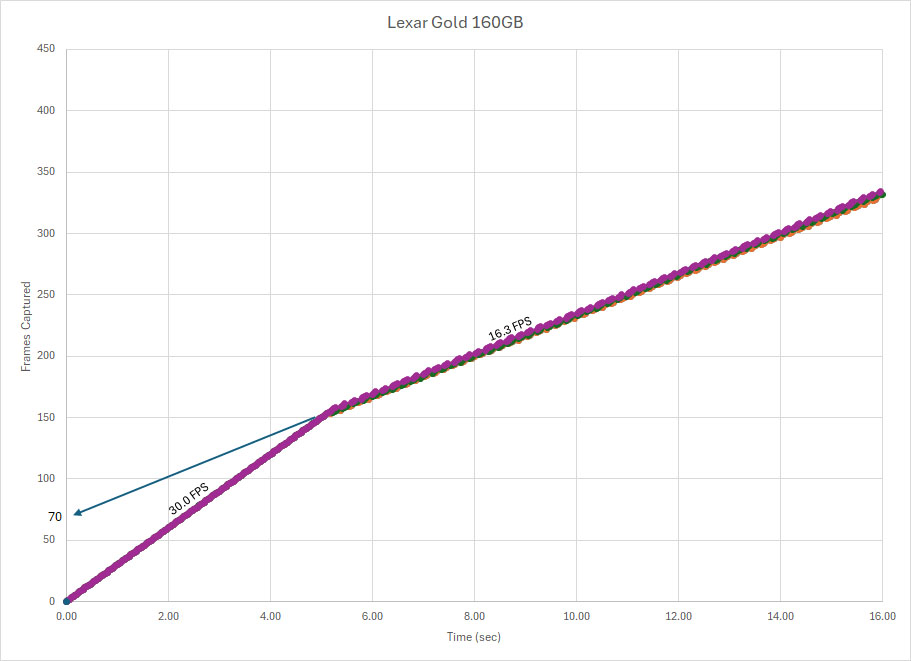
The first chart below shows several curves for different levels of compression of full-size JPEGs (Fine, Standard, Light) shot with the lens cap on and off. The reason for the lens cap is to see if the amount of image entropy makes a difference in the capture rates and durations, since it makes a significant difference in the achieved compression and final file size. Looking at the chart you may be thinking "I only see one curve", which is true, but the reason is that all the curves lie on top of each other. It makes no discernible difference to change the size of the JPEG. It is also interesting to compare this chart with the first one in post #1 of this thread. You see that the 30fps curve for compressed RAW and the curve for JPEGs are nearly identical except that the JPEGs do not experience the second break. Projection of the curve back to t=0 shows that the buffer is ~70 frames for all the JPEG file sizes. I have modified the original uncompressed RAW chart to show the projection back to t=0 and the buffer size there to be ~67 frames, which is similar to the JPEG buffer size.
The second chart shows the frame intervals. Again, the results are the same for all the JPEG sizes and compressions and identical to the compressed RAW data.
The size of the JPEG files varies from ~4MB to ~21MB. Since all the rates and durations are independent of the JPEG file size that means the data rates vary ~5X and are small compared to the rate specs of the card.
I did not record the EVF video to extract a precise measurement of the buffer clearing time. I did eyeball the EVF as the buffer was clearing and saw a consistent 83 files (a few 82 and 84) at the beginning and about 5-6 sec to clear the buffer. I do not know why the beginning number files to clear does not agree with the buffer size of 70 frames.
This is a further example of the camera electronics determining the capture rates and durations, not the memory card write speed specification. What conclusions can be reached about the relative load of compression of RAW files and production of the JPEG to embed in the RAW file metadata is subject to discussion.
May 17, 2024 at 10:12 AM
p.1 #9Sony A1 CFE-a Memory Card Performance Data
rdcny wrote:
wonderful EXCEPT!: :"As noted in the prior post, the actual rate at which data is written"
Data R
(data always are)
Thank You from the Bronx, NYC
"Technically, "data" is a plural noun—it is the plural form of the noun "datum." However, it is used with both singular and plural verbs." [Britannica Dictionary]
Specifically in computer science the singular verb form seems a good deal more common. So much so that the plural seems very archaic to me.
May 17, 2024 at 01:48 PM
p.1 #10Sony A1 CFE-a Memory Card Performance Data
dclark wrote:
The operational impact of the bi-model frame intervals is not significant in most cases, but it is a bit bizarre. Very few photographers would be aware of it or care. Regardless, the ideal would be for frames to be uniformly spaced in time.
As a workaround you can reduce the shooting speed. After the buffer hits, you then get a smoother distribution of exposures during the remaining burst. I used this when I took the wagtail image below.
https://live.staticflickr.com/65535/53728119591_aeefcff281_o.jpg
May 17, 2024 at 02:12 PM
p.1 #11Sony A1 CFE-a Memory Card Performance Data
I did a test, Sony A1, Compressed RAW using Pergear 1TB Prime CFEa card.
(This is a couple of years old, Labelled R: 800MB/s W: 700MB/s.)
155 files were written in 6.141 seconds.
Interval between files ranged between 0.032 and 0.034 seconds.
I've managed to confuse myself now, not surprising.
I think I can conclude:
I can shoot at 30 fps (actually about 30.3 fps) for 155 shots before slowing down.
The next 30 shots take 1.719 seconds which is 17.45 fps.
Other than the 3 consecutive shots 163,164,165, I get 2 shots at 30 fps, then 1 at around 8 fps.
I took 250 shots so I'll look ahead and see what happens between 185-250.
Hopefully this is easy enough to understand to show what happened after 155 files written.
EDIT: Added data for the whole 250 shot test
For the 95 shots, #156-250 average was 16.69 fps.
Conclusion: it seems the Pergear is just as fast as other cards tested.
It is less consistent though once it slows in this test, ie, unlike Dave Clark's 'triplet' finding, sometimes 3 files are written fast, consecutively and other times only 2, or even 1!
The intervals are the same, either 0.117 secs or 0.33 secs.
At 221 shots, it did start the triplet pattern.
https://live.staticflickr.com/65535/55430476853_177274a3c8_o.jpg
Jul 30, 2026 at 02:23 AM