Since 1907, always on the last Saturday in May, thousands of spectators have been coming together to see the capturing of Germany’s last wild horse breed.
Some of the yearling stallions will be separated from the herd by specially trained catchers on this day and auctioned off after the event.
I haven't really gotten around to reviewing my pictures today, just quickly developed a few pictures.
The Dülmen Pony is one of the oldest horse types and was first mentioned in 1316, one of the last real wild horses in whole Europe!
The entry of the herd of wild horses, around 300-400 animals after all, is an unforgettable experience.
Although I have no special relationship with horses, i.e. I don't have any significant contact with horses, the moment when you can hear the rumble of hooves from afar and the herd enters the arena is not only very primal, but also downright emotional.
It's hard to describe, but it gives you an idea of how majestic such herds of large wild animals must have been in prehistoric times.
An unforgettable experience, even without a photographic background.
The only drawback on yesterday's day and as a result of modern digital camera technology with high frame rates, the number of shots/releases during the event was easily in the four-digit range, nearly 3000.
I haven't even been able to view half of my shots yet.
Sometimes I'm really glad that I only own a Z6, because with a Z9 there would probably have been twice as many.
But I also have to say that the Z6 absolutely delivers.
If you work with the traditional AF methods, i.e. don't rely on tracking/auto-tracking, but work with the appropriate AF fields and of course with a certain amount of anticipation, as you needed in MF times, then the yield is very high.
Only when very fast movement comes directly at you, the AF does not follow fast enough and you have occasional blurred images in high frame rate series.
As I don't regularly shoot action, I was pleasantly surprised at how little wastage due to incorrect focus so far.
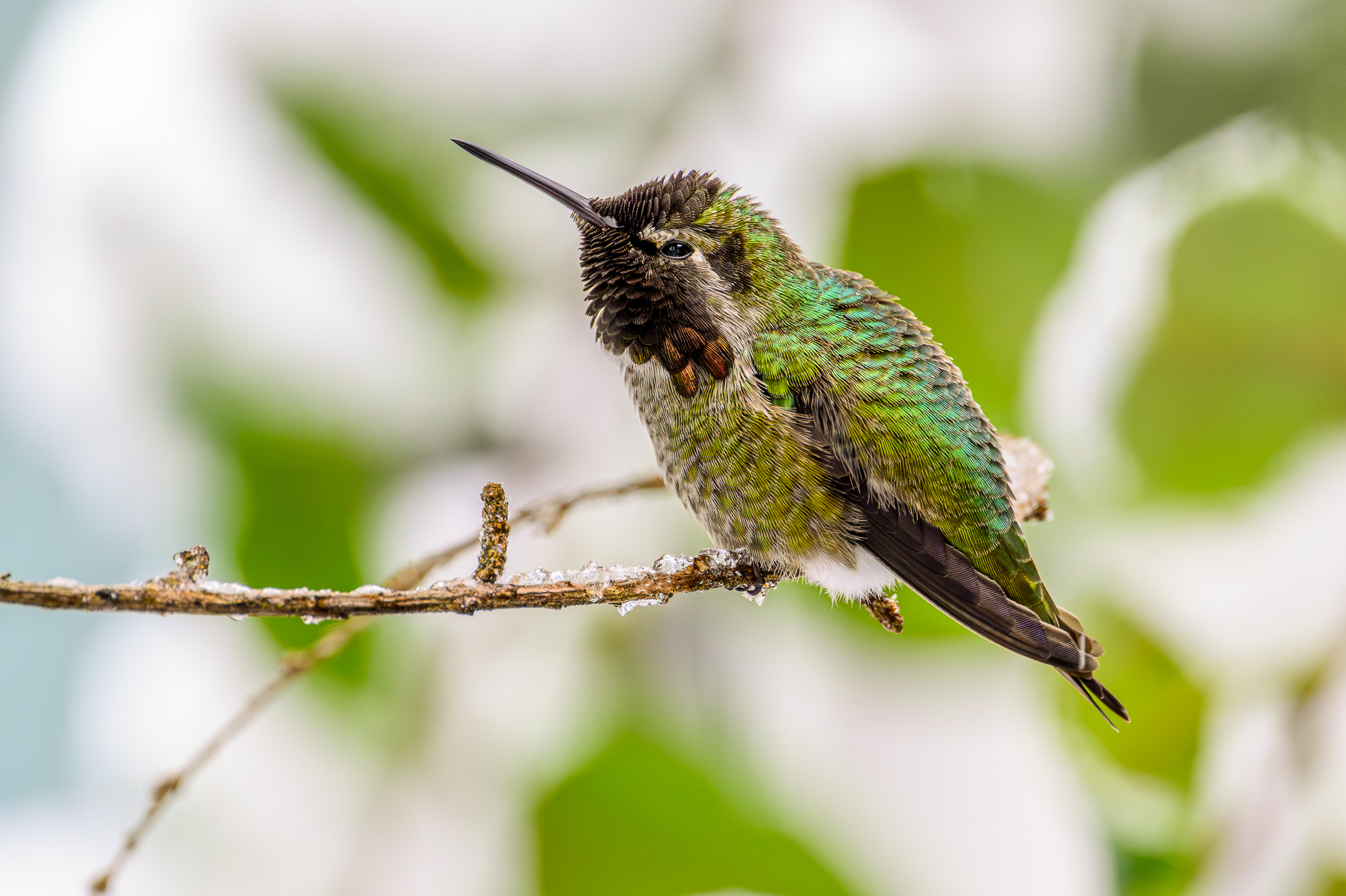
I've been going back over some of the files I captured last year, and managing to find a few that never got processed at the time. Here's one from when I first got the Z9 and 400 f4.5.
Anna's Hummingbird (Calypte Anna)
NIKON Z 9NIKKOR Z 400mm f/4.5 VR S Z TC-1.4x lens560mmf/6.31/200s3200 ISO+0.7 EV
I had been shooting a couple juvenile peregrine falcons in flight, when suddenly this adult flew right past me, close enough that I felt the breeze on my right shoulder. This is the only frame in focus before it exceeded the len's MFD. Z9 with 400 f4.5 plus 1.4 TC, f6.3, 1/2000, ISO 1600
Fred Amico wrote:
I had been shooting a couple juvenile peregrine falcons in flight, when suddenly this adult flew right past me, close enough that I felt the breeze on my right shoulder. This is the only frame in focus before it exceeded the len's MFD. Z9 with 400 f4.5 plus 1.4 TC, f6.3, 1/2000, ISO 1600
I know where there is one Peregrine nest in the same location each year, here in Maine. Have usually been so busy with Loons that I only tried photographing the Peregrine several times in years past. No image to post here.
I don't know how you guys (LanceB, sum1sgrampa and anyone of overlooked) are able to capture the image when this thing passes by. I did not realize the speed until the moment it passed fairly closely (no, it was *not* buzzing me.... just fairly close), directly over my head . It was flat moving....WOW!. The closer it got the faster the apparent speed. A lot faster!
And I was at least 200 yards from where we knew the nest to be (under a draw bridge in an enclosure). And we did not get *any* closer. Still, that Peregrine let us know that 200 yards was not far enough. ha-ha.
Could be wrong: In this respect, I think the Peregrine Falcon has the lowest, most unreasonable (ha-ha) tolerance of any bird I have known.
I know where there is one Peregrine nest in the same location each year, here in Maine. Have usually been so busy with Loons that I only tried photographing the Peregrine several times in years past. No image to post here.
I don't know how you guys (LanceB, sum1sgrampa and anyone of overlooked) are able to capture the image when this thing passes by. I did not realize the speed until the moment it passed fairly closely (no, it was buzzing me.... just fairly close), directly over my head . It was flat moving....WOW!. The closer it got the faster the apparent speed. A lot faster!
And I was at least 200 yards from where we knew the nest to be (under a draw bridge in an enclosure). And we did not get *any* closer. Still, that Peregrine let us know that 200 yards was not far enough. ha-ha.
Could be wrong: In this respect, I think the Peregrine Falcon has the lowest, most unreasonable (ha-ha) tolerance of any bird I have known.
Fred Amico wrote:
Thanks much, Robert, for your very kind words. It was quite a thrilling experience for me to have that falcon fly past so close to me.
One in a million opportunity but you were ready for it. Nice job