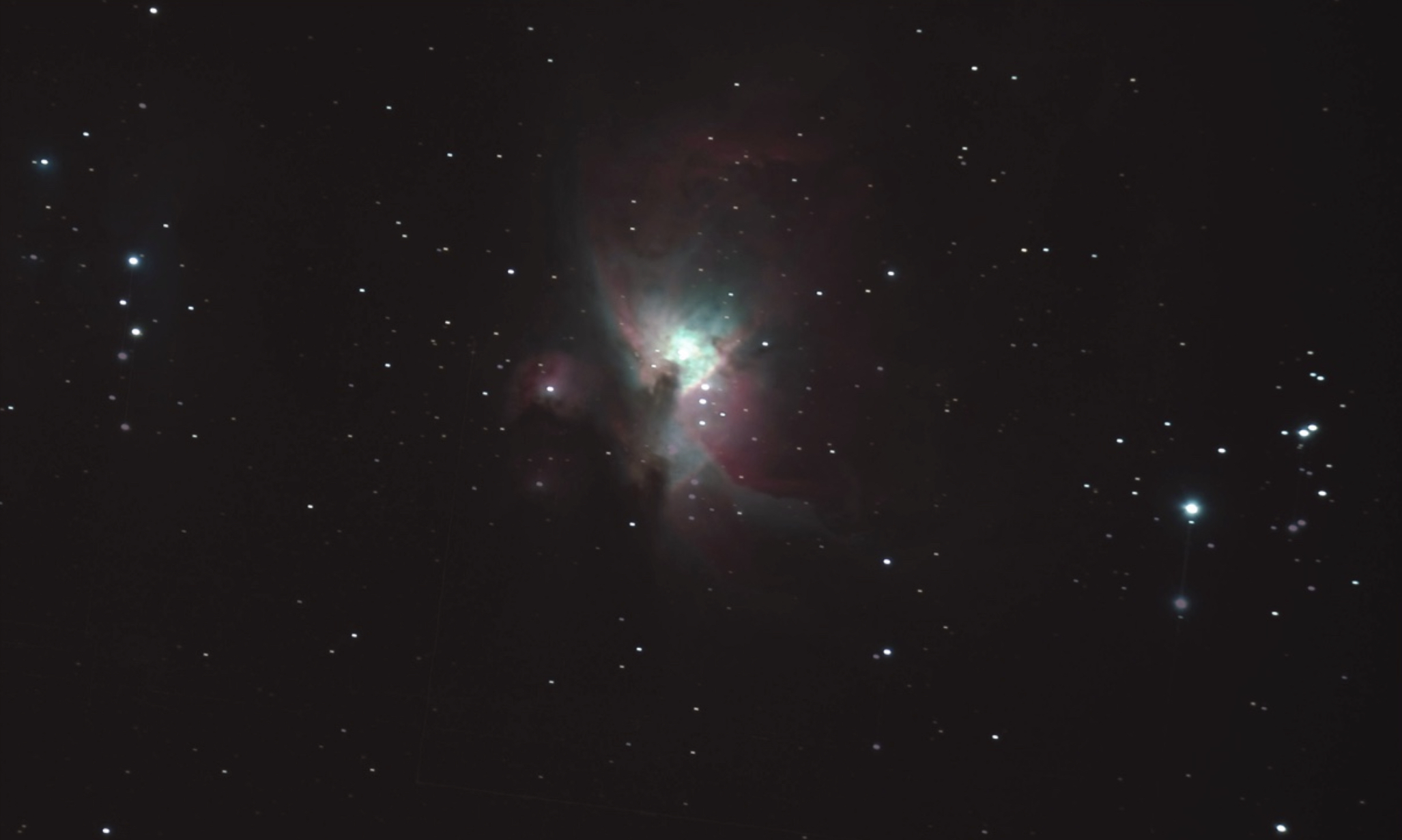
Some time ago I recall there were several threads of deep sky objects posted on this board, but I haven't noticed any recently (I must also say I visit FM and Landscape board very sparsely these days due to work). Since they are technically a "landscape in space" I decided to try and post some photos of space stuff I took in recent months.
My first composition is the "classic of the classics" and arguably the most famous nebula - Messier 42 - The Orion Nebula with some companions.It is a large nebula located in the Winter constellation of Orion and it is visible to the naked eye. It is also the most photographer nebula and often the first object beginners attempt to take because of its brightness. But it is definitely not so easy to process and do the justice to all the elements present in this composition. In other words - bright stuff is (mostly) easy. It's the faint stuff that takes a lot of work to capture and bring to life afterwards. Orion nebula has one tricky part - an extremely bright core with Trapezium star cluster located just to the right of the middle of the composition. Most people tame the brightness by doing HDR composition with short exposures, but I managed to pull a lot of details without resorting to HDR. The left part of my composition shows a number of deep sky objects collectively named "The Running Man" nebula - a very nice combination of Hydrogen alpha region (the red silouette) and a reflection nebula (blue) - a dust reflecting the light of nearby stars. There is also an open cluster of stars nicely visible there. Finally around it are the brown dusty regions which I hoped to be more prominent, but I clearly need to dedicate more time to this target next winnter. With all the tools modern astophotography offers, it is quite easy to come back to your older data and add more to your projects.
Tech details:
Captured by Skywatcher Newtonian telescope (1000mm, f5), with Baader Coma Corrector, Skywatcher EQ6 Pro Equatorial Mount, guided by the ZWO 120mm mini guide camera. The main imaging camera is the QHY 168C - a 16 mpix color cooled astrophotography camera cooled to -10C. A Baader Neodymium Moon & Skyglow filter was used to block some of the (inevitable) light pollution. I took 107 3-minute subexposures over 4 nights for a total of 321 minutes of integration.
Then there was quite a lot of processing involved (I don't want to go too much into that, let me know if you're interested) and here is the result. I hope you'll enjoy and let me know if I should post more photos. It takes a lot of fiddling to get these done, so it might be a while before I post the next one.
An amazing, 3-D feeling image! I respect the dedication that was required to pull this off! Thank you for the explanation at the beginning, too! I love learning more about our celestial neighbors. Do post more!!!
Chaz wrote:
A stunning capture beautifully presented!
Do you have any files processed where "The Trapezium" is more discernible?
Again, thank you for this superb view. Don't hesitate to post more!
Thank you very much. Here is a very very mild stretch of the source file of the Core region with the Trapezium star cluster. No color tweaking, or other adjustments. Although it looks like a dense blob of 4 stars, they are quite nicely visible. It shows that all the nebulosity around is pretty much intact, which is the testament that the sensor in my camera, although not the latest and greatest, is still capable of amazing captures.
Funny thing - even the massive and beautiful Hubble photo of the entire nebula available on the wiki page here: https://en.wikipedia.org/wiki/Orion_Nebula has the Trapezium cluster blown along with the three larger stars just "south" of it.
I could very well reprocess my photo and do the "darker" Hubble rendition, but then I wouldn't be uncovering nearly as much dark stuff around the nebula. It's really in the eye of the beholder and how one feels that particular day.
Thanks to everybody who commented, I'm really glad you like this type of work. I will post some more known and less known deep sky objects once I process them to my liking. That's easier said than done to be honest - the urge to constantly tinker with this type of images is strong .
p.1 #11 · Messier 42 + NGC 1975 - The Orion Nebula
Ssj92 wrote:
Very nice, this is all I am able to get for now.
The road is long and treacherous, but if you dedicate the time and funding, you will get there. I remember when me and my dad were lucky to acquire our current mount (second hand) and without guiding and proper support, our exposures were limited to about 1 minute. And about 25% of exposures showed some degree of trailing. Lately I've had some balancing issues, but with proper guiding, I wouldn't hesitate to try 10 minute exposures, especially towards the zenith.
p.1 #12 · Messier 42 + NGC 1975 - The Orion Nebula
I’ve got Celestron C11 on CGEM DX and now also have a Nikon 600mm F4E.
My CGEM DX is having issues and I may need a new control board. Haven’t been able to use the C11 in awhile. Hoping to get it running again. I have some other pics too just gotta find them.
p.1 #14 · Messier 42 + NGC 1975 - The Orion Nebula
A great rendition of M42. Down here in Sydney I have had no chance to image it this season due to a La Nina weather system basically producing six months of clouds. Tonight is clear, but it's full moon.......
p.1 #15 · Messier 42 + NGC 1975 - The Orion Nebula
Thanks Dave and everybody!
Aztatlan - If you have a narrowband filter or dual narrowband filter like Optolong L-Extreme or multiband filter like Optolong L-Enhance, you can image even in late Moon phases. I tried 2 or so hours with L-Extreme filter on Orion nebula and it produces quite impressive photo too - it just doesn't capture the reflection nebulae around The Running Man. Personally I haven't tried it during the Full Moon as I felt it was noticeably affecting the subexposures even with 7nm bandpasses, but might be worth trying out when the nebulae are back in the sky after the Galaxy Season we are in right now.
Ssj92 - I hope you'll be able to sort it out and get back to imaging.


 .
.