flash wrote:
Thanks for the articulate and well expressed answer. I do see why you have concerns but I don't think you're correct about the M11 or future M cameras.
Firstly Leica have always said that the RF is the heart of the M. And the M11 still operates around the RF. I don't have my EVF yet. I'm using the M11 as a rangefinder although, for my intended use the new EVF functionality is less important. I'm really here for the long exposures and adjustable LENR.
New sensor aside (I'll get back to it). the major *update* is the advancements in the live view side of the M. This is true. The real issue is whether that's affected the core M experience in a negative way. I don't think it has. The shutter opens when you turn the camera on. No big deal. You can still shoot centreweighted if you want to. All good so far. The shutter sound IS longer (very very slightly) than the M10R. But there's no increase in lag and it's quieter than the regular M10, M240 and M9. It's purely an aethetic change. That may or may not be one that bothers an M10-P shooter. But only a trip to a Leica store will answer that for each individual.
At least it doesn't have video. That was the death of the M as well, if I remeber correctly.
The simple solution is don't buy the Visoflex. But I'd argue that the Visoflex has been around for decades. Leica has always tried to expand the shooting envelope of the M and the current M10 or the new M11 Visoflex is actually the most elegant solution for Leica so far.
The next thing is the sensor. Is 60MP to big for an M? I'll ignore the factually incorrect argument that more MP needs higher shutter speeds and more blur. That's a function of enlargement size, not MP. I understand the pixel blur arguments but still it's enlargement not resolution that is the issue.
But I do think Leica has thought really hard about the resolution thing and having selectable resolutions is a really elegant solution. You don't need to decide between resolution and noise (SL2 or SL2-S?). And it's a good sensor. Really good.
Does it mean the death of the M is here? No. Absolutely not. The M is a halo product. Not having an M would damage Leica in a way they can't recover from. I don't think Leica will or should try and copy Fujifilm. A hybrid RF isn't an M. Plus they can't monetise it. Not the Leica way. They want you to spend 700 bucks on a $200 EVF. Or buy another camera. But Leica do like a niche. And there's a niche for an EVF camera with an M mount. A MF mirrorless camera. The M11 kind of does it and so does the SL2. But I think Leica are planning an EVF camera for M lenses. It makes sense. But it won't be an M. Think bigger CL with an M mount. If the M11 sells a lot of EVF's then it's proof of concept.
I agree that the M10 (M10R black paint to be specific) is close to peak M. With the M11 they had to change it but not ruin it. I really don't think they have. But that's just my opinion.
I really think you'll need a trip to the Leica store to see if the M11 is an M for you. I think you'll see that the fuss is overhyped. It's still an M. The size of an M with the battery from a 240. Or give me a yell and we can argue about it over coffee...
It'd be better in black paint on brass though......
Gordon.
p.s. Is it weird that already I'm turning my M10M on and waiting for the shutter to open??...Show more →
Man do I need to up my forum game! Very elegant and informed comment you present here on such a hot topic 👍🏼
After listening to Stefan Daniel once again reaffirm Leica IS the M [rangefinder] in one of the recent M11 announcement videos, I don't think the rangefinder is going to disappear any time soon, at least not while he is still in charge and the rangefinder still manages to bring in the required sales.
Oh an there is of course the fact that the M11 is a...rangefinder 😉
Well the rangefinder has outlived and or lived through the SLR, DSLR, Mirrorless, autofocus, etc revolutions. Many things have come and gone yet the rangefinder is still alive and kicking. Leica M is one of the few cameras that has seen continued success in these times when the big two maybe not so much.
Many Leica shooters have a hard time admitting this but yes, the M11's Sony sensor is quite impressive.
However, the M11's dual gain entry point differs and engages at ISO 64 and ~ISO 250. I really like what Leica accomplished here.
At ISO 200 and after ISO 400, both M10-R and M11 have similar DR, although the M11 is still does slightly better.
Having said that, this result does not mean that the M11 has over a stop of highlight recovery compared to the M10-R. That extra stop at ISO 64 may translate to cleaner shadows at this setting.
Fred Miranda wrote:
Many Leica shooters have a hard time admitting this but yes, the M11's Sony sensor is quite impressive.
However, the M11's dual gain entry point differs and engages at ISO 64 and ~ISO 250. I really like what Leica accomplished here.
At ISO 200 and after ISO 400, both M10-R and M11 have similar DR, although the M11 is still does slightly better.
Having said that, this result does not mean that the M11 has over a stop of highlight recovery compared to the M10-R. That extra stop at ISO 64 may translate to cleaner shadows at this setting.
I could never have imaged this level of Sensor IQ achievement possible in a Leica rangefinder when I purchased my first rangefinder in 2018, the M10. Never mind native ISO 64, USBC and 64GB internal memory 🤩
airfrogusmc wrote:
Well the rangefinder has outlived and or lived through the SLR, DSLR, Mirrorless, autofocus, etc revolutions. Many things have come and gone yet the rangefinder is still alive and kicking. Leica M is one of the few cameras that has seen continued success in these times when the big two maybe not so much.
Yes. Amazing really. And here we are in the midst of another global crisis to include the ever collapsing camera sales industry and Leica is confident to come to market with the $9K M11. I guess there is more magic in that red dot than I realized.
Boldest move for Leica M in my opinion was the original MM in 2012. I remember all the heat they were taking on all the forums. Ya know things like who the heck would buy a B&W only camera and I can do B&W in my camera or in PP why would anyone buy something like that? And #2 I would say would be the LCDless D model. Both just bold moves with a real commitment to photographers that dont want on need the stuff everyone else is selling.
SlowDriver wrote:
Fantastic cameras though... small brilliant lenses and image quality virtually indistinguishable from FF Leica... very underrated...
No arguments there. I was just being contrary. I do prefer the layout of CL with the multi-function controls and LCD on the top plate, but the TL's good, too. It does seem to me like the flat front of the CL would be more advantageous to a modular design ethos. Those who don't want a grip don't have to worry about it, and if you want to add a grip, I'm sure Leica and the third-party makers will keep you covered. The current Lecia Handgrip CL already gives a deeper grip than the TL and I'm sure some ingenious third party maker can come up with a similar solution that would give you a dovetail base and access to the battery compartment. The TL's design makes that difficult.
Fred Miranda wrote:
Many Leica shooters have a hard time admitting this but yes, the M11's Sony sensor is quite impressive.
However, the M11's dual gain entry point differs and engages at ISO 64 and ~ISO 250. I really like what Leica accomplished here.
At ISO 200 and after ISO 400, both M10-R and M11 have similar DR, although the M11 is still does slightly better.
Having said that, this result does not mean that the M11 has over a stop of highlight recovery compared to the M10-R. That extra stop at ISO 64 may translate to cleaner shadows at this setting.
The thing is.....
I'm not seeing what this chart says in the real world. I have all of these cameras except the 50R (I have an X1D) and 100 (I have a 100S) so it should be pretty much the exact same thing. I've used them all either for months or years, except the M11. I know these sensors really well. I'm seeing a bigger gap between the M10 and M10R and a smaller gap between the 50R and 100 in the field.
There results may be imperically correct but not an exact translation to real world use.
I'm not saying the M11 sensor isn't impressive. It is. I'm not saying it doesn't have more DR than the M10R. I have yet to test. I'm not saying it's not a Sony waffer, although there's an unconfirmed report on LUF that Leica said it isn't. It probably is a Sony waffer and the different CFA array and microlenses would explain the differences in dual gain spots. All I'm saying is that once you add a lens, processor and processing software into the mix these figures aren't exactly as what you see in the field and that needs to be taken into accound when interpreting the results.
I don't have an A7R4. But by all accounts it's similar to the A7R3, which I do have and there's just no way that sensor is 1.5 stops better than the M10R in real world usage. So I am highly dubious that my M11 has 1.5 stops improvement over the M10R, *in the real world*.
airfrogusmc wrote:
Boldest move for Leica M in my opinion was the original MM in 2012. I remember all the heat they were taking on all the forums. Ya know things like who the heck would buy a B&W only camera and I can do B&W in my camera or in PP why would anyone buy something like that?
Tell me about it. It appears Leica lost their sensabilities with not 1 but 2 encoures of M B&W's.
Who in their right mind would ever buy a camera like that.
And there seems to be no end to the lunacy they did it to a Q too.
I'm not seeing what this chart says in the real world. I have all of these cameras except the 50R (I have an X1D) and 100 (I have a 100S) so it should be pretty much the exact same thing. I've used them all either for months or years, except the M11. I know these sensors really well. I'm seeing a bigger gap between the M10 and M10R and a smaller gap between the 50R and 100 in the field.
There results may be imperically correct but not an exact translation to real world use.
I'm not saying the M11 sensor isn't impressive. It is. I'm not saying it doesn't have more DR than the M10R. I have yet to test. I'm not saying it's not a Sony waffer, although there's an unconfirmed report on LUF that Leica said it isn't. It probably is a Sony waffer and the different CFA array and microlenses would explain the differences in dual gain spots. All I'm saying is that once you add a lens, processor and processing software into the mix these figures aren't exactly as what you see in the field and that needs to be taken into accound when interpreting the results.
I don't have an A7R4. But by all accounts it's similar to the A7R3, which I do have and there's just no way that sensor is 1.5 stops better than the M10R in real world usage. So I am highly dubious that my M11 has 1.5 stops improvement over the M10R, *in the real world*. Gordon...Show more →
It's certainly not the "stock" Sony 60MP sensor. It's seems to be a modified version designed for Leica just like it was done for Sigma with the same sensor and for Fuji with their MF sensors.. Dual gain was tweaked to allow ISO 64 and apparently it didn't degrade the high ISO performance much compared to A7R4. I actually prefer the way this sensor works on the Leica compared to the Sony but as you wrote, the differences are just too small to be noticeable in real world images.
Going ISO 64 is very useful for Leica because of the camera's 1/4000s limitation when using the mechanical shutter.
Can some one explain this to me. On LUF someone said DR was reduced with cropping, which I am questioning. He claims that sites like P2P and DXO measure DR at a fixed output size and not at the pixel level. Is that true? I have always believed that DR was properly measured at a pixel level to determine the range that each pixel had. ie; what's the difference between the lowest readable signal and the highest recordable one. Am I wrong? That would mean nearly all modern high res sensors are measured when software reduced to a fixed size and not an actual hardware measurement.
Maybe I'm wrong but DoF is a fixed size and DR is at the pixel level?
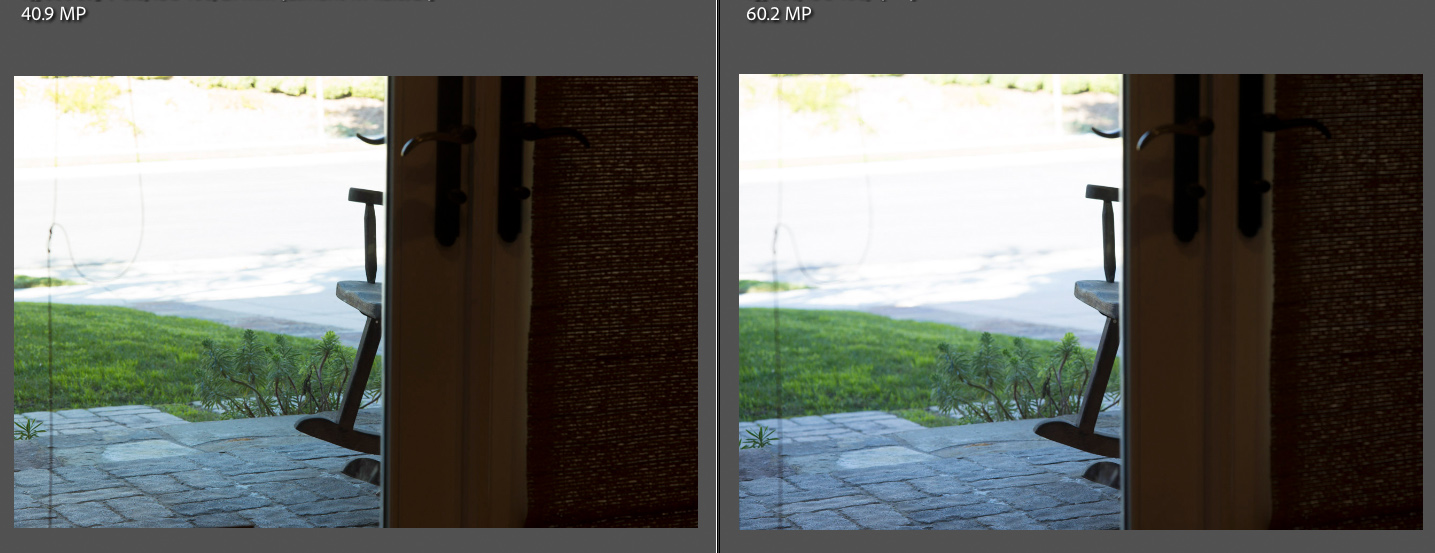
Here is a quick experiment comparing the sensor from the Sony A7R4 (similar to M11) and Leica M10-R in terms of highlight recovery. Both at ISO 100
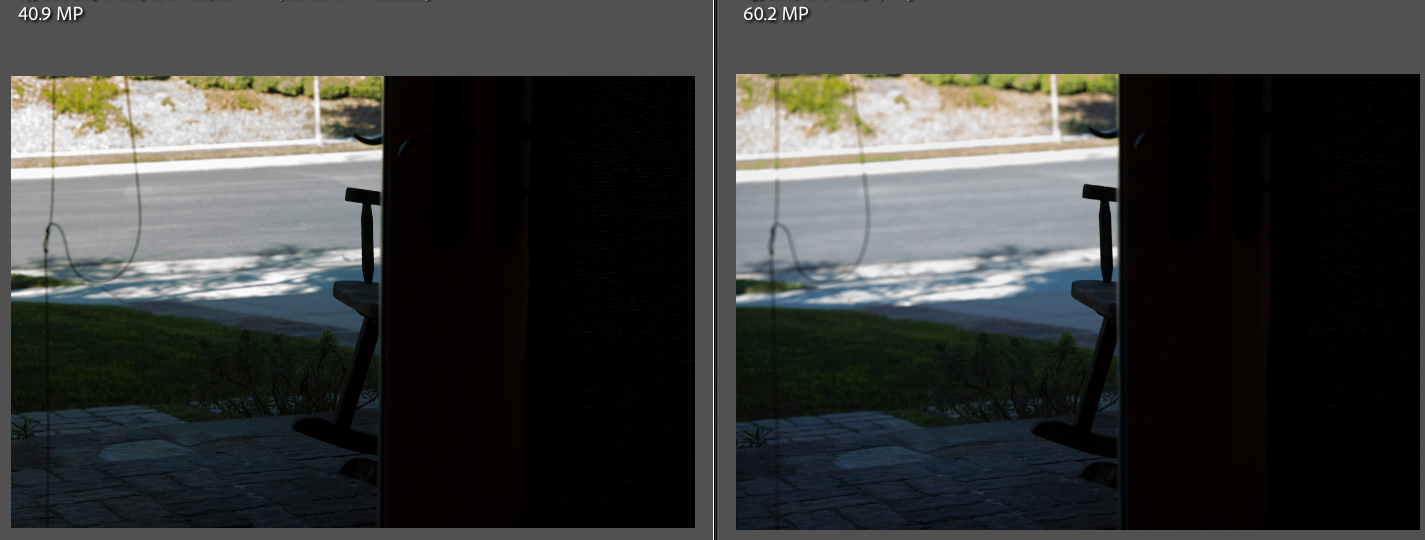
Outside of my office window, I overexposed the scene to about 3 stops for both cameras. In my previous tests, I found the M10-R had about 1 stop better highlight recovery compared to my M10 or M10P cameras. Well, although the Sony sensor has higher DR at ISO 100, the highlight recovery latitude is about the same. I conclude that the gain in DR is in the shadows and I expect the same for the M11. (I will test this if I get my hands on one)
Leica M10-R (LEFT) | Sony A7R4 (LEFT)
Overexposed scene (+3 stops)
Reduced 3 stops in Lightroom for both images. Highlight recovery seems very similar
Fred Miranda wrote:
Going ISO 64 is very useful for Leica because of the camera's 1/4000s limitation when using the mechanical shutter.
Agree 100%. I've long argued that a usable low ISO is generally more useful to more people than the stratospheric ISO figures camera companies use in their advertising.
One of the reasons the Noctilux was always more usable on the SL than the M. But that's now changed with the M11.
Also interesting that the've landed on ISO64 and not 50. Just like Nikon who also have a native ISO64. Leica usually uses whole stops for ISO.
ISO 64 is only a 2/3 stop advantage from ISO 100 so a ND filter may still be needed for F/1 lenses under harsh daylight when using mechanical.
flash wrote:
Agree 100%. I've long argued that a usable low ISO is generally more useful to more people than the stratospheric ISO figures camera companies use in their advertising.
One of the reasons the Noctilux was always more usable on the SL than the M. But that's now changed with the M11.
Also interesting that the've landed on ISO64 and not 50. Just like Nikon who also have a native ISO64. Leica usually uses whole stops for ISO.
I'm not seeing what this chart says in the real world. I have all of these cameras except the 50R (I have an X1D) and 100 (I have a 100S) so it should be pretty much the exact same thing. I've used them all either for months or years, except the M11. I know these sensors really well. I'm seeing a bigger gap between the M10 and M10R and a smaller gap between the 50R and 100 in the field.
There results may be imperically correct but not an exact translation to real world use.
I'm not saying the M11 sensor isn't impressive. It is. I'm not saying it doesn't have more DR than the M10R. I have yet to test. I'm not saying it's not a Sony waffer, although there's an unconfirmed report on LUF that Leica said it isn't. It probably is a Sony waffer and the different CFA array and microlenses would explain the differences in dual gain spots. All I'm saying is that once you add a lens, processor and processing software into the mix these figures aren't exactly as what you see in the field and that needs to be taken into accound when interpreting the results.
I don't have an A7R4. But by all accounts it's similar to the A7R3, which I do have and there's just no way that sensor is 1.5 stops better than the M10R in real world usage. So I am highly dubious that my M11 has 1.5 stops improvement over the M10R, *in the real world*.
I noticed a huge difference from GFX 50S/R to 100S when editing files in LR/C1. The color fidelity in the shadows when raised is so much better on the 100S – the 50S/R shadows turn burnt/brown by comparison – raise the ISO and the differences become more exaggerated. Tonal differences on files pushed really hard in post are dramatic, at least when using the 16-bit RAW on the 100S (I never tried the 14-bit) – gradients hold their smooth transitions much longer before posterizing, especially evident in b&w conversions. Highlight recovery is also much better – much less chance of color shifts when pulling them down.
---------------------------------------------
Fred Miranda wrote:
Here is a quick experiment comparing the sensor from the Sony A7R4 (similar to M11) and Leica M10-R in terms of highlight recovery. Both at ISO 100
Outside of my office window, I overexposed the scene to about 3 stops for both cameras. In my previous tests, I found the M10-R had about 1 stop better highlight recovery compared to my M10 or M10P cameras. Well, although the Sony sensor has higher DR at ISO 100, the highlight recovery latitude is about the same. I conclude that the gain in DR is in the shadows and I expect the same for the M11. (I will test this if I get my hands on one)
We need to see a 3-stop overexposed shot from the M11 to be sure. The GFX 100S uses the same base sensor and the highlight recovery feels nearly unlimited compared to the M10-R. But the 100S is base ISO of 100, so maybe the M11 will not be as good. I just keep thinking of what Leica did with the SL2-S with regard to highlight recovery – seems as good or even better than the GFX 100S.
Yes, DR will be reduce in crop mode. But at pixel level, you can crop to a single pixel still get to the same DR.
P2P and DXO indeed measure DR at a fixed output size and not at the pixel level. That is why for 14 bit file you can get 15 stop DR at reduced output size.
The confusion part is leica claim it gain one stop better DR for low resolution mode (notice: not crop)that they go back to pixel level DR for this claim. For the same final target print size, both 60M and 18M will have the same DR. But at pixel level, 18M will be cleaner to view or edit.
I know it may sound confusion but this is a very fundamental concept in signal processing
flash wrote:
Can some one explain this to me. On LUF someone said DR was reduced with cropping, which I am questioning. He claims that sites like P2P and DXO measure DR at a fixed output size and not at the pixel level. Is that true? I have always believed that DR was properly measured at a pixel level to determine the range that each pixel had. ie; what's the difference between the lowest readable signal and the highest recordable one. Am I wrong? That would mean nearly all modern high res sensors are measured when software reduced to a fixed size and not an actual hardware measurement.
Maybe I'm wrong but DoF is a fixed size and DR is at the pixel level?
zhangyue wrote:
The confusion part is leica claim it gain one stop better DR for low resolution mode (notice: not crop)that they go back to pixel level DR for this claim. For the same final target print size, both 60M and 18M will have the same DR. But at pixel level, 18M will be cleaner to view or edit.
DXO normalizes files to 8MP to get their DR numbers. I believe that PhotonsToPhotos normalizes to a SNR value based on a standard final image size and viewing distance.
Leica claims the low resolution mode (36MP and 18MP) have an increased DR but as you said that's because at pixel level, the shadows will be cleaner and therefore the total DR is increased when looking at the images at 100% magnification.
This is a correct statement. Leica didn’t wrong to claim it though in theory.
They are indeed first one to have a clean implementation that both canon and Nikon failed.
Fred Miranda wrote:
DXO normalizes files to 8MP to get their DR numbers. I believe that PhotonsToPhotos normalizes to a SNR value based on a standard final image size and viewing distance.
Leica claims the low resolution mode (36MP and 18MP) have an increased DR but as you said that's because at pixel level, the shadows will be cleaner and therefore the total DR is increased when looking at the images at 100% magnification.


 That was the death of the M as well, if I remeber correctly.