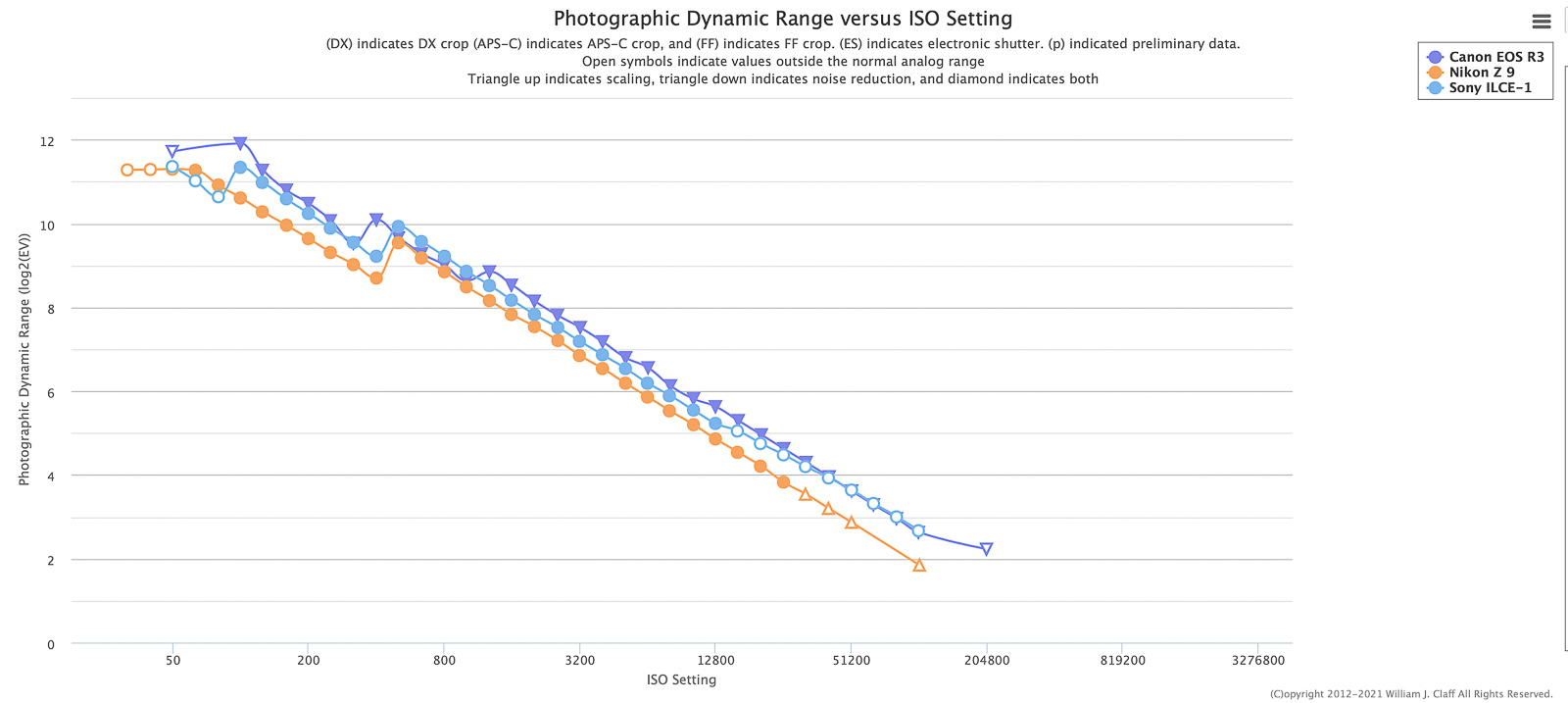
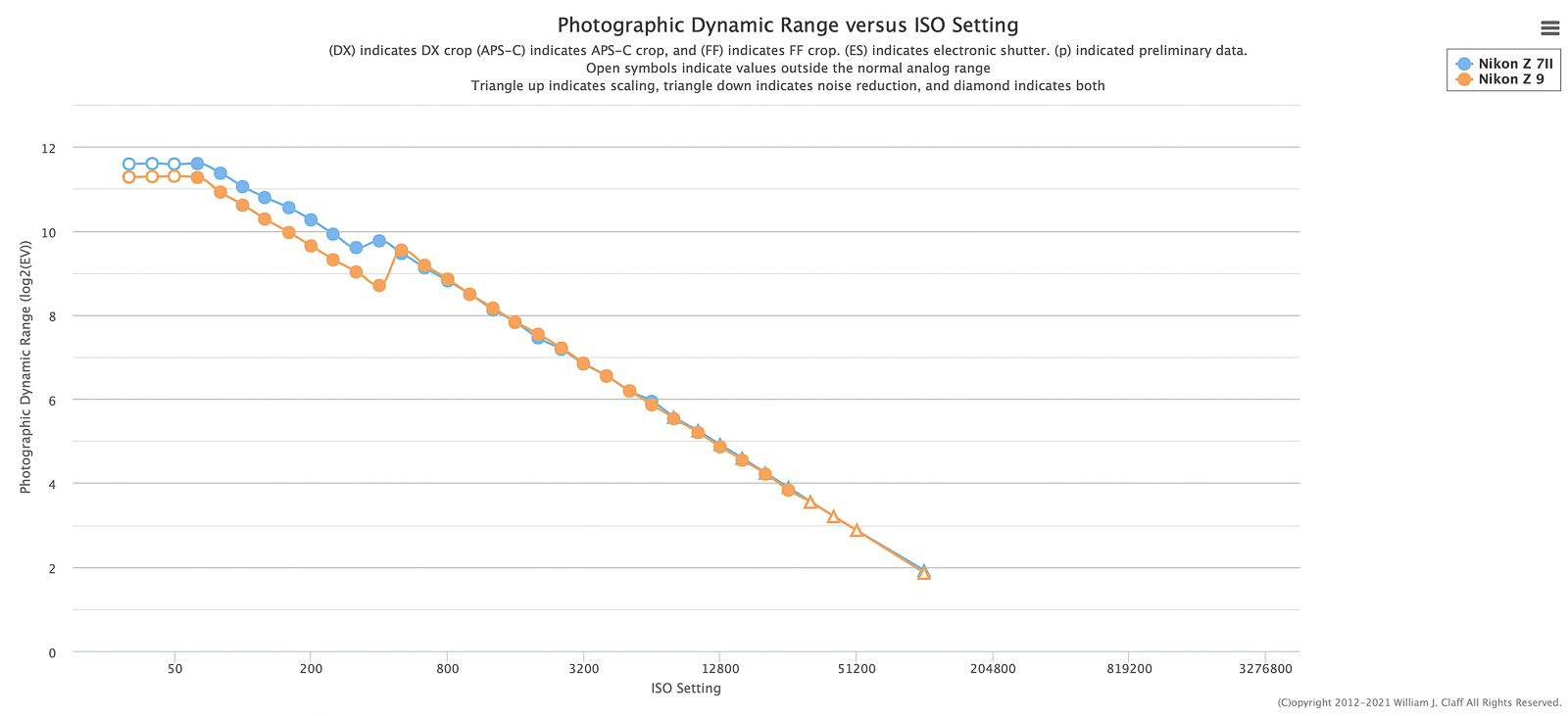
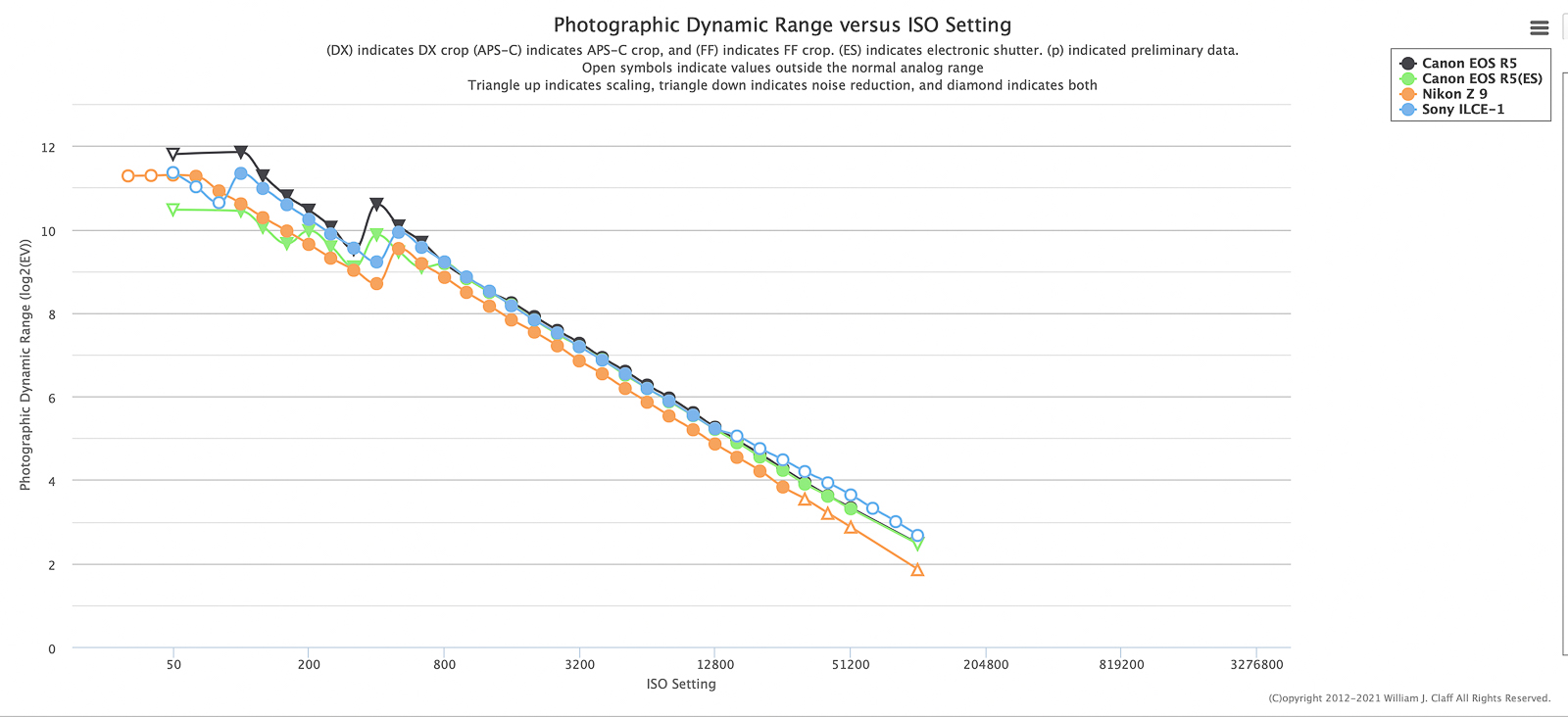
Here is Bill Claff's data. If you want low ISO DR for landscapes I'd stick with the Z7II. But for what the Z9 is targeted at it seems on par with the others.
Also dual-gain is at ISO 500 so for higher-ISO shooters like most sports and wildlife is shot at setting ISO 500 as your low point is ideal. You will need to go down to ISO 200 to match ISO 500. Below ISO 200 will have advantage. ISO 250 through ISO 400 best avoided.
arbitrage wrote:
Here is Bill Claff's data. If you want low ISO DR for landscapes I'd stick with the Z7II. But for what the Z9 is targeted at it seems on par with the others.
The Z7(II) beats it by a third of a stop at ISO 64 (i.e., base ISO), that isn't much of a difference to be worried about and very similar to the way that the Sony A7r III or IV beats the Sony A1. I am more disappointed by the high ISO shooting that matches the Z7 (II) but is about half a stop or a little more less than the D6. This is good DR performance at both high and low ISO but I wish for such an action oriented camera it was a little better at low ISO.
Also keep in mind at base ISO (64 for the Z9 and 100 for the Sony A1), the two camera have nearly identical PDR. So when there is lots of light or you can have long shutter speeds, the Sony A1 will have not advantage. That 1 stop advantage is only from ISO 100 to IS0 500. The camera that is probably behind is the Canon A3 which is using built in noise reduction at low ISO inflating the PDR in these tests.
this is me wrote:
Not sure I’ll be bothered by 0.3 stop to worry.
Z9 is really the camera that does it all for me.
Agreed...if you need a camera to do both low ISO and high ISO work and do it with top line AF then the small sacrifice at lower ISO is not really important.
Also of note for graphs of the R3 and R5 any points with triangles are showing that NR is being applied to the RAW file. R5 up to ISO 800, R3 throughout the entire ISO range. Take that into consideration as it can fudge the results in favour of the Canon.
I will still keep my Z7 ii for its size. However, even for street, daily use, Z9 AF is pretty addictive.
Going back to Z7 ii can be a bit annoying sometimes as I have been spoiled by Z9 this last few days.
Will have to see in the long term whether weight/size convenience or better AF/EVF will win out.
For landscape, for my usual routine with pulling shadow and various adjustment, I don't see any disadvantage for Z9 and the fact that I can change lenses without worry too much about dust is a major plus.
Using big lenses like 50/1.2s, Z9 is actually a bit more comfortable to hold even.
The D750 and the D780 are very close in dynamic range. Yet the D780 has far better color accuracy at high ISO. Take these data as just one bit of information, but look at actual pictures when making a decision. (A lower dynamic range does not result in better color accuracy in itself, however.)
AcuteShadows wrote:
The D750 and the D780 are very close in dynamic range. Yet the D780 has far better color accuracy at high ISO. Take these data as just one bit of information, but look at actual pictures when making a decision. (A lower dynamic range does not result in better color accuracy in itself, however.)
Yes, also the quality of the noise can make a big difference between cameras and may not be indicated by these graphs. These graphs have a place but as you say only a small part of the overall sensor quality and image quality.
Given this is a very fast stacked sensor and must be running the ADCs at very high clock speed, the small DR penalty below ISO500 is actually a great effort from Nikon for their first sensor of this type.
Will still be a fantastic landscape camera.
You can clearly see the dual gain nature at ISO500, so do you're ISOless exposure at ISO500+
Canon's R5 DR is a bit dubious with their baked in RAW NR, but it doesn't seem to hurt it's detail extraction, so not a biggie.
Here's the link to the Photo DR shadow improvement vs ISO ISO Z9 vs Z7II vs A1