Curious if those that use mostly m-mount glass and have upgraded from SL to SL2 saw any downsides with the increased resolution sensor with those lenses? I'm sure it depends on specific lenses, but any comments welcome. Love my newly acquired SL (use with several CV lenses) so much considering an upgrade, but would rather avoid heavier/larger glass as I have another system when I go that route (GFX).
The big upgrade isn't the sensor. It's IBIS. Yes you get more pixels but the IBIS will enlarge the shooting envelope considerably. If you don't need the pixels you could also consider the SL2S for it's incredible low light capabilities regarding noise and colour retention.
I do think they went slightly backwards with the new button placement on the SL2 but otherwise it's a step forward in every way.
While I’m sure I’d appreciate IBIS, I’d only upgrade due to the resolution. I have the GFX and know the joys of discovering new compositions in post and options of severe cropping. I also know my Voigtlander glass renders nicely on the GFX, but understandably sacrifices a noticeable amount of perceptual resolution when adapting to the larger sensor (compared to the native Fujinon lenses). These CVs are wonderful on my SL (and previous M240), but curious if others found they couldn’t keep up with the SL2’s sensor, thus they had to switch to larger/heavier L glass? I suppose it would be similar with the M10-R (without the L option). Again likely depends on the specific lens, but curious if there were any disappointments in the body/sensor upgrade?
flash wrote:
The big upgrade isn't the sensor. It's IBIS. Yes you get more pixels but the IBIS will enlarge the shooting envelope considerably. If you don't need the pixels you could also consider the SL2S for it's incredible low light capabilities regarding noise and colour retention.
I do think they went slightly backwards with the new button placement on the SL2 but otherwise it's a step forward in every way.
blessingx, here's a video on the Voigtlander 35/2.0 APO VM Lanthar on an SL2 (9:50 mark), he really likes it. I have the 50/2.0 APO VM Lanthar on my M10M, it's breathtakingly sharp. So these two lenses should stand up well to the SL2's MP demands. BTW, I have a 100S and GF110/2.0 so I know breathtaking.
I'm also curious how the wide angle Leica M lenses fare on the new SL2 47.3 MP sensor version as well. Some are not so good on the Nikon Z and Panasonic S1R because of microlens / sensor stack / ray angle fringing. I'd gladly sacrifice a few stops of dynamic range for no microlenses on a ~ 50 mp sensor, but alas, no one will build those anymore, or CCD sensors without microlenses for that matter. Maybe the 10-R is the answer for those Leica M wides, still.
On the whole I think the performance of the SL2 and native Leica SL lenses are enough of a selling point that I'd not be put off upgrading if some of the M wides don't perform so well, as there are plenty of native and retrofocus adaptable full frame wides from Zeiss, Nikkor, Canon, etc. with no color fringing issues due to ray angles.
I'll chime in that adapting M jewels such as the 50 Lux ASPH, APO 90 as well as many Voigtlanders to the 33x44 50c Sony sensor yields excellent results. If size and weight constraints matter a lot; an X1D with the Novoflex HAX/LEM adapter and Voigtlander 50/2 APO-Lanthar ASPH is 154g lighter than an SL2 with the M-ADAPTER L and the same lens. Both cameras are so similarly sized that it's only the extra heft of the Leica that tips the scale.
As to sharpness and resolution between the SL2 4.26 μm 24x36 47mp ( 8368 x 5584 DNG resolution ) full frame sensor and the X1D 5.3 µm 33x44 50mp mini medium format sensor, the X1D has a spatial resolution of ~93.93 line pairs per millimeter and 3100 line pairs per picture height, while the the SL2 has a spatial resolution of 116.33 line pairs per millimeter and 2792 line pairs per picture height, and in multishot mode that doubles to a dizzying 232.66 lp/mm & 5584 lp/ph.
The Diffraction Limited Aperture for the SL2 at a yellow green light wavelength of 0.565µm is F/6.19, and for the X1D the DLA is F/7.7 - beyond those F/Stops both cameras start losing resolution due to physical constraints regardless of how sharp the lens attached is.
If it's line pair resolution you're after aside from the SL2 there is the A7R4 in 16 multishot mode, the GFX100s, the Phase one IQ4 150 and the Hasselblad H6D-400c Multishot.
As to the color palette of the sensors themselves and their raw files I prefer vastly the X1D and IQ250 44x33 sensor to the Panasonic S1R ( the sister sensor to the SL2 ) for colors and robustness and dynamic range. I expect the SL2 to have entirely different color mapping than the S1R, and I have no experience with the SL2 DNG files directly, but I'm sad to see only sRGB colorspace for the SL2 DNGs. All that said, I prefer the Leica Typ 006 Kodak sensor with it's far reduced dynamic range to them all.
blessingx wrote:
While I’m sure I’d appreciate IBIS, I’d only upgrade due to the resolution. I have the GFX and know the joys of discovering new compositions in post and options of severe cropping. I also know my Voigtlander glass renders nicely on the GFX, but understandably sacrifices a noticeable amount of perceptual resolution when adapting to the larger sensor (compared to the native Fujinon lenses). These CVs are wonderful on my SL (and previous M240), but curious if others found they couldn’t keep up with the SL2’s sensor, thus they had to switch to larger/heavier L glass? I suppose it would be similar with the M10-R (without the L option). Again likely depends on the specific lens, but curious if there were any disappointments in the body/sensor upgrade?
Lenses aren't resolution limited. Even the bottom of a coke bottle will show more resolution on a higher resolution sensor. The question would be, is the SL2 as optimized for M lenses as the SL601? Yes, it is. Lens contrast and micro contrast may make the visible results subtle. But with most more modern CV lenses, they easily exceed what the SL601 can resolve so you'll get what you want. The M10R is slightly better with some lenses (older and wider, mostly) but the SL2 is the second best alternative.
Last week I tested many M lenses on the SL2 body using Leica's M-L adapter. These results should apply to the SL sensor as well.
Here are the results testing my own M lenses.
1) Lenses that perform identically on the M10-R and SL2. I can't detect any drop in resolution from center to the very corners of the frame. (infinity distance)
2) Lenses performing almost as good on the SL2 compared to the M10-R. Only the very edges see a very small drop in resolution due to induced field curvature and astigmatism.
Voigt 21/3.5 Color-Skopar
Voigt 28/2 II Ultron
3) Lenses that do not perform optimally on the SL2 sensor:
Leica 21/3.5 SEM (very surprising)
Leica 50/1.4 Lux (surprising)
Voigt 50/2 APO (suprising)
Voigt 50/1.2 Nokton (surprising)
Voigt 35/1.7 (expected)
So, listed by focal length, I recommend these lenses for those with dual systems (M and SL):
15mm (Voigtlander 15/4.5 III)
21mm (Voigtlander 21/1.4 Nokton and to a lesser degree Voigtlander 21/3.5 Color Skopar)
28mm (Voigt 28/2 II Ultron: Although not identical in performance, the corners look almost as good on the SL2 even wide open)
35mm (Leica 35/1.4 FLE or Voigt 35/1.4 II Nokton)
50mm (Zeiss 50/1.5 Sonnar: The only 50mm I've tested performing optimally on both sensors)
75mm (Voigtlander 75/1.5 Nokton but likely any Leica 75mm lenses will do well)
90mm+ (Leica 90/2 APO Cron or Leica 90/2.8 Elmarit. However, most M lenses will perform optimally at 90mm and longer FLs)
Thanks everyone for your comments. It's helped much. goodbokeh the video and your GFX implication points me in the right direction. I have the 50 APO-Lanther. That said, along with it I have the other Voigts in your "do not perform optimally" list Fred, so we'll see. Thanks especially for that list. Personally, have just left the M240 for the SL, I'll take a little sacrifice in performance for the SL/SL2 handling advantages for me, or especially my eyes. flash thanks for the warnings and AndereObjektiv no matter if I end up with the SL or SL2, each time I grab it I'll have to decide between it and the GFX50r, so I appreciate the specs.
blessingx wrote:
Thanks everyone for your comments. It's helped much. goodbokeh the video and your GFX implication points me in the right direction. I have the 50 APO-Lanther. That said, along with it I have the other Voigts in your "do not perform optimally" list Fred, so we'll see. Thanks especially for that list. Personally, have just left the M240 for the SL, I'll take a little sacrifice in performance for the SL/SL2 handling advantages for me, or especially my eyes. flash thanks for the warnings and AndereObjektiv no matter if I end up with the SL or SL2, each time I grab it I'll have to decide between it and the GFX50r, so I appreciate the specs. ...Show more →
Yes, it was disappointing to me that the Voigt 50/2 APO didn't perform optimally on the SL/SL2 sensor. (Same for their CV 35/2 APO-Lanthar as well)
Here is how the corners look even at f/5.6 (2 stops down) on the SL2 vs M10-R. Don't be too disappointed though, as it's way worse for Sony shooters with dual systems.
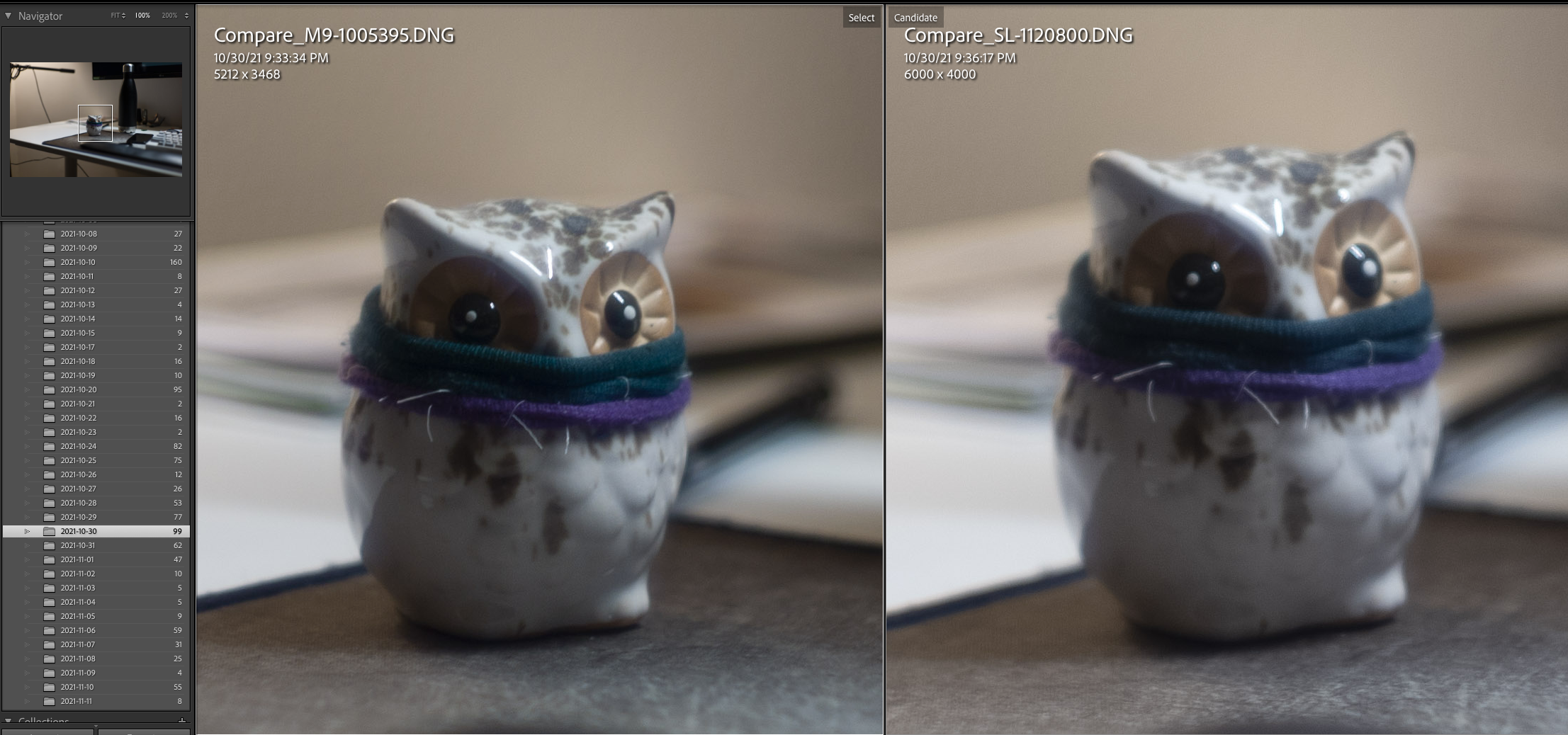
For anyone who is interested in mounting legacy range finder lenses on digital cameras: I find the CCD in Leica M9 actually performs better than the CMOS in Leica SL. My modern m mount lenses with ASPH/APO design, on the other hand, don’t show much difference between CCD and CMOS (simple post processing usually makes the rendering difference negligible)
I did some quick test recently on a Nikkor 5cm 1.4 LTM. Below I listed a screenshot of 100% cropped comparison between this lens wide [email protected] mounted on M9 vs. on Leica SL:
I found that the glowy look from this lens wide open is largely reduced in the CCD rendering. The color seems more solid and transparent. The cult for that Kodak CCD sensor might come from this kind of rendering ability.
Eznain wrote:
For anyone who is interested in mounting legacy range finder lenses on digital cameras: I find the CCD in Leica M9 actually performs better than the CMOS in Leica SL. My modern lenses with ASPH/APO design, on the other hand, don’t show much difference between CCD and CMOS (simple post processing usually makes the rendering difference negligible)
I did some quick test recently on Nikkor 5cm 1.4 ltm. Below I listed a 100% cropped comparison between this lens wide [email protected] mounted on M9 vs. on Leica SL:
I found that the glowy look from this lens wide open is largely reduced in the CCD rendering. The cult for that Kodak sensor might come from this kind of “magic” rendering ability. ...Show more →
Pure guessing, but CCD of that era has interesting "natural contrast" which probably reduces lens glow/haze. Might be curable with some targeted contrast boost on CMOS.
Also CCD is itself a bit "thicker and deeper" than CMOS, plus M9 probably had fairly decent IR/UV filters after M8 failure, which again could help with that.
CCD can be pushed to look like CMOS with post-processing, but doing it in opposite direction is a bit tricky.
I recently found this article, which mentions the "non-linearity" of CCD sensor. I believe the special IR/UV filters on the M9 also helps in its rendering here.
In theory, while being a bit tricky, the CCD or any film-like rendering could be achieved through post-processing. But I guess those efforts in post-processing could be saved to simply shoot in CCD/films directly.
Fred Miranda wrote:
Last week I tested many M lenses on the SL2 body using Leica's M-L adapter. These results should apply to the SL sensor as well.
Here are the results testing my own M lenses.
1) Lenses that perform identically on the M10-R and SL2. I can't detect any drop in resolution from center to the very corners of the frame. (infinity distance)
2) Lenses performing almost as good on the SL2 compared to the M10-R. Only the very edges see a very small drop in resolution due to induced field curvature and astigmatism.
Voigt 21/3.5 Color-Skopar
Voigt 28/2 II Ultron
3) Lenses that do not perform optimally on the SL2 sensor:
Leica 21/3.5 SEM (very surprising)
Leica 50/1.4 Lux (surprising)
Voigt 50/2 APO (suprising)
Voigt 50/1.2 Nokton (surprising)
Voigt 35/1.7 (expected)
So, listed by focal length, I recommend these lenses for those with dual systems (M and SL):
15mm (Voigtlander 15/4.5 III)
21mm (Voigtlander 21/1.4 Nokton and to a lesser degree Voigtlander 21/3.5 Color Skopar)
28mm (Voigt 28/2 II Ultron: Although not identical in performance, the corners look almost as good on the SL2 even wide open)
35mm (Leica 35/1.4 FLE or Voigt 35/1.4 II Nokton)
50mm (Zeiss 50/1.5 Sonnar: The only 50mm I've tested performing optimally on both sensors)
75mm (Voigtlander 75/1.5 Nokton but likely any Leica 75mm lenses will do well)
90mm+ (Leica 90/2 APO Cron or Leica 90/2.8 Elmarit. However, most M lenses will perform optimally at 90mm and longer FLs)
Only the SL bodies have the micro lenses covering the sensor necessary for M lens performance. I have both the SL and SL2 and use both with the following M mount lenses:
I am happy with the performance with all of them on the SL bodies and notice little difference in the extreme corners from that on my M bodies. To see it I have to go to 100% view and then navigate to the extreme corner of the image. Even then it is hard to differentiate from normal blurring due to DOF. I'm sure I could devise a test that would show it more clearly, but since I don't see it in normal use I am no longer concerned with it.
Luke_Miller wrote:
Only the SL bodies have the micro lenses covering the sensor necessary for M lens performance. I have both the SL and SL2 and use both with the following M mount lenses:
I am happy with the performance with all of them on the SL bodies and notice little difference in the extreme corners from that on my M bodies. To see it I have to go to 100% view and then navigate to the extreme corner of the image. Even then it is hard to differentiate from normal blurring due to DOF. I'm sure I could devise a test that would show it more clearly, but since I don't see it in normal use I am no longer concerned with it. ...Show more →
Thanks for the report on these lenses. From your list, I have only tested the 28/2 cron (version II) and it does well on the SL2.
For some reason, some Voigtlander M lenses do not perform well on the SL series. Two examples are the Voigtlander 50/2 and 35/2 APO-Lanthar lenses. They are outstanding on the M10-R but the corners suffer on the SL. So far, the only exception of the rule.
In the extreme corner, if i remember well all m9 successors, in old design lenses, got a lesser optical performance wide open, due to a little more thickness on cover/little different refractive index.
I am sure about lenses like 28mm elmarit v.III 11804 (42 year old design ! ).
In most case it is balaced with little more resolution, better sensor performance and better ir/uv filtration.
But i am writing about pixel peeping not photografy
Panasonic probably made his models with in mind the possible use of low-pass filter (s1H), without ragefinder film lenses as priority.
On SL2-S some RF lenses could not reach infinity cause the plastic protection frame around sensor.


 Thanks especially for that list. Personally, have just left the M240 for the SL, I'll take a little sacrifice in performance for the SL/SL2 handling advantages for me, or especially my eyes. flash thanks for the warnings and AndereObjektiv no matter if I end up with the SL or SL2, each time I grab it I'll have to decide between it and the GFX50r, so I appreciate the specs.