I'll send you a para or two on it, Petegh. Many readers dislike analytical criticisms of favourites here, and it's related to the lens's behaviour in my (now perhaps former) shooting environment at the top of the world, so you can say it's a case of n=1 for that reason.
In summary, often serious and resistant discolouration of shadows and extreme sensitivity to UV light = loss of contrast. Not the end of the world, but post work is often a recovery struggle. The lens is so good it's almost worth it, lol. I was watching a Dustin Abbott video on it the other day to see if I could see more of this, but he just did a lot of brick walls and bokeh. I agree it's a great lens for most people.
JVan_02 wrote: " target="_blank" rel="nofollow">Sony will soon announce the rx1r iii featuring the world's first 35mm format curved sensor and a brand new fixed 28mm f1.6 GM lens. The rx1r iii will come in at 725g, accept Z-type batteries, and feature the world's first ip68 rating on a dedicated camera. The 28 GM comes with lens based stabilization of 3 stops, and features an optical design of 14 elements in 10 groups—of which there are 3 XA elements and 2 APD elements. There will be 2 XLD motors, and the 28 GM has an astounding reproduction ratio of 1:2 at a distance of 13cm.
The rx1r iii is the first camera to feature user selectable frame lines, allowing the user to visualize compositions in selected focal lengths from 28-55mm. The rx1r iii's 61mpx sensor also features the color science of the Sony Venice camera, complete with S-cinetone—and manages to achieve 16 stops of dynamic range. Featuring dual processors—this camera achieves similar focusing speed, accuracy, and low light capability as the α7S III. Priced competitively, this camera will be released in Q2 of 2022 and have an MSRP of $5,500. ...Show more →
Predictions like that are the reason I'm down to 5% accuracy.
philip_pj wrote:
I'll send you a para or two on it, Petegh. Many readers dislike analytical criticisms of favourites here, and it's related to the lens's behaviour in my (now perhaps former) shooting environment at the top of the world, so you can say it's a case of n=1 for that reason.
In summary, often serious and resistant discolouration of shadows and extreme sensitivity to UV light = loss of contrast. Not the end of the world, but post work is often a recovery struggle. The lens is so good it's almost worth it, lol. I was watching a Dustin Abbott video on it the other day to see if I could see more of this, but he just did a lot of brick walls and bokeh. I agree it's a great lens for most people. ...Show more →
I’d post your thoughts Phillp! Diversity of opinions is good. Reasonable people can (and should) disagree. I’m always appreciative of forum members putting in thoughts with experience even if they don’t parallel my own thoughts.
I’ve been pretty vocal of CV lenses needing L41 UV filters for outdoor shooting. Hopefully there is tolerance of discussions around strengths and weaknesses (that someone perceives.)
I remember making a joke about that one, Tim! I should have explained that sky blue is something I always have to alter, often radically. They are always slanted to the purple or cyan ends. Well, my skies anyway, and never do I see uniform hues or tones across the sky. In fact, all my lenses vignette at f8!
In any case, I certainly meant no ill will to you, of all people. If I ever fail to reply in a thread it's because I like to avoid the argy bargy that happens sometimes. cheers.
Was supporting you, not calling you out Philip. I don’t even remember the reference you speak of. No worries!
I’m a happy camper. I found a solution to something that really cut down my enjoyment of shooting those lenses.
philip_pj wrote:
I remember making a joke about that one, Tim! I should have explained that sky blue is something I always have to alter, often radically. They are always slanted to the purple or cyan ends. Well, my skies anyway, and never do I see uniform hues or tones across the sky. In fact, all my lenses vignette at f8!
In any case, I certainly meant no ill will to you, of all people. If I ever fail to reply in a thread it's because I like to avoid the argy bargy that happens sometimes. cheers.
Good. I was thinking, is there another very recent high performer 85-90mm as light as this one? Under 300g is really game-changing for handhold work.
It's 75g lighter than the Sony FE 85/1.8, and a very large 185g lighter than the other well regarded 85mm - the Nikon Z 85/1.8 S. The CV 75/1.5 is also more, 385g on its adapter.
If you're referring to the propensity of Zeiss glass to let in extra UV philip, well, that's old news, and was solved by Tim with a Zeiss UV filter in his thread about CV lenses, which tend to do the same; I suspect it would solve the shadow issues as well.
I've shot a lot at altitude as well, as I used to work as a guide in the Karakoram in Pakistan; very similar conditions to your Zanskar work.
With CV I think the issue is a little more complicated than letting in more UV light, but at the end of the day there is a solution for that (Zeiss UV or Kenko L41 UV filter.) Again some people are more sensitive to the magenta shading than others, so it's good info to be aware of and people can make their own decisions.
It could be worth a try to see what impact it has on the Loxia 85, it may not address what Philip sees.
Petegh wrote:
If you're referring to the propensity of Zeiss glass to let in extra UV philip, well, that's old news, and was solved by Tim with a Zeiss UV filter in his thread about CV lenses, which tend to do the same; I suspect it would solve the shadow issues as well.
I've shot a lot at altitude as well, as I used to work as a guide in the Karakoram in Pakistan; very similar conditions to your Zanskar work.
The only down-side for me with the Loxia 85 is its slightly hefty weight. Otherwise, color and contrast are amazing and fit in with the other Loxia lenses (which is probably why they are a set for professional and industrial use).
All the Himalayan regions are very different from each other. The western (Pakistan) Karakoram has deep valleys and ultra mountains, and generally clear air - they are west of the great five 8000'ers. Where the L85 did worst for UV was in Nubra Valley, a lowish (~3000m) broad confluence valley nestled at the far end of the Eastern Karakoram (Sasar Kangri group to ~7500m) - it's more like Rupshu and the West Tibet ChangTang, and it's open to the great plain to the east.
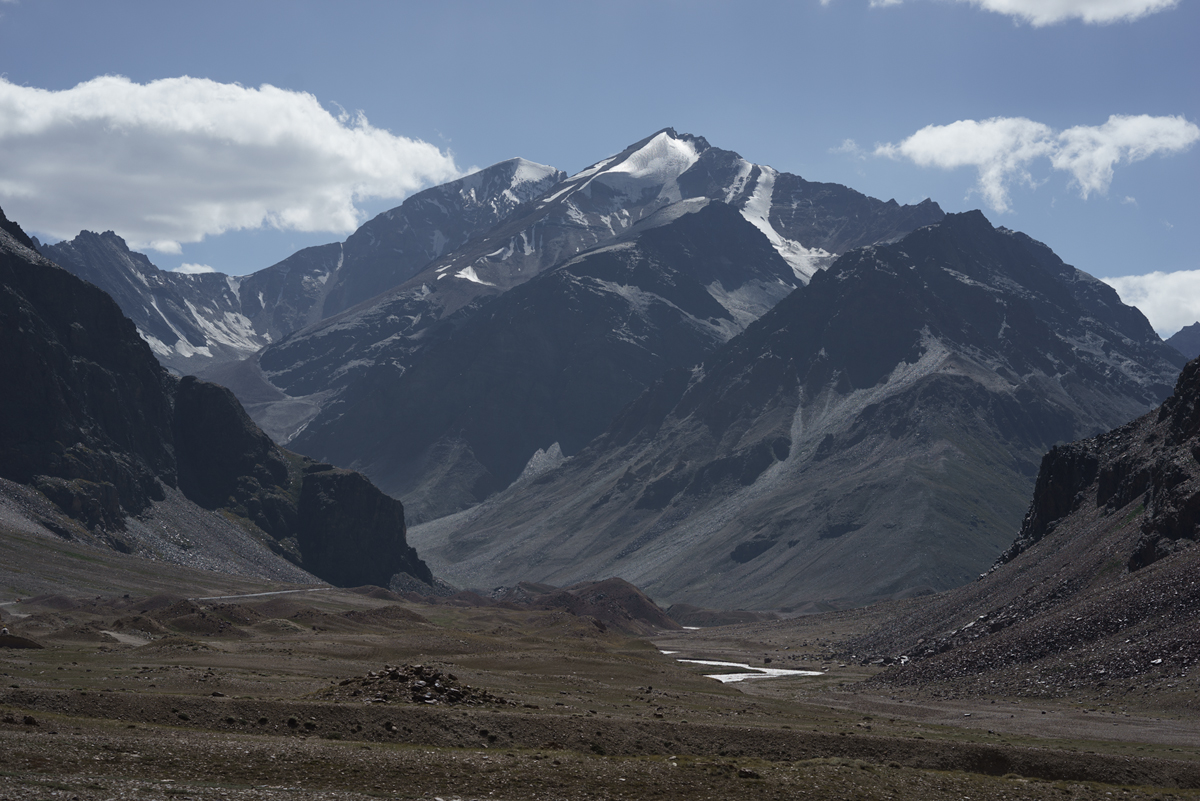
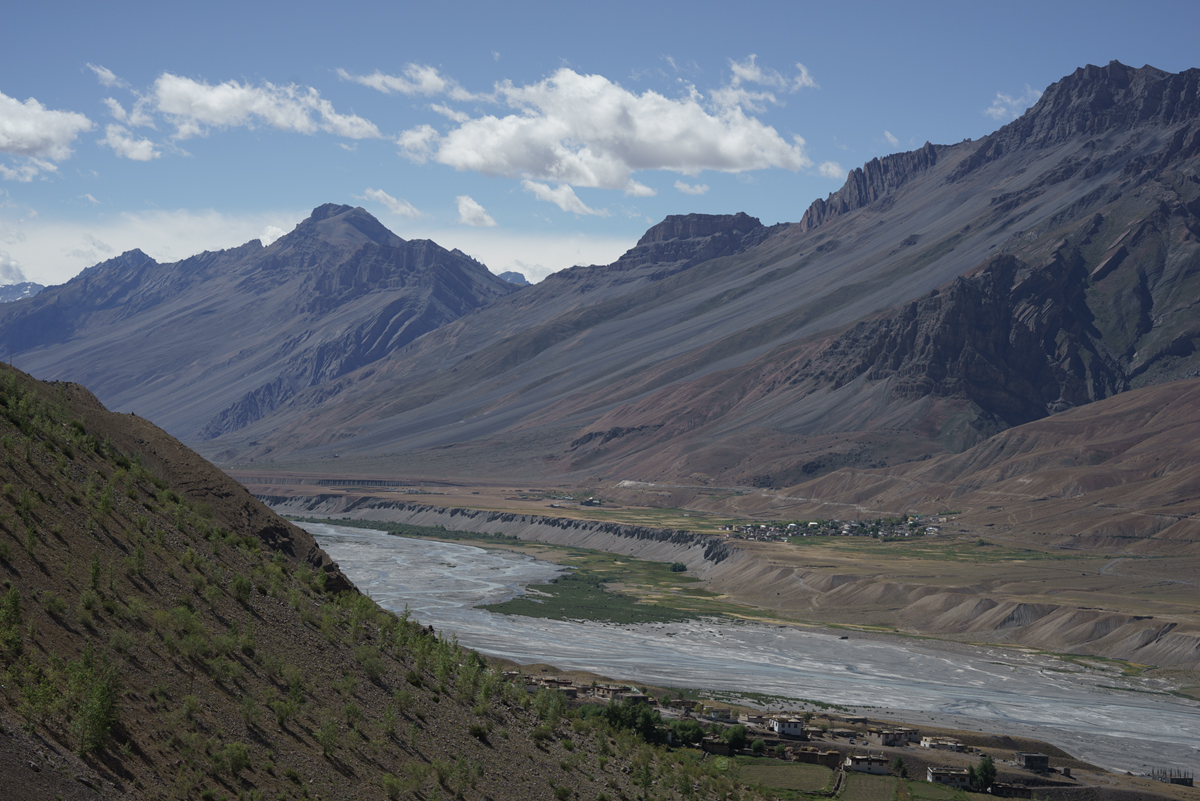
But colour. Here are two Loxia 85 images OOC with minor brightness increase and AWB, which seemed reasonable.
#1 was shot at 3.16pm and has these red-blue spot checks for parts of the image:
HIGHS high cloud: 229-234; river 205-208; snow cap 246-246
LOWS foreground rocks 14-14; left shadows 25-32; mountain face 57-70. The largest gap I could find in favour of red was 49-41.
#2 was shot at 10am and has these red-blue spot checks for parts of the image:
HIGHS puffy clouds 227-231; flat cloud strip 204-207
LOW low shadow 11-13. The river was 137-142.
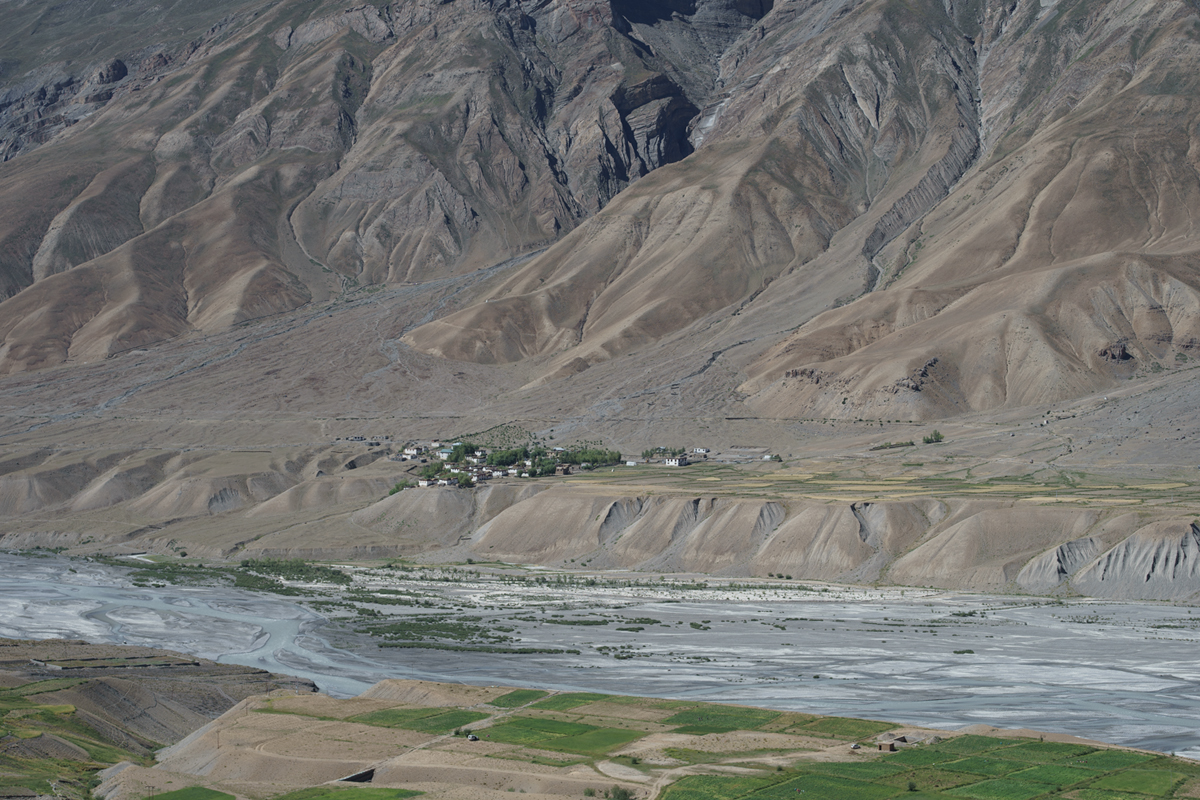
#3 is shot at 9.59 (same day as #2) with the CY 35-70, for a comparison - see the village in both images. I have copies of #1 and #2 with an extra 500 on the WB, not a great deal of change though.
Sigma "24mm F2 DG DN | Contemporary" L mount version has 13 lenses in 11 groups, 9 diaphragm blades (circular diaphragm), minimum shooting distance 24.5cm, maximum shooting magnification 1: 6.7, filter diameter 62mm, size. It is φ70x72mm, weighs 365g, and seems to be compatible with magnetic caps. The price seems to be same as for 90mm F2.8(85,800 yen including tax)?
Japan official prices are usually higher than street prices so I guess this might be similar to 35/2 street price which was around 69000 yen including tax at time of launch. Official price of 35/2 DG DN in Japan is also exactly 85800 JPY including tax.
Doesn't seem to have similar close focusing capability that 24/3.5 DG DN has (minimum focusing distance 10.8cm)...
Juha Kannisto wrote:
Doesn't seem to have similar close focusing capability that 24/3.5 DG DN has (minimum focusing distance 10.8cm)...
I mean, was that expected? So far as I know the only ways to get great MFDs on lenses are:
Long barrel with or without FLE construction. Example of this would be the 40 CF, which has an exceptionally long barrel for its spec/fl at 93mm.
Multiple focusing groups. Examples of this are all the latest G and GM series lenses from Sony. For reference, the 40 CF and the 40 G have an MFD just 1cm apart (24 vs 25cm) despite the Sony lens being less than half the length at 45mm. Do note that achieving this in the compact G series seemed to force each lens to experience wide angle focus breathing, leading to a little less utility than expected with the MFDs gained thusly.
Have the front element/front focus group be part of the AF chain. Examples of this are the RF 35 1.8 and the CV APO-Lanthar macros.
Whatever voodoo Sony pulled off with the 35 1.8 FE that allowed for an excellent MFD and virtually no focus breathing while still being relatively compact. May come with the downside of harsh rendering, though this would be much better spoken to by an actual optical engineer.
The MFD of the upcoming Sgima 24/2 looks average, is what I mean to say. Hopefully the optical performance is excellent.
JVan_02 wrote:
The MFD of the upcoming Sgima 24/2 looks average, is what I mean to say. Hopefully the optical performance is excellent.
Is that really such a big dealbraker? The new trend that every lens has to have a short MFD isn't exactly something a lot of people have asked for I believe. A 24/2 isn't something I would buy or demand a short MFD on.
It's all about trade-offs and expectations.
JVan_02 wrote:
I mean, was that expected? So far as I know the only ways to get great MFDs on lenses are:
Long barrel with or without FLE construction. Example of this would be the 40 CF, which has an exceptionally long barrel for its spec/fl at 93mm.
Multiple focusing groups. Examples of this are all the latest G and GM series lenses from Sony. For reference, the 40 CF and the 40 G have an MFD just 1cm apart (24 vs 25cm) despite the Sony lens being less than half the length at 45mm. Do note that achieving this in the compact G series seemed to force each lens to experience wide angle focus breathing, leading to a little less utility than expected with the MFDs gained thusly.
Have the front element/front focus group be part of the AF chain. Examples of this are the RF 35 1.8 and the CV APO-Lanthar macros.
Whatever voodoo Sony pulled off with the 35 1.8 FE that allowed for an excellent MFD and virtually no focus breathing while still being relatively compact. May come with the downside of harsh rendering, though this would be much better spoken to by an actual optical engineer.
The MFD of the upcoming Sgima 24/2 looks average, is what I mean to say. Hopefully the optical performance is excellent. ...Show more →
I didn't expect anything in particular, I just mentioned this point since the Sigma 24/3.5 DG DN has special close focusing capability and I was curious how this new one is going to compare to it in that area.
I have no plans to get the new 24/2 myself as I'm well covered with my 24/3.5 DG DN + 24/1.4 GM but I will probably get the 90/2.8. Not sure if I get it at launch timing or a bit later though. Based on 9/9 announcement date, I guess the new lenses or at least one of them would start shipping by late September.
zz wrote:
Is that really such a big dealbraker? The new trend that every lens has to have a short MFD isn't exactly something a lot of people have asked for I believe. A 24/2 isn't something I would buy or demand a short MFD on.
It's all about trade-offs and expectations.
I guess that depends on what you use it for but in general I find excellent MFDs useful and welcome additions to any lens—enough that I'd probably trade off a small optical advantage for the utility. I'm not in a market for a 24 of any stripe, but if I were I think the biggest thorn in this Sigma's side would be the Samyang 24 1.8.
JVan_02 wrote:
I guess that depends on what you use it for but in general I find excellent MFDs useful and welcome additions to any lens—enough that I'd probably trade off a small optical advantage for the utility. I'm not in a market for a 24 of any stripe, but if I were I think the biggest thorn in this Sigma's side would be the Samyang 24 1.8.
Yes, assuming the image quality is going to be comparable between the two (the 24/1.8 seems to be an excellent performer), the Samyang is going to have an edge in terms of MFD, speed and price. The only potential buyers of the Sigma 24/2 are probably those who don't like plastic lenses or 'collectors' of the I-series ...
keepcoding wrote:
Yes, assuming the image quality is going to be comparable between the two (the 24/1.8 seems to be an excellent performer), the Samyang is going to have an edge in terms of MFD, speed and price. The only potential buyers of the Sigma 24/2 are probably those who don't like plastic lenses or 'collectors' of the I-series ...
But of course it never hurts to have choices
To be fair, if the lenses were the exact same optically I might think twice about the Samyang lens with their history of bad QC. It's one of the things that no one talks about to the detriment of the customer. Like, is the reason your price is so low that your QC is still generations behind other 1st/3rd party manufacturers or have you actually shored up your QC to being within a generation of other brands and are now just literally the best value optical brand in the world? What is it Samyang?
Literally everyone is guilty of this, but no one outside the industry has any idea how these things change over time... so I often find lens purchasing practices rife with superstition.
JVan_02 wrote:
To be fair, if the lenses were the exact same optically I might think twice about the Samyang lens with their history of bad QC. It's one of the things that no one talks about to the detriment of the customer. Like, is the reason your price is so low that your QC is still generations behind other 1st/3rd party manufacturers or have you actually shored up your QC to being within a generation of other brands and are now just literally the best value optical brand in the world? What is it Samyang?
Literally everyone is guilty of this, but no one outside the industry has any idea how these things change over time... so I often find lens purchasing practices rife with superstition.
JVan_02 wrote:
To be fair, if the lenses were the exact same optically I might think twice about the Samyang lens with their history of bad QC. It's one of the things that no one talks about to the detriment of the customer. Like, is the reason your price is so low that your QC is still generations behind other 1st/3rd party manufacturers or have you actually shored up your QC to being within a generation of other brands and are now just literally the best value optical brand in the world? What is it Samyang?
Literally everyone is guilty of this, but no one outside the industry has any idea how these things change over time... so I often find lens purchasing practices rife with superstition.
Good point. I've had slightly more issues with QC with Samyang lenses than with Sigma lenses. However, I always try to buy from a place where I can return the lens since in my experience about every third lens (regardless of manufacturer) comes with QC issues. Even though this is annoying and I hate to return a brand new lens (which will potentially be scrapped), I kind of got used to it.


 zz wrote:
