fredmiranda.com
Login

Moderated by: Fred Miranda
  New fredmiranda.com Mobile Site
  New Feature: SMS Notification alert
  New Feature: Buy & Sell Watchlist
  

FM Forums | Nikon Forum | Join Upload & Sell


Archive 2021 · So, is the Z7 II the better camera then?


PixiPhotography
Offline
• • • •
Upload & Sell: On
p.1 #1 · So, is the Z7 II the better camera then?


I am currently shooting with the Z6 II. In order, I had the D850, Z7, Z6, and now Z6 II. I shoot primarily landscapes, portraits, and some milky way pictures. I had the idea that because the Z7 with its 45mp had more low light noise when I pushed the ISO's that the Z6 would better suit me. Except someone on here told me that, if you were to shoot the same image on both bodies, but crop the Z7 image to the Z6 image, the ISO performance is practically the same. I tried this and saw this was true. So, I am wondering now, does the Z7 suit me better then? As a landscaper, I miss the 45mp. I guess I am still somewhat a pixel peeper and I miss those details at times. I don't shoot video necessarily to say "Z6 video features decide it for me".. I do shoot video just less than 40% of the time, and its not even paid work. So.. Z7? Tell me either side of it..


Aug 07, 2021 at 03:33 PM
EB-1
Offline
• • • • • • •
Upload & Sell: Off
p.1 #2 · So, is the Z7 II the better camera then?


ArizonaImage wrote:
I am currently shooting with the Z6 II. In order, I had the D850, Z7, Z6, and now Z6 II. I shoot primarily landscapes, portraits, and some milky way pictures. I had the idea that because the Z7 with its 45mp had more low light noise when I pushed the ISO's that the Z6 would better suit me. Except someone on here told me that, if you were to shoot the same image on both bodies, but crop the Z7 image to the Z6 image, the ISO performance is practically the same. I tried this and saw this was
...Show more

I think you mean resample/downsample rather than crop. Downsampling averages certain types of noise. We are seeing the same rationale from Canon and Sony as well. The question is how often you use the high ISO and whether you want a body that does not produce the large, noisy files. If you already have the Z6 II I suggest adding the Z7 II as the second body (or making it the first body and using the Z6 II as the second body).

EBH


Aug 07, 2021 at 04:31 PM
1bwana1
Online
• • • • • •
Upload & Sell: On
p.1 #3 · So, is the Z7 II the better camera then?


If your primary focus is shooting landscapes from a tripod at ISO 64 then I, DPR, and many others believe that the Nikon Z 7II is the best mirrorless camera available today for this use case.


Aug 07, 2021 at 04:47 PM
PixiPhotography
Offline
• • • •
Upload & Sell: On
p.1 #4 · So, is the Z7 II the better camera then?


1bwana1 wrote:
If your primary focus is shooting landscapes from a tripod at ISO 64 then I, DPR, and many others believe that the Nikon Z 7II is the best mirrorless camera available today for this use case.


I saw this and this sort of opened the door even more for the Z7 II.


Aug 07, 2021 at 05:15 PM
JadedWriter
Offline
• • • •
Upload & Sell: Off
p.1 #5 · So, is the Z7 II the better camera then?


For portraits and landscapes just get the Z7II. I had to talk myself out of buying one recently and wish I did because my Z6II needs a Z mount partner for when I do events.
ArizonaImage wrote:
I saw this and this sort of opened the door even more for the Z7 II.


Aug 07, 2021 at 11:31 PM
DanielJStein
Offline
• • •
Upload & Sell: On
p.1 #6 · So, is the Z7 II the better camera then?


Like another photographer said, you are referring to the process of downsampling. While it is true that you can downsample the size of the Z7 files to equal that of the Z6 files, it does not paint a full picture of what is going on behind the scenes.

Natively, the Z7 has a sensor with 4.5 microns of pixel pitch while the Z6 has 6. This means that each pixel on the Z6 is larger and therefore can collect more photons per pixel. Think of it like a bucket. The bigger of a bucket you have, the more things you can put in it. If you have two rooms with a bunch of buckets taking up the same amount of surface area in each, but in one room the buckets are bigger, while the other room the buckets are smaller and there are more of them, which buckets are going to fill up more? The room with the buckets that are bigger. Therefore there is more in each bigger bucket. (More signal, less noise).

This equates to the Z6 being the better low light performer in that regard. In practice, the 6 is giving you about a 1.3 stop "noise" advantage over the 7. I have tested this with both my 6 and 7 and found it to be largely true.

In other words, no matter how you slice it, the 6 is still "better" as a low light camera. Not to say the 7 is bad, because it certainly is still an incredible camera, but if you prioritize milky way or other astro work you would still be better off with the 6. You cannot change the pixel pitch of a sensor simply by software downsampling. It is a physical property created by the size of the sensor divided by its resolution.

Since you benefit of having a few cameras what I would do is use your 7 for daytime landscapes, and your 6 for night work. This is what I personally do with my 6 and 7 and I have found it works great. The extra resolution of the 7 is really nice to have when it comes to landscapes, but I would rather sacrifice the resolution for the benefit of better low light for astro.


Aug 08, 2021 at 09:17 AM
Steve Spencer
Offline
• • • • • • •
Upload & Sell: On
p.1 #7 · So, is the Z7 II the better camera then?


DanielJStein wrote:
Like another photographer said, you are referring to the process of downsampling. While it is true that you can downsample the size of the Z7 files to equal that of the Z6 files, it does not paint a full picture of what is going on behind the scenes.

Natively, the Z7 has a sensor with 4.5 microns of pixel pitch while the Z6 has 6. This means that each pixel on the Z6 is larger and therefore can collect more photons per pixel. Think of it like a bucket. The bigger of a bucket you have, the more things you can
...Show more

Simply put the Z6 II will have just a bit better high ISO files, whereas the Z7 II will have more resolution and a bit better low ISO files. It really isn't a matter of one camera being better than the other camera. Each camera is slightly better than the other camera at what it does best.

That said the bucket analogy isn't being applied quite right here because it doesn't have that downsampling step that others have been talking about. It is that downsampling that let's Z7 II files get closer to Z6 II files. To stretch the analogy imagine you have a third room with buckets the same size as the room with the Z6 II buckets and they you distribute the water from the smaller buckets in the Z7 II room to this new room. The two rooms (the original Z6 II room and the new room with Z6 II sized buckets and water distributed from the smaller Z7 II buckets) will have petty similar buckets and amount of water in the buckets. That is what downsampling does. It redistributes the water from smaller buckets into bigger buckets.

These things can be measured and here is one measurement of the differences in dynamic range:

https://www.photonstophotos.net/Charts/PDR.htm#Nikon%20Z%206II,Nikon%20Z%207II

You will see that at base ISO (64 for the Z7 II and 100 for the Z6 II), the Z7 II has four tenths of a stop better dynamic range. This reflects the better low ISO performance of the Z7 II. Conversely at ISO 3200 the Z6 II has four tenths of a stop better dynamic range than the Z7 II (and this even accounts for downsampling). The difference at high ISO if you downsample is nowhere near a stop and a third, but there is still and advantage at high ISO for the Z6 II.

So, again there is no easy answer here about which camera is better. You will get more resolution and more dynamic range with the Z7 II when you are shooting at ISO 64, but at high ISO the Z6 II will give you a bit of advantage even if you downsample. You will either have to get both cameras or decide which type of shooting is more important for you.


Aug 08, 2021 at 10:10 AM
Jack Flesher
Offline
• • • •
Upload & Sell: On
p.1 #8 · So, is the Z7 II the better camera then?


ArizonaImage wrote:
someone on here told me that, if you were to shoot the same image on both bodies, but crop the Z7 image to the Z6 image, the ISO performance is practically the same. I tried this and saw this was true.


I think you pretty much answered your own question right there

Cropping can eliminate the *impression* of noise, but the noise is still there -- it's just not as obvious. IMHO, that is still *improvement* to the situation... Downsampling however does reduce actual noise. So yes, worst case the Z7ii will produce a downsampled 24MP image that is virtually equivalent to --and possibly even occasionally superior to-- a Z6ii image taken at the same ISO.

PS: Realize that I'm about to get flamed by a large number Z6ii shooters that don't want to believe this!


Aug 08, 2021 at 11:44 AM
dclark
Online
• • • • •
Upload & Sell: On
p.1 #9 · So, is the Z7 II the better camera then?


DanielJStein wrote:
Like another photographer said, you are referring to the process of downsampling. While it is true that you can downsample the size of the Z7 files to equal that of the Z6 files, it does not paint a full picture of what is going on behind the scenes.

Natively, the Z7 has a sensor with 4.5 microns of pixel pitch while the Z6 has 6. This means that each pixel on the Z6 is larger and therefore can collect more photons per pixel. Think of it like a bucket. The bigger of a bucket you have, the more things you can
...Show more

---------------------------------------------

Steve Spencer wrote:
Simply put the Z6 II will have just a bit better high ISO files, whereas the Z7 II will have more resolution and a bit better low ISO files. It really isn't a matter of one camera being better than the other camera. Each camera is slightly better than the other camera at what it does best.

That said the bucket analogy isn't being applied quite right here because it doesn't have that downsampling step that others have been talking about. It is that downsampling that let's Z7 II files get closer to Z6 II files. To stretch the
...Show more

The best measure of sensor performance is image information.

The pixel SNR is interesting but not a good measure of the image information produced by a sensor.
Photographic dynamic range (PDR) is better but still does not measure the image information.
Consider an ideal sensor that is limited only by shot noise (read noise, pattern noise, etc are zero). The SNR of each pixel is approximately sqrt(number of photoelectrons). If each pixel is divided into 4 pixels, the photoelectrons are also divided up among the 4 pixels. If they equally divide each of the smaller pixels now has a worse SNR that is 2X the SNR of the large pixel. Note that the SNR per unit area is unchanged. That means the photographic dynamic range is unchanged. Which one has the most image information? Clearly the one that provides more information about the spatial distribution of the photoelectrons. That is the one that provides more information about higher spatial frequencies in the image. This is true regardless of how small the number of photoelectrons may be (i.e. how high the ISO may be).

That may be true for an ideal sensor, but what about real sensors. What if each pixel contributes some read noise so that when the number of pixels is increased the amount of read noise in the image increases. The noise in the image is not only shot noise. Photographic dynamic range, which is a measure of SNR per unit area, is a better measure of image information capability than single pixel SNR. But if two sensors have the same PDR but one has more pixels, the one with more pixels produces more image information. If the sensor with more pixels has worse PDR, how much worse can it be and still produce more image information? That's a very difficult question. A full discussion of that would go on for a long time and IMO at the end of the long discussion there would be disagreement.

I agree with Steve that the best unambiguous data we have to compare the noise performance of sensors is PDR, but if the higher resolution sensor is slightly worse for PDR it is not convincing. I also look at the input referred read noise and analyze how far into the shadows we need to go to see a real impact on SNR from read noise. What I find completely useless is the "calibrated eyeballs" that look at a bunch of images and conclude which sensor is better. Unfortunately that is the most common form of sensor comparison on the internet.

Dave

Edit: I corrected a major error. I had written 1/sqrt(number of photoelectrons) where I should have written sqrt(number of photoelectrons).


Edited on Aug 16, 2021 at 10:07 PM · View previous versions


Aug 08, 2021 at 12:08 PM
ilkka_nissila
Offline
• • • •
Upload & Sell: Off
p.1 #10 · So, is the Z7 II the better camera then?


PDR only reflects the quality of information in the shadows which may or may not be the most important characteristic.

DXO's color sensitivity is one metric which I follow; it basically quantifies how many distinct color values can be distinguished from noise. This correlates with how rich and smooth the colors are in the images. But dynamic range is of interest as well, especially for those who do a lot of shadow pulling in post.

The Z6 II has better mid to high ISO image characteristics (by several metrics) and the Z7 II is better at low ISO. This is how it is also with the Canon R6 vs. R5. It depends on the application, which is better.

Nominally the Z6 II has better low light AF, but the Z7 II allows one to pinpoint a smaller area for focusing (the phase detection points scale with pixel size). So again, it depends on the task at hand, which is better.

Video quality (4K25) is noticeably better on the Z6 II as it uses all of the sensor data to produce the video feed (6K->4K oversampling) while the full-frame 4K from the Z7 II skips some of the data, resulting in a lower-quality video. This is why the Z6 II is also offered in kits for filmmaking.


Aug 08, 2021 at 12:28 PM
Steve Spencer
Offline
• • • • • • •
Upload & Sell: On
p.1 #11 · So, is the Z7 II the better camera then?


dclark wrote:
---------------------------------------------

The best measure of sensor performance is image information.

The pixel SNR is interesting but not a good measure of the image information produced by a sensor.
Photographic dynamic range (PDR) is better but still does not measure the image information.
Consider an ideal sensor that is limited only by shot noise (read noise, pattern noise, etc are zero). The SNR of each pixel is approximately 1/sqrt(number of photoelectrons). If each pixel is divided into 4 pixels, the photoelectrons are also divided up among the 4 pixels. If they equally divide each of the smaller pixels now has a worse SNR that is
...Show more

As usual Dave, a very thoughtful and thorough discussion. I always learn from your post and what you say makes perfect sense.


Aug 08, 2021 at 12:43 PM
Steve Spencer
Offline
• • • • • • •
Upload & Sell: On
p.1 #12 · So, is the Z7 II the better camera then?


ilkka_nissila wrote:
PDR only reflects the quality of information in the shadows which may or may not be the most important characteristic.

DXO's color sensitivity is one metric which I follow; it basically quantifies how many distinct color values can be distinguished from noise. This correlates with how rich and smooth the colors are in the images. But dynamic range is of interest as well, especially for those who do a lot of shadow pulling in post.

The Z6 II has better mid to high ISO image characteristics (by several metrics) and the Z7 II is better at low ISO. This is how it
...Show more

All great points Ikka, and I too like supplementing PDR scores with DXO color sensitivity scores.


Aug 08, 2021 at 12:45 PM
PixiPhotography
Offline
• • • •
Upload & Sell: On
p.1 #13 · So, is the Z7 II the better camera then?


I guess the only logical thing to do at this point is rent a Z7 II and put it through their paces see which one makes more sense. It’ll be good to try all my lenses and put the camera through numerous paces like low light with the same lens and go from there. I’ll post pics and results here


Aug 08, 2021 at 02:15 PM
PixiPhotography
Offline
• • • •
Upload & Sell: On
p.1 #14 · So, is the Z7 II the better camera then?


While waiting on my rental Z7 II, DPreview has their Studio Tool which conveniently downscales the images so that they are equal. Results are nice

ISO 400


ISO 1600


ISO 3200


ISO 6400


Aug 08, 2021 at 02:58 PM
DanielJStein
Offline
• • •
Upload & Sell: On
p.1 #15 · So, is the Z7 II the better camera then?


Wow there is a lot of great information on this thread! I appreciate another poster here correcting me on the bucket analogy, I can totally see how that applies to downscaling.

But with that in mind, I think the best way to figure out which is best for OP is some real world testing. I have tried to do so with my own gear, but I do not have the luxury or the knowledge to do so scientifically. That DP Review studio feature the poster above mentioned looks to be a solid way to gauge noise when downscaling, but I also have done my own tests for astrophotography specifically.

While not scientific, these tests are visual, and at the end of the day I hope this can answer OP's inquiry of which one suits his/her needs for whatever they want to shoot. We can talk numbers and figures all day, but I think the real world results are the best way to gauge ones needs.

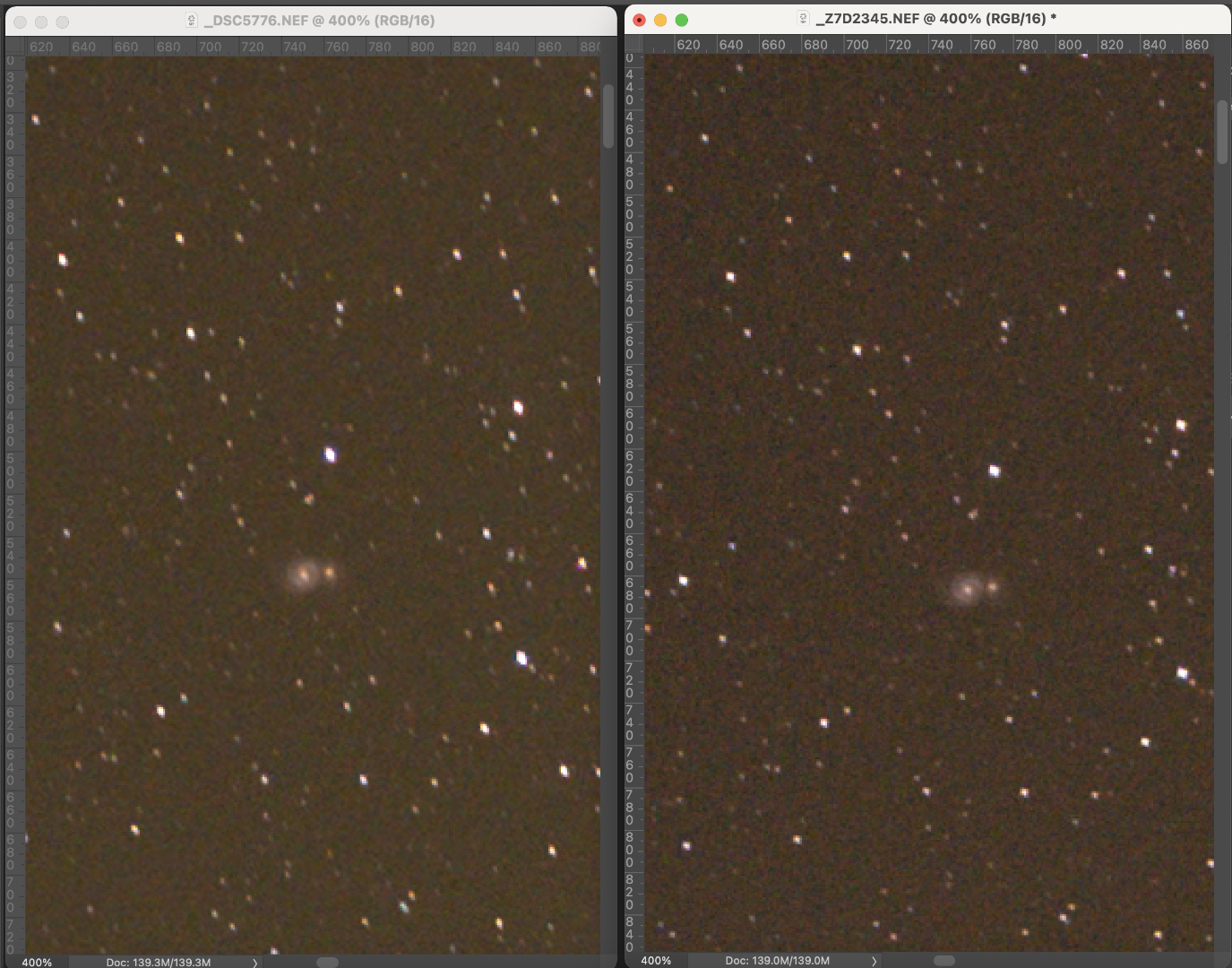
With that in mind, my unscientific test still prove what is discussed above. The Z6 is still better in low light, but the Z7 provides more detail.

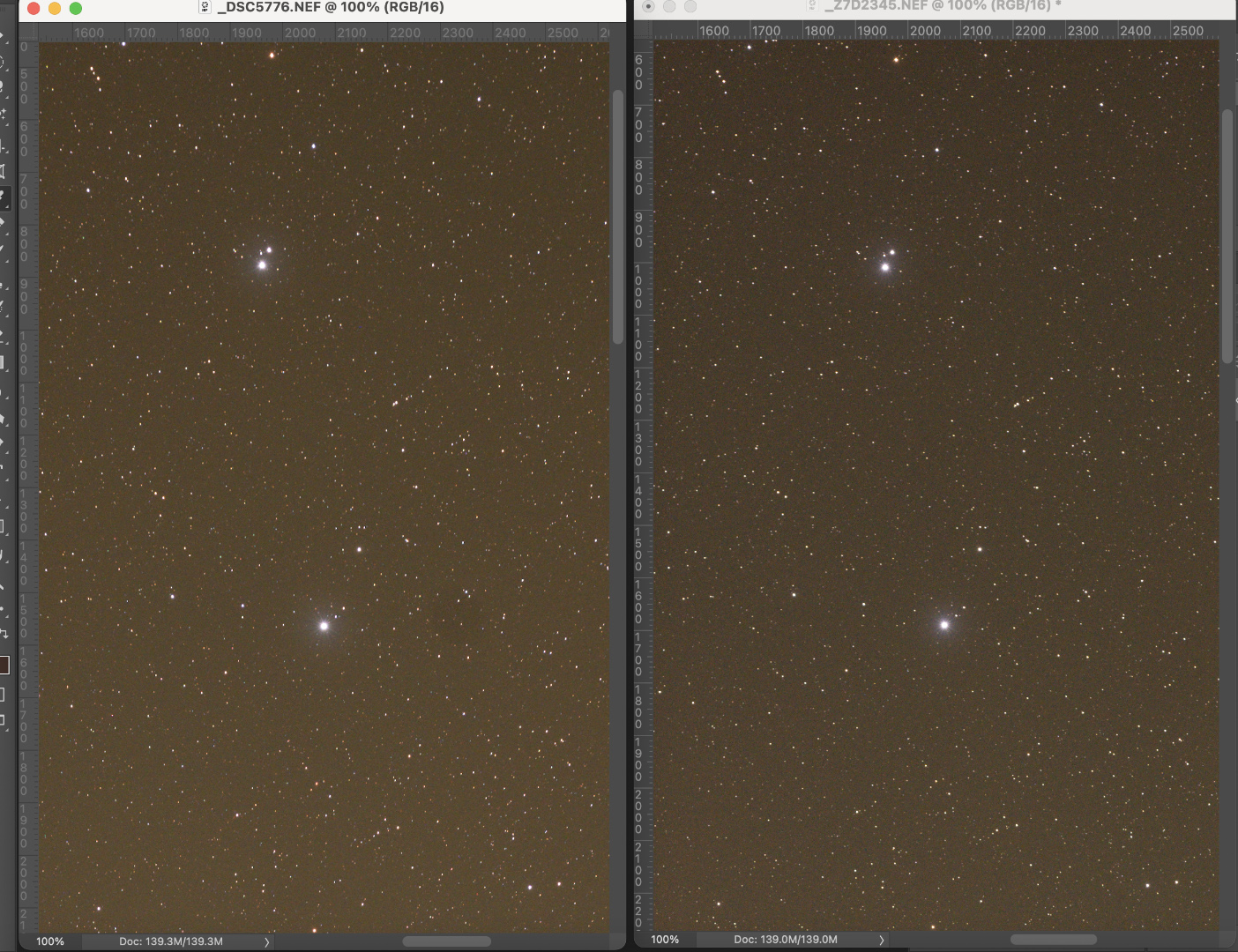
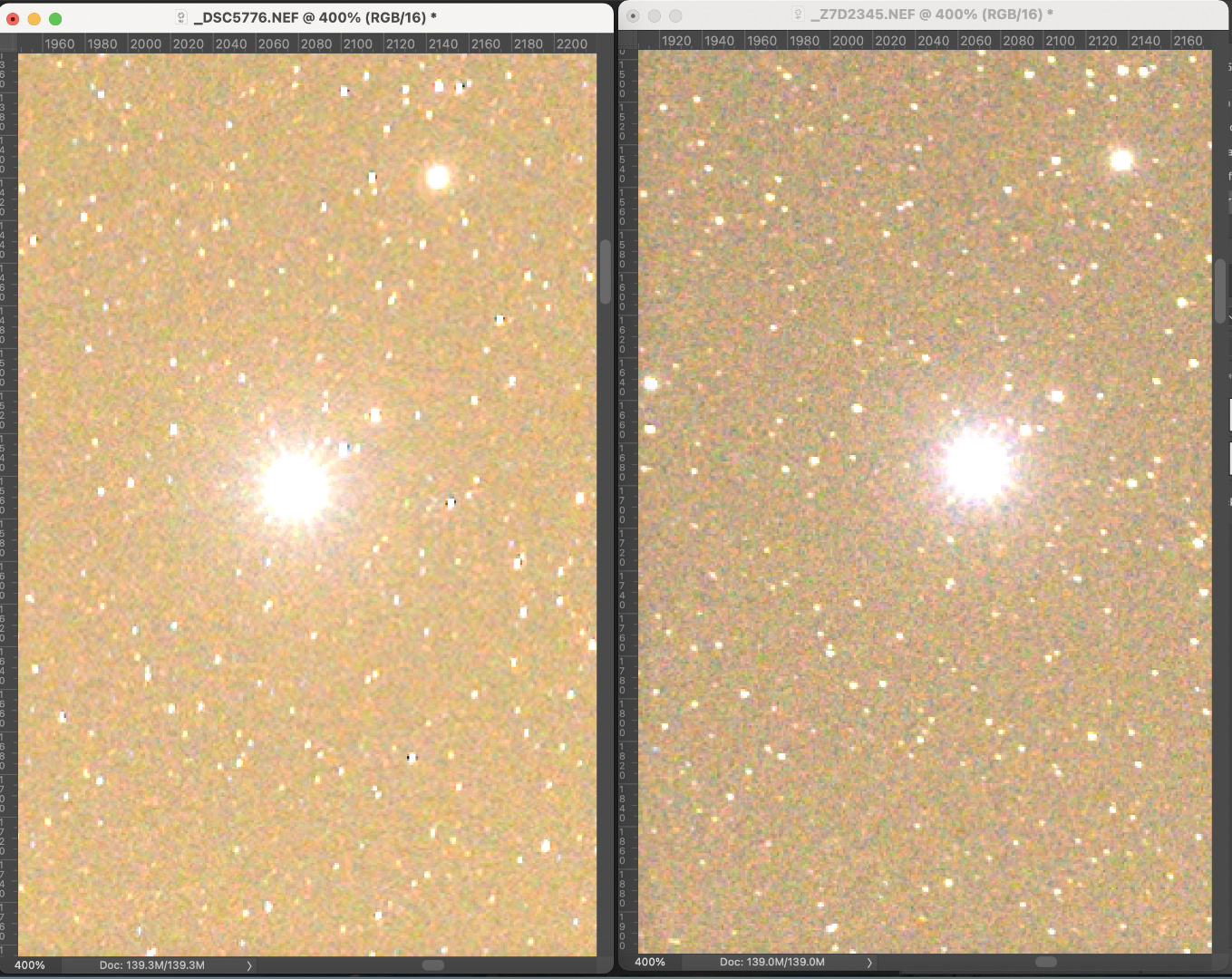
For the shots, I took each on my tracker at 3 minutes, ISO 1600, while using my Z 50 1.8 S stopped to f/4. I also should fully disclose the Z6 sensor was a lot hotter at the start of its test as I was using it all night, while the Z7 was just chilling in my cool car throughout the night.

The Z6 image is on the left, the Z7 on the right. Downscaling was done using the bilinear sample method in Photoshop. I simply just changed the resolution of the 7 to that of the 6. Since there are a lot of smart cookies on this forum hopefully one of you can tell me if I totally botched this up and my test is no bueno.


Zoomed to 400% after downscaling, the 6 still looks cleaner to me.


At 100%, I still think more luminance noise looks present on the Z7. Bonus: The double star Mizor and Alcor just chilling.


For this one I bumped up the EV for each shot by 3 stops. Again, Z6 still to me looks cleaner.


Aug 09, 2021 at 06:13 AM
Jack Flesher
Offline
• • • •
Upload & Sell: On
p.1 #16 · So, is the Z7 II the better camera then?


Speaking only for myself after viewing your comparisons over the web, I can’t see enough noise difference to care. However, even after downsampling, the Z7ii files seem crisper and more detailed with superior contrast. This could be from the slight net exposure difference, or perhaps some sharpening auto applied in PS, IDK. But to me, the Z7ii crops look “better” overall, especially the one at 100% which is probably most relevant.


Aug 09, 2021 at 09:09 AM
Jan Brittenson
Offline
• • • •
Upload & Sell: Off
p.1 #17 · So, is the Z7 II the better camera then?


I'm not sure astrophotography is all that relevant to general photography. To begin with, a Z7 with a 600mm lens has a resolution of about 12.5 arcseconds. A very large (visually) star like Betelgeuse has a size of about 0.05 arcsec. This means no matter what the camera resolution and practical lens focal length, no general-purpose camera will ever resolve a star. It's a point much smaller than one pixel. In fact, it's so small that for a Z7 if the lens could actually resolve them they might disappear in the space between cell sites! The fact that a star looks bigger than this is an optical aberration. A star field is a monochrome point field (even if you use spectral filters to e.g. determine red shift), so to recreate it each of the optical blobs should be replaced with a single point, with its brightness determined as a function of the blob size and optical spread. The problem here of course is the blob obscures other points and you'd end up with a black disk around a gray point. This means for astrophotograpy SNR (and things like gain noise factor in the ADCs) is paramount. You may need a tracking mount and use multiple exposures and survey by magnitude range (and carefully position bright ones out of view). But bright stars will always cause problems, no matter what.

This is so completely different from any normal photography it's practically irrelevant. We just don't photograph nearly infinitely bright, infinitely small points of light to produce images where the visual appearance is dominated by optical aberrations.


Aug 09, 2021 at 03:19 PM
PixiPhotography
Offline
• • • •
Upload & Sell: On
p.1 #18 · So, is the Z7 II the better camera then?


DanielJStein wrote:
Wow there is a lot of great information on this thread! I appreciate another poster here correcting me on the bucket analogy, I can totally see how that applies to downscaling.

But with that in mind, I think the best way to figure out which is best for OP is some real world testing. I have tried to do so with my own gear, but I do not have the luxury or the knowledge to do so scientifically. That DP Review studio feature the poster above mentioned looks to be a solid way to gauge noise when downscaling, but I
...Show more

Very nice comparison. I think one of the few good things Tony Northrup said is that with higher megapixels, you can also apply noise reduction in post and still retain details where you may lose it with a lower resolution sensor. I am waiting my Z7 II rental to do some astro testing as well. To me the Z6 does look cleaner, but it could be because the pixel size is larger thus there are less/bigger noise vs the smaller/more noise on the Z7


Aug 09, 2021 at 06:35 PM
saaketham
Offline
• • • • •
Upload & Sell: On
p.1 #19 · So, is the Z7 II the better camera then?


z7ii with the awesome 14-24mm f/2.8 S .. yes, it takes sharpening quite well and someone better than me can make this camera shine for landscapes and portraits. If you're thinking of adding it to your bag, do it.
https://photos.smugmug.com/photos/i-xZS9MDk/0/4cada1fd/X4/i-xZS9MDk-X4.jpg
https://photos.smugmug.com/photos/i-7ZqHwGg/0/4b07c2ab/O/i-7ZqHwGg.jpg
https://photos.smugmug.com/photos/i-x7rjFJX/0/1ef4ee3c/O/i-x7rjFJX.jpg
https://photos.smugmug.com/photos/i-662ZqP2/0/d0c9a468/O/i-662ZqP2.jpg


Edited on Aug 10, 2021 at 07:25 AM · View previous versions


Aug 09, 2021 at 10:05 PM
DanielJStein
Offline
• • •
Upload & Sell: On
p.1 #20 · So, is the Z7 II the better camera then?


gear-nut wrote:
Speaking only for myself after viewing your comparisons over the web, I can’t see enough noise difference to care. However, even after downsampling, the Z7ii files seem crisper and more detailed with superior contrast. This could be from the slight net exposure difference, or perhaps some sharpening auto applied in PS, IDK. But to me, the Z7ii crops look “better” overall, especially the one at 100% which is probably most relevant.


You know you are right. It is pretty tough to tell on this forum. The JPEG compression really does not do a comparison like this a justice. I totally see what you are saying, but I guess just doing this comparison on my end left me with the result that the 7 does indeed look crisper like you are saying, but to me the 6 definitely looks cleaner.

---------------------------------------------

Jan Brittenson wrote:
I'm not sure astrophotography is all that relevant to general photography. To begin with, a Z7 with a 600mm lens has a resolution of about 12.5 arcseconds. A very large (visually) star like Betelgeuse has a size of about 0.05 arcsec. This means no matter what the camera resolution and practical lens focal length, no general-purpose camera will ever resolve a star. It's a point much smaller than one pixel. In fact, it's so small that for a Z7 if the lens could actually resolve them they might disappear in the space between cell sites! The fact that a
...Show more

While you are totally correct in that astro is certainly a different methodology to most other genres of photography, I think the above test is still relevant to OP's inquiry as they asked about doing some astro stuff. The test, again while unscientific, is on the wide-field end, using just a simple 50mm lens and tracking mount.

Yes certainly, I see what you are saying in that rendering small pinpoints of light versus a dark background is a difficult thing to ask of an imaging train, but the fact of the matter is the background where the noise exists in the shadows still to me seems like a good way to gauge these two camera's performance when it comes to the hobby.

The point of this test was more-so a way to see if one camera or the other will help OP in any way with some form of astro work, considering the fact that they asked about it specifically.

---------------------------------------------

ArizonaImage wrote:
Very nice comparison. I think one of the few good things Tony Northrup said is that with higher megapixels, you can also apply noise reduction in post and still retain details where you may lose it with a lower resolution sensor. I am waiting my Z7 II rental to do some astro testing as well. To me the Z6 does look cleaner, but it could be because the pixel size is larger thus there are less/bigger noise vs the smaller/more noise on the Z7


I am glad to help! Testing on your own is absolutely the best way to determine which one will suit your needs. I am going to challenge that Northrup quote for a second though.

I get what he is saying, but that is basically just another reference to the downscaling type of stuff discussed above. With the higher megapixels, you would need to apply more noise reduction to equal that of the noise of the lower resolution sensor. So in essence, you would be losing more detail to the point of the lower resolution sensor in the first place—so I would think... but correct me if I am wrong.


Aug 10, 2021 at 06:43 AM


FM Forums | Nikon Forum | Join Upload & Sell


Welcome back
Log in to your account