I think that is a hardware limitation, due to the sensor and electronics. Are you expecting that some change can be made to produce meaningful LSB or two?
I suspect Canon had to limit something either because of h'ware limitations ... need to shuttle around less bits to keep up with 20 fps ... or the marketing department wanted to leave something out for the next model release.
The point of my post above is to provoke discussion on the value of deeper bit depth... some say you can't tell a difference and therefore it is not important. Others, like the author of that vid disagree and he denotes it is required when you manipulate the shot. I manipulate everything I shoot.
Some of the information in that video isn't really correct.
You can make a 32 bit file in Photoshop by simply changing the working mode to 32 bit. Shooting HDR and merging in Photoshop does indeed yield a 32 bit file since it is linearized data, and being able to hold the extra stops requires additional bits in the file.
The R5 sensor is not capable of capturing 14 bits of usable color information, 2 of the bits will be primarily dedicated to describing the noise of the sensor. In the midtones you will have finer grained information assuming the A/D is compressing the information for the 12/13 bit files rather than clipping shadow regions (it seems to be compressing based on the examples in the earlier thread).
When creating an HDR, you are adding additional information that was physically impossible for the sensor to describe in a single frame. Your ability to manipulate that data further is only tangentially related to bit depth. The reason you can manipulate the data to a noticeably increased degree is because through the exposure bracketing and merging process you have added additional data that could not have been captured in a single frame by the sensor.
When capturing in 12 bit mode, you are making the data slightly less fine grained, but all of the information is still there. In Photoshop, if you switch to 16 bit mode (recommended over 32 bit mode as many adjustments aren't available in 32 bit mode) your adjustments will still be very fine grained and the difference will be fairly negligable.
It is unlikely that in H+ or ES that having 14 bit A/D conversion would yield any benefit to you.
I just did a test with my daughter in shadow with strong backlight. With the auto exposure set to 0 bias, she was of course underexposed. Pushing the shadows +100 in LR revealed a little more noise on the ES image vs the MS image. Of course, adding +2 EC in camera made the difference irrelevant. For the situations where it does matter, you can always use the appropriate shutter mode.
Jesse Evans wrote:
The R5 sensor is not capable of capturing 14 bits of usable color information, 2 of the bits will be primarily dedicated to describing the noise of the sensor.
Could you elaborate on that? I'd like to better understand why that would be the case.
It's also mostly academic because the dynamic range is that many stops up to ISO 400 or thereabouts, when you're at 1600 you have way less and you can easily pack that into 12 bits.
TeamSpeed wrote:
I am sure bit depth, in the end, matters only a tiny bit, over the other gains we could have.
---------------------------------------------
stanj wrote:
It's also mostly academic because the dynamic range is that many stops up to ISO 400 or thereabouts, when you're at 1600 you have way less and you can easily pack that into 12 bits.
It does matter quite a lot for some shooters, and it's not mostly academic, unfortunately.
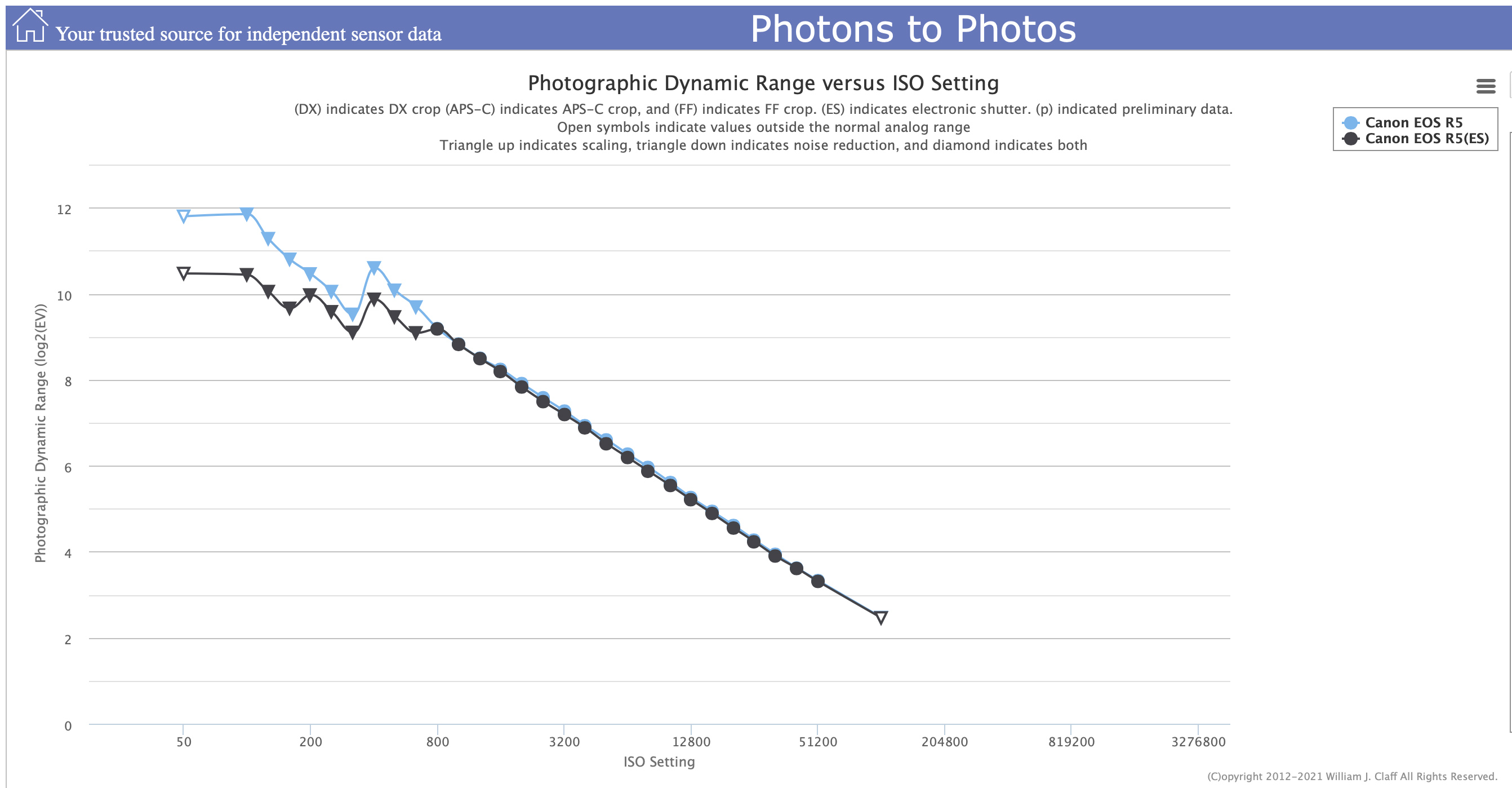
The Photons to Photos chart below shows a big drop in DR at base ISO with ES (becoming a non-issue by ISO 800):
Landscape shooters typically use base ISO + ES to minimize all vibrations, even those from the rear curtain of EFCS, albeit minimal. So with the R5 for landscape, we're stuck with EFCS as the best option to preserve DR while minimizing detail-robbing vibration from shutter shock.
EFCS has 14 bit I take it according to this ........
Don
JPEG: 2 compression options RAW: RAW, C-RAW 14 bit (14-bit with Mechanical shutter and Electronic 1st Curtain, 13-bit A/D conversion with H+ mode, 12-bit A/D conversion with Electronic shutter, Canon original RAW 3rd edition) HEIF: 10bit HEIF is available in HDR shooting with [HDR PQ] set to [Enable] Complies with Exif 2.31 and Design rule for Camera File system 2.0 Complies with Digital Print Order Format [DPOF] Version 1.1
The PDR is effectively a measurement of where the noise floor is on the sensor relative to it’s maximum highlight value.
Each stop of light is 2x as bright as the preceding stop. With boolean numbers you need 1 bit for each stop of light.
Since the sensor can’t capture more than 12 stops, and the recorded values are distributed linearly, you only need 12 bits to capture all of the available dynamic range. Adding additional bits does have other advantages, smoother gradients, higher color precision, but it is not really that noticeable as 12 bits is already getting very close to the maximal ability of your visual system to distinguish these things.
It does matter quite a lot for some shooters, and it's not mostly academic, unfortunately.
The Photons to Photos chart below shows a big drop in DR at base ISO with ES (becoming a non-issue by ISO 800):
Landscape shooters typically use base ISO + ES to minimize all vibrations, even those from the rear curtain of EFCS, albeit minimal. So with the R5 for landscape, we're stuck with EFCS as the best option to preserve DR while minimizing detail-robbing vibration from shutter shock.
But that is a measurement of ES vs MS, and not necessarily related to having 12 bit vs 14 bit.
On camera systems using 12 bit raw compressed formats that can be compared to 14 bit uncompressed like the Sony A7rIII the differences are much much smaller.
Jesse Evans wrote:
But that is a measurement of ES vs MS, and not necessarily related to having 12 bit vs 14 bit.
On camera systems using 12 bit raw compressed formats that can be compared to 14 bit uncompressed like the Sony A7rIII the differences are much much smaller.
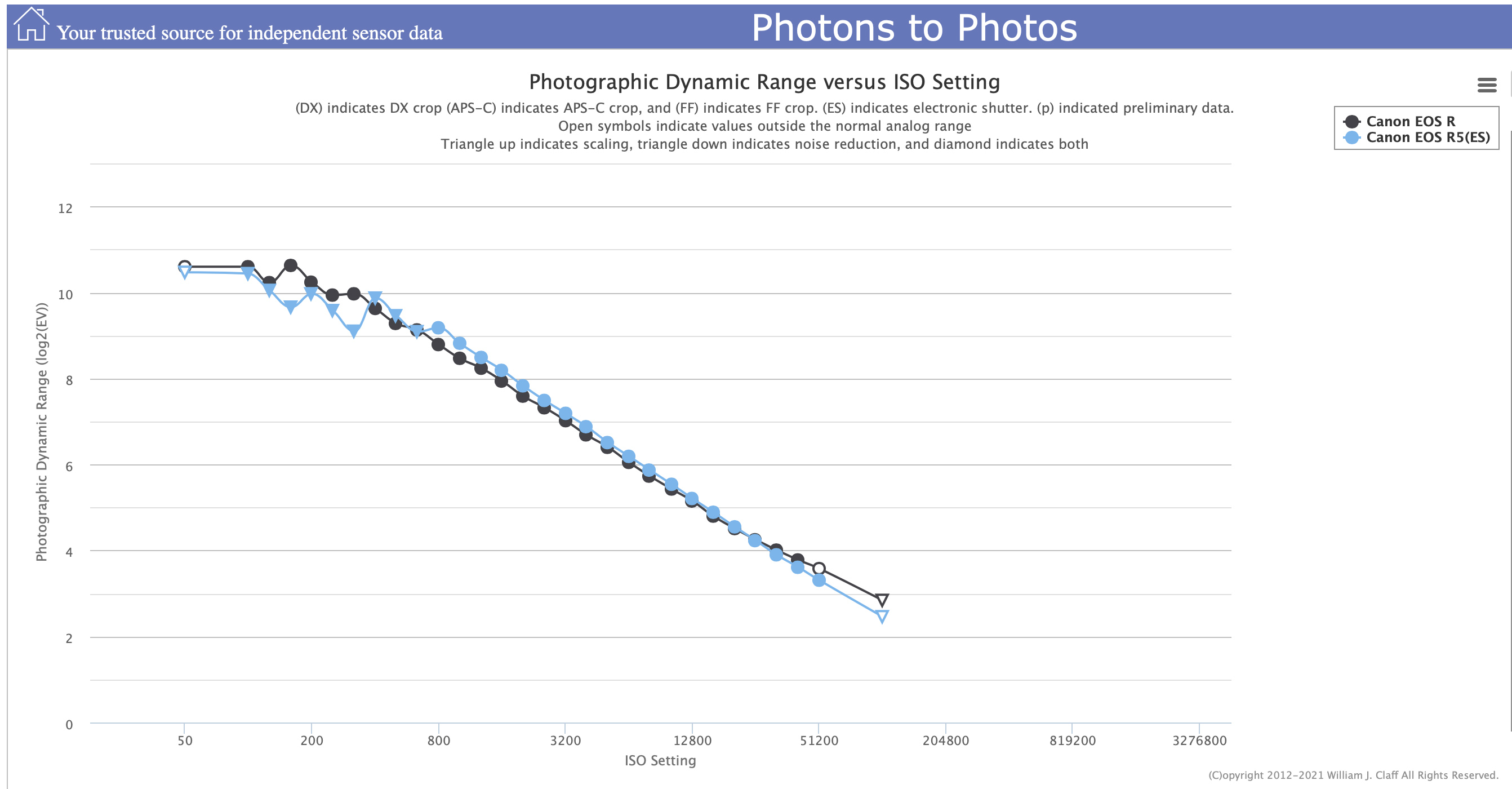
I don't care what Canon does with bit depth if they could have maintained DR at the same level. The ES DR drop is directly related to the drop in bit depth. You can see the DR drop on the P2P chart by turning on all options for R5: MS (14 bit), HS (13-bit) and ES (12-bit). With each of those reductions in bit depth comes a corresponding drop in DR. And to further illustrate – the ES on the EOS R is 14 bit with no drop in DR.
ES at base ISO on the R5 is essentially like shooting a 45mp EOS R as far as DR is concerned.
highdesertmesa wrote:
I don't care what Canon does with bit depth if they could have maintained DR at the same level. The ES DR drop is directly related to the drop in bit depth. You can see the DR drop on the P2P chart by turning on all options for R5: MS (14 bit), HS (13-bit) and ES (12-bit). With each of those reductions in bit depth comes a corresponding drop in DR. And to further illustrate – the ES on the EOS R is 14 bit with no drop in DR.
ES at base ISO on the R5 is essentially like shooting a 45mp EOS R as far as DR is concerned....Show more →
You're probably right. It is probably that the ADC essentially is averaging out the 14 bits that it could read in to 13 or 12 bits and it's moving the noise further up the brightness levels (where it would be in the lowest bits, it's now averaged in to higher bits).
Jesse Evans wrote:
You're probably right. It is probably that the ADC essentially is averaging out the 14 bits that it could read in to 13 or 12 bits and it's moving the noise further up the brightness levels (where it would be in the lowest bits, it's now averaged in to higher bits).
Not being very technically minded, I didn't understand a "bit" of that!
I assume that the chart and commentary are for those who shoot and then just use the shot out of the camera no? What about those of us who highly manipulate a photo in say LightRoom?
I shoot a ton of birds, dark birds against a bright sky means you are always bringing up the shadows ... and the noise.
Every little bit of bit depth will help us no? Again, what about us manipulators?
One can only hope the R3 doesn't suffer this huge DR drop in ES. It really is a turn off for the R5/R6 being reduced to slightly less DR than the 5DIV below ISO 400
Bruce n Philly wrote:
I assume that the chart and commentary are for those who shoot and then just use the shot out of the camera no? What about those of us who highly manipulate a photo in say LightRoom?
I shoot a ton of birds, dark birds against a bright sky means you are always bringing up the shadows ... and the noise.
Every little bit of bit depth will help us no? Again, what about us manipulators?
Peace
Bruce in Philly
Usually when i shoot birds I’m using the 100-500 with or without the 1.4x, so my ISO is usually 800 or higher anyway. At 800+ ISO, there is no difference in DR between all the shutter modes. If you shoot a big white f/4 prime, then you still would have to be at base ISO to notice a difference — at ISO 200, the DR with ES is probably close enough to MS to not matter. Oh, and if you shoot high speed modes, your bit depth drops anyway. Usually for birds you’d at least be in H mode and sometimes H+. Bit depth drop for high speed shooting is common across brands and nothing unusual.
But yes it does affect the RAW, this isn’t just a JPEG thing. The reduced ES DR is mainly an issue only for landscape shooters who are usually shooting at ISO 100.