Milan Hutera wrote:
I wish I could get as good a photo of Antares region as you have. Scorpius never raises very high in our region and even though we are probably halfway between Bortle 4 and 5, it's right behind lightdomes of several villages. It is also worth checking out Cuiv The Lazy Geek on Youtube. He is shooting from Tokyo (mostly narrowband/multiband though) and it all can be done, but he's shooting like 400-500 60sec. exposures and says the results are "quite noisy" after PP.
I just spent two evenings in a row setting up the shot - then the clouds came to the region I wanted to shoot, so I had to find another target (platesolve, refocusing, which currently takes a while...), then the clouds came again so no proper work was done except 2-3 hours wasted on nothing... Yes, it's a beautiful hobby ...Show more →
Thanks mate, I have the same problem with Andromeda haha always very low and bathed in LP and I only get 2-3 months during the year to attempt it.
Definitely time consuming with steep learning curve but at the same time fascinating and rewarding.
I am only shooting with pretty amateur kit at the moment though haha...just an AZ-GTI with DSLR body and lenses.
bballfreak6 wrote:
Thanks mate, I have the same problem with Andromeda haha always very low and bathed in LP and I only get 2-3 months during the year to attempt it.
Definitely time consuming with steep learning curve but at the same time fascinating and rewarding.
I am only shooting with pretty amateur kit at the moment though haha...just an AZ-GTI with DSLR body and lenses.
DSLR and lenses combo definitely has some advantages. Liveview and focusing with modern dual pixel AF is a breeze. It gets quite frustrating with dedicated astro cam - for some reason I can't get either APT or N.I.N.A. liveview to shoot faster than 1 sec exposures for our new QHY 168C. Also figuring out the spacing between the camera and coma corrector is quite a chore - on a DSLR, you just mount the thing to the adapter, put the camera on the scope and enjoy pin sharp stars right to the corners (at least on APS-C). But the limited results I got with our new camera are promising. So far I was only able to get 29 minutes and 1 hour on M13. That 1 hour photo is somewhat worse than the shorther one because the Moon was already quite large and it created quite a gradient. And this week I did 50 minutes on M27 - The Dumbbell Nebula, which turned out quite nice for such a short integration time, but for fainter parts to come out, I'm guessing I'll have to do at least 4 - 5 hours. My immediate plan was to shoot M16 (pun not intended ) which is somewhat affected by lightdomes here, but my attempts got ruined two evenings in a row with those pesky clouds....
Milan Hutera wrote:
DSLR and lenses combo definitely has some advantages. Liveview and focusing with modern dual pixel AF is a breeze. It gets quite frustrating with dedicated astro cam - for some reason I can't get either APT or N.I.N.A. liveview to shoot faster than 1 sec exposures for our new QHY 168C. Also figuring out the spacing between the camera and coma corrector is quite a chore - on a DSLR, you just mount the thing to the adapter, put the camera on the scope and enjoy pin sharp stars right to the corners (at least on APS-C). But the limited results I got with our new camera are promising. So far I was only able to get 29 minutes and 1 hour on M13. That 1 hour photo is somewhat worse than the shorther one because the Moon was already quite large and it created quite a gradient. And this week I did 50 minutes on M27 - The Dumbbell Nebula, which turned out quite nice for such a short integration time, but for fainter parts to come out, I'm guessing I'll have to do at least 4 - 5 hours. My immediate plan was to shoot M16 (pun not intended ) which is somewhat affected by lightdomes here, but my attempts got ruined two evenings in a row with those pesky clouds.... ...Show more →
For sure the simplicity of a DSLR setup is definitely nice.
I hear you about them clouds; the number of times the sky looked clear (with supposedly clear sky predictions too) and I'd setup and get it polar aligned and clouds would then roll in out of nowhere.
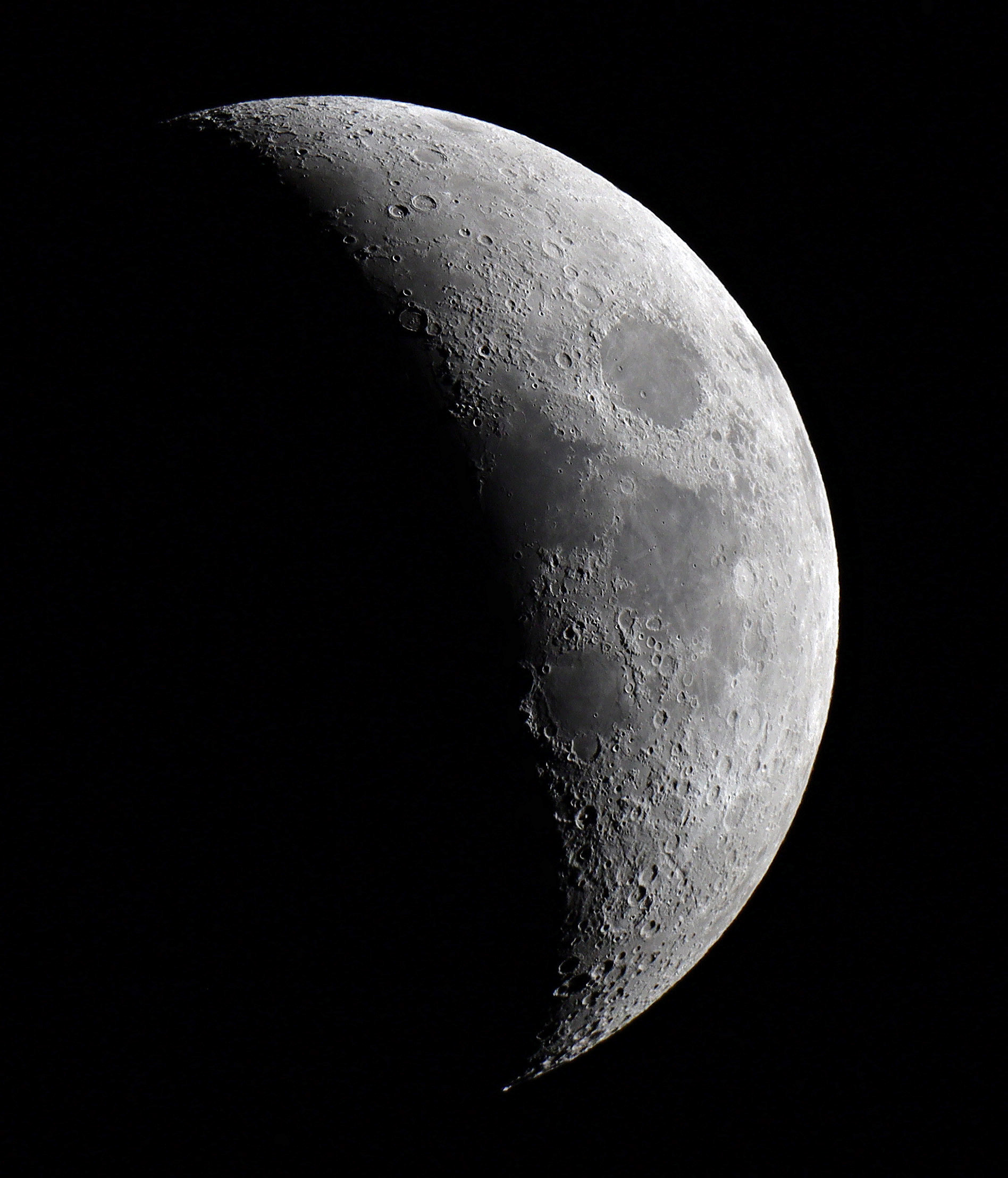
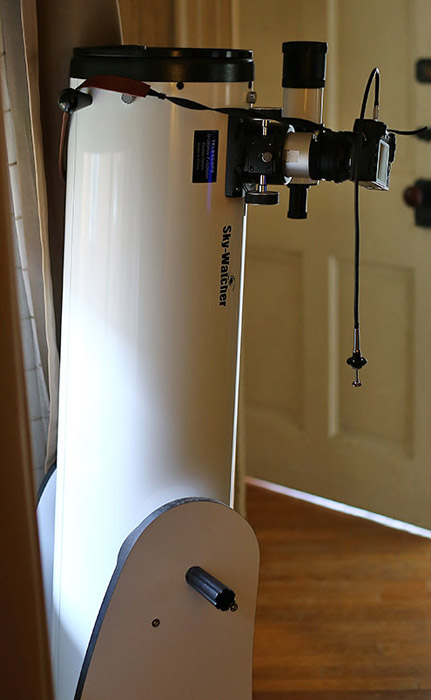
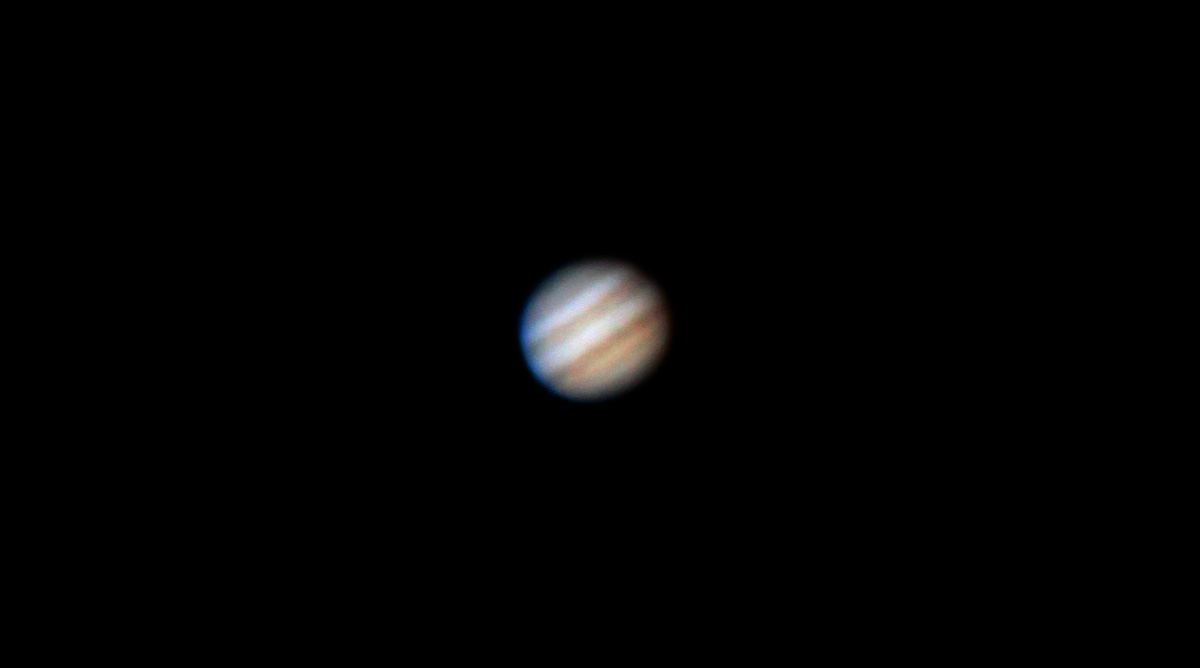
I used a Sky Watcher 8'', 1200mm Dobsonian & RP/Fuji X-E3 for my moon shoots. Had to sell the scope because of back problems, but for $340, at the time, it was impressive for the moon/planets.
Jim
scubasteve208 wrote:
no idea what im getting myself into reading the above comments.... 4-5 hours? wow
4-5 hours is actually quite short integration time. The pair of galaxies I posted on first page took 8 hours (3 and 5 minute exposures) to photograph, but that was with an awful Canon 40D. I'm shooting with f5 Newtonian telescope, which is considered "quite fast" in Astrophotography. Most serious refracting telescopes are around f7-8 if no FL reducer is applied. Celestron Schmidt-Cassegrain telescopes, such as Edge HD series are f10-f11. Another factor is the light pollution - the brighter your sky is, the more time you will have to spend shooting and even then you will get lower quality/noisier photos after extracting the light pollution gradients. Of course, the law of diminishing returns does come into effect after certain integration time. For example - if you already spent 10 hours integrating and you are getting good signal with not a lot of light pollution, going to 15-20 hours will make your photo better, but not 2x better.
scubasteve208 wrote:
so im assuming you set this up in your backyard or deck, porch.?
when you say 8 hours, is that stacking multiple 3 and 5 minute exposures?
Yes, you can either set up each time in your backyard or if your situation allows it, you can go for a permanent setup. This can be a shed with retractable roof, observatory domes that can be purchased from vendors such as NexDome or you can go fully custom made dome. Me and my dad built a fully custom fiberglass dome about 10 years ago. Then we had nothing in it (except a tiny refractor my dad built himself about 40 years ago until 2019 when we first purchased a telescope, then mount etc.). Permanent setup gives you several advantages - you have everything basically ready to go and you don't have to polar align your mount each time. It's a good thing to check the alignment from time to time, but last time I did that was maybe 9 months ago and the tracking is still good. I did try a 10 minute exposure with our new camera and the stars weren't great, so I might to check that again. Also we never had a problem with dew, even when I used my 300 f2.8 L IS for imaging, which is a big hunk of glass.
Stacking is the way to go - that way you reduce the risk of mechanical, weather, issues and most importantly sensor noise. I'm in the process of capturing Messier 16 now, so far I was able to do 15 5 minute exposures (90 minutes total integration) with our new QHY 168C dedicated astro cam. Stacking these exposures with dithering (which is a deliberate movement of the mount between exposures by a few pixels so the noise of the sensor is in different places on each subexposure), the results were breathtaking even uncalibrated (no dark frames, bias frames or flat frames applied). On brighter parts of the nebula, the noise was virtually non existent, in darker regions, the noise was really nice. When you get rid of chrominance noise (the ugly color one, which wasn't that apparent either), the luminance noise was really nice and not distracting at all. Still, I'm aiming for at least 4 hours on this bright and popular summer target.
what's your current set up. i know you said you just got the QHY 168C. is that in your current rig or are you trying to integrate with what you already have?
Milan Hutera wrote:
Yes, you can either set up each time in your backyard or if your situation allows it, you can go for a permanent setup. This can be a shed with retractable roof, observatory domes that can be purchased from vendors such as NexDome or you can go fully custom made dome. Me and my dad built a fully custom fiberglass dome about 10 years ago. Then we had nothing in it (except a tiny refractor my dad built himself about 40 years ago until 2019 when we first purchased a telescope, then mount etc.). Permanent setup gives you several advantages - you have everything basically ready to go and you don't have to polar align your mount each time. It's a good thing to check the alignment from time to time, but last time I did that was maybe 9 months ago and the tracking is still good. I did try a 10 minute exposure with our new camera and the stars weren't great, so I might to check that again. Also we never had a problem with dew, even when I used my 300 f2.8 L IS for imaging, which is a big hunk of glass.
Stacking is the way to go - that way you reduce the risk of mechanical, weather, issues and most importantly sensor noise. I'm in the process of capturing Messier 16 now, so far I was able to do 15 5 minute exposures (90 minutes total integration) with our new QHY 168C dedicated astro cam. Stacking these exposures with dithering (which is a deliberate movement of the mount between exposures by a few pixels so the noise of the sensor is in different places on each subexposure), the results were breathtaking even uncalibrated (no dark frames, bias frames or flat frames applied). On brighter parts of the nebula, the noise was virtually non existent, in darker regions, the noise was really nice. When you get rid of chrominance noise (the ugly color one, which wasn't that apparent either), the luminance noise was really nice and not distracting at all. Still, I'm aiming for at least 4 hours on this bright and popular summer target. ...Show more →
scubasteve208 wrote:
what's your current set up. i know you said you just got the QHY 168C. is that in your current rig or are you trying to integrate with what you already have?
black hole of a hobby for sure
Telescope - Skywatcher 200/1000mm f5 PDS Newtonian telescope - PDS has a dual stage "Crayford" focuser that lets you really fine tune the focus. The ratio between normal focus knob and precise focus knob is 10:1 I believe. We also got a Baader Multi Purpose Coma Corrector, which is a must have accessory to get round (ish) stars across the field.
Mount - Skywatcher EQ6 Pro with Synscan Go-To Controller - but I don't use that. I'm running it via special "EQMod" Cable on my laptop and using the software of the same name to control it.
Guiding - Stock finder scope that came with the telescope + ZWO 120mm mini monochrome camera
Focusing - via an old ASCOM compatible focuser. Basically it's a stepper motor connected to telescope's focus knob and it lets you remotely focus the telescope without actually touching it. You can even set up an automated routine to find the best possible focus via photo acquisition software.
Camera - QHY 168C which is a "one shot color" camera. Basically a Nikon D5000 series camera sensor without any buttons or displays on it, shaped like a cylinder, that has a TEC cooler attached to it.
Before getting the camera, we already had telescope, mount, guiding and focuser. Everything works together via ASCOM platform, so you just buy stuff whenever it's convenient for you and build up the rig.
Really nice and I envy once again as I'd have to travel somewhere without light pollution to capture this region from our country.
I do have three projects that are currently "work in progress", but I was super busy during the weekend to go full night of imaging (and there were some clouds around mid-night anyway). For M16 I'd really like to put at least one more hour and half into it, for M27 I have just under two hours on it and it looks "nice" but the faint parts around it are barely visible, so I'd like to give it another two-three hours too. And I just started a super close view of Sadr star and the immediate nebulosity around it, but I only have 65 minutes of that so far. Again, it looks "nice", but still, another one hour (at least) would be beneficial.
Not sure if I'd be allowed to post any of that here though since not a single piece of Canon gear was used to capture these . I can always say I have my Canons in my heart though...
Milan Hutera wrote:
Really nice and I envy once again as I'd have to travel somewhere without light pollution to capture this region from our country.
I do have three projects that are currently "work in progress", but I was super busy during the weekend to go full night of imaging (and there were some clouds around mid-night anyway). For M16 I'd really like to put at least one more hour and half into it, for M27 I have just under two hours on it and it looks "nice" but the faint parts around it are barely visible, so I'd like to give it another two-three hours too. And I just started a super close view of Sadr star and the immediate nebulosity around it, but I only have 65 minutes of that so far. Again, it looks "nice", but still, another one hour (at least) would be beneficial.
Not sure if I'd be allowed to post any of that here though since not a single piece of Canon gear was used to capture these . I can always say I have my Canons in my heart though... ...Show more →
I'm sure it's fine it is a thread about astrophotography
Milan Hutera wrote:
every camera is a cannon i say you're good to go! But not every cannon is produced by Canon
i copy your earlier post.....yes this will get expensive quicker than I can blink. But i said the same thing many moons ago when I purchased my first DSLR
I have had some fun with astro over the years. I started with a home made door mount with an edmunds scientific gear motor that was 30$ total. Built it in a motel room while i was ski bumming in wyoming. I now have an ioptron unit that was a few hundred bucks. My limiting factor for the fun was clear nights in wyoming during winter are COLD. 10 below zero cold. Last night, in maui we had a clear sky so i did some simple tripod shots. Working in shorts was great.
Hardest part about using the homemade mount is aiming precision at the north point. Ioptron is 100x better for this. I have shot with 200f2.8r, 16to35r, leica 35to70f4, and 24tse. All with decent results. I have not done stacking yet.
Have fun with it, when the investment is low, you cant get mad at yourself for not getting better eq, its just part of the journey. Jp
Ok, so with Canon in my heart... ... I'm sharing two of my targets that are still "in progress" with QHY 168C "One Shot Color" camera. I find that by doing these "crude processings" you will have some idea of what you are actually capturing, the amount of detail you can expect in your final photo, if your star shapes hold up and so. These are usually uncalibrated - no darks, bias or flat frames applied and vignetting removed in PP, which is not the way it is done (properly), but since I'm capturing and integrating at the same time on the same laptop, I don't want it to explode on the spot . Also I'm not yet finished taking dark frame library - which are of the same length and temperature as your light frames (for me it's 5 minutes at -5C for summer time).
The first one is Messier 16 - The Eagle Nebula with famous "Pillars of Creation" in the center. Captured in broadband with the basic Baader Neodymium Moon & Skyglow + UV/IR cut filter that helps a little by blocking the ugly yellow light. This is 3 hours worth of 5 minute exposures. This target is well past its time in my location and it doesn't raise very high at its time either. So what I do is - each evening right from the start, I'm trying to add 30 to 60 minutes of integration time. This is frustrating, because at the very start of the night the conditions are far from ideal, but if I waited further into the night, the target would descent into more light pollution. So it takes time. I'm getting back to the target coordinates each time via Platesolving function. https://milanhutera.com/wp-content/uploads/2021/08/Pillars-of-Creation-Autosave002_ABE-180min.jpg
The second photo is IC 5146 - The Cocoon Nebula. This is a very popular summer target and yesterday I managed to capture 2 hours of it - again, with 5 minute exposures, then switched to Sh 2 - 101 - Tulip Nebula with Cygnus X-1 - the first discovered Black hole. The nebula itself shows really nicely after two hours, however, there are some prominent dust areas around it, plus it "drags" a distinctive dust lane behind it. This is actually a good candidate to do a off center composition, but I decided to go with the center comp to show incredible dense star field around it. Plus, the APS-C sensor captures a decent field of view, so the dust lane is showing nicely as well. This will require more integration time, I'm guessing at least two more hours. This is completely uncalibrated, just light frames thrown together and crudely processed. https://milanhutera.com/wp-content/uploads/2021/08/IC-5146-Autosave_ABE-120min.jpg
So to resurrect a thread, I'm posting a photo I finished today, before I post it elsewhere. Or maybe not. This is a heavy crop (1000mm) of the area known as "Sadr Region" in the heart of Cygnus constellation. Sadr is the massive star in the top right corner. It looks the way it does because it is BIG and constantly shining into a large mirror. The nebulosity around it is quite beautiful and can be captured nicely with 200mm or 300mm if you're shooting APS-C or FF. For such a close up a mosaic would be great, but it would take quite some time. This photo is just over 4 hours worth of 5 minute exposures.
Skywatcher 1000mm f5 Newtonian telescope, Skywatcher EQ6 + Eqmod, ZWO 120mm and PHD2 for guiding, QHY 168C as the imaging camera, Astrophotography tool for acquisition. No Canon gear but I held and shot my R6 both yesterday and today, so that counts, right?
As far as processing goes:
- calibrated with Darks, Flats and Darkflats
- Drizzle integration for upscaling and smoothing the edges (not necessary in this case, but nice to have)
- Background extraction (somewhat difficult, since there is very little of dark backtround in the frame
- Photometric color calibration (to get the white balance close to what it should be)
- Noise reduction (I did it in several steps, I got it quite smooth without killing fine details.)
- Histogram transformation (fancy "levels" to get into something we can actually see)
- Colors/Saturation
- Decent star size reduction (again, temptation is high to overdo it)
- Final Lightroom color/contrast tweaks, including some more NR, but that can easily be switched off


 ) which is somewhat affected by lightdomes here, but my attempts got ruined two evenings in a row with those pesky clouds....


 . I can always say I have my Canons in my heart though...
  ... I'm sharing two of my targets that are still "in progress" with QHY 168C "One Shot Color" camera. I find that by doing these "crude processings" you will have some idea of what you are actually capturing, the amount of detail you can expect in your final photo, if your star shapes hold up and so. These are usually uncalibrated - no darks, bias or flat frames applied and vignetting removed in PP, which is not the way it is done (properly), but since I'm capturing and integrating at the same time on the same laptop, I don't want it to explode on the spot
  but I held and shot my R6 both yesterday and today, so that counts, right?