AmbientMike wrote:
No, I'm not talking about multiple short exposures adding up. I'll look at these later but my understanding is that's no good, wamted to make that clear. I am saying if you work it out, 6400, 1.4, and 6 sec is the same exposure as 5.6 at 1600 and 6 min 40 sec.
6 sec at 1.4 is the same exposure as 25 sec at 2.8 and 100 sec at 5.6. Then 2 stops more from 6400 to 1600 goes to 400 sec, 6 min 40 sec.
Also there seems to be a lot of cropping. Talked to a guy, I believe he shot M51 + companion (nice shot of that above BTW ) on aps using a shorrter FL than you did, and had to be cropped quite a bit. Even using 11", one might need to crop a large sensor on herschel 400 list a lot and other dim galaxies . Probably had something to do with 720 pixel sensors. I'd definitely prefer 2x the pixels of 5DsR vs 6D2, on regular photography. But it's probably not as big as people, myself included, like to think, either.
But you have to stack the shots regardless. Even for landscape photos. For single exposures, your math might be correct, but real life results won't be an exact match. From the photos I did for some "twilight landscape photography", the brightness levels definitely weren't the same when I shot at ISO 1600 and then "did the math" and shot at lower exposures. Watch the videos.
M51 you have to crop, but using 11" will give you EXCELLENT framing even with APS-C sensor, let alone with with smaller sensors. I drizzled the data 2 times which made my 10mpix photo into 35-36 mpix file. This helps with cropping quite a lot. Again, I used the Atik with small sensor and you can drizzle 3 times to get a 10-11 mpix file and you won't have to crop as much because of that smaller sensor, but it's not the same. The file just isn't as sharp to begin with. The online calculator that compares telescopes and cameras tells me this combo should be good (not undersampling or oversampling) but still my eyes tell me otherwise.
scottsoutter wrote:
I came at this from the cheapskate angle. Bought a used vixen polarie and cobbled together an inexpensive counterweight system with a 300mm arca rail and some theater lights weights (convenient in that they have a 1/4 screw on them).
Put my 5D4 plus either a zeiss 100mm f/2 or my 100-400 on there and it was nicely balanced. I found that a geared head was really helpful to get close enough to polar alignment for 20-30 second exposures.
It produces nowhere near the level of clarity and sophistication of some of the photos I have seen but I was able to scratch the itch for about $150 and figure out whether this was something worth going deep in to for me. It is most assuredly a domain which requires pretty hefty buy in to start doing the really technical photography.
If you’re interested in this kind of a trial run I’d be happy to send you photos of the set up and some of the gotchas I found. ...Show more →
The Vixen Polarie has a very low periodic error for the small trackers. May be relatively inexpensive and small, but it's no slouch for wide to normal focal length lenses where I can image a single exposure for minutes. The greater benefit of the counterweight systems (some are commercially available) for me is to ensure I am perfectly polar aligned after attaching my camera and finding my target. I took off one of my axes from the Manfrotto geared head and love it.
Jeffrey Myers wrote:
Is there anyone into astrophotography? About once a year I get a wild hair and start looking into astrophotography, this is that time for this year
When that happens I read a bunch of forums, watch a ton of youtube videos and read online content and what I come away with is a TON of different opinions and things people swear by that are polar opposites of each other.
From a community that I trust more than others.. what do you use?
Where do I start?
I've been shooting as a hobbyist for 23 years. Went from a point and shoot Olympus to a 10D to a 5D3 and soon to upgrade to the R6.
I've heard I need a dedicated body specifically for night sky. Others said I can use any that I have.
I'd like to start by mounting my current setup on an EQ mount. This is the least expensive route to get my feet wet. I started digging this week and before I knew it was had a list that included a Celestron Edge HD 11" telescope, ZWO ASI 160mm pro camera etc. etc. before I knew it, I had $12,000 in my cart... So, I backed up and came here.
I don't like to skimp and regret not getting 'what I really needed'.
Any help getting started would be greatly appreciated. ...Show more →
Join a local astronomy club. They love showing their all gear and talking about it.
Join a forum like Cloudy Nights. They love talking about gear and processing images.
You can get a lot out of these two venues without running out and spending gobs of money on a hobby you may not pursue but casually.
I think the op should either mount his 85/1.4 on a tripod, get a suitable tracking mount for the 70-200/2.8 (not sure if a tracker can handle the 70-200/2.8?), or if he winds up getting a CG-5 class mount get a ~70mm refractor in addition to his current gear. Just go out get some photos and get used to it. It sounds like a big jump from daylight to astro using an 11". Anything in between is likely to help and just get used to getting the darks, flats, etc and putting them in the stacking software. And the ~70mm + mount is a pretty standard astrophotography set up, if that's the op's original question. Maybe more like $1200 used instead of $12k, & just use dslr
My 85/1.4 Rokinon really isn't bad after dark imo. Lots of CA, and certainly not the sharpest lens, but honestly I think it's tough to eliminate all the movement from your system. Maybe using autoguiding like the guy in the video? But most people don't seem to be using that, perhaps due to cost, and even then I'm not sure if you can eliminate it 100%. I tried lenses that might be considered "better," but I got funny shaped stars. That negates any performance advantages, pretty fast.
Going to chime in here and try to expand on what Milan was saying.
If you're purely talking about exposure ie what you're seeing being output onto a screen then yes for example f/2.8 at 1 minute and ISO 400 is the same as f/2.8 at 30 second and ISO 800 in that they'll "look the same".
But the problem here is the amount of actual signal the sensor is picking up is purely dependent on the aperture and exposure time where ISO is only an amplification of the signal so in the previous example f/2.8/1 min/ISO 400 has collected twice the amount of light as f/2.8/30 sec/ISO 800. The longer exposure at the same aperture has collected more light irrespective of the ISO. This is important on a number of fronts because one the longer exposure will look better and show more nebulosity for the fact that it has more actual signal than just an amplification by increasing ISO (which also adds noise etc); secondly using lower ISO means you're not blowing out the highlights as much and it allows for tighter and better colour retention in the bright stars. This is why even though I own fast UW lenses like the Sigma 14mm f/1.8 if opportunity allows I'd still mount it on a tracker for my Milky Way landscape to collect as much real signal as I can.
Amen to that Bfreak.
Long ago, when we were using different digital gear 5-7 years ago, some astro folks were stating ISO 800 was an ideal setting as far as balancing introduced noise during long exposure with standard cameras (not the fancy astro CCD cameras, etc).
Going down further in ISO did not seem to help the S/N of the final single image. Of course there are newer sensors these days and that advice may have change.
dgdg wrote:
Amen to that Bfreak.
Long ago, when we were using different digital gear 5-7 years ago, some astro folks were stating ISO 800 was an ideal setting as far as balancing introduced noise during long exposure with standard cameras (not the fancy astro CCD cameras, etc).
Going down further in ISO did not seem to help the S/N of the final single image. Of course there are newer sensors these days and that advice may have change.
Yea with my 77D and old 5D4 I pretty much had my ISO set at 400 as those sensors are more or less ISO invariant at that point. Have since sold the 5D4 and moved onto the R6 so looking forward to giving the new camera a try for astro though I'd say ISO 400 would probably still be the way to go.
Also edited my previous post was meant to say f/2.8/30 sec/ISO 800 in the last paragraph haha.
The lower you go on the ISO, the less noise. No surprise there. But you can get a pretty good exposure using high ISO if you don't have a drive. I'm just using a tripod , you get a little star trails even at 6 sec at 85mm. Although I think some books etc say you can go longer at that FL and it's OK.
I remember seeing something about how you should use a certain ISO on a certain camera, but I'm not sure what the reasoning behind this was. And I think the newer more ISO invariant ones are more exempt.
The other thing is, I've gotten a lot of noise even at a minute or 2 IIRC. So using high ISO seems to help, there.
AmbientMike wrote:
The lower you go on the ISO, the less noise. No surprise there. But you can get a pretty good exposure using high ISO if you don't have a drive. I'm just using a tripod , you get a little star trails even at 6 sec at 85mm. Although I think some books etc say you can go longer at that FL and it's OK.
I remember seeing something about how you should use a certain ISO on a certain camera, but I'm not sure what the reasoning behind this was. And I think the newer more ISO invariant ones are more exempt.
The other thing is, I've gotten a lot of noise even at a minute or 2 IIRC. So using high ISO seems to help, there. ...Show more →
Again using my example above it's not just about noise but being able to use longer exposures allows for more light being collected and consequently more detail as upping ISO only amplifies the light collected based on your shutter speed and aperture; also not clipping the highlights as much if you're able to use lower ISO.
That's not to say you shouldn't up the ISO if you have to of course; not everyone has access to a tracker nor does it suit all situations, I was simply trying to explain why upping the ISO is not the same as making your exposure longer.
bballfreak6 wrote:
Yea with my 77D and old 5D4 I pretty much had my ISO set at 400 as those sensors are more or less ISO invariant at that point. Have since sold the 5D4 and moved onto the R6 so looking forward to giving the new camera a try for astro though I'd say ISO 400 would probably still be the way to go.
Also edited my previous post was meant to say f/2.8/30 sec/ISO 800 in the last paragraph haha.
Funilly enough, there is not that much difference in gain settings of our new QHY 168C either, which uses Sony IMX071 sensor found in some older Nikon DSLR's. You can set the gain from 0 to 15, unity gain is 10. I tried unity gain and gain 1, which should have about 1,5 - 2 stops advantage for DR. The difference in brightness wasn't massive, the difference in noise wasn't massive either. So I've elected to shoot at gain 1 for 3-5 minute exposures. Individual exposures are actually quite noisy, even cooled down to -5C, but when you stack even few good *uncalibrated* exposures together (like 10-12 3-5 minutes long) the noise becomes so nice I wasn't remotely tempted to use any NR. Of course, once you do the background/gradient extaction, the signal suffers from such a low integration time - if only clouds and Moon situation permitted a proper session....
Milan Hutera wrote:
if only clouds and Moon situation permitted a proper session....
Always the challenge lol. Makes you really appreciate those hardcore astro guys throwing sometimes hundreds of hours into a single image...how many sessions they would've taken.
bballfreak6 wrote:
Always the challenge lol. Makes you really appreciate those hardcore astro guys throwing sometimes hundreds of hours into a single image...how many sessions they would've taken.
There was an APOD of a very faint, rather unkown nebula, that had like 120hours of integration time. But I believe at least two teams did the shooting and there are ways to attach two telescopes on 1 mount, so there are ways to cut down the actual capturing hours. But still, collecting 100+ hours of data must've taken weeks, if not months, depending on the weather/Moonphase. With Narrowband filters, especially Halpha, the "big Moon problem" can be greatly reduced.
Yeah I'm not sure how they do it, but people seem to get nice images in light polluted areas. So I'm not sure how much of a problem it is, especially given the amount of pp in astro.
I'm not saying that 6400 is ideal, but I think one major reason you put several exposures into the stacking software is NR. And I leave LENR on for regular photography, but that's just one dark frame and they usually use several in astro. A big function of the stacking software seems to be NR.
AmbientMike wrote:
Yeah I'm not sure how they do it, but people seem to get nice images in light polluted areas. So I'm not sure how much of a problem it is, especially given the amount of pp in astro.
I'm not saying that 6400 is ideal, but I think one major reason you put several exposures into the stacking software is NR. And I leave LENR on for regular photography, but that's just one dark frame and they usually use several in astro. A big function of the stacking software seems to be NR.
Light pollution is a MASSIVE problem. Not just for astrophotography, but for health of humans and animals. Virtually every city or settlement in developed parts of world has now switched to white LED streetlights which is a broadband source of light, whereas the old style streetlights were of a specific wavelength. LED's are essentially turning night into day. In astrophotography, nothing can replace a dark sky. You can mitigate light pollution by reducing the exposure time of individual subexposures (but that reduces the good signal, as we tried to explain before) or using narrowband/multiband filters which only let in specific colors/wavelengths. But the resulting images often aren't "truecolor" like broadband images are. And these filters require LONG exposures and additional integration time (as we tried to explain before). For example, the Eagle nebula - M16 with Pillars of Creation is appears to be brick red/pink in broadband/LRGB. With narrowband you will find all kinds of results - from the classic "green/gold" of Hubble Palette, blue, even rainbow color. Just browse Astrobin.
AmbientMike wrote:
Yeah I'm not sure how they do it, but people seem to get nice images in light polluted areas. So I'm not sure how much of a problem it is, especially given the amount of pp in astro.
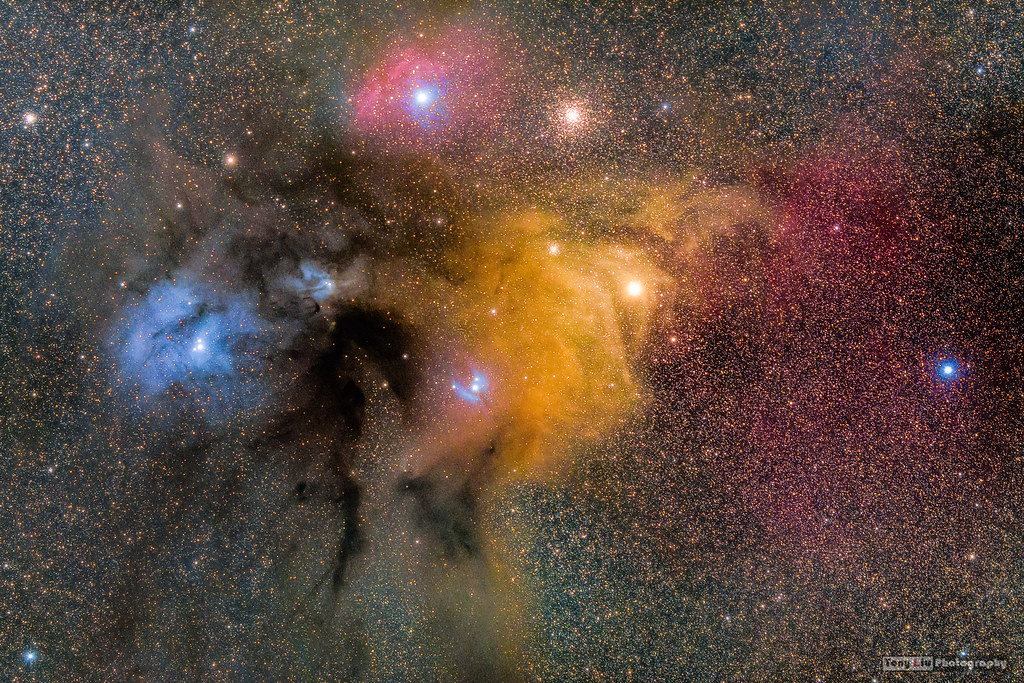
Many, many hours of data mate. I live in Bortle 5/6 zone in Australia and I got these from the backyard:
Milan Hutera wrote:
Light pollution is a MASSIVE problem. Not just for astrophotography, but for health of humans and animals. Virtually every city or settlement in developed parts of world has now switched to white LED streetlights which is a broadband source of light, whereas the old style streetlights were of a specific wavelength. LED's are essentially turning night into day. In astrophotography, nothing can replace a dark sky. You can mitigate light pollution by reducing the exposure time of individual subexposures (but that reduces the good signal, as we tried to explain before) or using narrowband/multiband filters which only let in specific colors/wavelengths. But the resulting images often aren't "truecolor" like broadband images are. And these filters require LONG exposures and additional integration time (as we tried to explain before). For example, the Eagle nebula - M16 with Pillars of Creation is appears to be brick red/pink in broadband/LRGB. With narrowband you will find all kinds of results - from the classic "green/gold" of Hubble Palette, blue, even rainbow color. Just browse Astrobin. ...Show more →
Not only that, even just the fact that many people have never (and probably never will) see what a true dark sky looks like; I am lucky where I live I can drive about 1.5 hours and get to a Bortle 2 site and the sky is stunning to look at out there with the naked eye and it's something many will never get to experience which is quite sad.
i've always wanted to know how ya'll do what you do, and this is great insight. Thanks to OP and thanks to everyone contributing to this thread......learning a lot here
I have a mate in LA in Bortle 9 sky who's pulling out galaxies from his driveway but he's throwing like 20-30 hours of data at an image.
I wish I could get as good a photo of Antares region as you have. Scorpius never raises very high in our region and even though we are probably halfway between Bortle 4 and 5, it's right behind lightdomes of several villages. It is also worth checking out Cuiv The Lazy Geek on Youtube. He is shooting from Tokyo (mostly narrowband/multiband though) and it all can be done, but he's shooting like 400-500 60sec. exposures and says the results are "quite noisy" after PP.
I just spent two evenings in a row setting up the shot - then the clouds came to the region I wanted to shoot, so I had to find another target (platesolve, refocusing, which currently takes a while...), then the clouds came again so no proper work was done except 2-3 hours wasted on nothing... Yes, it's a beautiful hobby


 ) on aps using a shorrter FL than you did, and had to be cropped quite a bit. Even using 11", one might need to crop a large sensor on herschel 400 list a lot and other dim galaxies . Probably had something to do with 720 pixel sensors. I'd definitely prefer 2x the pixels of 5DsR vs 6D2, on regular photography. But it's probably not as big as people, myself included, like to think, either.