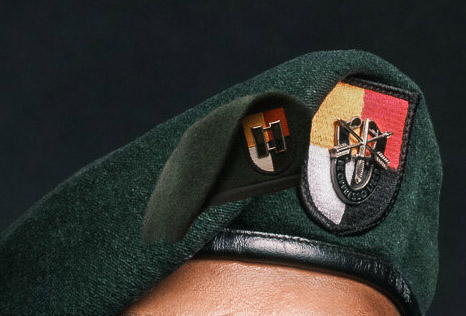
Gotcha @ artistic liberty ... just didn't want it to become a slippery slope for ya where specific colors have specific meaning. Just something that caught my eye.
Yeah, but I'm not so sure about the Yellow(shift) Beret, instead of the Green Beret. They may have changed the color of the uniform, but I don't know if they changed the color of the Beret. Imo, the Green Beret should be wearing a Green Beret. Imo, the warm cast renders the beret something different than it is specified to be ... artistic liberty notwithstanding.
The official regulation color of a green beret is “Rifle Green,” #414833.
I pulled an eydropper from the web image and a representative section.and it gives me a #384234, a color which is a hair less saturated, but actually about 8nm wavelength cooler than the regulation color if we are going full pantone.
Suggest your monitor calibration may need a look, but we all see things differently. I am comfortable the color of my headgear is reflected accurately enough here within an acceptable range of artistic license. Glad to take the point that you feel this image is too warm (color temp definitely seems to be your thing looking over previous posts!), but I don’t think one can credibly argue that the colors overstep the bounds of identifiability of and respect for the uniform and its decorations.
RustyBug wrote:
Yeah, but I'm not so sure about the Yellow(shift) Beret, instead of the Green Beret. They may have changed the color of the uniform, but I don't know if they changed the color of the Beret. Imo, the Green Beret should be wearing a Green Beret. Imo, the warm cast renders the beret something different than it is specified to be ... artistic liberty notwithstanding.
RustyBug wrote:
Yeah, but I'm not so sure about the Yellow(shift) Beret, instead of the Green Beret. They may have changed the color of the uniform, but I don't know if they changed the color of the Beret. Imo, the Green Beret should be wearing a Green Beret. Imo, the warm cast renders the beret something different than it is specified to be ... artistic liberty notwithstanding.
Fair enough ... I just see two different hues of beret between your images. I color check the neutrals and see the numerical warmth in the various neutrals throughout the image (multiple eyedropper).
I never meant to disturb your sense of propriety. I only wanted to convey that it is factually warm (and readily discernible to me) and the beret colors don't match in your two images ... particularly given the level of marksmanship of your subjects. If you and your clients don't see any diffs, then you're good.
Here's the (unaltered) overlay, noting the diff's not only in the greens, but also the white, black, as well as the warmth in the silver. Not sure, if you'll see the diff's on your monitor, by eye (accommodation) ... but, when I color check the whites of the Beret Flash, I see one with a:1 b:-1, and the other with a:8 b:13, which renders it beige, not white. Hopefully being juxtaposed in proximity to the neutral white / black, the eye won't accommodate as much.
So, again, my only interest was to aid (meant in good regard) in alerting to the warmth having a color influence that can be seen ... hopefully the overlay makes it more easily discerned. But, it will always be your message, your pic, your call on how you choose to render it.
All the best to you, as I know you aspire to give your best in recognition of those who give their best. To that ... I've given you my best. HTH
The official regulation color of a green beret is “Rifle Green,” #414833.
I pulled an eydropper from the web image and a representative section.and it gives me a #384234, a color which is a hair less saturated, but actually about 8nm wavelength cooler than the regulation color if we are going full pantone.
Suggest your monitor calibration may need a look, but we all see things differently. I am comfortable the color of my headgear is reflected accurately enough here within an acceptable range of artistic license. Glad to take the point that you feel this image is too warm (color temp definitely seems to be your thing looking over previous posts!), but I don’t think one can credibly argue that the colors overstep the bounds of identifiability of and respect for the uniform and its decorations.
I understand your perspective that it might be my monitor, or my vision. That's a fair consideration. But, my monitor wouldn't be the reason for them to look different and be of such differing values. Same goes for when I look on a different device(s). Same goes for when I've shown it to others, as the overlay makes it a bit more readily discernible, that even non-military personnel can readily detect the difference(s). Just some basic, something that is supposed to be the same ... yet, isn't.
Again, only meant to help, as I've held (and hold) your work in high regard.
One of the first things you learn when printing color neg and it carries through to digital is never adjust or judge color until you get density correct. You can clearly see that smaller beret or the one from #1 is not the same density as the larger one or #2. # 1 is darker.
And I wanted to add, when doing portraits, in my opinion and in many other portrait photographers share this opinion, skin tone is probably the most important thing when it comes to color and when talking skin tone a touch warmer is usually desired. And you can tell the portrait of the black soldier is a bit hotter exposure wise, than the portrait of the caucasian soldier, is to keep the dark tones from blocking up. We used to say open up a half stop at least for black skin tones.
I appreciate the time and effort you put into the feedback!
A few comments:
-The flash on my beret is kinda dingy in real life. It happens due to sweat, and mine is not as bad as some. I’ve often fixed dinginess on the flash in post on other shots but did not do it for mine. Point being, thats a poor reference for true white, although the warm treatment exacerbates to be sure. I suspect some reflected color (the thread is shiny) from the uniform may also exacerbate.
-I would argue the color of the beret in the shot of my friend in the blues is probably further from regulation that the color of the beret in my selfie. I tend to do a color grading approach for the blues shots that cools everything but the skin tones. Its a scaled back version of a Michael Bay movie. So if you are using the second shot I posted as a reference for correct, that’s misleading. The truth is in between the two. But since you have not objected to the split toning in the blues shot I’ll infer that you find it more pleasing, even if neither is “true.” That, to me, is useful feedback.
-overall, I don’t consider perfect color fidelity on these shots necessary or desirable so long as I meet criteria of identifiability and respect. I have enough limitations placed upon me by 670-1 and decorum (IE no hands in pockets!) without chasing pantone perfection at the expense of searching for a pleasing palette. I also do these in B&W, where one really would struggle to tell an O4 from an O5. I suspect one’s grandchildren won’t care very much. I certainly hope mine won’t! I do make a habit of asking the subject if there is any aspect of the uniform that has particular significance, and would likely avoid B&W for example on a subject for whom their LTC promotion held special meaning. When I first started the series, I actually refused to do color because I wanted to focus on the subject and de-emphasize the specifics of the awards and such.
So to my eye in both shots one can “read” the colors on the uniform well enough to understand them, even if neither is clinically accurate color. These are portraits first and foremost, for me and my subjects (to whom I explain this purpose).
-You have raised an interesting question for me on consistency within the series. I have been doing these for many years now and have tried different approaches, posing, equipment, lighting, you name it. I have shot everything from the most modern digital workflow to 4x5 and hand developed. Looking on it as a body of work it is far from consistent. For the most part I assume that vanishingly few people will ever care about my work other than maybe my subjects’ families, for whom I do these shots at no charge. But perhaps as I move forward I may consider issues of consistency, although retaining freedom to adapt to differing uniforms and subjects.
As I said I appreciate the time and care. I hope I have not come across as overly argumentative. Cheers!
RustyBug wrote:
I understand your perspective that it might be my monitor, or my vision. That's a fair consideration. But, my monitor wouldn't be the reason for them to look different and be of such differing values. Same goes for when I look on a different device(s). Same goes for when I've shown it to others, as the overlay makes it a bit more readily discernible, that even non-military personnel can readily detect the difference(s). Just some basic, something that is supposed to be the same ... yet, isn't.
Again, only meant to help, as I've held (and hold) your work in high regard.
I'm glad you understand ... and thanks for the explanation. I guess the compelling point for me was the consistency issue (i.e. they couldn't both be the same, etc.) that left me scratchin' my head. Knowing that you are fully aware of it, and have explained it as part of your ever changing body of work, discoloration (sweat), etc. ... well, that's a horse of a different color.
airfrogusmc wrote:
One of the first things you learn when printing color neg and it carries through to digital is never adjust or judge color until you get density correct. You can clearly see that smaller beret or the one from #1 is not the same density as the larger one or #2. # 1 is darker.
And I wanted to add, when doing portraits, in my opinion and in many other portrait photographers share this opinion, skin tone is probably the most important thing when it comes to color and when talking skin tone a touch warmer is usually desired. And you can tell the portrait of the black soldier is a bit hotter exposure wise, than the portrait of the caucasian soldier, is to keep the dark tones from blocking up. We used to say open up a half stop at least for black skin tones. ...Show more →
+1 there are differences between the two.
Your point regarding "never adjust or judge color until you get density correct", can you expand on that a bit regarding the workflow? Ideally, as it might pertain to the diff's in these ... particularly given the coinciding point about opening and warming skin different tones.
Do you mean getting density where you want it (aesthetically), or getting density to where it should be (technically) in regard to "get density correct"? I'd think that use of tools like the color checker / incident metering would prevail with regard to establishing density and color ... after which, aesthetic to taste would be final adjustment for artistic liberty. In that manner, offending issues are mitigated first, and only desired aesthetic considerations are adjusted in, rather than having casts baked in overall.
More than one way to skin a cat (or path to a destination), of course.