Voigtlander 28mm f/2 Ultron II Review
p.41 #1Voigtlander 28mm f/2 Ultron II Review
Steve Spencer wrote:
I find on my vanilla M10 if I use f/2 and center weighted metering I do get about twice the shutter speed in aperture priority mode as when I shoot f/2.8. I don't doubt that the edges and corners are a bit underexposed at that shutter speed, but I would not call the aperture f/2.4 either.---------------------------------------------
With the exposure speed locked to one speed, and comparing the resulting images of both f/2 and f/2.4, the f/2 image is only a little brighter in a small portion of the centre. Try that with an Elmarit or a Summicron and that half stop aperture change is going to make a much larger difference.The exposure does not change much in the corners from f/2 to f/2.4 due to optical vignetting.Yes, that is of course true as it is true for many if not most rangefinder lenses when you stop down a half stop from wide open, but that does not mean the lens is f/2.4 or it is sensible to call it f/2.4. Light transmission could of course be measured and we could compare it to other lenses, but I am willing to bet that there is nowhere near a half stop difference between this lens and any Leica summicron in light transmission and that the difference in light transmission between this lens and any Leica Elmarit is at least three quarters of a stop.I don't think we should consider transmission to be @ f/2.4 either. Usually this is calculated at center as most fast lenses show some level of optical vignetting.And that means we definitely shouldn't consider the aperture to be f/2.4. It simply isn't.
Yes! It's a f/2 lens and should not be considered f/2.4 because of the lower transmission off-axis.
Fred Miranda wrote
Steve Spencer wrote
Fred Miranda wrote
Steve Spencer wrote
hmzimelka wrote
Don't hold your breath for that f/2 aperture... its f/2.4 at best, and for all practical purposes I just treat this lens like an f/2.8 lens. There is essentially no exposure difference between f/2 and f/2.4 with exception of a slight centre hot spot.hmzimelka wrote
Steve Spencer wrote
I find on my vanilla M10 if I use f/2 and center weighted metering I do get about twice the shutter speed in aperture priority mode as when I shoot f/2.8. I don't doubt that the edges and corners are a bit underexposed at that shutter speed, but I would not call the aperture f/2.4 either.Yes! It's a f/2 lens and should not be considered f/2.4 because of the lower transmission off-axis.
Sep 17, 2022 at 02:31 PM
p.41 #2Voigtlander 28mm f/2 Ultron II Review
Steve Spencer wrote:
I find on my vanilla M10 if I use f/2 and center weighted metering I do get about twice the shutter speed in aperture priority mode as when I shoot f/2.8. I don't doubt that the edges and corners are a bit underexposed at that shutter speed, but I would not call the aperture f/2.4 either.---------------------------------------------
With the exposure speed locked to one speed, and comparing the resulting images of both f/2 and f/2.4, the f/2 image is only a little brighter in a small portion of the centre. Try that with an Elmarit or a Summicron and that half stop aperture change is going to make a much larger difference.The exposure does not change much in the corners from f/2 to f/2.4 due to optical vignetting.Yes, that is of course true as it is true for many if not most rangefinder lenses when you stop down a half stop from wide open, but that does not mean the lens is f/2.4 or it is sensible to call it f/2.4. Light transmission could of course be measured and we could compare it to other lenses, but I am willing to bet that there is nowhere near a half stop difference between this lens and any Leica summicron in light transmission and that the difference in light transmission between this lens and any Leica Elmarit is at least three quarters of a stop.I don't think we should consider transmission to be @ f/2.4 either. Usually this is calculated at center as most fast lenses show some level of optical vignetting.And that means we definitely shouldn't consider the aperture to be f/2.4. It simply isn't. The transmission is almost certainly less than the aperture as it is with most lenses. What I think needs to be noted is that the lens has a lot of vignetting not misstatements about aperture. It isn't, however, all that unusual for rangefinder lenses and especially relatively fast one to have a lot of vignetting. The vignetting is a bit stronger for this lens than typical but it isn't a night a day thing either. I am pretty sure my Leica M 50 Lux...Show more →
The transmission is likely less than the aperture, but that doesn’t make it not an f2.4 lens as that just is defined by the (relative) aperture size. It might make it less than T2.4, but that’s a different matter. Nor does off axis falloff affect the aperture - it just affects the sensors view of the aperture, as it were. f2.4 is f2.4.
That’s termininology though. What matters? Well slight reduction of transmission across the field I don’t care about in the slightest. I can’t recall when I last took a wide aperture photo where, say, a stop of transmission reduction pushed the noise levels into unacceptable territory. Off axis mechanical/optical vignetting, OTOH, can make the bokeh very uneven, and is an almost universal problem with compact rangefinder lenses.
Fred Miranda wrote
Steve Spencer wrote
Fred Miranda wrote
Steve Spencer wrote
hmzimelka wrote
Don't hold your breath for that f/2 aperture... its f/2.4 at best, and for all practical purposes I just treat this lens like an f/2.8 lens. There is essentially no exposure difference between f/2 and f/2.4 with exception of a slight centre hot spot.hmzimelka wrote
Steve Spencer wrote
I find on my vanilla M10 if I use f/2 and center weighted metering I do get about twice the shutter speed in aperture priority mode as when I shoot f/2.8. I don't doubt that the edges and corners are a bit underexposed at that shutter speed, but I would not call the aperture f/2.4 either.The transmission is likely less than the aperture, but that doesn’t make it not an f2.4 lens as that just is defined by the (relative) aperture size. It might make it less than T2.4, but that’s a different matter. Nor does off axis falloff affect the aperture - it just affects the sensors view of the aperture, as it were. f2.4 is f2.4.
That’s termininology though. What matters? Well slight reduction of transmission across the field I don’t care about in the slightest. I can’t recall when I last took a wide aperture photo where, say, a stop of transmission reduction pushed the noise levels into unacceptable territory. Off axis mechanical/optical vignetting, OTOH, can make the bokeh very uneven, and is an almost universal problem with compact rangefinder lenses.
Sep 17, 2022 at 03:32 PM

p.41 #3Voigtlander 28mm f/2 Ultron II Review
I got to use this lens on my XPro3, ultimately becoming a 42mm FL. Beautifully built and great output.
Sep 17, 2022 at 04:54 PM
p.41 #4Voigtlander 28mm f/2 Ultron II Review
DavidBM wrote:
---------------------------------------------
The exposure does not change much in the corners from f/2 to f/2.4 due to optical vignetting.Yes, that is of course true as it is true for many if not most rangefinder lenses when you stop down a half stop from wide open, but that does not mean the lens is f/2.4 or it is sensible to call it f/2.4. Light transmission could of course be measured and we could compare it to other lenses, but I am willing to bet that there is nowhere near a half stop difference between this lens and any Leica summicron in light transmission and that the difference in light transmission between this lens and any Leica Elmarit is at least three quarters of a stop.I don't think we should consider transmission to be @ f/2.4 either. Usually this is calculated at center as most fast lenses show some level of optical vignetting.And that means we definitely shouldn't consider the aperture to be f/2.4. It simply isn't. The transmission is almost certainly less than the aperture as it is with most lenses. What I think needs to be noted is that the lens has a lot of vignetting not misstatements about aperture. It isn't, however, all that unusual for rangefinder lenses and especially relatively fast one to have a lot of vignetting. The vignetting is a bit stronger for this lens than typical but it isn't a night a day thing either. I am pretty sure my Leica M 50 Lux Asph has about as much and probably a bit more. The discussion seemed to be going down the route that Leica lenses are relatively free from these sort of exposure issues, but this Voigtlander lens is a half stop slower than its reported aperture. That is what I found misleading.
Small size is valued by rangefinder shooters (and it is highly valued by me), but along with small size almost always comes relatively high vignetting and that is true for this lens but it is also true for most small Leica lenses as well.The transmission is likely less than the aperture, but that doesn’t make it not an f2.4 lens as that just is defined by the (relative) aperture size. It might make it less than T2.4, but that’s a different matter. Nor does off axis falloff affect the aperture - it just affects the sensors view of the aperture, as it were. f2.4 is f2.4.
That’s termininology though. What matters? Well slight reduction of transmission across the field I don’t care about in the slightest. I can’t recall when I last took a wide aperture photo where, say, a stop of transmission reduction...Show more →
Yep, that was my point, but you said it better than I did. I suppose I am less bothered by the uneven bokeh of compact rangefinder lenses than you are, but such judgments are always subjective.
My major point, however, was when comparing this lens to other compact lenses, you really should think of it as an f/2 lens and not an f/2.4 lens and you should think of it as being a stop faster than a compact f/2.8 lens, because that is what it is.
Steve Spencer wrote
Fred Miranda wrote
Steve Spencer wrote
Fred Miranda wrote
Steve Spencer wrote
I find on my vanilla M10 if I use f/2 and center weighted metering I do get about twice the shutter speed in aperture priority mode as when I shoot f/2.8. I don't doubt that the edges and corners are a bit underexposed at that shutter speed, but I would not call the aperture f/2.4 either.hmzimelka wrote
With the exposure speed locked to one speed, and comparing the resulting images of both f/2 and f/2.4, the f/2 image is only a little brighter in a small portion of the centre. Try that with an Elmarit or a Summicron and that half stop aperture change is going to make a much larger difference.Small size is valued by rangefinder shooters (and it is highly valued by me), but along with small size almost always comes relatively high vignetting and that is true for this lens but it is also true for most small Leica lenses as well.
That’s termininology though. What matters? Well slight reduction of transmission across the field I don’t care about in the slightest. I can’t recall when I last took a wide aperture photo where, say, a stop of transmission reduction...Show more →
Yep, that was my point, but you said it better than I did. I suppose I am less bothered by the uneven bokeh of compact rangefinder lenses than you are, but such judgments are always subjective.
My major point, however, was when comparing this lens to other compact lenses, you really should think of it as an f/2 lens and not an f/2.4 lens and you should think of it as being a stop faster than a compact f/2.8 lens, because that is what it is.
Sep 17, 2022 at 06:03 PM
p.41 #5Voigtlander 28mm f/2 Ultron II Review
Steve Spencer wrote:
The exposure does not change much in the corners from f/2 to f/2.4 due to optical vignetting.Yes, that is of course true as it is true for many if not most rangefinder lenses when you stop down a half stop from wide open, but that does not mean the lens is f/2.4 or it is sensible to call it f/2.4. Light transmission could of course be measured and we could compare it to other lenses, but I am willing to bet that there is nowhere near a half stop difference between this lens and any Leica summicron in light transmission and that the difference in light transmission between this lens and any Leica Elmarit is at least three quarters of a stop.I don't think we should consider transmission to be @ f/2.4 either. Usually this is calculated at center as most fast lenses show some level of optical vignetting.And that means we definitely shouldn't consider the aperture to be f/2.4. It simply isn't. The transmission is almost certainly less than the aperture as it is with most lenses. What I think needs to be noted is that the lens has a lot of vignetting not misstatements about aperture. It isn't, however, all that unusual for rangefinder lenses and especially relatively fast one to have a lot of vignetting. The vignetting is a bit stronger for this lens than typical but it isn't a night a day thing either. I am pretty sure my Leica M 50 Lux Asph has about as much and probably a bit more. The discussion seemed to be going down the route that Leica lenses are relatively free from these sort of exposure issues, but this Voigtlander lens is a half stop slower than its reported aperture. That is what I found misleading.
Small size is valued by rangefinder shooters (and it is highly valued by me), but along with small size almost always comes relatively high vignetting and that is true for this lens but it is also true for most small Leica lenses as well.The transmission is likely less than the aperture, but that doesn’t make it not an f2.4 lens as that just is defined by the (relative) aperture size. It might make it less than T2.4, but that’s a different matter. Nor does off axis falloff affect the aperture - it just affects the sensors view of the aperture, as it were. f2.4 is f2.4.
That’s termininology though. What matters? Well slight reduction of transmission across the field I don’t care about in the slightest. I can’t recall when I last took a wide aperture photo where, say, a stop of transmission reduction pushed the noise levels into unacceptable territory. Off axis mechanical/optical vignetting, OTOH, can make the bokeh very uneven, and is an almost universal problem with compact rangefinder lenses.Yep, that was my point, but you said it better than I did. I suppose I am less bothered by the uneven bokeh of compact rangefinder lenses than you are, but such judgments are always subjective.
My major point, however, was when comparing this lens to other compact lenses, you really should think of it as an f/2 lens and not an f/2.4 lens and you should think of it as being a stop faster than a compact f/2.8 lens, because that is what it is.
Sorry Steve, I think I misunderstood your previous post!
DavidBM wrote
Steve Spencer wrote
Fred Miranda wrote
Steve Spencer wrote
Fred Miranda wrote
---------------------------------------------The exposure does not change much in the corners from f/2 to f/2.4 due to optical vignetting.
Small size is valued by rangefinder shooters (and it is highly valued by me), but along with small size almost always comes relatively high vignetting and that is true for this lens but it is also true for most small Leica lenses as well.
That’s termininology though. What matters? Well slight reduction of transmission across the field I don’t care about in the slightest. I can’t recall when I last took a wide aperture photo where, say, a stop of transmission reduction pushed the noise levels into unacceptable territory. Off axis mechanical/optical vignetting, OTOH, can make the bokeh very uneven, and is an almost universal problem with compact rangefinder lenses.
My major point, however, was when comparing this lens to other compact lenses, you really should think of it as an f/2 lens and not an f/2.4 lens and you should think of it as being a stop faster than a compact f/2.8 lens, because that is what it is.
Sorry Steve, I think I misunderstood your previous post!
Sep 18, 2022 at 04:41 AM

p.41 #7Voigtlander 28mm f/2 Ultron II Review
DavidBM wrote:
I don't think we should consider transmission to be @ f/2.4 either. Usually this is calculated at center as most fast lenses show some level of optical vignetting.And that means we definitely shouldn't consider the aperture to be f/2.4. It simply isn't. The transmission is almost certainly less than the aperture as it is with most lenses. What I think needs to be noted is that the lens has a lot of vignetting not misstatements about aperture. It isn't, however, all that unusual for rangefinder lenses and especially relatively fast one to have a lot of vignetting. The vignetting is a bit stronger for this lens than typical but it isn't a night a day thing either. I am pretty sure my Leica M 50 Lux Asph has about as much and probably a bit more. The discussion seemed to be going down the route that Leica lenses are relatively free from these sort of exposure issues, but this Voigtlander lens is a half stop slower than its reported aperture. That is what I found misleading.
Small size is valued by rangefinder shooters (and it is highly valued by me), but along with small size almost always comes relatively high vignetting and that is true for this lens but it is also true for most small Leica lenses as well.The transmission is likely less than the aperture, but that doesn’t make it not an f2.4 lens as that just is defined by the (relative) aperture size. It might make it less than T2.4, but that’s a different matter. Nor does off axis falloff affect the aperture - it just affects the sensors view of the aperture, as it were. f2.4 is f2.4.
That’s termininology though. What matters? Well slight reduction of transmission across the field I don’t care about in the slightest. I can’t recall when I last took a wide aperture photo where, say, a stop of transmission reduction pushed the noise levels into unacceptable territory. Off axis mechanical/optical vignetting, OTOH, can make the bokeh very uneven, and is an almost universal problem with compact rangefinder lenses.Yep, that was my point, but you said it better than I did. I suppose I am less bothered by the uneven bokeh of compact rangefinder lenses than you are, but such judgments are always subjective.
My major point, however, was when comparing this lens to other compact lenses, you really should think of it as an f/2 lens and not an f/2.4 lens and you should think of it as being a stop faster than a compact f/2.8 lens, because that is what it is.Sorry Steve, I think I misunderstood your previous post!
No problem David. I always appreciate your contributions on the board. I have learned a lot for you over the years. I could have and should have been a lot clearer in my post. The misunderstanding was my fault. As usual you were polite and informative. Thanks for that contribution and your many other contributions.
Steve Spencer wrote
DavidBM wrote
Steve Spencer wrote
Fred Miranda wrote
Steve Spencer wrote
Yes, that is of course true as it is true for many if not most rangefinder lenses when you stop down a half stop from wide open, but that does not mean the lens is f/2.4 or it is sensible to call it f/2.4. Light transmission could of course be measured and we could compare it to other lenses, but I am willing to bet that there is nowhere near a half stop difference between this lens and any Leica summicron in light transmission and that the difference in light transmission between this lens and any Leica Elmarit is at least three quarters of a stop.Small size is valued by rangefinder shooters (and it is highly valued by me), but along with small size almost always comes relatively high vignetting and that is true for this lens but it is also true for most small Leica lenses as well.
That’s termininology though. What matters? Well slight reduction of transmission across the field I don’t care about in the slightest. I can’t recall when I last took a wide aperture photo where, say, a stop of transmission reduction pushed the noise levels into unacceptable territory. Off axis mechanical/optical vignetting, OTOH, can make the bokeh very uneven, and is an almost universal problem with compact rangefinder lenses.
My major point, however, was when comparing this lens to other compact lenses, you really should think of it as an f/2 lens and not an f/2.4 lens and you should think of it as being a stop faster than a compact f/2.8 lens, because that is what it is.
No problem David. I always appreciate your contributions on the board. I have learned a lot for you over the years. I could have and should have been a lot clearer in my post. The misunderstanding was my fault. As usual you were polite and informative. Thanks for that contribution and your many other contributions.
Sep 18, 2022 at 06:38 AM
p.41 #8Voigtlander 28mm f/2 Ultron II Review
DavidBM wrote:
---------------------------------------------
The exposure does not change much in the corners from f/2 to f/2.4 due to optical vignetting.Yes, that is of course true as it is true for many if not most rangefinder lenses when you stop down a half stop from wide open, but that does not mean the lens is f/2.4 or it is sensible to call it f/2.4. Light transmission could of course be measured and we could compare it to other lenses, but I am willing to bet that there is nowhere near a half stop difference between this lens and any Leica summicron in light transmission and that the difference in light transmission between this lens and any Leica Elmarit is at least three quarters of a stop.I don't think we should consider transmission to be @ f/2.4 either. Usually this is calculated at center as most fast lenses show some level of optical vignetting.And that means we definitely shouldn't consider the aperture to be f/2.4. It simply isn't. The transmission is almost certainly less than the aperture as it is with most lenses. What I think needs to be noted is that the lens has a lot of vignetting not misstatements about aperture. It isn't, however, all that unusual for rangefinder lenses and especially relatively fast one to have a lot of vignetting. The vignetting is a bit stronger for this lens than typical but it isn't a night a day thing either. I am pretty sure my Leica M 50 Lux Asph has about as much and probably a bit more. The discussion seemed to be going down the route that Leica lenses are relatively free from these sort of exposure issues, but this Voigtlander lens is a half stop slower than its reported aperture. That is what I found misleading.
Small size is valued by rangefinder shooters (and it is highly valued by me), but along with small size almost always comes relatively high vignetting and that is true for this lens but it is also true for most small Leica lenses as well.The transmission is likely less than the aperture, but that doesn’t make it not an f2.4 lens as that just is defined by the (relative) aperture size. It might make it less than T2.4, but that’s a different matter. Nor does off axis falloff affect the aperture - it just affects the sensors view of the aperture, as it were. f2.4 is f2.4.
That’s termininology though. What matters? Well slight reduction of transmission across the field I don’t care about in the slightest. I can’t recall when I last took a wide aperture photo where, say, a stop of transmission reduction...Show more →
Yeah.
I'm not claiming that at f/2 the light transmission is the same as f/2.4, measured at the centre. As mentioned there is a centre portion that gets brighter. In theory and on paper it may be f/2, but the high amounts of natural and optical vignetting of the Ultron 28 and 35mm, at least to me, leave an impression that the lens should have mechanically stopped at f/2.4. Opening to f/2 just seems a little redundant and impractical. Most lenses I've used have at least in the greater central area, a more significant light transmission difference from their widest aperture to the next half step down.
Both my Ultron 35 and 28mm can have the same shutter speed at f/2 and f/2.4 that a very large majority of the frame is exposed the same. The difference between my Ultron 35mm at f/2.4 and my Color Skopar 35/2.5 PII is significant enough that I would prefer the Color Skopar even with its nominal f/2.5 aperture.
Steve Spencer wrote
Fred Miranda wrote
Steve Spencer wrote
Fred Miranda wrote
Steve Spencer wrote
I find on my vanilla M10 if I use f/2 and center weighted metering I do get about twice the shutter speed in aperture priority mode as when I shoot f/2.8. I don't doubt that the edges and corners are a bit underexposed at that shutter speed, but I would not call the aperture f/2.4 either.hmzimelka wrote
With the exposure speed locked to one speed, and comparing the resulting images of both f/2 and f/2.4, the f/2 image is only a little brighter in a small portion of the centre. Try that with an Elmarit or a Summicron and that half stop aperture change is going to make a much larger difference.Small size is valued by rangefinder shooters (and it is highly valued by me), but along with small size almost always comes relatively high vignetting and that is true for this lens but it is also true for most small Leica lenses as well.
That’s termininology though. What matters? Well slight reduction of transmission across the field I don’t care about in the slightest. I can’t recall when I last took a wide aperture photo where, say, a stop of transmission reduction...Show more →
Yeah.
I'm not claiming that at f/2 the light transmission is the same as f/2.4, measured at the centre. As mentioned there is a centre portion that gets brighter. In theory and on paper it may be f/2, but the high amounts of natural and optical vignetting of the Ultron 28 and 35mm, at least to me, leave an impression that the lens should have mechanically stopped at f/2.4. Opening to f/2 just seems a little redundant and impractical. Most lenses I've used have at least in the greater central area, a more significant light transmission difference from their widest aperture to the next half step down.
Both my Ultron 35 and 28mm can have the same shutter speed at f/2 and f/2.4 that a very large majority of the frame is exposed the same. The difference between my Ultron 35mm at f/2.4 and my Color Skopar 35/2.5 PII is significant enough that I would prefer the Color Skopar even with its nominal f/2.5 aperture.
Sep 18, 2022 at 10:18 AM
p.41 #9Voigtlander 28mm f/2 Ultron II Review
If a lens is f/2.0 in the center it can, will and should be called f/2.0 and not some fictional emotional value.
Enough said.
Enough said.
Sep 18, 2022 at 11:27 AM
p.41 #10Voigtlander 28mm f/2 Ultron II Review
hmzimelka wrote:
The exposure does not change much in the corners from f/2 to f/2.4 due to optical vignetting.Yes, that is of course true as it is true for many if not most rangefinder lenses when you stop down a half stop from wide open, but that does not mean the lens is f/2.4 or it is sensible to call it f/2.4. Light transmission could of course be measured and we could compare it to other lenses, but I am willing to bet that there is nowhere near a half stop difference between this lens and any Leica summicron in light transmission and that the difference in light transmission between this lens and any Leica Elmarit is at least three quarters of a stop.I don't think we should consider transmission to be @ f/2.4 either. Usually this is calculated at center as most fast lenses show some level of optical vignetting.And that means we definitely shouldn't consider the aperture to be f/2.4. It simply isn't. The transmission is almost certainly less than the aperture as it is with most lenses. What I think needs to be noted is that the lens has a lot of vignetting not misstatements about aperture. It isn't, however, all that unusual for rangefinder lenses and especially relatively fast one to have a lot of vignetting. The vignetting is a bit stronger for this lens than typical but it isn't a night a day thing either. I am pretty sure my Leica M 50 Lux Asph has about as much and probably a bit more. The discussion seemed to be going down the route that Leica lenses are relatively free from these sort of exposure issues, but this Voigtlander lens is a half stop slower than its reported aperture. That is what I found misleading.
Small size is valued by rangefinder shooters (and it is highly valued by me), but along with small size almost always comes relatively high vignetting and that is true for this lens but it is also true for most small Leica lenses as well.The transmission is likely less than the aperture, but that doesn’t make it not an f2.4 lens as that just is defined by the (relative) aperture size. It might make it less than T2.4, but that’s a different matter. Nor does off axis falloff affect the aperture - it just affects the sensors view of the aperture, as it were. f2.4 is f2.4.
That’s termininology though. What matters? Well slight reduction of transmission across the field I don’t care about in the slightest. I can’t recall when I last took a wide aperture photo where, say, a stop of transmission reduction pushed the noise levels into unacceptable territory. Off axis mechanical/optical vignetting, OTOH, can make the bokeh very uneven, and is an almost universal problem with compact rangefinder lenses.Yeah.
I'm not claiming that at f/2 the light transmission is the same as f/2.4, measured at the centre. As mentioned there is a centre portion that gets brighter. In theory and on paper it may be f/2, but the high amounts of natural and optical vignetting of the Ultron 28 and 35mm, at least to me, leave an impression that the lens should have mechanically stopped at f/2.4. Opening to f/2 just seems a little redundant and impractical. Most lenses I've used have at least in the greater central area, a more significant light transmission difference from their widest...Show more →
The point of having a wider f-stop of f/2 with the same effective t-stop as you have at f/2.5 is for central subject isolation by vignetting and central f/2 bokeh. So no way should they have “left off” f/2 on this lens — it has a use!
Even the giant Canon RF 50 1.2 has so much vignetting wide open that the light transmission/t-stop at f/1.2 are maybe not what you’d expect. I think criticizing the Canon lens makes more sense since it’s obviously not size-limited like an M lens.
It is unfortunate that non-cine lenses are not also labeled in t-stops so we can evaluate both: f/2 + T-2.5 (not saying this lens is T-2.5, just illustrating), and then you’d know what to expect. But honestly given the small size of this lens and its tiny 39mm filter, I think expecting anything close to T-2 at f/2 is wildly unrealistic.
DavidBM wrote
Steve Spencer wrote
Fred Miranda wrote
Steve Spencer wrote
Fred Miranda wrote
---------------------------------------------The exposure does not change much in the corners from f/2 to f/2.4 due to optical vignetting.
Small size is valued by rangefinder shooters (and it is highly valued by me), but along with small size almost always comes relatively high vignetting and that is true for this lens but it is also true for most small Leica lenses as well.
That’s termininology though. What matters? Well slight reduction of transmission across the field I don’t care about in the slightest. I can’t recall when I last took a wide aperture photo where, say, a stop of transmission reduction pushed the noise levels into unacceptable territory. Off axis mechanical/optical vignetting, OTOH, can make the bokeh very uneven, and is an almost universal problem with compact rangefinder lenses.
I'm not claiming that at f/2 the light transmission is the same as f/2.4, measured at the centre. As mentioned there is a centre portion that gets brighter. In theory and on paper it may be f/2, but the high amounts of natural and optical vignetting of the Ultron 28 and 35mm, at least to me, leave an impression that the lens should have mechanically stopped at f/2.4. Opening to f/2 just seems a little redundant and impractical. Most lenses I've used have at least in the greater central area, a more significant light transmission difference from their widest...Show more →
The point of having a wider f-stop of f/2 with the same effective t-stop as you have at f/2.5 is for central subject isolation by vignetting and central f/2 bokeh. So no way should they have “left off” f/2 on this lens — it has a use!
Even the giant Canon RF 50 1.2 has so much vignetting wide open that the light transmission/t-stop at f/1.2 are maybe not what you’d expect. I think criticizing the Canon lens makes more sense since it’s obviously not size-limited like an M lens.
It is unfortunate that non-cine lenses are not also labeled in t-stops so we can evaluate both: f/2 + T-2.5 (not saying this lens is T-2.5, just illustrating), and then you’d know what to expect. But honestly given the small size of this lens and its tiny 39mm filter, I think expecting anything close to T-2 at f/2 is wildly unrealistic.
Sep 18, 2022 at 12:21 PM
|
p.41 #11Voigtlander 28mm f/2 Ultron II Review
hmzimelka wrote:
The exposure does not change much in the corners from f/2 to f/2.4 due to optical vignetting.Yes, that is of course true as it is true for many if not most rangefinder lenses when you stop down a half stop from wide open, but that does not mean the lens is f/2.4 or it is sensible to call it f/2.4. Light transmission could of course be measured and we could compare it to other lenses, but I am willing to bet that there is nowhere near a half stop difference between this lens and any Leica summicron in light transmission and that the difference in light transmission between this lens and any Leica Elmarit is at least three quarters of a stop.I don't think we should consider transmission to be @ f/2.4 either. Usually this is calculated at center as most fast lenses show some level of optical vignetting.And that means we definitely shouldn't consider the aperture to be f/2.4. It simply isn't. The transmission is almost certainly less than the aperture as it is with most lenses. What I think needs to be noted is that the lens has a lot of vignetting not misstatements about aperture. It isn't, however, all that unusual for rangefinder lenses and especially relatively fast one to have a lot of vignetting. The vignetting is a bit stronger for this lens than typical but it isn't a night a day thing either. I am pretty sure my Leica M 50 Lux Asph has about as much and probably a bit more. The discussion seemed to be going down the route that Leica lenses are relatively free from these sort of exposure issues, but this Voigtlander lens is a half stop slower than its reported aperture. That is what I found misleading.
Small size is valued by rangefinder shooters (and it is highly valued by me), but along with small size almost always comes relatively high vignetting and that is true for this lens but it is also true for most small Leica lenses as well.The transmission is likely less than the aperture, but that doesn’t make it not an f2.4 lens as that just is defined by the (relative) aperture size. It might make it less than T2.4, but that’s a different matter. Nor does off axis falloff affect the aperture - it just affects the sensors view of the aperture, as it were. f2.4 is f2.4.
That’s termininology though. What matters? Well slight reduction of transmission across the field I don’t care about in the slightest. I can’t recall when I last took a wide aperture photo where, say, a stop of transmission reduction pushed the noise levels into unacceptable territory. Off axis mechanical/optical vignetting, OTOH, can make the bokeh very uneven, and is an almost universal problem with compact rangefinder lenses.Yeah.
I'm not claiming that at f/2 the light transmission is the same as f/2.4, measured at the centre. As mentioned there is a centre portion that gets brighter. In theory and on paper it may be f/2, but the high amounts of natural and optical vignetting of the Ultron 28 and 35mm, at least to me, leave an impression that the lens should have mechanically stopped at f/2.4. Opening to f/2 just seems a little redundant and impractical. Most lenses I've used have at least in the greater central area, a more significant light transmission difference from their widest...Show more →
Ok, so we can all agree this is an f/2 lens, or at least I hope we can all agree. I think we can all agree that the lens has strong vignetting when it is not corrected. My lens performs just like the lens that Bastian reviewed. Here is a link to his picture depicting the vignetting:
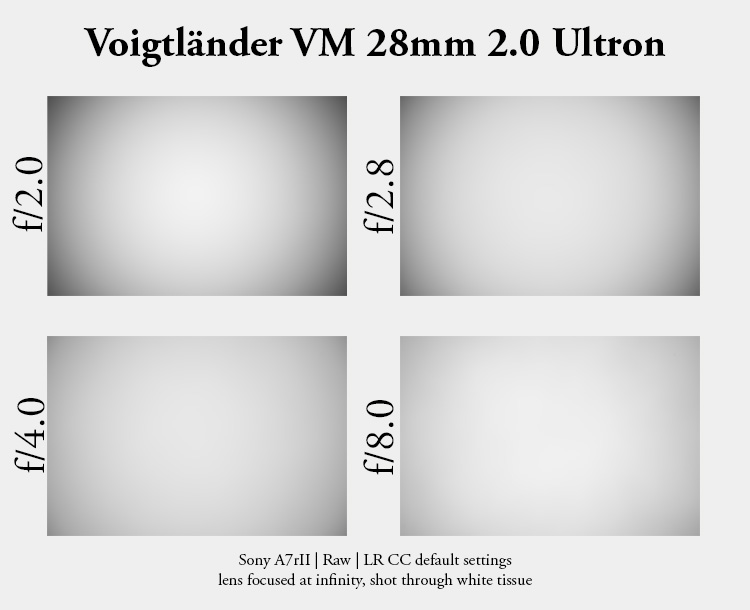
As you will see there the corners are definitely darkened at f/2 and there is even some darkening on the long edges (but very little to no darkening on the short edges). This tells us there is a circle with a 24mm diameter in the center that does not have significant reduction in illumination. I don't think it is accurate to call that a small section in the center, but call it whatever you want we can describe the actual measurement of the bright area in the center.
Further given this, IMO, rather larger 24mm circle with little to no effect of vignetting I can't see how changing the aperture on your lens from f/2 to f/2.4 doesn't change the shutter speed. If I were you I would investigate both your camera and lens to see if they are functioning properly. Opening up the lens to f/2 from f/2.4 should get you about a 50% increase in shutter speed and that is what I see with my camera (M10) and my copy of the lens. Now I do always use center weighted metering and perhaps you will have better luck if you switch to center weighted metering if you are using something else. Of course one of the advantages of center weighted metering is that it isn't affected very much at all by vignetting when exposure on the outer part of the frame is not much of a concern.
Finally, it should be noted that either six-bit coding this lens or selecting in Lightroom corrections for the Leica 28 summicron, nicely cleans up the vignetting. The majority of my shots using a rangefinder I crop to 4 X 5 aspect ratio, so I don't bother with vignetting correction for most of my shots, but when I need it with this lens it does work quite well with all the usual caveats about increasing noise in the corners.
So, this is a f/2 lens with a lot vignetting. Each individual user will have to decide how much the vignetting bothers them and even whether it is a deal breaker for the lens and if it is not how they want to handle it. Personally, I find it a mild annoyance but not really that big of a deal.
DavidBM wrote
Steve Spencer wrote
Fred Miranda wrote
Steve Spencer wrote
Fred Miranda wrote
---------------------------------------------The exposure does not change much in the corners from f/2 to f/2.4 due to optical vignetting.
Small size is valued by rangefinder shooters (and it is highly valued by me), but along with small size almost always comes relatively high vignetting and that is true for this lens but it is also true for most small Leica lenses as well.
That’s termininology though. What matters? Well slight reduction of transmission across the field I don’t care about in the slightest. I can’t recall when I last took a wide aperture photo where, say, a stop of transmission reduction pushed the noise levels into unacceptable territory. Off axis mechanical/optical vignetting, OTOH, can make the bokeh very uneven, and is an almost universal problem with compact rangefinder lenses.
I'm not claiming that at f/2 the light transmission is the same as f/2.4, measured at the centre. As mentioned there is a centre portion that gets brighter. In theory and on paper it may be f/2, but the high amounts of natural and optical vignetting of the Ultron 28 and 35mm, at least to me, leave an impression that the lens should have mechanically stopped at f/2.4. Opening to f/2 just seems a little redundant and impractical. Most lenses I've used have at least in the greater central area, a more significant light transmission difference from their widest...Show more →
Ok, so we can all agree this is an f/2 lens, or at least I hope we can all agree. I think we can all agree that the lens has strong vignetting when it is not corrected. My lens performs just like the lens that Bastian reviewed. Here is a link to his picture depicting the vignetting:
As you will see there the corners are definitely darkened at f/2 and there is even some darkening on the long edges (but very little to no darkening on the short edges). This tells us there is a circle with a 24mm diameter in the center that does not have significant reduction in illumination. I don't think it is accurate to call that a small section in the center, but call it whatever you want we can describe the actual measurement of the bright area in the center.
Further given this, IMO, rather larger 24mm circle with little to no effect of vignetting I can't see how changing the aperture on your lens from f/2 to f/2.4 doesn't change the shutter speed. If I were you I would investigate both your camera and lens to see if they are functioning properly. Opening up the lens to f/2 from f/2.4 should get you about a 50% increase in shutter speed and that is what I see with my camera (M10) and my copy of the lens. Now I do always use center weighted metering and perhaps you will have better luck if you switch to center weighted metering if you are using something else. Of course one of the advantages of center weighted metering is that it isn't affected very much at all by vignetting when exposure on the outer part of the frame is not much of a concern.
Finally, it should be noted that either six-bit coding this lens or selecting in Lightroom corrections for the Leica 28 summicron, nicely cleans up the vignetting. The majority of my shots using a rangefinder I crop to 4 X 5 aspect ratio, so I don't bother with vignetting correction for most of my shots, but when I need it with this lens it does work quite well with all the usual caveats about increasing noise in the corners.
So, this is a f/2 lens with a lot vignetting. Each individual user will have to decide how much the vignetting bothers them and even whether it is a deal breaker for the lens and if it is not how they want to handle it. Personally, I find it a mild annoyance but not really that big of a deal.
Sep 18, 2022 at 08:39 PM
p.41 #12Voigtlander 28mm f/2 Ultron II Review
naturephoto1 wrote:
My new Voigtlander 28mm f2 Ultron II lens from Cameraquest was delivered at about 3:15 PM today. That was too late for my running any tests comparing the lens with my Leica R 28mm f2.8 Elmarit V2.
https://www.fredmiranda.com/forum/ufiles/39/2177439.jpg
I did take the image below though comparing the sizes of my Leica M 24mm f3.8 Asph lens with Leica hood to the far left, my Minolta CLE MC 28mm f2.8 M-Rokkor (without white spots) and Minolta hood to its right, my new Voigtlander 28mm f2 Ultron II with the Haoge LH-VM12 hood (their replacement for the Voigtlander LH-12 hood) to its right, and...Show more →
Hi Rich,
Which hood are you using for your CV 28/2 II on this picture?
Sep 18, 2022 at 10:06 PM
p.41 #13Voigtlander 28mm f/2 Ultron II Review
Fred Miranda wrote:
https://www.fredmiranda.com/forum/ufiles/39/2177439.jpg
I did take the image below though comparing the sizes of my Leica M 24mm f3.8 Asph lens with Leica hood to the far left, my Minolta CLE MC 28mm f2.8 M-Rokkor (without white spots) and Minolta hood to its right, my new Voigtlander 28mm f2 Ultron II with the Haoge LH-VM12 hood (their replacement for the Voigtlander LH-12 hood) to its right, and my Leica R 28mm f2.8 Elmarit V2 with the hood extended at the far right.
The new Voigtlander 28mm f2 Ultron II is quite small and without the hood, I believe is smaller than the Minolta CLE 28mm M-Rokker lens though it is heavier than the Minolta.
Hopefully tomorrow I will run some tests of the new Voigtlander 28mm f2 Ultron II including confirming the lens is centered. I will test the lens on my Kolari Vision UT sensor modded A7rII and compare the performance of the lens with my Leica R 28mm f2.8 Elmarit V2 on the Kolari UT A7rII and also on my stock A7rIII. I do not intend to test the Voigtlander on my stock A7rIII.
Once I have some of the test results, I plan to post them here.
RichHi Rich,
Which hood are you using for your CV 28/2 II on this picture?
Hi Fred,
I am using the Haoge LH-VM12 Bayonet Square Metal Lens Hood:
https://www.amazon.com/gp/product/B07WFLRN6V/ref=ppx_yo_dt_b_asin_title_o02_s00?ie=UTF8&psc=1
Rich
naturephoto1 wrote
My new Voigtlander 28mm f2 Ultron II lens from Cameraquest was delivered at about 3:15 PM today. That was too late for my running any tests comparing the lens with my Leica R 28mm f2.8 Elmarit V2.https://www.fredmiranda.com/forum/ufiles/39/2177439.jpg
I did take the image below though comparing the sizes of my Leica M 24mm f3.8 Asph lens with Leica hood to the far left, my Minolta CLE MC 28mm f2.8 M-Rokkor (without white spots) and Minolta hood to its right, my new Voigtlander 28mm f2 Ultron II with the Haoge LH-VM12 hood (their replacement for the Voigtlander LH-12 hood) to its right, and my Leica R 28mm f2.8 Elmarit V2 with the hood extended at the far right.
The new Voigtlander 28mm f2 Ultron II is quite small and without the hood, I believe is smaller than the Minolta CLE 28mm M-Rokker lens though it is heavier than the Minolta.
Hopefully tomorrow I will run some tests of the new Voigtlander 28mm f2 Ultron II including confirming the lens is centered. I will test the lens on my Kolari Vision UT sensor modded A7rII and compare the performance of the lens with my Leica R 28mm f2.8 Elmarit V2 on the Kolari UT A7rII and also on my stock A7rIII. I do not intend to test the Voigtlander on my stock A7rIII.
Once I have some of the test results, I plan to post them here.
Rich
Which hood are you using for your CV 28/2 II on this picture?
Hi Fred,
I am using the Haoge LH-VM12 Bayonet Square Metal Lens Hood:
https://www.amazon.com/gp/product/B07WFLRN6V/ref=ppx_yo_dt_b_asin_title_o02_s00?ie=UTF8&psc=1
Rich
Sep 18, 2022 at 11:10 PM
p.41 #14Voigtlander 28mm f/2 Ultron II Review
Steve Spencer wrote:
I don't think we should consider transmission to be @ f/2.4 either. Usually this is calculated at center as most fast lenses show some level of optical vignetting.And that means we definitely shouldn't consider the aperture to be f/2.4. It simply isn't. The transmission is almost certainly less than the aperture as it is with most lenses. What I think needs to be noted is that the lens has a lot of vignetting not misstatements about aperture. It isn't, however, all that unusual for rangefinder lenses and especially relatively fast one to have a lot of vignetting. The vignetting is a bit stronger for this lens than typical but it isn't a night a day thing either. I am pretty sure my Leica M 50 Lux Asph has about as much and probably a bit more. The discussion seemed to be going down the route that Leica lenses are relatively free from these sort of exposure issues, but this Voigtlander lens is a half stop slower than its reported aperture. That is what I found misleading.
Small size is valued by rangefinder shooters (and it is highly valued by me), but along with small size almost always comes relatively high vignetting and that is true for this lens but it is also true for most small Leica lenses as well.The transmission is likely less than the aperture, but that doesn’t make it not an f2.4 lens as that just is defined by the (relative) aperture size. It might make it less than T2.4, but that’s a different matter. Nor does off axis falloff affect the aperture - it just affects the sensors view of the aperture, as it were. f2.4 is f2.4.
That’s termininology though. What matters? Well slight reduction of transmission across the field I don’t care about in the slightest. I can’t recall when I last took a wide aperture photo where, say, a stop of transmission reduction pushed the noise levels into unacceptable territory. Off axis mechanical/optical vignetting, OTOH, can make the bokeh very uneven, and is an almost universal problem with compact rangefinder lenses.Yeah.
I'm not claiming that at f/2 the light transmission is the same as f/2.4, measured at the centre. As mentioned there is a centre portion that gets brighter. In theory and on paper it may be f/2, but the high amounts of natural and optical vignetting of the Ultron 28 and 35mm, at least to me, leave an impression that the lens should have mechanically stopped at f/2.4. Opening to f/2 just seems a little redundant and impractical. Most lenses I've used have at least in the greater central area, a more significant light transmission difference from their widest aperture to the next half step down.
Both my Ultron 35 and 28mm can have the same shutter speed at f/2 and f/2.4 that a very large majority of the frame is exposed the same. The difference between my Ultron 35mm at f/2.4 and my Color Skopar 35/2.5 PII is significant enough that I would prefer the Color Skopar even with its nominal f/2.5 aperture.Ok, so we can all agree this is an f/2 lens, or at least I hope we can all agree. I think we can all agree that the lens has strong vignetting when it is not corrected. My lens performs just like the lens that Bastian reviewed. Here is a link to his picture depicting the vignetting:
https://phillipreeve.net/blog/wp-content/uploads/2022/04/vignetting_Voigtlander_VM_28mm_2.0.jpg
As you will see there the corners are definitely darkened at f/2 and there is even some darkening on the long edges (but very little to no darkening on the short edges). This tells us there is a circle with a 24mm diameter...Show more →
Both my lenses and camera are functioning fine. A difference in exposure is absolutely noticable from f/2 to f/2.8. From f/2 to that half step position, which I refer to as f/2.4, the difference is so small that keeping the shutter speed the same results in two images that look identical with exception of little brighter small central area. The 28mm Elmarit that I had, my Color Skopar 35mm, and Summicron 50mm all show a much wider spread affect of exposure with the first half step.
In terms of my attempts at matching brightness at the centre, the difference between f/2 and the half step to f/2.4 on the Ultron 28mm is around 0.25 stop.
I get it, its an f/2 lens because (unverified) the aperture measurement is theoretically wide enough to claim the nominal value. It may or may not be a rounded value too. Who knows. But as much as aperture should be aperture value, so should focal length be focal length. But then we have situations like the Leica Q with its 28mm lens.
Anyways. I suppose I was more questioning the point at which one should accept a claim of a lens being f/2. Suppose the next lens that comes along and claims its f/2, but with a transmission change across an even smaller portion at the dead centre. Still acceptable?
Here are two images shot with the Ultron 28mm. Both have the same shutter speed and ISO value. Aperture was the only thing changed from f/2 to the next half step f/2.4. It would seem this is perfectly acceptable for most. I find it disappointing and pointless that the lens has an f/2 aperture that may technically classify as f/2 but functionally falls short. Again, the difference in brightness in Lightroom is around 0.25 stop to match brightness. Lets even round that up to 0.3. Still a fair bit away from the supposed 0.5 stops at dead centre!
(The lens is in camera coded to the Summicron 28mm ASPH)
1/45sec, f/2
1/45sec, f/2.4
hmzimelka wrote
DavidBM wrote
Steve Spencer wrote
Fred Miranda wrote
Steve Spencer wrote
Yes, that is of course true as it is true for many if not most rangefinder lenses when you stop down a half stop from wide open, but that does not mean the lens is f/2.4 or it is sensible to call it f/2.4. Light transmission could of course be measured and we could compare it to other lenses, but I am willing to bet that there is nowhere near a half stop difference between this lens and any Leica summicron in light transmission and that the difference in light transmission between this lens and any Leica Elmarit is at least three quarters of a stop.Small size is valued by rangefinder shooters (and it is highly valued by me), but along with small size almost always comes relatively high vignetting and that is true for this lens but it is also true for most small Leica lenses as well.
That’s termininology though. What matters? Well slight reduction of transmission across the field I don’t care about in the slightest. I can’t recall when I last took a wide aperture photo where, say, a stop of transmission reduction pushed the noise levels into unacceptable territory. Off axis mechanical/optical vignetting, OTOH, can make the bokeh very uneven, and is an almost universal problem with compact rangefinder lenses.
I'm not claiming that at f/2 the light transmission is the same as f/2.4, measured at the centre. As mentioned there is a centre portion that gets brighter. In theory and on paper it may be f/2, but the high amounts of natural and optical vignetting of the Ultron 28 and 35mm, at least to me, leave an impression that the lens should have mechanically stopped at f/2.4. Opening to f/2 just seems a little redundant and impractical. Most lenses I've used have at least in the greater central area, a more significant light transmission difference from their widest aperture to the next half step down.
Both my Ultron 35 and 28mm can have the same shutter speed at f/2 and f/2.4 that a very large majority of the frame is exposed the same. The difference between my Ultron 35mm at f/2.4 and my Color Skopar 35/2.5 PII is significant enough that I would prefer the Color Skopar even with its nominal f/2.5 aperture.
https://phillipreeve.net/blog/wp-content/uploads/2022/04/vignetting_Voigtlander_VM_28mm_2.0.jpg
As you will see there the corners are definitely darkened at f/2 and there is even some darkening on the long edges (but very little to no darkening on the short edges). This tells us there is a circle with a 24mm diameter...Show more →
Both my lenses and camera are functioning fine. A difference in exposure is absolutely noticable from f/2 to f/2.8. From f/2 to that half step position, which I refer to as f/2.4, the difference is so small that keeping the shutter speed the same results in two images that look identical with exception of little brighter small central area. The 28mm Elmarit that I had, my Color Skopar 35mm, and Summicron 50mm all show a much wider spread affect of exposure with the first half step.
In terms of my attempts at matching brightness at the centre, the difference between f/2 and the half step to f/2.4 on the Ultron 28mm is around 0.25 stop.
I get it, its an f/2 lens because (unverified) the aperture measurement is theoretically wide enough to claim the nominal value. It may or may not be a rounded value too. Who knows. But as much as aperture should be aperture value, so should focal length be focal length. But then we have situations like the Leica Q with its 28mm lens.
Anyways. I suppose I was more questioning the point at which one should accept a claim of a lens being f/2. Suppose the next lens that comes along and claims its f/2, but with a transmission change across an even smaller portion at the dead centre. Still acceptable?
Here are two images shot with the Ultron 28mm. Both have the same shutter speed and ISO value. Aperture was the only thing changed from f/2 to the next half step f/2.4. It would seem this is perfectly acceptable for most. I find it disappointing and pointless that the lens has an f/2 aperture that may technically classify as f/2 but functionally falls short. Again, the difference in brightness in Lightroom is around 0.25 stop to match brightness. Lets even round that up to 0.3. Still a fair bit away from the supposed 0.5 stops at dead centre!
(The lens is in camera coded to the Summicron 28mm ASPH)
1/45sec, f/2
 |
||
 |
||
|
1/45sec, f/2.4
|
||
 |
||
|
Sep 18, 2022 at 11:14 PM
p.41 #15Voigtlander 28mm f/2 Ultron II Review
T Stop...
"A T-stop (for transmission stops, by convention written with capital letter T) is an f-number adjusted to account for light transmission efficiency (transmittance)."
"For example, an f/2.0 lens with transmittance of 75% has a T-stop of 2.3: "
"Since real lenses have transmittances of less than 100%, a lens's T-stop number is always greater than its f-number."
"T-stops are sometimes used instead of f-numbers to more accurately determine exposure, particularly when using external light meters. Lens transmittances of 60%–95% are typical. T-stops are often used in cinematography..."
https://en.wikipedia.org/wiki/F-number#T-stop
Sep 19, 2022 at 05:18 AM
p.41 #16Voigtlander 28mm f/2 Ultron II Review
hmzimelka wrote:
And that means we definitely shouldn't consider the aperture to be f/2.4. It simply isn't. The transmission is almost certainly less than the aperture as it is with most lenses. What I think needs to be noted is that the lens has a lot of vignetting not misstatements about aperture. It isn't, however, all that unusual for rangefinder lenses and especially relatively fast one to have a lot of vignetting. The vignetting is a bit stronger for this lens than typical but it isn't a night a day thing either. I am pretty sure my Leica M 50 Lux Asph has about as much and probably a bit more. The discussion seemed to be going down the route that Leica lenses are relatively free from these sort of exposure issues, but this Voigtlander lens is a half stop slower than its reported aperture. That is what I found misleading.
Small size is valued by rangefinder shooters (and it is highly valued by me), but along with small size almost always comes relatively high vignetting and that is true for this lens but it is also true for most small Leica lenses as well.The transmission is likely less than the aperture, but that doesn’t make it not an f2.4 lens as that just is defined by the (relative) aperture size. It might make it less than T2.4, but that’s a different matter. Nor does off axis falloff affect the aperture - it just affects the sensors view of the aperture, as it were. f2.4 is f2.4.
That’s termininology though. What matters? Well slight reduction of transmission across the field I don’t care about in the slightest. I can’t recall when I last took a wide aperture photo where, say, a stop of transmission reduction pushed the noise levels into unacceptable territory. Off axis mechanical/optical vignetting, OTOH, can make the bokeh very uneven, and is an almost universal problem with compact rangefinder lenses.Yeah.
I'm not claiming that at f/2 the light transmission is the same as f/2.4, measured at the centre. As mentioned there is a centre portion that gets brighter. In theory and on paper it may be f/2, but the high amounts of natural and optical vignetting of the Ultron 28 and 35mm, at least to me, leave an impression that the lens should have mechanically stopped at f/2.4. Opening to f/2 just seems a little redundant and impractical. Most lenses I've used have at least in the greater central area, a more significant light transmission difference from their widest aperture to the next half step down.
Both my Ultron 35 and 28mm can have the same shutter speed at f/2 and f/2.4 that a very large majority of the frame is exposed the same. The difference between my Ultron 35mm at f/2.4 and my Color Skopar 35/2.5 PII is significant enough that I would prefer the Color Skopar even with its nominal f/2.5 aperture.Ok, so we can all agree this is an f/2 lens, or at least I hope we can all agree. I think we can all agree that the lens has strong vignetting when it is not corrected. My lens performs just like the lens that Bastian reviewed. Here is a link to his picture depicting the vignetting:
https://phillipreeve.net/blog/wp-content/uploads/2022/04/vignetting_Voigtlander_VM_28mm_2.0.jpg
As you will see there the corners are definitely darkened at f/2 and there is even some darkening on the long edges (but very little to no darkening on the short edges). This tells us there is a circle with a 24mm diameter in the center that does not have significant reduction in illumination. I don't think it is accurate to call that a small section in the center, but call it whatever you want we can describe the actual measurement of the bright area in the center.
Further given this, IMO, rather larger 24mm circle with little to no effect of vignetting I can't see how changing the aperture on your lens from f/2 to f/2.4 doesn't change the shutter speed. If I were you I would investigate both your camera and lens to see if they are functioning properly. Opening up the lens to f/2 from f/2.4 should get you about a 50% increase in shutter speed and that is what I see with my camera (M10) and my copy of the lens. Now I do always use center weighted metering and perhaps you will have better luck if you switch to center weighted metering if you are using something else. Of course one of the advantages of center weighted metering is that it isn't affected very much at all by vignetting when exposure on the outer part of the frame is not much of a concern.
Finally, it should be noted that either six-bit coding this lens or selecting in Lightroom corrections for the Leica 28 summicron, nicely cleans up the vignetting. The majority of my shots using a rangefinder I crop to 4 X 5 aspect ratio, so I don't bother with vignetting correction for most of my shots, but when I need it with this lens it does work quite well with all the usual caveats about increasing noise in the corners.
So, this is a f/2 lens with a lot vignetting. Each individual user will have to decide how much the vignetting bothers them and even whether it is a deal breaker for the lens and if it is not how they want to handle it. Personally, I find it a mild annoyance but not really that big of a deal.Both my lenses and camera are functioning fine. A difference in exposure is absolutely noticable from f/2 to f/2.8. From f/2 to that half step position, which I refer to as f/2.4, the difference is so small that keeping the shutter speed the same results in two images that look identical with exception of little brighter small central area. The 28mm Elmarit that I had, my Color Skopar 35mm, and Summicron 50mm all show a much wider spread affect of exposure with the first half step.
In terms of my attempts at matching brightness at the centre, the difference between f/2...Show more →
Sorry, but this is a really uncontrolled test. You are using sunlight to illuminate the image and that can change easily with movements of clouds, etc. What I know from my experience with my lens is that changing the aperture from f/2 to f/2.4 does result in exposure changes and it is about a half stop difference. As I said, perhaps your lens is different, but mine is no different from my other rangefinder lenses in this regard.
PS - We also know that in the past Voigtlander has been relatively precise about reporting f numbers. For example they had at one point a 28 f/1.9, and they had a 50 f/1.1, etc. Given that history I think we can expect that any rounding of the aperture value would be small f/2.04 or less.
Steve Spencer wrote
hmzimelka wrote
DavidBM wrote
Steve Spencer wrote
Fred Miranda wrote
I don't think we should consider transmission to be @ f/2.4 either. Usually this is calculated at center as most fast lenses show some level of optical vignetting.Small size is valued by rangefinder shooters (and it is highly valued by me), but along with small size almost always comes relatively high vignetting and that is true for this lens but it is also true for most small Leica lenses as well.
That’s termininology though. What matters? Well slight reduction of transmission across the field I don’t care about in the slightest. I can’t recall when I last took a wide aperture photo where, say, a stop of transmission reduction pushed the noise levels into unacceptable territory. Off axis mechanical/optical vignetting, OTOH, can make the bokeh very uneven, and is an almost universal problem with compact rangefinder lenses.
I'm not claiming that at f/2 the light transmission is the same as f/2.4, measured at the centre. As mentioned there is a centre portion that gets brighter. In theory and on paper it may be f/2, but the high amounts of natural and optical vignetting of the Ultron 28 and 35mm, at least to me, leave an impression that the lens should have mechanically stopped at f/2.4. Opening to f/2 just seems a little redundant and impractical. Most lenses I've used have at least in the greater central area, a more significant light transmission difference from their widest aperture to the next half step down.
Both my Ultron 35 and 28mm can have the same shutter speed at f/2 and f/2.4 that a very large majority of the frame is exposed the same. The difference between my Ultron 35mm at f/2.4 and my Color Skopar 35/2.5 PII is significant enough that I would prefer the Color Skopar even with its nominal f/2.5 aperture.
https://phillipreeve.net/blog/wp-content/uploads/2022/04/vignetting_Voigtlander_VM_28mm_2.0.jpg
As you will see there the corners are definitely darkened at f/2 and there is even some darkening on the long edges (but very little to no darkening on the short edges). This tells us there is a circle with a 24mm diameter in the center that does not have significant reduction in illumination. I don't think it is accurate to call that a small section in the center, but call it whatever you want we can describe the actual measurement of the bright area in the center.
Further given this, IMO, rather larger 24mm circle with little to no effect of vignetting I can't see how changing the aperture on your lens from f/2 to f/2.4 doesn't change the shutter speed. If I were you I would investigate both your camera and lens to see if they are functioning properly. Opening up the lens to f/2 from f/2.4 should get you about a 50% increase in shutter speed and that is what I see with my camera (M10) and my copy of the lens. Now I do always use center weighted metering and perhaps you will have better luck if you switch to center weighted metering if you are using something else. Of course one of the advantages of center weighted metering is that it isn't affected very much at all by vignetting when exposure on the outer part of the frame is not much of a concern.
Finally, it should be noted that either six-bit coding this lens or selecting in Lightroom corrections for the Leica 28 summicron, nicely cleans up the vignetting. The majority of my shots using a rangefinder I crop to 4 X 5 aspect ratio, so I don't bother with vignetting correction for most of my shots, but when I need it with this lens it does work quite well with all the usual caveats about increasing noise in the corners.
So, this is a f/2 lens with a lot vignetting. Each individual user will have to decide how much the vignetting bothers them and even whether it is a deal breaker for the lens and if it is not how they want to handle it. Personally, I find it a mild annoyance but not really that big of a deal.
In terms of my attempts at matching brightness at the centre, the difference between f/2...Show more →
Sorry, but this is a really uncontrolled test. You are using sunlight to illuminate the image and that can change easily with movements of clouds, etc. What I know from my experience with my lens is that changing the aperture from f/2 to f/2.4 does result in exposure changes and it is about a half stop difference. As I said, perhaps your lens is different, but mine is no different from my other rangefinder lenses in this regard.
PS - We also know that in the past Voigtlander has been relatively precise about reporting f numbers. For example they had at one point a 28 f/1.9, and they had a 50 f/1.1, etc. Given that history I think we can expect that any rounding of the aperture value would be small f/2.04 or less.
Sep 19, 2022 at 06:10 AM
p.41 #17Voigtlander 28mm f/2 Ultron II Review
Could metering mode possibly impact the differences (forgetting variability of ambient light for the moment)? I would have to believe center weighted vs multi might have some impact on exposure in this scenario.
Steve Spencer wrote:
hmzimelka wrote
Steve Spencer wrote
hmzimelka wrote
DavidBM wrote
Steve Spencer wrote
And that means we definitely shouldn't consider the aperture to be f/2.4. It simply isn't. The transmission is almost certainly less than the aperture as it is with most lenses. What I think needs to be noted is that the lens has a lot of vignetting not misstatements about aperture. It isn't, however, all that unusual for rangefinder lenses and especially relatively fast one to have a lot of vignetting. The vignetting is a bit stronger for this lens than typical but it isn't a night a day thing either. I am pretty sure my Leica M 50 Lux Asph has about as much and probably a bit more. The discussion seemed to be going down the route that Leica lenses are relatively free from these sort of exposure issues, but this Voigtlander lens is a half stop slower than its reported aperture. That is what I found misleading.Small size is valued by rangefinder shooters (and it is highly valued by me), but along with small size almost always comes relatively high vignetting and that is true for this lens but it is also true for most small Leica lenses as well.
That’s termininology though. What matters? Well slight reduction of transmission across the field I don’t care about in the slightest. I can’t recall when I last took a wide aperture photo where, say, a stop of transmission reduction pushed the noise levels into unacceptable territory. Off axis mechanical/optical vignetting, OTOH, can make the bokeh very uneven, and is an almost universal problem with compact rangefinder lenses.
I'm not claiming that at f/2 the light transmission is the same as f/2.4, measured at the centre. As mentioned there is a centre portion that gets brighter. In theory and on paper it may be f/2, but the high amounts of natural and optical vignetting of the Ultron 28 and 35mm, at least to me, leave an impression that the lens should have mechanically stopped at f/2.4. Opening to f/2 just seems a little redundant and impractical. Most lenses I've used have at least in the greater central area, a more significant light transmission difference from their widest aperture to the next half step down.
Both my Ultron 35 and 28mm can have the same shutter speed at f/2 and f/2.4 that a very large majority of the frame is exposed the same. The difference between my Ultron 35mm at f/2.4 and my Color Skopar 35/2.5 PII is significant enough that I would prefer the Color Skopar even with its nominal f/2.5 aperture.
https://phillipreeve.net/blog/wp-content/uploads/2022/04/vignetting_Voigtlander_VM_28mm_2.0.jpg
As you will see there the corners are definitely darkened at f/2 and there is even some darkening on the long edges (but very little to no darkening on the short edges). This tells us there is a circle with a 24mm diameter in the center that does not have significant reduction in illumination. I don't think it is accurate to call that a small section in the center, but call it whatever you want we can describe the actual measurement of the bright area in the center.
Further given this, IMO, rather larger 24mm circle with little to no effect of vignetting I can't see how changing the aperture on your lens from f/2 to f/2.4 doesn't change the shutter speed. If I were you I would investigate both your camera and lens to see if they are functioning properly. Opening up the lens to f/2 from f/2.4 should get you about a 50% increase in shutter speed and that is what I see with my camera (M10) and my copy of the lens. Now I do always use center weighted metering and perhaps you will have better luck if you switch to center weighted metering if you are using something else. Of course one of the advantages of center weighted metering is that it isn't affected very much at all by vignetting when exposure on the outer part of the frame is not much of a concern.
Finally, it should be noted that either six-bit coding this lens or selecting in Lightroom corrections for the Leica 28 summicron, nicely cleans up the vignetting. The majority of my shots using a rangefinder I crop to 4 X 5 aspect ratio, so I don't bother with vignetting correction for most of my shots, but when I need it with this lens it does work quite well with all the usual caveats about increasing noise in the corners.
So, this is a f/2 lens with a lot vignetting. Each individual user will have to decide how much the vignetting bothers them and even whether it is a deal breaker for the lens and if it is not how they want to handle it. Personally, I find it a mild annoyance but not really that big of a deal.
In terms of my attempts at matching brightness at the centre, the difference between f/2 and the half step to f/2.4 on the Ultron 28mm is around 0.25 stop.
I get it, its an f/2 lens because (unverified) the aperture measurement is theoretically wide enough to claim the nominal value. It may or may not be a rounded value too. Who knows. But as much as aperture should be aperture value, so should focal length be focal length. But then we have situations like the Leica Q with its 28mm lens.
Anyways. I suppose I was more questioning the point at which one should accept a claim of a lens being f/2. Suppose the next lens that comes along and claims its f/2, but with a transmission change across an even smaller portion at the dead centre. Still acceptable?
Here are two images shot with the Ultron 28mm. Both have the same shutter speed and ISO value. Aperture was the only thing changed from f/2 to the next half step f/2.4. It would seem this is perfectly acceptable for most. I find it disappointing and pointless that the lens has an f/2 aperture that may technically classify as f/2 but functionally falls short. Again, the difference in brightness in Lightroom is around 0.25 stop to match brightness. Lets even round that up to 0.3. Still a fair bit away from the supposed 0.5 stops at dead centre!
(The lens is in camera coded to the Summicron 28mm ASPH)
1/45sec, f/2
https://live.staticflickr.com/65535/52368591785_4bdc76570f_h.jpg
1/45sec, f/2.4
https://live.staticflickr.com/65535/52368402093_cf205234a1_h.jpg
Sep 19, 2022 at 06:23 AM
p.41 #18Voigtlander 28mm f/2 Ultron II Review
tsdevine wrote:
Could metering mode possibly impact the differences (forgetting variability of ambient light for the moment)? I would have to believe center weighted vs multi might have some impact on exposure in this scenario.
That’s termininology though. What matters? Well slight reduction of transmission across the field I don’t care about in the slightest. I can’t recall when I last took a wide aperture photo where, say, a stop of transmission reduction pushed the noise levels into unacceptable territory. Off axis mechanical/optical vignetting, OTOH, can make the bokeh very uneven, and is an almost universal problem with compact rangefinder lenses.Yeah.
I'm not claiming that at f/2 the light transmission is the same as f/2.4, measured at the centre. As mentioned there is a centre portion that gets brighter. In theory and on paper it may be f/2, but the high amounts of natural and optical vignetting of the Ultron 28 and 35mm, at least to me, leave an impression that the lens should have mechanically stopped at f/2.4. Opening to f/2 just seems a little redundant and impractical. Most lenses I've used have at least in the greater central area, a more significant light transmission difference from their widest aperture to the next half step down.
Both my Ultron 35 and 28mm can have the same shutter speed at f/2 and f/2.4 that a very large majority of the frame is exposed the same. The difference between my Ultron 35mm at f/2.4 and my Color Skopar 35/2.5 PII is significant enough that I would prefer the Color Skopar even with its nominal f/2.5 aperture.Ok, so we can all agree this is an f/2 lens, or at least I hope we can all agree. I think we can all agree that the lens has strong vignetting when it is not corrected. My lens performs just like the lens that Bastian reviewed. Here is a link to his picture depicting the vignetting:
https://phillipreeve.net/blog/wp-content/uploads/2022/04/vignetting_Voigtlander_VM_28mm_2.0.jpg
As you will see there the corners are definitely darkened at f/2 and there is even some darkening on the long edges (but very little to no darkening on the short edges). This tells us there is a circle with a 24mm diameter in the center that does not have significant reduction in illumination. I don't think it is accurate to call that a small section in the center, but call it whatever you want we can describe the actual measurement of the bright area in the center.
Further given this, IMO, rather larger 24mm circle with little to no effect of vignetting I can't see how changing the aperture on your lens from f/2 to f/2.4 doesn't change the shutter speed. If I were you I would investigate both your camera and lens to see if they are functioning properly. Opening up the lens to f/2 from f/2.4 should get you about a 50% increase in shutter speed and that is what I see with my camera (M10) and my copy of the lens. Now I do always use center weighted metering and perhaps you will have better luck if you switch to center weighted metering if you are using something else. Of course one of the advantages of center weighted metering is that it isn't affected very much at all by vignetting when exposure on the outer part of the frame is not much of a concern.
Finally, it should be noted that either six-bit coding this lens or selecting in Lightroom corrections for the Leica 28 summicron, nicely cleans up the vignetting. The majority of my shots using a rangefinder I crop to 4 X 5 aspect ratio, so I don't bother with vignetting correction for most of my shots, but when I need it with this lens it does work quite well with all the usual caveats about increasing noise in the corners.
So, this is a f/2 lens with a lot vignetting. Each individual user will have to decide how much the vignetting bothers them and even whether it is a deal breaker for the lens and if it is not how they want to handle it. Personally, I find it a mild annoyance but not really that big of a deal.Both my lenses and camera are functioning fine. A difference in exposure is absolutely noticable from f/2 to f/2.8. From f/2 to that half step position, which I refer to as f/2.4, the difference is so small that keeping the shutter speed the same results in two images that look identical with exception of little brighter small central area. The 28mm Elmarit that I had, my Color Skopar 35mm, and Summicron 50mm all show a much wider spread affect of exposure with the first half step.
In terms of my attempts at matching brightness at the centre, the difference between f/2 and the half step to f/2.4 on the Ultron 28mm is around 0.25 stop.
I get it, its an f/2 lens because (unverified) the aperture measurement is theoretically wide enough to claim the nominal value. It may or may not be a rounded value too. Who knows. But as much as aperture should be aperture value, so should focal length be focal length. But then we have situations like the Leica Q with its 28mm lens.
Anyways. I suppose I was more questioning the point at which one should accept a claim of a lens being f/2. Suppose the next lens that comes along and claims its f/2, but with a transmission change across an even smaller portion at the dead centre. Still acceptable?
Here are two images shot with the Ultron 28mm. Both have the same shutter speed and ISO value. Aperture was the only thing changed from f/2 to the next half step f/2.4. It would seem this is perfectly acceptable for most. I find it disappointing and pointless that the lens has an f/2 aperture that may technically classify as f/2 but functionally falls short. Again, the difference in brightness in Lightroom is around 0.25 stop to match brightness. Lets even round that up to 0.3. Still a fair bit away from the supposed 0.5 stops at dead centre!
(The lens is in camera coded to the Summicron 28mm ASPH)
1/45sec, f/2
https://live.staticflickr.com/65535/52368591785_4bdc76570f_h.jpg
1/45sec, f/2.4
https://live.staticflickr.com/65535/52368402093_cf205234a1_h.jpgSorry, but this is a really uncontrolled test. You are using sunlight to illuminate the image and that can change easily with movements of clouds, etc. What I know from my experience with my lens is that changing the aperture from f/2 to f/2.4 does result in exposure changes and it is about a half stop difference. As I said, perhaps your lens is different, but mine is no different from my other rangefinder lenses in this regard.
Yes, Tim. I made the same suggestion in my post above. I use center-weight metering almost exclusively with my M10 largely because I don't want metering affected by vignetting and many rangefinder lenses (like this one) have pretty high vignetting. I don't know what metering hmzimelka is using but if he is using metering in live view that may account for at least part of the differences we are reporting.
Could metering mode possibly impact the differences (forgetting variability of ambient light for the moment)? I would have to believe center weighted vs multi might have some impact on exposure in this scenario.
Steve Spencer wrote
hmzimelka wrote
Steve Spencer wrote
hmzimelka wrote
DavidBM wrote
The transmission is likely less than the aperture, but that doesn’t make it not an f2.4 lens as that just is defined by the (relative) aperture size. It might make it less than T2.4, but that’s a different matter. Nor does off axis falloff affect the aperture - it just affects the sensors view of the aperture, as it were. f2.4 is f2.4.That’s termininology though. What matters? Well slight reduction of transmission across the field I don’t care about in the slightest. I can’t recall when I last took a wide aperture photo where, say, a stop of transmission reduction pushed the noise levels into unacceptable territory. Off axis mechanical/optical vignetting, OTOH, can make the bokeh very uneven, and is an almost universal problem with compact rangefinder lenses.
I'm not claiming that at f/2 the light transmission is the same as f/2.4, measured at the centre. As mentioned there is a centre portion that gets brighter. In theory and on paper it may be f/2, but the high amounts of natural and optical vignetting of the Ultron 28 and 35mm, at least to me, leave an impression that the lens should have mechanically stopped at f/2.4. Opening to f/2 just seems a little redundant and impractical. Most lenses I've used have at least in the greater central area, a more significant light transmission difference from their widest aperture to the next half step down.
Both my Ultron 35 and 28mm can have the same shutter speed at f/2 and f/2.4 that a very large majority of the frame is exposed the same. The difference between my Ultron 35mm at f/2.4 and my Color Skopar 35/2.5 PII is significant enough that I would prefer the Color Skopar even with its nominal f/2.5 aperture.
https://phillipreeve.net/blog/wp-content/uploads/2022/04/vignetting_Voigtlander_VM_28mm_2.0.jpg
As you will see there the corners are definitely darkened at f/2 and there is even some darkening on the long edges (but very little to no darkening on the short edges). This tells us there is a circle with a 24mm diameter in the center that does not have significant reduction in illumination. I don't think it is accurate to call that a small section in the center, but call it whatever you want we can describe the actual measurement of the bright area in the center.
Further given this, IMO, rather larger 24mm circle with little to no effect of vignetting I can't see how changing the aperture on your lens from f/2 to f/2.4 doesn't change the shutter speed. If I were you I would investigate both your camera and lens to see if they are functioning properly. Opening up the lens to f/2 from f/2.4 should get you about a 50% increase in shutter speed and that is what I see with my camera (M10) and my copy of the lens. Now I do always use center weighted metering and perhaps you will have better luck if you switch to center weighted metering if you are using something else. Of course one of the advantages of center weighted metering is that it isn't affected very much at all by vignetting when exposure on the outer part of the frame is not much of a concern.
Finally, it should be noted that either six-bit coding this lens or selecting in Lightroom corrections for the Leica 28 summicron, nicely cleans up the vignetting. The majority of my shots using a rangefinder I crop to 4 X 5 aspect ratio, so I don't bother with vignetting correction for most of my shots, but when I need it with this lens it does work quite well with all the usual caveats about increasing noise in the corners.
So, this is a f/2 lens with a lot vignetting. Each individual user will have to decide how much the vignetting bothers them and even whether it is a deal breaker for the lens and if it is not how they want to handle it. Personally, I find it a mild annoyance but not really that big of a deal.
In terms of my attempts at matching brightness at the centre, the difference between f/2 and the half step to f/2.4 on the Ultron 28mm is around 0.25 stop.
I get it, its an f/2 lens because (unverified) the aperture measurement is theoretically wide enough to claim the nominal value. It may or may not be a rounded value too. Who knows. But as much as aperture should be aperture value, so should focal length be focal length. But then we have situations like the Leica Q with its 28mm lens.
Anyways. I suppose I was more questioning the point at which one should accept a claim of a lens being f/2. Suppose the next lens that comes along and claims its f/2, but with a transmission change across an even smaller portion at the dead centre. Still acceptable?
Here are two images shot with the Ultron 28mm. Both have the same shutter speed and ISO value. Aperture was the only thing changed from f/2 to the next half step f/2.4. It would seem this is perfectly acceptable for most. I find it disappointing and pointless that the lens has an f/2 aperture that may technically classify as f/2 but functionally falls short. Again, the difference in brightness in Lightroom is around 0.25 stop to match brightness. Lets even round that up to 0.3. Still a fair bit away from the supposed 0.5 stops at dead centre!
(The lens is in camera coded to the Summicron 28mm ASPH)
1/45sec, f/2
https://live.staticflickr.com/65535/52368591785_4bdc76570f_h.jpg
1/45sec, f/2.4
https://live.staticflickr.com/65535/52368402093_cf205234a1_h.jpg
Yes, Tim. I made the same suggestion in my post above. I use center-weight metering almost exclusively with my M10 largely because I don't want metering affected by vignetting and many rangefinder lenses (like this one) have pretty high vignetting. I don't know what metering hmzimelka is using but if he is using metering in live view that may account for at least part of the differences we are reporting.
Sep 19, 2022 at 06:27 AM
p.41 #19Voigtlander 28mm f/2 Ultron II Review
Steve Spencer wrote:
Small size is valued by rangefinder shooters (and it is highly valued by me), but along with small size almost always comes relatively high vignetting and that is true for this lens but it is also true for most small Leica lenses as well.The transmission is likely less than the aperture, but that doesn’t make it not an f2.4 lens as that just is defined by the (relative) aperture size. It might make it less than T2.4, but that’s a different matter. Nor does off axis falloff affect the aperture - it just affects the sensors view of the aperture, as it were. f2.4 is f2.4.
That’s termininology though. What matters? Well slight reduction of transmission across the field I don’t care about in the slightest. I can’t recall when I last took a wide aperture photo where, say, a stop of transmission reduction pushed the noise levels into unacceptable territory. Off axis mechanical/optical vignetting, OTOH, can make the bokeh very uneven, and is an almost universal problem with compact rangefinder lenses.Yeah.
I'm not claiming that at f/2 the light transmission is the same as f/2.4, measured at the centre. As mentioned there is a centre portion that gets brighter. In theory and on paper it may be f/2, but the high amounts of natural and optical vignetting of the Ultron 28 and 35mm, at least to me, leave an impression that the lens should have mechanically stopped at f/2.4. Opening to f/2 just seems a little redundant and impractical. Most lenses I've used have at least in the greater central area, a more significant light transmission difference from their widest aperture to the next half step down.
Both my Ultron 35 and 28mm can have the same shutter speed at f/2 and f/2.4 that a very large majority of the frame is exposed the same. The difference between my Ultron 35mm at f/2.4 and my Color Skopar 35/2.5 PII is significant enough that I would prefer the Color Skopar even with its nominal f/2.5 aperture.Ok, so we can all agree this is an f/2 lens, or at least I hope we can all agree. I think we can all agree that the lens has strong vignetting when it is not corrected. My lens performs just like the lens that Bastian reviewed. Here is a link to his picture depicting the vignetting:
https://phillipreeve.net/blog/wp-content/uploads/2022/04/vignetting_Voigtlander_VM_28mm_2.0.jpg
As you will see there the corners are definitely darkened at f/2 and there is even some darkening on the long edges (but very little to no darkening on the short edges). This tells us there is a circle with a 24mm diameter in the center that does not have significant reduction in illumination. I don't think it is accurate to call that a small section in the center, but call it whatever you want we can describe the actual measurement of the bright area in the center.
Further given this, IMO, rather larger 24mm circle with little to no effect of vignetting I can't see how changing the aperture on your lens from f/2 to f/2.4 doesn't change the shutter speed. If I were you I would investigate both your camera and lens to see if they are functioning properly. Opening up the lens to f/2 from f/2.4 should get you about a 50% increase in shutter speed and that is what I see with my camera (M10) and my copy of the lens. Now I do always use center weighted metering and perhaps you will have better luck if you switch to center weighted metering if you are using something else. Of course one of the advantages of center weighted metering is that it isn't affected very much at all by vignetting when exposure on the outer part of the frame is not much of a concern.
Finally, it should be noted that either six-bit coding this lens or selecting in Lightroom corrections for the Leica 28 summicron, nicely cleans up the vignetting. The majority of my shots using a rangefinder I crop to 4 X 5 aspect ratio, so I don't bother with vignetting correction for most of my shots, but when I need it with this lens it does work quite well with all the usual caveats about increasing noise in the corners.
So, this is a f/2 lens with a lot vignetting. Each individual user will have to decide how much the vignetting bothers them and even whether it is a deal breaker for the lens and if it is not how they want to handle it. Personally, I find it a mild annoyance but not really that big of a deal.Both my lenses and camera are functioning fine. A difference in exposure is absolutely noticable from f/2 to f/2.8. From f/2 to that half step position, which I refer to as f/2.4, the difference is so small that keeping the shutter speed the same results in two images that look identical with exception of little brighter small central area. The 28mm Elmarit that I had, my Color Skopar 35mm, and Summicron 50mm all show a much wider spread affect of exposure with the first half step.
In terms of my attempts at matching brightness at the centre, the difference between f/2 and the half step to f/2.4 on the Ultron 28mm is around 0.25 stop.
I get it, its an f/2 lens because (unverified) the aperture measurement is theoretically wide enough to claim the nominal value. It may or may not be a rounded value too. Who knows. But as much as aperture should be aperture value, so should focal length be focal length. But then we have situations like the Leica Q with its 28mm lens.
Anyways. I suppose I was more questioning the point at which one should accept a claim of a lens being f/2. Suppose the next lens that comes along and claims its f/2, but with a transmission change across an even smaller portion at the dead centre. Still acceptable?
Here are two images shot with the Ultron 28mm. Both have the same shutter speed and ISO value. Aperture was the only thing changed from f/2 to the next half step f/2.4. It would seem this is perfectly acceptable for most. I find it disappointing and pointless that the lens has an f/2 aperture that may technically classify as f/2 but functionally falls short. Again, the difference in brightness in Lightroom is around 0.25 stop to match brightness. Lets even round that up to 0.3. Still a fair bit away from the supposed 0.5 stops at dead centre!
(The lens is in camera coded to the Summicron 28mm ASPH)
1/45sec, f/2
https://live.staticflickr.com/65535/52368591785_4bdc76570f_h.jpg
1/45sec, f/2.4
https://live.staticflickr.com/65535/52368402093_cf205234a1_h.jpgSorry, but this is a really uncontrolled test. You are using sunlight to illuminate the image and that can change easily with movements of clouds, etc. What I know from my experience with my lens is that changing the aperture from f/2 to f/2.4 does result in exposure changes and it is about a half stop difference. As I said, perhaps your lens is different, but mine is no different from my other rangefinder lenses in this regard.
PS - We also know that in the past Voigtlander has been relatively precise about reporting f numbers. For example they had...Show more →
Ok, I think this is just becoming a redundant discussion. The EXIF states 1 sec difference in date stamp. Clear Sky.
The above images represent exactly what I said. If you want to question my technique or the integrity of my camera and lens or lenses, then thats also fine. It's easy to replicate for those that are curious; Lock the Exposure speed and ISO, and just change the aperture from f/2 to f/2.4.
hmzimelka wrote
Steve Spencer wrote
hmzimelka wrote
DavidBM wrote
Steve Spencer wrote
And that means we definitely shouldn't consider the aperture to be f/2.4. It simply isn't. The transmission is almost certainly less than the aperture as it is with most lenses. What I think needs to be noted is that the lens has a lot of vignetting not misstatements about aperture. It isn't, however, all that unusual for rangefinder lenses and especially relatively fast one to have a lot of vignetting. The vignetting is a bit stronger for this lens than typical but it isn't a night a day thing either. I am pretty sure my Leica M 50 Lux Asph has about as much and probably a bit more. The discussion seemed to be going down the route that Leica lenses are relatively free from these sort of exposure issues, but this Voigtlander lens is a half stop slower than its reported aperture. That is what I found misleading.Small size is valued by rangefinder shooters (and it is highly valued by me), but along with small size almost always comes relatively high vignetting and that is true for this lens but it is also true for most small Leica lenses as well.
That’s termininology though. What matters? Well slight reduction of transmission across the field I don’t care about in the slightest. I can’t recall when I last took a wide aperture photo where, say, a stop of transmission reduction pushed the noise levels into unacceptable territory. Off axis mechanical/optical vignetting, OTOH, can make the bokeh very uneven, and is an almost universal problem with compact rangefinder lenses.
I'm not claiming that at f/2 the light transmission is the same as f/2.4, measured at the centre. As mentioned there is a centre portion that gets brighter. In theory and on paper it may be f/2, but the high amounts of natural and optical vignetting of the Ultron 28 and 35mm, at least to me, leave an impression that the lens should have mechanically stopped at f/2.4. Opening to f/2 just seems a little redundant and impractical. Most lenses I've used have at least in the greater central area, a more significant light transmission difference from their widest aperture to the next half step down.
Both my Ultron 35 and 28mm can have the same shutter speed at f/2 and f/2.4 that a very large majority of the frame is exposed the same. The difference between my Ultron 35mm at f/2.4 and my Color Skopar 35/2.5 PII is significant enough that I would prefer the Color Skopar even with its nominal f/2.5 aperture.
https://phillipreeve.net/blog/wp-content/uploads/2022/04/vignetting_Voigtlander_VM_28mm_2.0.jpg
As you will see there the corners are definitely darkened at f/2 and there is even some darkening on the long edges (but very little to no darkening on the short edges). This tells us there is a circle with a 24mm diameter in the center that does not have significant reduction in illumination. I don't think it is accurate to call that a small section in the center, but call it whatever you want we can describe the actual measurement of the bright area in the center.
Further given this, IMO, rather larger 24mm circle with little to no effect of vignetting I can't see how changing the aperture on your lens from f/2 to f/2.4 doesn't change the shutter speed. If I were you I would investigate both your camera and lens to see if they are functioning properly. Opening up the lens to f/2 from f/2.4 should get you about a 50% increase in shutter speed and that is what I see with my camera (M10) and my copy of the lens. Now I do always use center weighted metering and perhaps you will have better luck if you switch to center weighted metering if you are using something else. Of course one of the advantages of center weighted metering is that it isn't affected very much at all by vignetting when exposure on the outer part of the frame is not much of a concern.
Finally, it should be noted that either six-bit coding this lens or selecting in Lightroom corrections for the Leica 28 summicron, nicely cleans up the vignetting. The majority of my shots using a rangefinder I crop to 4 X 5 aspect ratio, so I don't bother with vignetting correction for most of my shots, but when I need it with this lens it does work quite well with all the usual caveats about increasing noise in the corners.
So, this is a f/2 lens with a lot vignetting. Each individual user will have to decide how much the vignetting bothers them and even whether it is a deal breaker for the lens and if it is not how they want to handle it. Personally, I find it a mild annoyance but not really that big of a deal.
In terms of my attempts at matching brightness at the centre, the difference between f/2 and the half step to f/2.4 on the Ultron 28mm is around 0.25 stop.
I get it, its an f/2 lens because (unverified) the aperture measurement is theoretically wide enough to claim the nominal value. It may or may not be a rounded value too. Who knows. But as much as aperture should be aperture value, so should focal length be focal length. But then we have situations like the Leica Q with its 28mm lens.
Anyways. I suppose I was more questioning the point at which one should accept a claim of a lens being f/2. Suppose the next lens that comes along and claims its f/2, but with a transmission change across an even smaller portion at the dead centre. Still acceptable?
Here are two images shot with the Ultron 28mm. Both have the same shutter speed and ISO value. Aperture was the only thing changed from f/2 to the next half step f/2.4. It would seem this is perfectly acceptable for most. I find it disappointing and pointless that the lens has an f/2 aperture that may technically classify as f/2 but functionally falls short. Again, the difference in brightness in Lightroom is around 0.25 stop to match brightness. Lets even round that up to 0.3. Still a fair bit away from the supposed 0.5 stops at dead centre!
(The lens is in camera coded to the Summicron 28mm ASPH)
1/45sec, f/2
https://live.staticflickr.com/65535/52368591785_4bdc76570f_h.jpg
1/45sec, f/2.4
https://live.staticflickr.com/65535/52368402093_cf205234a1_h.jpg
PS - We also know that in the past Voigtlander has been relatively precise about reporting f numbers. For example they had...Show more →
Ok, I think this is just becoming a redundant discussion. The EXIF states 1 sec difference in date stamp. Clear Sky.
The above images represent exactly what I said. If you want to question my technique or the integrity of my camera and lens or lenses, then thats also fine. It's easy to replicate for those that are curious; Lock the Exposure speed and ISO, and just change the aperture from f/2 to f/2.4.
Sep 19, 2022 at 07:09 AM
p.41 #20Voigtlander 28mm f/2 Ultron II Review
tsdevine wrote:
Could metering mode possibly impact the differences (forgetting variability of ambient light for the moment)? I would have to believe center weighted vs multi might have some impact on exposure in this scenario.
That’s termininology though. What matters? Well slight reduction of transmission across the field I don’t care about in the slightest. I can’t recall when I last took a wide aperture photo where, say, a stop of transmission reduction pushed the noise levels into unacceptable territory. Off axis mechanical/optical vignetting, OTOH, can make the bokeh very uneven, and is an almost universal problem with compact rangefinder lenses.Yeah.
I'm not claiming that at f/2 the light transmission is the same as f/2.4, measured at the centre. As mentioned there is a centre portion that gets brighter. In theory and on paper it may be f/2, but the high amounts of natural and optical vignetting of the Ultron 28 and 35mm, at least to me, leave an impression that the lens should have mechanically stopped at f/2.4. Opening to f/2 just seems a little redundant and impractical. Most lenses I've used have at least in the greater central area, a more significant light transmission difference from their widest aperture to the next half step down.
Both my Ultron 35 and 28mm can have the same shutter speed at f/2 and f/2.4 that a very large majority of the frame is exposed the same. The difference between my Ultron 35mm at f/2.4 and my Color Skopar 35/2.5 PII is significant enough that I would prefer the Color Skopar even with its nominal f/2.5 aperture.Ok, so we can all agree this is an f/2 lens, or at least I hope we can all agree. I think we can all agree that the lens has strong vignetting when it is not corrected. My lens performs just like the lens that Bastian reviewed. Here is a link to his picture depicting the vignetting:
https://phillipreeve.net/blog/wp-content/uploads/2022/04/vignetting_Voigtlander_VM_28mm_2.0.jpg
As you will see there the corners are definitely darkened at f/2 and there is even some darkening on the long edges (but very little to no darkening on the short edges). This tells us there is a circle with a 24mm diameter in the center that does not have significant reduction in illumination. I don't think it is accurate to call that a small section in the center, but call it whatever you want we can describe the actual measurement of the bright area in the center.
Further given this, IMO, rather larger 24mm circle with little to no effect of vignetting I can't see how changing the aperture on your lens from f/2 to f/2.4 doesn't change the shutter speed. If I were you I would investigate both your camera and lens to see if they are functioning properly. Opening up the lens to f/2 from f/2.4 should get you about a 50% increase in shutter speed and that is what I see with my camera (M10) and my copy of the lens. Now I do always use center weighted metering and perhaps you will have better luck if you switch to center weighted metering if you are using something else. Of course one of the advantages of center weighted metering is that it isn't affected very much at all by vignetting when exposure on the outer part of the frame is not much of a concern.
Finally, it should be noted that either six-bit coding this lens or selecting in Lightroom corrections for the Leica 28 summicron, nicely cleans up the vignetting. The majority of my shots using a rangefinder I crop to 4 X 5 aspect ratio, so I don't bother with vignetting correction for most of my shots, but when I need it with this lens it does work quite well with all the usual caveats about increasing noise in the corners.
So, this is a f/2 lens with a lot vignetting. Each individual user will have to decide how much the vignetting bothers them and even whether it is a deal breaker for the lens and if it is not how they want to handle it. Personally, I find it a mild annoyance but not really that big of a deal.Both my lenses and camera are functioning fine. A difference in exposure is absolutely noticable from f/2 to f/2.8. From f/2 to that half step position, which I refer to as f/2.4, the difference is so small that keeping the shutter speed the same results in two images that look identical with exception of little brighter small central area. The 28mm Elmarit that I had, my Color Skopar 35mm, and Summicron 50mm all show a much wider spread affect of exposure with the first half step.
In terms of my attempts at matching brightness at the centre, the difference between f/2 and the half step to f/2.4 on the Ultron 28mm is around 0.25 stop.
I get it, its an f/2 lens because (unverified) the aperture measurement is theoretically wide enough to claim the nominal value. It may or may not be a rounded value too. Who knows. But as much as aperture should be aperture value, so should focal length be focal length. But then we have situations like the Leica Q with its 28mm lens.
Anyways. I suppose I was more questioning the point at which one should accept a claim of a lens being f/2. Suppose the next lens that comes along and claims its f/2, but with a transmission change across an even smaller portion at the dead centre. Still acceptable?
Here are two images shot with the Ultron 28mm. Both have the same shutter speed and ISO value. Aperture was the only thing changed from f/2 to the next half step f/2.4. It would seem this is perfectly acceptable for most. I find it disappointing and pointless that the lens has an f/2 aperture that may technically classify as f/2 but functionally falls short. Again, the difference in brightness in Lightroom is around 0.25 stop to match brightness. Lets even round that up to 0.3. Still a fair bit away from the supposed 0.5 stops at dead centre!
(The lens is in camera coded to the Summicron 28mm ASPH)
1/45sec, f/2
https://live.staticflickr.com/65535/52368591785_4bdc76570f_h.jpg
1/45sec, f/2.4
https://live.staticflickr.com/65535/52368402093_cf205234a1_h.jpgSorry, but this is a really uncontrolled test. You are using sunlight to illuminate the image and that can change easily with movements of clouds, etc. What I know from my experience with my lens is that changing the aperture from f/2 to f/2.4 does result in exposure changes and it is about a half stop difference. As I said, perhaps your lens is different, but mine is no different from my other rangefinder lenses in this regard.
As mentioned, I locked the exposure to 1/45sec.
I also use centre weighted metering on the M11.
Could metering mode possibly impact the differences (forgetting variability of ambient light for the moment)? I would have to believe center weighted vs multi might have some impact on exposure in this scenario.
Steve Spencer wrote
hmzimelka wrote
Steve Spencer wrote
hmzimelka wrote
DavidBM wrote
The transmission is likely less than the aperture, but that doesn’t make it not an f2.4 lens as that just is defined by the (relative) aperture size. It might make it less than T2.4, but that’s a different matter. Nor does off axis falloff affect the aperture - it just affects the sensors view of the aperture, as it were. f2.4 is f2.4.That’s termininology though. What matters? Well slight reduction of transmission across the field I don’t care about in the slightest. I can’t recall when I last took a wide aperture photo where, say, a stop of transmission reduction pushed the noise levels into unacceptable territory. Off axis mechanical/optical vignetting, OTOH, can make the bokeh very uneven, and is an almost universal problem with compact rangefinder lenses.
I'm not claiming that at f/2 the light transmission is the same as f/2.4, measured at the centre. As mentioned there is a centre portion that gets brighter. In theory and on paper it may be f/2, but the high amounts of natural and optical vignetting of the Ultron 28 and 35mm, at least to me, leave an impression that the lens should have mechanically stopped at f/2.4. Opening to f/2 just seems a little redundant and impractical. Most lenses I've used have at least in the greater central area, a more significant light transmission difference from their widest aperture to the next half step down.
Both my Ultron 35 and 28mm can have the same shutter speed at f/2 and f/2.4 that a very large majority of the frame is exposed the same. The difference between my Ultron 35mm at f/2.4 and my Color Skopar 35/2.5 PII is significant enough that I would prefer the Color Skopar even with its nominal f/2.5 aperture.
https://phillipreeve.net/blog/wp-content/uploads/2022/04/vignetting_Voigtlander_VM_28mm_2.0.jpg
As you will see there the corners are definitely darkened at f/2 and there is even some darkening on the long edges (but very little to no darkening on the short edges). This tells us there is a circle with a 24mm diameter in the center that does not have significant reduction in illumination. I don't think it is accurate to call that a small section in the center, but call it whatever you want we can describe the actual measurement of the bright area in the center.
Further given this, IMO, rather larger 24mm circle with little to no effect of vignetting I can't see how changing the aperture on your lens from f/2 to f/2.4 doesn't change the shutter speed. If I were you I would investigate both your camera and lens to see if they are functioning properly. Opening up the lens to f/2 from f/2.4 should get you about a 50% increase in shutter speed and that is what I see with my camera (M10) and my copy of the lens. Now I do always use center weighted metering and perhaps you will have better luck if you switch to center weighted metering if you are using something else. Of course one of the advantages of center weighted metering is that it isn't affected very much at all by vignetting when exposure on the outer part of the frame is not much of a concern.
Finally, it should be noted that either six-bit coding this lens or selecting in Lightroom corrections for the Leica 28 summicron, nicely cleans up the vignetting. The majority of my shots using a rangefinder I crop to 4 X 5 aspect ratio, so I don't bother with vignetting correction for most of my shots, but when I need it with this lens it does work quite well with all the usual caveats about increasing noise in the corners.
So, this is a f/2 lens with a lot vignetting. Each individual user will have to decide how much the vignetting bothers them and even whether it is a deal breaker for the lens and if it is not how they want to handle it. Personally, I find it a mild annoyance but not really that big of a deal.
In terms of my attempts at matching brightness at the centre, the difference between f/2 and the half step to f/2.4 on the Ultron 28mm is around 0.25 stop.
I get it, its an f/2 lens because (unverified) the aperture measurement is theoretically wide enough to claim the nominal value. It may or may not be a rounded value too. Who knows. But as much as aperture should be aperture value, so should focal length be focal length. But then we have situations like the Leica Q with its 28mm lens.
Anyways. I suppose I was more questioning the point at which one should accept a claim of a lens being f/2. Suppose the next lens that comes along and claims its f/2, but with a transmission change across an even smaller portion at the dead centre. Still acceptable?
Here are two images shot with the Ultron 28mm. Both have the same shutter speed and ISO value. Aperture was the only thing changed from f/2 to the next half step f/2.4. It would seem this is perfectly acceptable for most. I find it disappointing and pointless that the lens has an f/2 aperture that may technically classify as f/2 but functionally falls short. Again, the difference in brightness in Lightroom is around 0.25 stop to match brightness. Lets even round that up to 0.3. Still a fair bit away from the supposed 0.5 stops at dead centre!
(The lens is in camera coded to the Summicron 28mm ASPH)
1/45sec, f/2
https://live.staticflickr.com/65535/52368591785_4bdc76570f_h.jpg
1/45sec, f/2.4
https://live.staticflickr.com/65535/52368402093_cf205234a1_h.jpg
As mentioned, I locked the exposure to 1/45sec.
I also use centre weighted metering on the M11.
Sep 19, 2022 at 07:13 AM