Congratulations to crf59 for winning Feature Thread of the Week with 2 votes - View Previous Winners
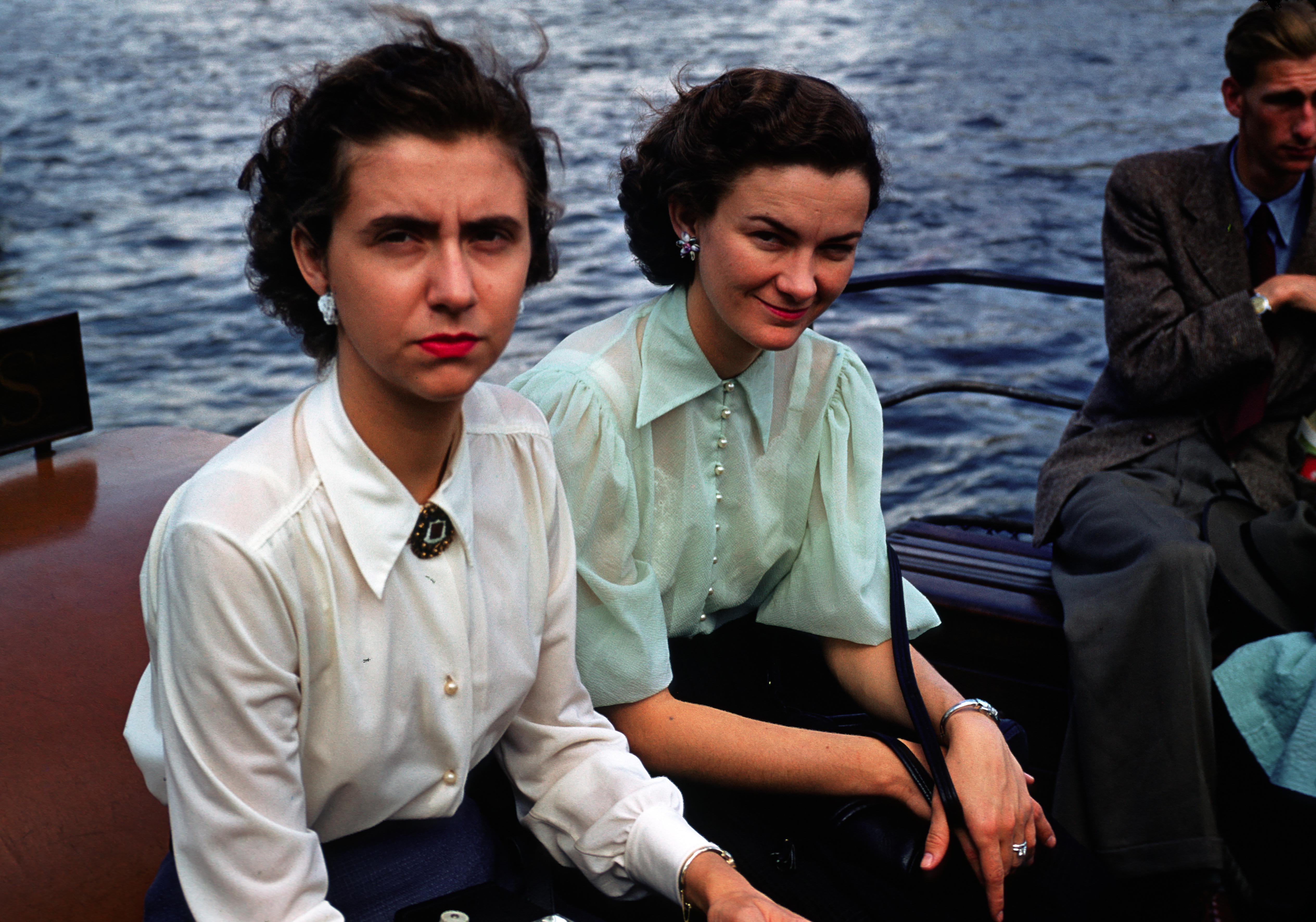
It has taken me forever, but am getting through the scanning process of more than 2000 slides my father took in the 50s while living in Europe (England, Spain, Germany, France).
This shot was taken with his Leica IIIG and 50mm Elmar, Kodachrome slide film. My mother is one in the green shirt. Some of the slides I have scanned so far are just terrific. I am a big fan of the softer look of some of the earlier films.
This is a nice example of how 50's era Kodachrome can survive for decades. You've also made a nice scan of an emulsion that is notoriously difficult to scan. I'm curious, however, if there's more detail to be had in the hair in particular. I don't know what scanner you used but most don't get the last two stops or so in the shadows of that approx. 3.8 dmax of Kodachrome, and even when you are using a scanner that can see that, the shadows tend to get very grainy very fast. Nice palette though. Very three-strip like.
Peter, it is a Nikon 5000 ED, but to be honest I am still tinkering with software and settings. Seems like each slide is different. I’m also going to try a few different scanning setups and see what I can do.
Chuck - You're doing a good job with the scans. That scanner is leaving some shadow detail in the film as the scanner itself can only see to barely more than a 3.0 density while the film could be as high as 3.8, but it also feels like the original is slightly under as well, but overall you've done a great job.
I've been trying to replicate this look in digital for a long time. Can't ever seem to quite capture the look. Always cool to see vintage slides, thanks for sharing!
This is great. The colors are wonderful and if I didn't know it was from the 50s, I would assume it was a recent shot taken with a modern camera and edited well. It goes to show the enduring quality of old slides!
Well, Kodachrome slides, stored in the dark, survive remarkably intact many decades later with little or no fading. Ektachrome, Agfachrome and Anscochrome - not so much. Those E-3 and E-4 process films from that era faded quite quickly with shadows losing most of their green and blue density first. Ironically, Kodachrome in all its iterations, while very resistant to dark fading was just the opposite when exposed to light and even worse when exposed to the bright lights of a slide projector, often visibly fading after only a few projections. This was such an issue that many who shot Kodachrome professionally would have their slides duped to Ektachrome duplicating film when they knew they were to be projected. Today we can make high quality, high res scans that can preserve and correct those old images.
Kodachrome, as you have kinda pointed out Peter, was the only archival color process concerning color film negative or color transparency. The reason was the process. The dyes with K 14 were added during the process instead of being in the emulsion of the film as with c41 and e6 processes. And for printing cibachrome was thaought to have been archival but has now been shown not to be. Leaving die transfer as being the only archival color print process from the film age.
Dye transfer was not really archival either. The black and white separations to make the transfer prints were, but the prints themselves were not very long lived, although museums and galleries sure bought into the notion that they were. At least you could go back to the original separations and pull new prints when the originals faded. And dye transfer, being two generations away from the original, were never as sharp as they might have been, and actually were when printed to Ciba back in the day. In my second darkroom back in the late 1970's, I processed Cibachrome in a tube - a Beseler or maybe Ciba had their own tube I think and then later, after Art Center, I actually tray developed Ciba's completely in the dark. Not unlike making those old Panalure black and white prints from color negs.
Yeah I processed my share of ciba in the day to. The fumes could make you really sick. I know from first hand experience ha ha.
When I was in college Swedlund came to our college and gave a two day workshop on Dye Transfer. It involved either shooting with threre separate negs. Usually large format, with red, green, blue filters or making 3 separate matrix's. The reason die transfer prints are so stable is the process itself. 3 separate matrix's in pin register and rolling the three color dyes (magenta, cyan, yellow) out one at a time on an archival paper. https://en.wikipedia.org/wiki/Dye-transfer_process
From the article 6th para down 3rd sentence in
" In its heyday, dye transfer prints were the only color print a museum would accept in their collection." https://www.dpreview.com/forums/post/41533884
crf59 wrote:
Peter, it is a Nikon 5000 ED, but to be honest I am still tinkering with software and settings. Seems like each slide is different. I’m also going to try a few different scanning setups and see what I can do.
Chuck
Mine is a Nikon LS-4000ED that I have had for at least 15-20 years. It does a great job but I still am "getting used to it" today!
It is a wonderful tool! And I totally agree with the "tinkering"...
Now I guess I should mention that the Canon 9000E does a fine job but not what the Nikon can IMHO. It is my "go to" but if you want a fine result..Nikon is great! Now I have no idea on "drum scanners".
Dan
Dan - The problem with scanning Kodachrome is that while we see the blacks in the slides as being black, a good scanner sees those same blacks as more of a bluish black with the blue component being 20-30 points higher than it should be for a neutral rendering. That is exacerbated with drum scanners because they see far more into the shadows - up to two full stops of shadow detail - than CCD scanners. Remember that the d-max for Kodachrome was in the 3.7-3.8 range while Ektachrome was closer to 3.4. CCD scanners, no matter what they claim, can barely register 3.0-3.2 while scanners like my Howtek with its vacuum tubes are measured at 3.88. Kodachrome is also problematic when you're trying to open up shadows that are too dark. The film can look like two very different films in the same frame, going from beautiful, smooth, ultra fine grained to very coarse, super noisy and very grainy just as it flips into a dark area that has been opened up. It helps to have that extra d-max of the photomultiplier tubes but the Nikon is probably the next best bet.