This topic is in the 2020 archive. You can read it and like its posts here. It is read only.
Archive 2020Anyone try leica m lenses on S5?
p.1 #1Anyone try leica m lenses on S5?
Thought this might be a decent platform for m lenses. Just curious
Oct 02, 2020 at 05:30 PM
p.1 #2Anyone try leica m lenses on S5?
Would be curious to learn about this as well. I'm currently using a Sony for my manual focus lenses, but am not entirely satisfied. Wondering if the S5 would be a better experience.
Mar 09, 2021 at 01:45 PM
p.1 #3Anyone try leica m lenses on S5?
I don't think so, due to sensor stack and microlenses. On Leica M (especially M10-R), these are designed to achieve a minimal optical thickness of the sensor element, and most current M lenses are designed for those sensors. Older M lenses are designed for film, and the M sensor is optically closer to film than other sensors. Thus, with many Leica M lenses, the optical system with a Panasonic (or Sony, Nikon etc.) sensor will show color drift towards the corners, and, in particularly bad cases, visible astigmatism in the periphery.
Mar 09, 2021 at 02:58 PM

p.1 #4Anyone try leica m lenses on S5?
AcuteShadows wrote:
I don't think so, due to sensor stack and microlenses. On Leica M (especially M10-R), these are designed to achieve a minimal optical thickness of the sensor element, and most current M lenses are designed for those sensors. Older M lenses are designed for film, and the M sensor is optically closer to film than other sensors. Thus, with many Leica M lenses, the optical system with a Panasonic (or Sony, Nikon etc.) sensor will show color drift towards the corners, and, in particularly bad cases, visible astigmatism in the periphery.
Do we have a known value for the S5 sensor stack vs. the M sensor stack?
Understanding the trig for refraction, etc. the amount of difference could make it anywhere from barely noticeable to tolerable to intolerable. Granted the M will be better, but I think the question for some might be how much / little difference. Of course, it'll be lens dependent, too.
Mar 11, 2021 at 04:46 PM
p.1 #6Anyone try leica m lenses on S5?
RustyBug wrote:
Do we have a known value for the S5 sensor stack vs. the M sensor stack?
Understanding the trig for refraction, etc. the amount of difference could make it anywhere from barely noticeable to tolerable to intolerable. Granted the M will be better, but I think the question for some might be how much / little difference. Of course, it'll be lens dependent, too.
From everything that I have read about this issue, the actual thickness of the sensor stack is only part of the story. The whole setup of the sensor influences its optical properties. For example, the sensor stack of the M10-R is probably not significantly thinner than that of the M10, yet it shows almost no astigmatism or color shift, even without applying lens profiles.
AcuteShadows wrote
I don't think so, due to sensor stack and microlenses. On Leica M (especially M10-R), these are designed to achieve a minimal optical thickness of the sensor element, and most current M lenses are designed for those sensors. Older M lenses are designed for film, and the M sensor is optically closer to film than other sensors. Thus, with many Leica M lenses, the optical system with a Panasonic (or Sony, Nikon etc.) sensor will show color drift towards the corners, and, in particularly bad cases, visible astigmatism in the periphery.Understanding the trig for refraction, etc. the amount of difference could make it anywhere from barely noticeable to tolerable to intolerable. Granted the M will be better, but I think the question for some might be how much / little difference. Of course, it'll be lens dependent, too.
From everything that I have read about this issue, the actual thickness of the sensor stack is only part of the story. The whole setup of the sensor influences its optical properties. For example, the sensor stack of the M10-R is probably not significantly thinner than that of the M10, yet it shows almost no astigmatism or color shift, even without applying lens profiles.
Mar 12, 2021 at 08:03 PM
p.1 #7Anyone try leica m lenses on S5?
New S5 $2000
Used Leica M240 $2200
One works perfectly with M lenses. The other does not.
Used Leica M240 $2200
One works perfectly with M lenses. The other does not.
Mar 12, 2021 at 09:16 PM
p.1 #8Anyone try leica m lenses on S5?
Desmolicious wrote:
New S5 $2000
Used Leica M240 $2200
One works perfectly with M lenses. The other does not.
I think this brings up a point / perspective ...
Are folks trying to find out which M lenses will work with the S5. Or are they trying to find out which body works with M lenses.
New S5 $2000
Used Leica M240 $2200
One works perfectly with M lenses. The other does not.
I think this brings up a point / perspective ...
Are folks trying to find out which M lenses will work with the S5. Or are they trying to find out which body works with M lenses.
Mar 12, 2021 at 09:33 PM
p.1 #9Anyone try leica m lenses on S5?
Desmolicious wrote:
New S5 $2000
Used Leica M240 $2200
One works perfectly with M lenses. The other does not.
If only this could be the final word on the endless (and pointless) search for non-Leica bodies on which Leica M lenses work well.
New S5 $2000
Used Leica M240 $2200
One works perfectly with M lenses. The other does not.
If only this could be the final word on the endless (and pointless) search for non-Leica bodies on which Leica M lenses work well.
Mar 13, 2021 at 02:30 AM
p.1 #10Anyone try leica m lenses on S5?
I have an S1, same sensor as S5. Unless you are using the latest m lenses i wouldnt recommend it. At least thats been my experience, if its not corner smearing its color cast. I havent been able to get any great results with any of my m lenses, they all shine in the m system, but in the s1 they really are not worth the prices. If you want to use m lenses with an evf, better go for a use SL, they are going for around 2k usd, and will offer you much better results.
Some examples below:
Leica 24mm elmar, (sharp corners, but i am not able to get the colors i want, seems to have some strong color cast, specially seen in day shots)
Skopar 35mm, (colors seem okay, but very strong corner smearing even if closing down)
https://photos.smugmug.com/StreetPhotography/n-Hdtzt/Romania-2020/i-DNVB3DW/2/6a1f8394/X2/20200513-P1000709-X2.jpg
Zeiss 35mm 1.4, (as with the 24mm some color cast, corners are kay)
Leica 50mm 1.4 preasph v2, (seems to behave the best)
28mm Summicron, (very strong vighetting and also color cast)
Some examples below:
Leica 24mm elmar, (sharp corners, but i am not able to get the colors i want, seems to have some strong color cast, specially seen in day shots)
 |
||
| https://photos.smugmug.com/StreetPhotography/n-Hdtzt/Romania-2020/i-bKKrz8w/1/d808f00e/X2/20200808-P1036113-X2.jpg | ||
|
|
||
| https://photos.smugmug.com/StreetPhotography/n-Hdtzt/Romania-2020/i-tCqLMhw/0/f118af1e/X2/20200919-P1037347-X2.jpg | ||
|
|
||
| https://photos.smugmug.com/StreetPhotography/n-Hdtzt/Romania-2020/i-W673887/0/6515dd04/X2/20201002-P1038036-X2.jpg | ||
|
|
||
| https://photos.smugmug.com/StreetPhotography/n-Hdtzt/Romania-2020/i-C58QKGc/0/1470dcab/X2/20201002-P1038083-X2.jpg | ||
|
|
||
| https://photos.smugmug.com/StreetPhotography/n-Hdtzt/Romania-2020/i-QVbwBXv/0/8ba0b1ec/X2/20200919-P1037153-X2.jpg | ||
|
|
||
| https://photos.smugmug.com/StreetPhotography/n-Hdtzt/Romania-2020/i-NnMknXz/0/e1a4d33a/X2/20200919-P1037295-X2.jpg | ||
|
Skopar 35mm, (colors seem okay, but very strong corner smearing even if closing down)
|
||
| https://photos.smugmug.com/StreetPhotography/n-Hdtzt/Romania-2020/i-fXq9tt8/0/7d918c13/X2/20200613-P1012092-X2.jpg | ||
|
https://photos.smugmug.com/StreetPhotography/n-Hdtzt/Romania-2020/i-DNVB3DW/2/6a1f8394/X2/20200513-P1000709-X2.jpg
|
||
| https://photos.smugmug.com/photos/i-TDLVgT4/0/8cc04ff2/X2/i-TDLVgT4-X2.jpg | ||
|
Zeiss 35mm 1.4, (as with the 24mm some color cast, corners are kay)
|
||
| https://photos.smugmug.com/photos/i-pdXBTGn/0/e7d8fc1c/X2/i-pdXBTGn-X2.jpg | ||
|
|
||
| https://photos.smugmug.com/StreetPhotography/n-Hdtzt/Romania-2020/i-RwhTjqB/0/2d823c2b/X2/20200124-P1037841-X2.jpg | ||
|
|
||
| https://photos.smugmug.com/StreetPhotography/n-Hdtzt/Romania-2020/i-zFt22Bt/0/ca57e6bf/X2/20200919-P1037428-Enhanced-X2.jpg | ||
|
Leica 50mm 1.4 preasph v2, (seems to behave the best)
|
||
| https://photos.smugmug.com/StreetPhotography/n-Hdtzt/Romania-2020/i-CqjP8Tk/0/d76e9b89/X2/20200926-P1037921-X2.jpg | ||
|
|
||
| https://photos.smugmug.com/StreetPhotography/n-Hdtzt/Romania-2020/i-kkPSpgD/0/8d00abcd/X2/20200926-P1037896-X2.jpg | ||
|
28mm Summicron, (very strong vighetting and also color cast)
|
||
| https://photos.smugmug.com/StreetPhotography/n-Hdtzt/Romania-2021/i-TqrN9Tg/0/9f023807/X2/P1039642-X2.jpg | ||
|
Mar 13, 2021 at 04:23 AM
p.1 #11Anyone try leica m lenses on S5?
Desmolicious wrote:
New S5 $2000
Used Leica M240 $2200
One works perfectly with M lenses. The other does not.
genji wrote:
If only this could be the final word on the endless (and pointless) search for non-Leica bodies on which Leica M lenses work well.
http://gmpphoto.blogspot.com/2016/01/the-future-of-sensor-technology-at-leica.html
And here's ^ the why (imo).
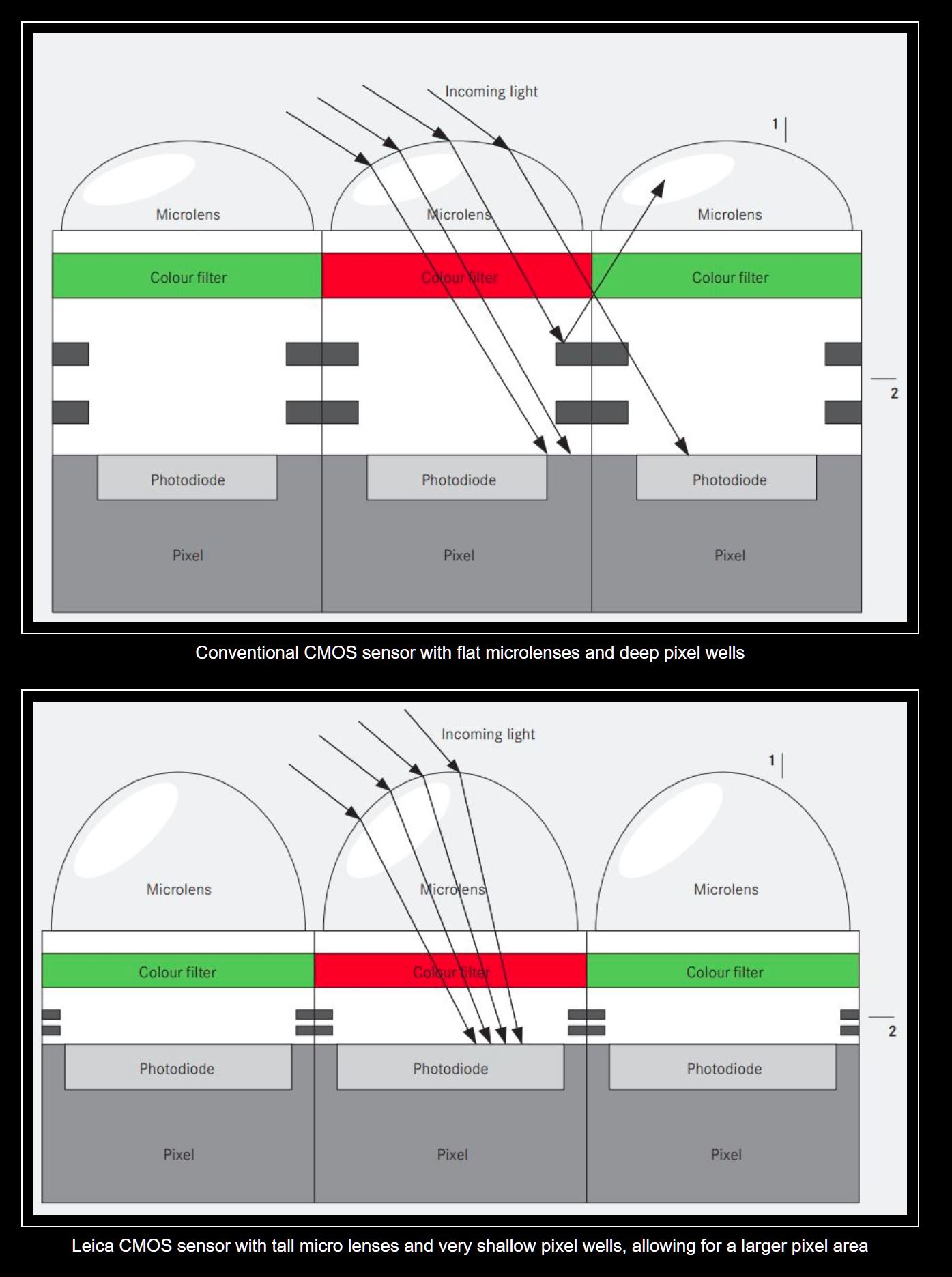
The sensor stack is but one piece of the puzzle. The microlens shape for redirecting the light path is the other (and likely more significant) for contending with the challenging angles imposed with optical projections set so close to the film plane. Lenses which have their projection set farther from the film plane don't have to contend with such steep angles.
Leica essentially made a "curved sensor" via the elongated microlens in order to bend the light more (at the microlens) so it enters the stack more perpendicular (i.e. less refraction through the stack).
Imo, there's little point to expect a lens set so close to the film plane to do well in the corners ... unless you have a way of contending with the steep angles (such as Leica has done).
The alternative is to use lenses whose projection is NOT set so close to the film plane. Of course, as you move the projection farther from the film plane, it's inherent contrast changes. For those who aspire for the contrast that the M lenses afford by being so close to the film plane, it makes sense to use the Leica sensor to capture it best ... that, or use it on a crop body, so you're cutting out the problem area beyond the 1:1 portion of the projection / capture (i.e. edges / corners).
New S5 $2000
Used Leica M240 $2200
One works perfectly with M lenses. The other does not.
genji wrote:
If only this could be the final word on the endless (and pointless) search for non-Leica bodies on which Leica M lenses work well.
http://gmpphoto.blogspot.com/2016/01/the-future-of-sensor-technology-at-leica.html
And here's ^ the why (imo).
The sensor stack is but one piece of the puzzle. The microlens shape for redirecting the light path is the other (and likely more significant) for contending with the challenging angles imposed with optical projections set so close to the film plane. Lenses which have their projection set farther from the film plane don't have to contend with such steep angles.
Leica essentially made a "curved sensor" via the elongated microlens in order to bend the light more (at the microlens) so it enters the stack more perpendicular (i.e. less refraction through the stack).
Imo, there's little point to expect a lens set so close to the film plane to do well in the corners ... unless you have a way of contending with the steep angles (such as Leica has done).
The alternative is to use lenses whose projection is NOT set so close to the film plane. Of course, as you move the projection farther from the film plane, it's inherent contrast changes. For those who aspire for the contrast that the M lenses afford by being so close to the film plane, it makes sense to use the Leica sensor to capture it best ... that, or use it on a crop body, so you're cutting out the problem area beyond the 1:1 portion of the projection / capture (i.e. edges / corners).
Mar 13, 2021 at 05:10 AM