Sony FE 12-24mm f/2.8 GM Review
p.4 #1Sony FE 12-24mm f/2.8 GM Review
Self censored. Off topic. Happens to the best of us.
Edited on Aug 19, 2020 at 04:57 PM · View previous versions
Edited on Aug 19, 2020 at 04:57 PM · View previous versions
Aug 19, 2020 at 02:03 PM
p.4 #2Sony FE 12-24mm f/2.8 GM Review
Petegh wrote:
At landscape apertures, say F5.6 and beyond, there is no meanigful difference between these lenses that you would ever detect in any real world print.Personally I use ~f/8 + focus stacking a lot for landscapes and some lenses are better than others. Both Sony and Sigma zooms perform better than most prime lenses, especially at the wider range. So, I agree that both zooms are too close in performance at small apertures to make a difference in real images.
The Sony 12-24/2.8 GM's differential is the higher resolution/contrast wide open compared to the Sigma and the extra 12-13mm range. I still don't know much about coma, flare resistance, sunstar definition and rendering differences yet.From what I see here, if you're still shooting 42Mpix, there probably won't be any meaningful sharpness/contrast differences between these lenses. However, to my eye, Fred's 60Mpix examples show a significant advantage to the GM in the center and mid-frame, up to f5.6: whether you would see that in print or not depends on the size of the print (I believe you would in a large print). There's not much point talking about f8 and beyond as both lenses are diffraction limited on a 60Mpix camera.
We need to keep in mind that cameras and lenses are getting so good now, you can't just dismiss the difference between the GM and the Sigma as 'not significant', as this is representative of the level of improvement we're likely to see going forward; you guy's bought your RIV's for a reason, and that reason is visible in Fred's examples: to dismiss it seems to be a little self contradictory to me.At F5.6 and beyond you won't see the difference between the IQ of these two lenses regardless of the sensor you are using. To get an idea of what you would see in a 40" print from 60mp, you need to go to at most 50% views (probably smaller depending on your monitor) of Fred's comparisons. Even much larger sensors won't change that, because you need to zoom out more (on screen) to see what a 40" print would look like. The Sigma is so good in terms of sharpness that I don't believe further lens improvements will give us better 30 or 40" prints. How often do you print beyond 40"?
Also, I suspect many landscape photographers do indeed shoot landscapes at around F8 rather than much wider (unless it's essentially an infinity shot) because the number of focus stacked images you need becomes unmanageable. And if you're not focus stacking, lens differences are greatly reduced by DOF considerations in much of the frame. The only exception I can think of is astrophotogprahy where you are likely shooting the sky wide open. But in that case 40" prints look pretty awful anyway due to noise, and again in smaller prints you won't see a benfit due to the lens
What the new Sony does bring to the table though, is the very high level of UWA IQ that the Sigma introduced a year ago extended to 12 mm (if you allow for field curvature), which is very impressive. Whether that is worth the price difference, only you can decide.Richard, I'm enjoying watching you try to talk yourself out of buying the GM! - I jest. Seriously though, as I mentioned in the
comments above, I thought I was seeing a little too much confirmation bias creeping into the summaries of Fred's tests by people who already own the Sigma 14-24 f2.8, and I thought it needed calling out. This is completely understandable considering the cost of the GM. I know from our previous discussions that it took you three samples to get a good Sigma 14-24, and I share your angst about having to do the same with a...Show more →
Yes, I meant my comments within the context of reasonable sized prints.
And I'm not trying to talk myself out of the GM. I actually have one on its way to me for "evaluation purposes".
But on the basis of Fred's comparison I don't expect to see real world differences in terms of sharpness. Instead I will be looking more at whether the slighlty wider range is useful to me, whether it's flare performance for the kinds of scenes where I shoot against the sun is any better than the Sigma, whether it's color is as satisfactory (I didn't really like the GM 16-35 much in that regard), and whether all of that sufficiently offsets the significant price and front diameter increases.
rvh23 wrote
Petegh wrote
Fred Miranda wrote
rvh23 wrote
Justin Stone wrote
Midfield matters a lot in landscape—of which the GM excels. It matters more if you ask me than corners. To each their own of course.The Sony 12-24/2.8 GM's differential is the higher resolution/contrast wide open compared to the Sigma and the extra 12-13mm range. I still don't know much about coma, flare resistance, sunstar definition and rendering differences yet.
We need to keep in mind that cameras and lenses are getting so good now, you can't just dismiss the difference between the GM and the Sigma as 'not significant', as this is representative of the level of improvement we're likely to see going forward; you guy's bought your RIV's for a reason, and that reason is visible in Fred's examples: to dismiss it seems to be a little self contradictory to me.
Also, I suspect many landscape photographers do indeed shoot landscapes at around F8 rather than much wider (unless it's essentially an infinity shot) because the number of focus stacked images you need becomes unmanageable. And if you're not focus stacking, lens differences are greatly reduced by DOF considerations in much of the frame. The only exception I can think of is astrophotogprahy where you are likely shooting the sky wide open. But in that case 40" prints look pretty awful anyway due to noise, and again in smaller prints you won't see a benfit due to the lens
What the new Sony does bring to the table though, is the very high level of UWA IQ that the Sigma introduced a year ago extended to 12 mm (if you allow for field curvature), which is very impressive. Whether that is worth the price difference, only you can decide.
comments above, I thought I was seeing a little too much confirmation bias creeping into the summaries of Fred's tests by people who already own the Sigma 14-24 f2.8, and I thought it needed calling out. This is completely understandable considering the cost of the GM. I know from our previous discussions that it took you three samples to get a good Sigma 14-24, and I share your angst about having to do the same with a...Show more →
Yes, I meant my comments within the context of reasonable sized prints.
And I'm not trying to talk myself out of the GM. I actually have one on its way to me for "evaluation purposes".
But on the basis of Fred's comparison I don't expect to see real world differences in terms of sharpness. Instead I will be looking more at whether the slighlty wider range is useful to me, whether it's flare performance for the kinds of scenes where I shoot against the sun is any better than the Sigma, whether it's color is as satisfactory (I didn't really like the GM 16-35 much in that regard), and whether all of that sufficiently offsets the significant price and front diameter increases.
Aug 19, 2020 at 03:31 PM
p.4 #3Sony FE 12-24mm f/2.8 GM Review
rvh23 wrote:
Field curvature is moderate from 12 until 14mm. After that FC is very low to negligible.
Here are some crops showing the corners at 12mm, 18mm and 24mm. There were focused at center (LEFT) and at corner (RIGHT).
If you remove the field curvature variable, the GM puts up a great performance at 12mm and 14mm.
PS: It got a bit overcast here.Excellent work again Fred. Do you think if you corner focus, it then matches the Sigma (which had a corner advantage at 14mm in your first comparisons) at 2.8?
Hi Richard, I've just tested this.
Now that we know there is moderate field curvature for the FE 12-24/2.8 GM from 12-14mm, it's not surprising that the Sony GM performs better at the far corners when focusing on it.
However, the surprise was that it performed noticeably better than the Sigma when both are focused at the corners.
Here are the crops showing both Sony and Sigma @14mm f/2.8 focusing at the corner - instead of the center like I did for the main 14mm comparison.
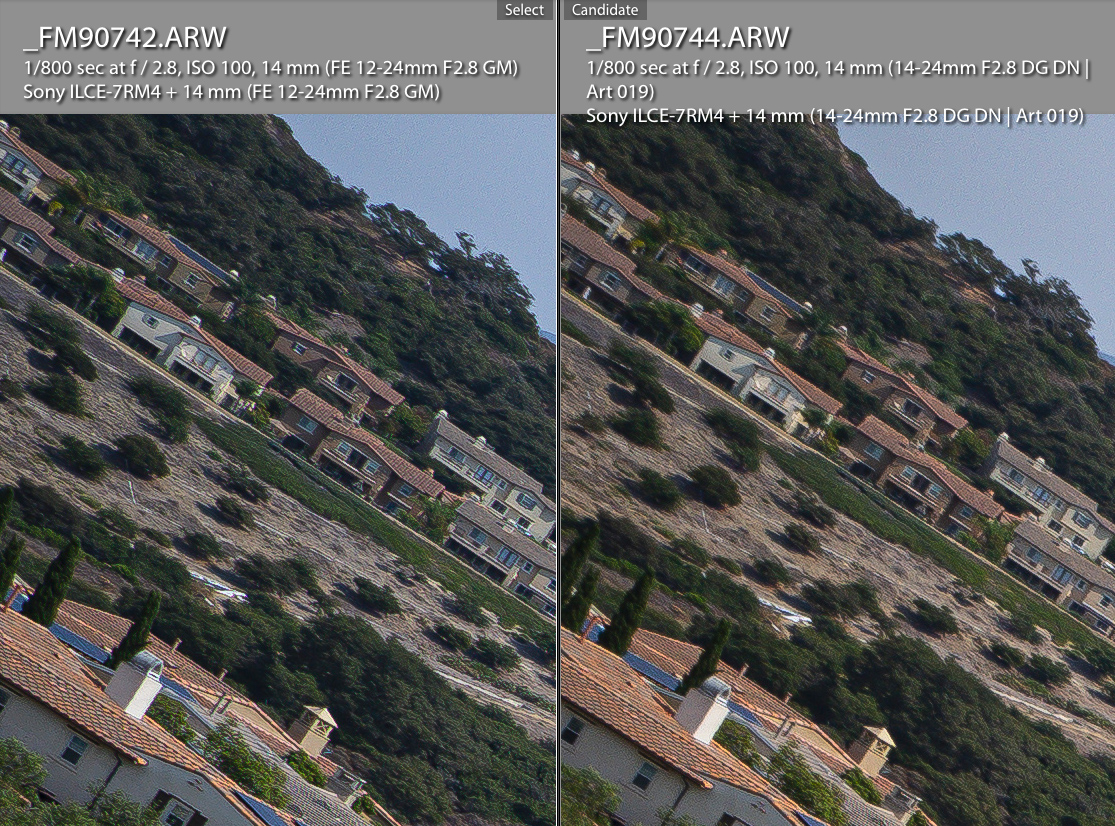
Fred Miranda wrote
Field CurvatureField curvature is moderate from 12 until 14mm. After that FC is very low to negligible.
Here are some crops showing the corners at 12mm, 18mm and 24mm. There were focused at center (LEFT) and at corner (RIGHT).
If you remove the field curvature variable, the GM puts up a great performance at 12mm and 14mm.
PS: It got a bit overcast here.
Hi Richard, I've just tested this.
Now that we know there is moderate field curvature for the FE 12-24/2.8 GM from 12-14mm, it's not surprising that the Sony GM performs better at the far corners when focusing on it.
However, the surprise was that it performed noticeably better than the Sigma when both are focused at the corners.
Here are the crops showing both Sony and Sigma @14mm f/2.8 focusing at the corner - instead of the center like I did for the main 14mm comparison.
Aug 19, 2020 at 04:17 PM
p.4 #4Sony FE 12-24mm f/2.8 GM Review
Awesome test. That is pretty outstanding!  So it's better to focus bit away from the center, mid way to the corners for optimal corner sharpness when shooting at 12-14mm then. That's good to know.
Aug 19, 2020 at 04:18 PM
p.4 #5Sony FE 12-24mm f/2.8 GM Review
When you do this though, or focus into the corners like Fred did in his test, what happens to the center? Is it still really good?
In other words is it a worthwhile trade off?
sismailian wrote:
Awesome test. That is pretty outstanding! So it's better to focus bit away from the center, mid way to the corners for optimal corner sharpness when shooting at 12-14mm then. That's good to know.
In other words is it a worthwhile trade off?
sismailian wrote:
Awesome test. That is pretty outstanding!
So it's better to focus bit away from the center, mid way to the corners for optimal corner sharpness when shooting at 12-14mm then. That's good to know.Aug 19, 2020 at 04:56 PM
p.4 #6Sony FE 12-24mm f/2.8 GM Review
Fred Miranda wrote:
Field curvature is moderate from 12 until 14mm. After that FC is very low to negligible.
Here are some crops showing the corners at 12mm, 18mm and 24mm. There were focused at center (LEFT) and at corner (RIGHT).
If you remove the field curvature variable, the GM puts up a great performance at 12mm and 14mm.
PS: It got a bit overcast here.Excellent work again Fred. Do you think if you corner focus, it then matches the Sigma (which had a corner advantage at 14mm in your first comparisons) at 2.8?Hi Richard, I've just tested this.
Now that we know there is moderate field curvature for the FE 12-24/2.8 GM from 12-14mm, it's not surprising that the Sony GM performs better at the far corners when focusing on it.
However, the surprise was that it performed noticeably better than the Sigma when both are focused at the corners.
Here are the crops showing both Sony and Sigma @14mm@ f/2.8 focusing at the corner - instead of the center like I did for the main 14mm comparison.
Thanks Fred, that's pretty impressive.
rvh23 wrote
Fred Miranda wrote
Field CurvatureField curvature is moderate from 12 until 14mm. After that FC is very low to negligible.
Here are some crops showing the corners at 12mm, 18mm and 24mm. There were focused at center (LEFT) and at corner (RIGHT).
If you remove the field curvature variable, the GM puts up a great performance at 12mm and 14mm.
PS: It got a bit overcast here.
Now that we know there is moderate field curvature for the FE 12-24/2.8 GM from 12-14mm, it's not surprising that the Sony GM performs better at the far corners when focusing on it.
However, the surprise was that it performed noticeably better than the Sigma when both are focused at the corners.
Here are the crops showing both Sony and Sigma @14mm@ f/2.8 focusing at the corner - instead of the center like I did for the main 14mm comparison.
Thanks Fred, that's pretty impressive.
Aug 19, 2020 at 04:56 PM
p.4 #7Sony FE 12-24mm f/2.8 GM Review
Hmm I am eager to find out. Today is like 110 degrees outside so really don't wanna step out to do some test shots  Tomorrow morning I can. I generally didn't always pay too much attention in the extreme corners but at 14 and below i think it's going to be a fun new learning experience as I start to also do more focus stacking at f/8.
I think in freds test i assume he focus peaks into corners and then hits the AF button to focus or he manually focuses into that corner until it is sharp.
Justin Stone wrote:
When you do this though, or focus into the corners like Fred did in his test, what happens to the center? Is it still really good?
In other words is it a worthwhile trade off?
So it's better to focus bit away from the center, mid way to the corners for optimal corner sharpness when shooting at 12-14mm then. That's good to know.
Tomorrow morning I can. I generally didn't always pay too much attention in the extreme corners but at 14 and below i think it's going to be a fun new learning experience as I start to also do more focus stacking at f/8. I think in freds test i assume he focus peaks into corners and then hits the AF button to focus or he manually focuses into that corner until it is sharp.
Justin Stone wrote:
When you do this though, or focus into the corners like Fred did in his test, what happens to the center? Is it still really good?
In other words is it a worthwhile trade off?
sismailian wrote
Awesome test. That is pretty outstanding! So it's better to focus bit away from the center, mid way to the corners for optimal corner sharpness when shooting at 12-14mm then. That's good to know.Aug 19, 2020 at 05:47 PM
p.4 #8Sony FE 12-24mm f/2.8 GM Review
Thanks for these extensive tests, Fred. They are making it harder for me to resist replacing my 12-24G with the GM. I can't really justify upgrading, but I'd like to. I think I'd see the most benefit from upgrading in astro, but living in a metropolitan area, I don't do that much night photography. Still, it is tempting to upgrade.
I think I'd see the most benefit from upgrading in astro, but living in a metropolitan area, I don't do that much night photography. Still, it is tempting to upgrade.Aug 19, 2020 at 05:59 PM
p.4 #9Sony FE 12-24mm f/2.8 GM Review
I think if i had the 12-24 f4 i would have to think hard about the upgrade. Is the f4 version flare that bad? I've seen examples of some pretty bad flare and some not too bad. Some youtube reviews i seen aren't that fond of the lens somehow due to vignetting and flare.
Aug 19, 2020 at 06:42 PM
p.4 #10Sony FE 12-24mm f/2.8 GM Review
sismailian wrote:
I think if i had the 12-24 f4 i would have to think hard about the upgrade. Is the f4 version flare that bad? I've seen examples of some pretty bad flare and some not too bad. Some youtube reviews i seen aren't that fond of the lens somehow due to vignetting and flare.
If you get a really nice copy of the F4 version it is quite good. If you have it or the Sigma you have to think is it twice as good money wise. Also you have to need 2.8 which is not to be taken lightly and is 14 wide enough. This is a tough call
Aug 19, 2020 at 06:59 PM
|
p.4 #11Sony FE 12-24mm f/2.8 GM Review
What does the Center look like when you focus on the corners?
Thanks Fred,
Chris
Thanks Fred,
Chris
Aug 19, 2020 at 07:23 PM
p.4 #12Sony FE 12-24mm f/2.8 GM Review
Damn, that is some fine glass. I'm not the audience for this lens, but it does look like ridiculously wide done right.
Thanks for the tests, Fred. I'm very interested to see how it does with the finer points.
Thanks for the tests, Fred. I'm very interested to see how it does with the finer points.
Aug 19, 2020 at 09:00 PM
p.4 #13Sony FE 12-24mm f/2.8 GM Review
Schlotkins wrote:
What does the Center look like when you focus on the corners?
Thanks Fred,
Chris
I honestly have a issue with focusing on the corners. Why, are you really going to do that as we normally never do that and more over with a super wide I would not even think about focusing on the corners as it’s not that easy to see and focus. Soooo I’m a believer on how you normal would work. I work fast and that would not be conducive to how I shoot. But that’s me so the focus on corner thing I tend to ignore those tests. If I focus on center and corners go out than I’ll stop down.
Aug 19, 2020 at 10:00 PM
p.4 #14Sony FE 12-24mm f/2.8 GM Review
Great job Fred I would be curious to see a comparison at 16/18/24 mm with the 16 35 gm at f.2.8 and f.8
Aug 19, 2020 at 10:40 PM
p.4 #15Sony FE 12-24mm f/2.8 GM Review
Thank Fred. Nice sharpness results from the new Sony. Comparing sharpness to the Sigma 14-24 is likely to be more dependent on specific copies, due to copy variation, than anything else. Good copies appear to be so close in sharpness that any difference is negligible to me. The other factors (color/contrast. flare/ghosting, astigmatism, sun stars (where I don't think either excels) are more important.
Aug 19, 2020 at 11:10 PM
p.4 #16Sony FE 12-24mm f/2.8 GM Review
Stefano 1967 wrote:
Great job Fred I would be curious to see a comparison at 16/18/24 mm with the 16 35 gm at f.2.8 and f.8
I actually tested it against my 16-35 GM and it really surprised me how much more resolution the 12-24 GM is capable of, especially wide open in center/mid frame. It's really noticeable as soon as you go to 14 all the way to 24mm. My 16-35 GM does slightly better at 24mm wide open in the corners but the 12-24 GM catches up quickly when you stop down. Slight note that my center images are not exactly center, more mid point to the right. I am very happy with my 12-24 GM copy
16mm 2.8 center

16mm 2.8 left corner

16mm 5.6 center

16mm 5.6 left corner

24mm 2.8 center

24mm 2.8 left corner

24mm 5.6 center

24mm 5.6 left corner

Hope that helped as I am not doing anymore of these I am happy with both lenses!

Great job Fred I would be curious to see a comparison at 16/18/24 mm with the 16 35 gm at f.2.8 and f.8
I actually tested it against my 16-35 GM and it really surprised me how much more resolution the 12-24 GM is capable of, especially wide open in center/mid frame. It's really noticeable as soon as you go to 14 all the way to 24mm. My 16-35 GM does slightly better at 24mm wide open in the corners but the 12-24 GM catches up quickly when you stop down. Slight note that my center images are not exactly center, more mid point to the right. I am very happy with my 12-24 GM copy
16mm 2.8 center
16mm 2.8 left corner
16mm 5.6 center
16mm 5.6 left corner
24mm 2.8 center
24mm 2.8 left corner
24mm 5.6 center
24mm 5.6 left corner
Hope that helped as I am not doing anymore of these
I am happy with both lenses! Aug 19, 2020 at 11:32 PM
p.4 #17Sony FE 12-24mm f/2.8 GM Review
And here just a few at F8. No more
16mm F8 center

16mm F8 left corner

24mm F8 center

24mm F8 left corner

16mm F8 center
16mm F8 left corner
24mm F8 center
24mm F8 left corner
Aug 19, 2020 at 11:46 PM
p.4 #18Sony FE 12-24mm f/2.8 GM Review
sismailian wrote:
My 16-35 GM does slightly better at 24mm wide open in the corners but the 12-24 GM catches up quickly when you stop down. Slight note that my center images are not exactly center, more mid point to the right. I am very happy with my 12-24 GM copy
The 24/2.8 corners for the 12-24 look poorer than I was expecting. But on the otherhand, once field curvature is taken into account to improve the corners at the wide end, 24mm is where Fred's copy also looked weakest and couldn't match the Sigma.
Aug 20, 2020 at 12:13 AM
p.4 #19Sony FE 12-24mm f/2.8 GM Review
Just a quick note I only focused in the center and did not refocus in the corners. Yea I think 24mm is the weakest FL for this lens.No perfect lens exists To me it doesn't matter as I most likely won't be shooting at 24mm especially wide open. I am always at F8 and above. I know the 16-35 isn't that great at 35mm either.
At that point I will go to the 24-70 GM. Also looks like the website/forums went to turtle speed. Barely loading. Ok speed seems to be fine now 🤔
Here is the overall image at 24mm that I zoomed in to get an idea:

Edited on Aug 20, 2020 at 08:37 AM · View previous versions
To me it doesn't matter as I most likely won't be shooting at 24mm especially wide open. I am always at F8 and above. I know the 16-35 isn't that great at 35mm either.At that point I will go to the 24-70 GM. Also looks like the website/forums went to turtle speed. Barely loading. Ok speed seems to be fine now 🤔
Here is the overall image at 24mm that I zoomed in to get an idea:
Edited on Aug 20, 2020 at 08:37 AM · View previous versions
Aug 20, 2020 at 12:16 AM
p.4 #20Sony FE 12-24mm f/2.8 GM Review
rvh23 wrote:
Personally I use ~f/8 + focus stacking a lot for landscapes and some lenses are better than others. Both Sony and Sigma zooms perform better than most prime lenses, especially at the wider range. So, I agree that both zooms are too close in performance at small apertures to make a difference in real images.
The Sony 12-24/2.8 GM's differential is the higher resolution/contrast wide open compared to the Sigma and the extra 12-13mm range. I still don't know much about coma, flare resistance, sunstar definition and rendering differences yet.From what I see here, if you're still shooting 42Mpix, there probably won't be any meaningful sharpness/contrast differences between these lenses. However, to my eye, Fred's 60Mpix examples show a significant advantage to the GM in the center and mid-frame, up to f5.6: whether you would see that in print or not depends on the size of the print (I believe you would in a large print). There's not much point talking about f8 and beyond as both lenses are diffraction limited on a 60Mpix camera.
We need to keep in mind that cameras and lenses are getting so good now, you can't just dismiss the difference between the GM and the Sigma as 'not significant', as this is representative of the level of improvement we're likely to see going forward; you guy's bought your RIV's for a reason, and that reason is visible in Fred's examples: to dismiss it seems to be a little self contradictory to me.At F5.6 and beyond you won't see the difference between the IQ of these two lenses regardless of the sensor you are using. To get an idea of what you would see in a 40" print from 60mp, you need to go to at most 50% views (probably smaller depending on your monitor) of Fred's comparisons. Even much larger sensors won't change that, because you need to zoom out more (on screen) to see what a 40" print would look like. The Sigma is so good in terms of sharpness that I don't believe further lens improvements will give us better 30 or 40" prints. How often do you print beyond 40"?
Also, I suspect many landscape photographers do indeed shoot landscapes at around F8 rather than much wider (unless it's essentially an infinity shot) because the number of focus stacked images you need becomes unmanageable. And if you're not focus stacking, lens differences are greatly reduced by DOF considerations in much of the frame. The only exception I can think of is astrophotogprahy where you are likely shooting the sky wide open. But in that case 40" prints look pretty awful anyway due to noise, and again in smaller prints you won't see a benfit due to the lens
What the new Sony does bring to the table though, is the very high level of UWA IQ that the Sigma introduced a year ago extended to 12 mm (if you allow for field curvature), which is very impressive. Whether that is worth the price difference, only you can decide.Richard, I'm enjoying watching you try to talk yourself out of buying the GM! - I jest. Seriously though, as I mentioned in the
comments above, I thought I was seeing a little too much confirmation bias creeping into the summaries of Fred's tests by people who already own the Sigma 14-24 f2.8, and I thought it needed calling out. This is completely understandable considering the cost of the GM. I know from our previous discussions that it took you three samples to get a good Sigma 14-24, and I share your angst about having to do the same with a 5K (AUD) lens!
In response to your other comments:
1) "At 5.6 and beyond you won't see the difference between the IQ of these two lenses regardless of the sensor" To my eye, the GM reaches its best performance at f5.6 in most of Fred's examples (which isn't surprising really), so you should really be saying 'At f8 and beyond'. I know you mean this in the context of a 40x60 print, and I would agree with you from f8 or higher, but I believe a single or focus stacked image with the GM at f5.6 on the A7rIV would be superior and visible in a 40x60 print. (although I agree with you that in a single shot, the GM can only be better near the focal plane - the circle of confusion at the depth of field boundaries will stay the same between 42 vs 60Mpix.) As the old saying goes, the distance people judge the sharpness of a print is only limited by the length of their nose!
2) "you need to zoom out more" Evaluating images at anything other than 100% on screen is fraught with scaling issues, and as I mentioned in my comments above, 4K screens are not suitable for critical image analysis at 100% (unless very large)
3) "many landscape photographers do indeed shoot landscapes at f8...because the number of focus stacked images you need becomes unmanageable" Yes, I understand this, and I assume its why Fred says he often focus stacks at f8 - its the best compromise between quality and practicality in the field - even though a f5.6 stack would be sharper if possible.Yes, I meant my comments within the context of reasonable sized prints.
And I'm not trying to talk myself out of the GM. I actually have one on its way to me for "evaluation purposes".
But on the basis of Fred's comparison I don't expect to see real world differences in terms of sharpness. Instead I will be looking more at whether the slighlty wider range is useful to me, whether it's flare performance for the kinds of scenes where I shoot against the sun is any better than the Sigma, whether it's color is as satisfactory (I didn't...Show more →
No worries Richard, hope you get a good copy. Don't read too much into my last sentence 'to dismiss it seems a little contradictory' - I was being deliberately provocative here, just stirring the pot a bit to see if I'd get a bite.
Everyone has their own idea about what 'real world' means: if the differences you see aren't significant to you, that's a decision only you can make...
Petegh wrote
rvh23 wrote
Petegh wrote
Fred Miranda wrote
rvh23 wrote
At landscape apertures, say F5.6 and beyond, there is no meanigful difference between these lenses that you would ever detect in any real world print.The Sony 12-24/2.8 GM's differential is the higher resolution/contrast wide open compared to the Sigma and the extra 12-13mm range. I still don't know much about coma, flare resistance, sunstar definition and rendering differences yet.
We need to keep in mind that cameras and lenses are getting so good now, you can't just dismiss the difference between the GM and the Sigma as 'not significant', as this is representative of the level of improvement we're likely to see going forward; you guy's bought your RIV's for a reason, and that reason is visible in Fred's examples: to dismiss it seems to be a little self contradictory to me.
Also, I suspect many landscape photographers do indeed shoot landscapes at around F8 rather than much wider (unless it's essentially an infinity shot) because the number of focus stacked images you need becomes unmanageable. And if you're not focus stacking, lens differences are greatly reduced by DOF considerations in much of the frame. The only exception I can think of is astrophotogprahy where you are likely shooting the sky wide open. But in that case 40" prints look pretty awful anyway due to noise, and again in smaller prints you won't see a benfit due to the lens
What the new Sony does bring to the table though, is the very high level of UWA IQ that the Sigma introduced a year ago extended to 12 mm (if you allow for field curvature), which is very impressive. Whether that is worth the price difference, only you can decide.
comments above, I thought I was seeing a little too much confirmation bias creeping into the summaries of Fred's tests by people who already own the Sigma 14-24 f2.8, and I thought it needed calling out. This is completely understandable considering the cost of the GM. I know from our previous discussions that it took you three samples to get a good Sigma 14-24, and I share your angst about having to do the same with a 5K (AUD) lens!
In response to your other comments:
1) "At 5.6 and beyond you won't see the difference between the IQ of these two lenses regardless of the sensor" To my eye, the GM reaches its best performance at f5.6 in most of Fred's examples (which isn't surprising really), so you should really be saying 'At f8 and beyond'. I know you mean this in the context of a 40x60 print, and I would agree with you from f8 or higher, but I believe a single or focus stacked image with the GM at f5.6 on the A7rIV would be superior and visible in a 40x60 print. (although I agree with you that in a single shot, the GM can only be better near the focal plane - the circle of confusion at the depth of field boundaries will stay the same between 42 vs 60Mpix.) As the old saying goes, the distance people judge the sharpness of a print is only limited by the length of their nose!
2) "you need to zoom out more" Evaluating images at anything other than 100% on screen is fraught with scaling issues, and as I mentioned in my comments above, 4K screens are not suitable for critical image analysis at 100% (unless very large)
3) "many landscape photographers do indeed shoot landscapes at f8...because the number of focus stacked images you need becomes unmanageable" Yes, I understand this, and I assume its why Fred says he often focus stacks at f8 - its the best compromise between quality and practicality in the field - even though a f5.6 stack would be sharper if possible.
And I'm not trying to talk myself out of the GM. I actually have one on its way to me for "evaluation purposes".
But on the basis of Fred's comparison I don't expect to see real world differences in terms of sharpness. Instead I will be looking more at whether the slighlty wider range is useful to me, whether it's flare performance for the kinds of scenes where I shoot against the sun is any better than the Sigma, whether it's color is as satisfactory (I didn't...Show more →
No worries Richard, hope you get a good copy. Don't read too much into my last sentence 'to dismiss it seems a little contradictory' - I was being deliberately provocative here, just stirring the pot a bit to see if I'd get a bite.
Everyone has their own idea about what 'real world' means: if the differences you see aren't significant to you, that's a decision only you can make...
Aug 20, 2020 at 02:33 AM