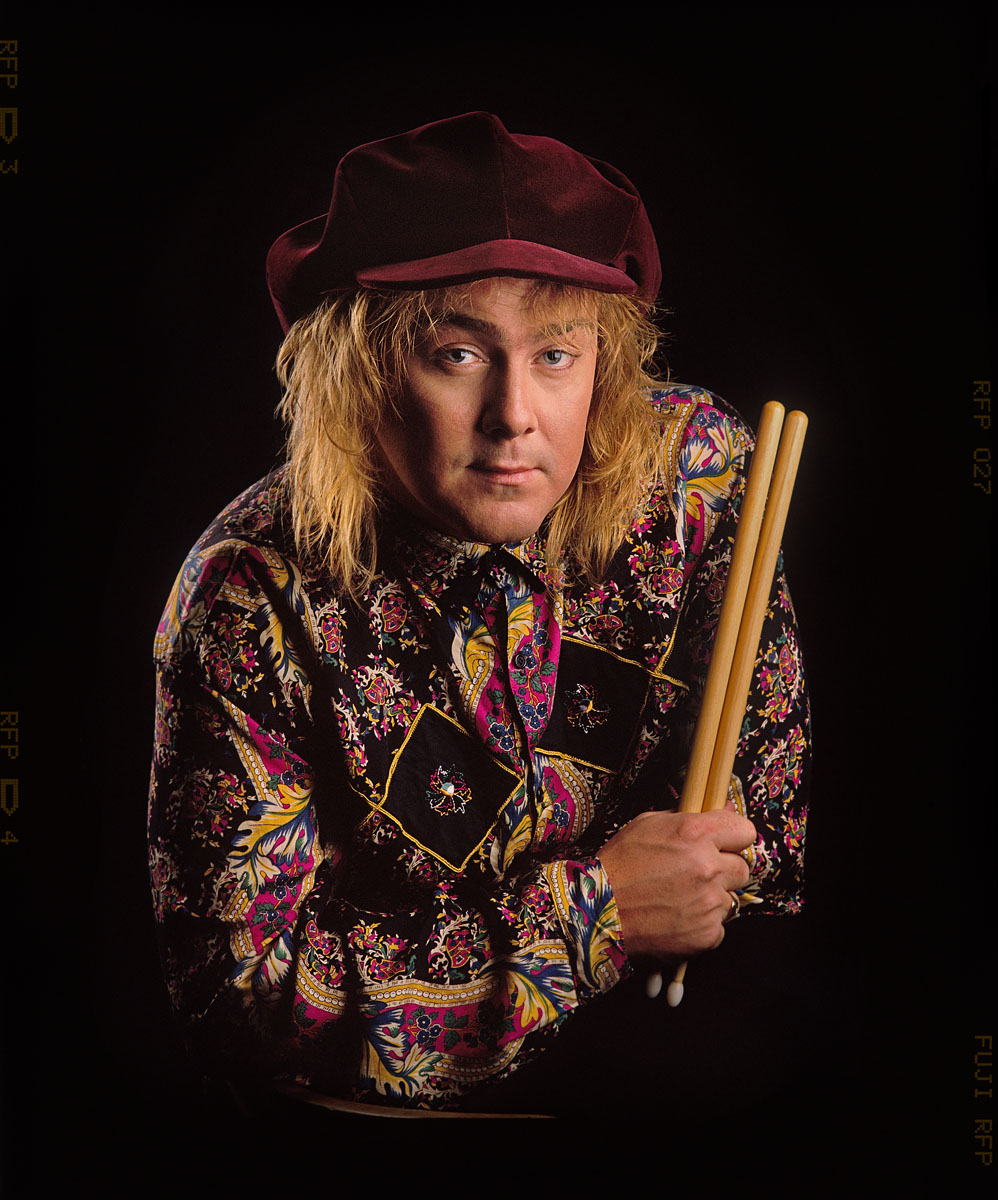
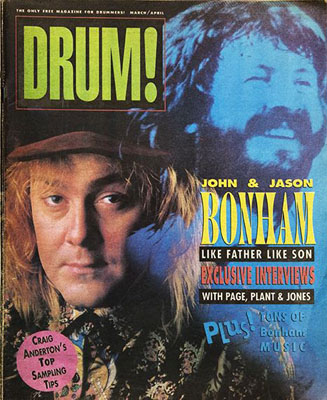
This is from about 30 years ago, more or less. Every once in a while certain images creep back into my conscience, so I dug this up and scanned it. Then I had to search online for an image of the cover and could find no actual year, only that it was issue #4. I remember that Jason was so late getting to the studio that we had him come back the next day. The magazine had sent me a postcard of John Bonham (Led Zeppelin for those who don't know) and I came up with a pre-Photoshop way to combining the images together. I copied the postcard onto 35mm slide film, then took the hero shot of Jason all into my darkroom at the time. I taped a 4x5 film holder under the enlarger and made a series of exposure and color tests with both images, projecting them onto a sheet of 4x5 Ektachrome Duplicating Film. Once I had the tests back from the lab, I then, in total darkness, exposed part of the piece of film in the holder using my hand to dodge out the area where the other image was going to be exposed into. Moving my hand during the exposure made a soft edged transition. Insert the dark slide, put the next piece of film in the enlarger and make a new exposure reversing the hand dodging to complete the composite. I think I did about half a dozen versions as every one was different and what I didn't remember until looking up the cover today, is that they flipped the whole thing horizontally. Anyhow, that's how we did it before Photoshop was born.
Great story and great image Peter. That was a highly resourceful solution! I think about things that are trivial in the PS world that were difficult, if not impossible in the film days.
Search YouTube for "Heart Stairway to Heaven". I tried to link, but got an error.
For someone( and a bass player) who grew up with, and still listen to, "The Yardbirds" and "Led Zepplin", this is a fantastic image! Scanned?? WOW!!!
Great backstory to your post!
Dan
Doug - You know only too well how we were not necessarily taught at Art Center how to do something but more how to figure your way through a problem. It still seems crazy when I think back on doing this and how long it took. I'm pretty sure that this is one of the jobs I did for free for Drum in the beginning - in return for shares in the magazine and being on the board of directors. They finally sold it to the company that owns Acoustic Guitar Mag and between the time they started the process and ended the price got negotiated way down and I ended up with enough basically for a case of guitar strings. And yes, I've seen the Heart version of STH. Takes a lot of guts to take on that song but they do a great job on it.
Dan - Thank you as always, but I'm curious why the ?? after scanned? Another Howtek drum scan proving once again that film was pretty damned good in its day. Manual focus too on a Mamiya RZ. Ha.
Peter Figen wrote:
Dan - Thank you as always, but I'm curious why the ?? after scanned? Another Howtek drum scan proving once again that film was pretty damned good in its day. Manual focus too on a Mamiya RZ. Ha.
I am getting old and sometimes I read something and still have a question at the end. Yes you say you scanned it. The scanned image is an excellent image! I use a Pro scanner and I am not sure my scans are as "perfect" as yours! So I was just re-affirming, in my mind, your 1st sentence..."scanned". That is all! No disrespect no negatives just admiration and positives Peter!
No disrespect Dan. I've been drum scanning for over twenty years now and have it down pretty well. But of course it helps when your film is basically there to begin with. The biggest change from the original is that today I probably made it a little less warm, as back then I was alway putting at least an 81C filter over the lens and often an 81EF and then I'm sure I pulled some detail out of his cap, which got lost in the analog duplicating process and who knows what sort of scan the magazine did back then, which probably crushed the bottom end even more. I actually have two drum scanners - a Howtek 8000, which scans to 8000 ppi anywhere on the drum, and a Howtek 7500, which has a much larger drum and either 2500 ppi on the larger drum or 5000 on the smaller drum, and even after two decades of scanning I'm still finding film I have not yet scanned. And the weird thing is that I started off looking for some Larry Carlton shots I took at his house in the 90's and ended up scanning Jason.
Peter Figen wrote:
No disrespect Dan. I've been drum scanning for over twenty years now and have it down pretty well. But of course it helps when your film is basically there to begin with. The biggest change from the original is that today I probably made it a little less warm, as back then I was alway putting at least an 81C filter over the lens and often an 81EF and then I'm sure I pulled some detail out of his cap, which got lost in the analog duplicating process and who knows what sort of scan the magazine did back then, which probably crushed the bottom end even more. I actually have two drum scanners - a Howtek 8000, which scans to 8000 ppi anywhere on the drum, and a Howtek 7500, which has a much larger drum and either 2500 ppi on the larger drum or 5000 on the smaller drum, and even after two decades of scanning I'm still finding film I have not yet scanned. And the weird thing is that I started off looking for some Larry Carlton shots I took at his house in the 90's and ended up scanning Jason. ...Show more →
Peter, do you have a site with these fine musician photos? I am an olde fart so I go waaaaaay back to the start of my music enjoyment! Even a crystal radio set using my bed-springs as an antenna!!!
Thanks!
Dan
The lighting on that first image is superb! What did you use besides the big soft box high and to the right of the photographer. Left-hand side of image subjects hair is really well lit. Hard to believe that could be accomplished with just a soft box high and to the right of the photographer.
Second image is very impressive considering the technology at the time. Well done!
Since this was around thirty years ago, it's hard to remember exactly what I did, but the main light was definitely a Chimera medium and the kicker was more than likely a Chimera small, because that's pretty much all I had at the time. The main box wasn't high at all, it was much lower as you can tell by how the shadow falls, and it was very close to him, probably just out of the frame.
Peter this is a very cool article. I remember having a darkroom in the basement in the 70's but nothing like you were doing. I can imagine how much time and effort that went into your image. What a great talent you have.
Thanks Dave. I think this took place over probably four or five days total. Well, more like five as Jason showed up four hours late and the makeup artist was gone so he had to come back the next day. The kind of stuff where today we could do the whole thing from start to finish in a couple of hours.


 !
!