Home · Register · Join Upload & Sell

Moderated by: Fred Miranda
Username  

FM Forum Rules
Landscape Posting Guidelines
  

FM Forums | Landscape Photographer | Join Upload & Sell


Archive 2020 · The Anatomy of an Astro Image


Colorado CJ
Offline
• •
Upload & Sell: Off
p.1 #1 · p.1 #1 · The Anatomy of an Astro Image


I post my astrophotos here about once a week.

I figured I'd take you though exactly how I get these images.

Depending on the target of the night, there are different capturing techniques, and different editing techniques, but here is one I just completed today; The Rosette Nebula.

To make this image, I decided to shoot in Narrow band, using filters that only let in 6nm of the exact wavelength of light. This is normally done shooting through Hydrogen Alpha, Sulfur II and Oxygen III filters. Shooting though these filters, filter out all other light except for a very narrow band or wavelength of light associated with specific gasses. Combining these in different ways makes color images, the best known being the "Hubble Palette", where you make images from the Sulfur II filter the Red channel, images from the Hydrogen Alpha filter the Green channel and images from the Oxygen III filter, the blue channel.

First you get set up for a night of imaging. I completed my backyard observatory a few months ago, so that is easy for me. It used to take about an hour to drag everything out into the yard, set everything up, get the mount Polar aligned and wait for the scope to become thermally stable. Now, all I have to do, is open up the shutter on the dome, connect my computer and I am imaging in less than 10 minutes.

New RASA 11 by Colo CJ, on Flickr


Imaging can take up to 30+ hours, depending on your setup and how "deep" you want to image. The more time in an image, the more detailed and noise free the final image is. I now am using an f2.2 scope, so I can get images in just a couple hours that would have taken my 20-30 hours to get with my last setup.

After getting the images, the fun part begins.

First you have to use a program to "stack" and align the individual filtered images to combine them. This gives you a final set of stacked images, one image for each filter. Then you use another program to combine these seperate black and white images to get a final color image. I use Photoshop for this, but there are dedicated astro programs that do this (some say) better, but they are costly.

Here is the Hydrogen Alpha image after stacking 60 individual 120 second frames. This will be the Green channel in the final image
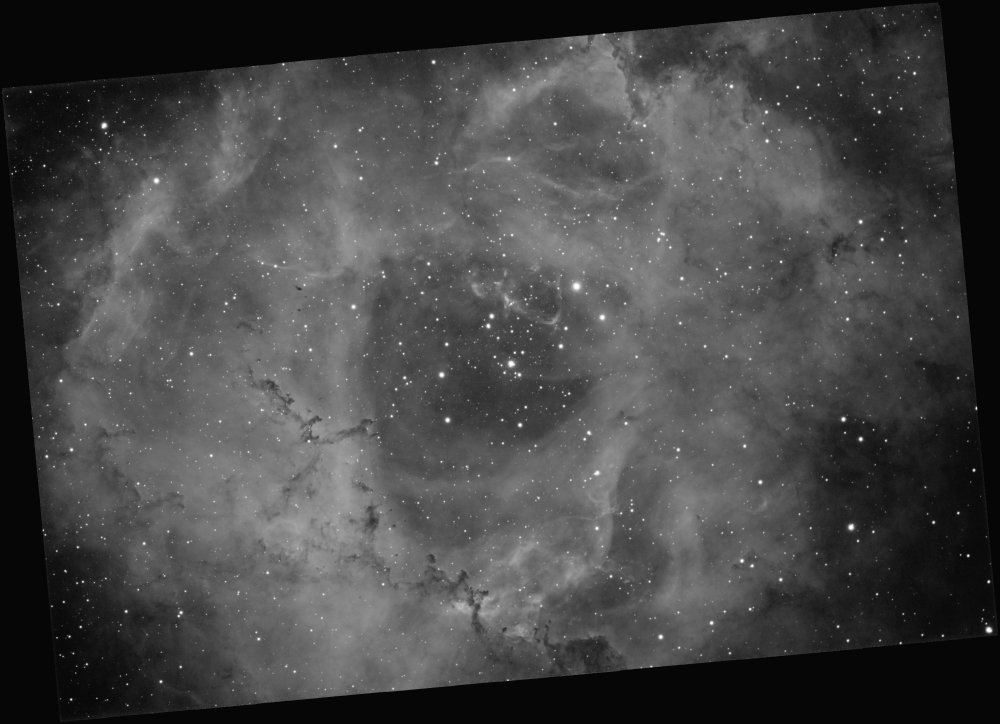
Ha2 by Colo CJ, on Flickr


And here is the Oxygen III image after stacking 35 individual 120 second frames. This will be the blue channel in the final image.

OIII2 by Colo CJ, on Flickr


For this image, I didn't shoot through the Sulfur II filter. I didn't really have the time and the weather hasn't been very clear. Luckily this nebula doesn't have a huge amount of Sulfur II data, so I used the Hydrogen Alpha and Oxygen III images to create a synthetic Sulfur II image. This will be the red channel in the final image.

Synth Green by Colo CJ, on Flickr


After combining the three images in photoshop, I get a color image. Many times this image is very dull, depending on the object you are photographing. The data is there, but you have to really pull it out of the image. After all, there is over 1GB of data in this image, you just have to coax that data out.

SHO Before Editing by Colo CJ, on Flickr


For this image, since I knew I'd have to pull every bit of color and detail as possible out, I edited out the stars. This lets me edit the nebulosity and not bloat the stars. Bloated stars look bad. To get here from the previous image took about an hour of editing. WAY too much to get into specifics, but this is really the fun part for me.

HST_image2_starless by Colo CJ, on Flickr

I then added the stars back into the image, did a little more color and contrast correction and ended up with this final image (for now).

When the weather cooperates I am going to go back and shoot with a color camera to get the stars the right colors. Here they are too bland. It is hard to get decent color in stars with narrow band imaging, so most shoot a separate color set just for correcting the stars.


Here it is, 3.2 hours of imaging, 1 hour of stacking and roughly 3 hours of final editing.

The Rosette
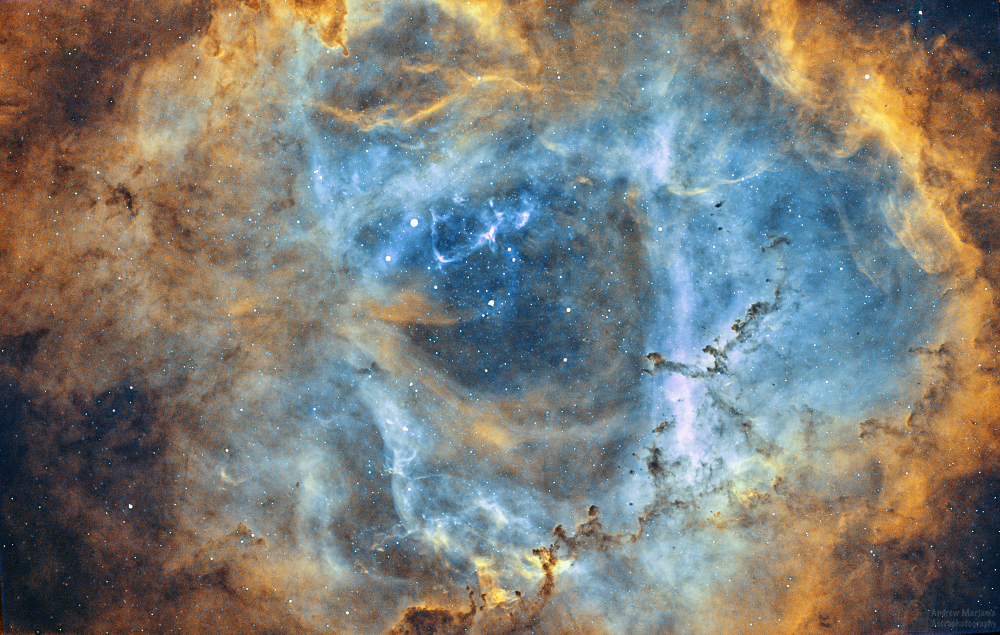
Rosette 3 Hours (S)HO small by Colo CJ, on Flickr


Mar 11, 2020 at 08:30 PM
InnomnateViem
Offline
• •
Upload & Sell: Off
p.1 #2 · p.1 #2 · The Anatomy of an Astro Image


nice.... i saw your posts on how you built your observatory. job well done. impressive, most impressive.

keep up your good works.....


Mar 11, 2020 at 08:54 PM
Sunny Sra
Offline
• • • • • • •
Upload & Sell: On
p.1 #3 · p.1 #3 · The Anatomy of an Astro Image


Andrew,
Freakin amazing man! Great stuff.


Mar 11, 2020 at 09:16 PM
KCollett
Offline
• • • • • • •
Upload & Sell: Off
p.1 #4 · p.1 #4 · The Anatomy of an Astro Image


Very interesting reading! And the images you create are intriguing and beautiful. Your hard work = my enjoyment. Thank you!


Mar 11, 2020 at 10:04 PM
scottsoutter
Offline
• •
Upload & Sell: Off
p.1 #5 · p.1 #5 · The Anatomy of an Astro Image


Thank you for writing that up. It was very interesting to learn how your images are produced. Very, very cool.


Mar 11, 2020 at 11:42 PM
twoflower
Offline
• • •
Upload & Sell: Off
p.1 #6 · p.1 #6 · The Anatomy of an Astro Image


Wow, that is SOME work you put into making that photo.
That is really amazing, and I am always amazed by your photos.
Keep up the good work.


Mar 12, 2020 at 04:16 AM
jforkner
Offline
• • •
Upload & Sell: Off
p.1 #7 · p.1 #7 · The Anatomy of an Astro Image


Nice orientation to AP. Great observatory, too.

Jack


Mar 12, 2020 at 06:28 AM
Chaz
Offline
• • •
Upload & Sell: On
p.1 #8 · p.1 #8 · The Anatomy of an Astro Image


Informative and detailed introduction to your stunning images! Thank you.


Mar 12, 2020 at 10:16 AM
kwilliam8
Online
• • • • •
Upload & Sell: On
p.1 #9 · p.1 #9 · The Anatomy of an Astro Image


Its a labor of love, but the results are often breathtaking!


Mar 12, 2020 at 12:08 PM
tntcorp
Offline
• • • •
Upload & Sell: Off
p.1 #10 · p.1 #10 · The Anatomy of an Astro Image


wow.. the tremendous effort behind the result.

how do you manage to locate the location of the nebula through the scope. surely it does not stand out in deep space as it does in the final image.


Mar 12, 2020 at 02:02 PM
Lightsearcher
Offline
• • • • •
Upload & Sell: Off
p.1 #11 · p.1 #11 · The Anatomy of an Astro Image


Wow, amazing final result..!!!

So if i understood correctly the pictures were shot in different days?

Thank you for sharing.

Marcelo


Mar 13, 2020 at 06:58 AM
Harold Carlson
Offline
• • •
Upload & Sell: Off
p.1 #12 · p.1 #12 · The Anatomy of an Astro Image


Thank you for sharing your amazing images


Mar 13, 2020 at 05:44 PM
Colorado CJ
Offline
• •
Upload & Sell: Off
p.1 #13 · p.1 #13 · The Anatomy of an Astro Image


Thanks everyone! I figured you might be interested in a little of what it takes to get these images.

tntcorp wrote:
wow.. the tremendous effort behind the result.

how do you manage to locate the location of the nebula through the scope. surely it does not stand out in deep space as it does in the final image.


I use a thing called "plate solving". Basically, my imaging program takes a couple second image of the sky and uses star triangulation to figure out exactly where it is pointed. It then updates the mount to "sync" the mount to the planetarium program.

I then use the planetarium program to point the mount to what I want to shoot for the night. Using "plate solving" I can lock on to the object within a couple of pixels of accuracy.

It is almost unbelievable how accurate today's equipment is.


Mar 14, 2020 at 02:45 PM
Colorado CJ
Offline
• •
Upload & Sell: Off
p.1 #14 · p.1 #14 · The Anatomy of an Astro Image


Lightsearcher wrote:
Wow, amazing final result..!!!

So if i understood correctly the pictures were shot in different days?

Thank you for sharing.

Marcelo


Yes, these were shot on two separate nights. As you can see in the black and white images, I didn't get my camera exactly rotated the same as the first night when I mounted it on the second night.

The stacking software registers the stars in the image and rotates the two images so they will line up exactly when stacked, so it isn't a huge deal. I did lose a little around the edges since i had to crop more to get the final image though.


Mar 14, 2020 at 02:46 PM
shamilton
Offline

Upload & Sell: Off
p.1 #15 · p.1 #15 · The Anatomy of an Astro Image


This is really amazing. When I look at the images, I swear it seems like they are moving! Almost an optical illusion.

Thanks for sharing!


Mar 16, 2020 at 10:57 AM
xterra07
Offline
• • • •
Upload & Sell: On
p.1 #16 · p.1 #16 · The Anatomy of an Astro Image


Excellent info and behind the scenes look into what it takes to capture your great images.

Well done with this post and your past beautiful star images!!


Mar 16, 2020 at 12:37 PM
dbehrens
Offline
• • • •
Upload & Sell: On
p.1 #17 · p.1 #17 · The Anatomy of an Astro Image


Simply put - your images are breathtaking and spellbinding. And what goes into each of these images and your willingness to explain is exemplary.


Mar 16, 2020 at 12:48 PM
tntcorp
Offline
• • • •
Upload & Sell: Off
p.1 #18 · p.1 #18 · The Anatomy of an Astro Image


Colorado CJ wrote:
Thanks everyone! I figured you might be interested in a little of what it takes to get these images.

I use a thing called "plate solving". Basically, my imaging program takes a couple second image of the sky and uses star triangulation to figure out exactly where it is pointed. It then updates the mount to "sync" the mount to the planetarium program.

I then use the planetarium program to point the mount to what I want to shoot for the night. Using "plate solving" I can lock on to the object within a couple of pixels of accuracy.

It is
...Show more


ahh.. such accuracy.. i would have never known the technique of "plate solving".. ;')


Mar 16, 2020 at 12:53 PM


FM Forums | Landscape Photographer | Join Upload & Sell


You are not logged in. Login or Register

Username       Or Reset password


This site is protected by reCAPTCHA and the Google Privacy Policy and Terms of Service apply.