p.3 #2 · Sony 24-105 and a wide prime for Landscape work?
The 24-105 is on my camera by default most of the time. When out shooting landscapes I usually at least start with this lens. I can easily play with focal lengths and compositions. I often capture some of my best landscape images this way. Most of the time I am content with these images.
If I have my camera bag with me, and the light, and scenery, is exceptional enough that I think I may end up printing a large image of the scene, I will take my closest prime to the FL I prefered and shoot some frames with it to get the best possible image. It is a workflow that works well for me.
Often when I get back to my editing computer I find that I really love an image shot with the 24-105. I have no hesitation printing these, and have never been disappointed by any lens shortcomings.
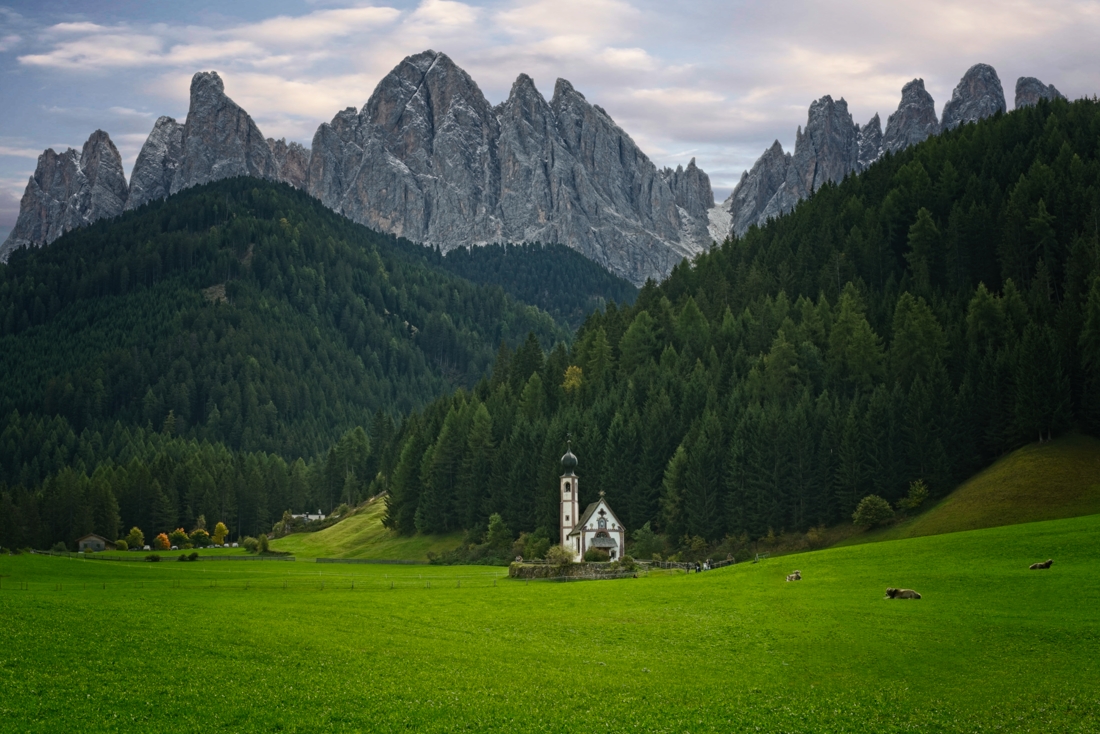
The first image below was shot from a ridge. I was using the 24-105 to snipe around the valley below taking many images at different FL, and with different compositions. Even though I had an excellent prime in my bag that was close enough to the 42mm FL I didn't bother to pull it out and use it. I am not at all disappointed in the IQ of this image, nor the print that came from it.
The second image below is a case where, as I described above, I did take the time to pull out a prime in a FL I liked. The compositions at this location were rather limited so the flexibility of the zoom was not much of an advantage. I am also satisfied with this image. But have yet to print it.
p.3 #3 · Sony 24-105 and a wide prime for Landscape work?
I do the same thing, when I start walking around it's always with the 24-105/4 on the camera, and basically looking for a reason to switch to the 16-35GM.
p.3 #4 · Sony 24-105 and a wide prime for Landscape work?
A very fair review. My impressions with the lens for the year I had it was very similar. I miss mine, just couldn’t justify keeping it. My style is wide zooms with primes.
RayinNY wrote:
This is a very complete review of the 24-105
p.3 #5 · Sony 24-105 and a wide prime for Landscape work?
When I review the images taken by my favorite Sony photographers on FM - the ones that use primes and the 24-105 - I always prefer their work with the primes. And that preference is never affected by resolution - the resolution of a good zoom and a prime are virtually indistinguishable when reviewing online images. What sways me is the rendering. I've always perceived a flatness in the Sony 24-105 images - color, contrast, and "pop" - that I don't see in the prime images.
What I can't figure out is how much of this preference is affected by my knowing what lens was used. I go in to the evaluation with bias.
p.3 #6 · Sony 24-105 and a wide prime for Landscape work?
Just my own personal experience but I find the 24-105 to be at it's weakest on the wide end.
I treat it as 35-105 basically, anything wider than that and I switch to the 16-35GM, 24GM, or Loxia 21.
As someone mentioned, the biggest difference between the zooms and a good prime is that the zooms lack contrast. The 24GM and Loxia 21 have a contrast punch that not even the 16-35GM matches. And the GM zoom is significantly better than the 24-105 in the contrast department.
p.3 #7 · Sony 24-105 and a wide prime for Landscape work?
I don’t buy my lenses to shoot bookcases and I also don’t give two hoots about online rating; I only care about the shots I bring home. The A7R3 and 24-105 are giving me the best hiking shots I’ve ever gotten from any combo. Keep your bag of primes, I ain’t got time to juggle lenses on the side of mountains for single digit % sharpness gains. Nothing beats the size/weight/quality ratio of the 24-105 in the field.
SpecFoto wrote:
Not according to the sonyalpha blog tests.
Except for the test results being suspect and the conclusion being flawed, specifically on the 24-105 f4,…….maybe.
I don’t know about you but I did not buy my lenses based upon shooting a bookcase in a bedroom 2 meters away. According to the tests on the sonyalpha blog, here is how various Sony primes hold up against the 24-105 at working apertures that landscape photographers would most likely use, f4, f5.6, f8 and f11, higher than that and diffraction sets in. The ratings listed cover both the center and corners for the various FOV, meaning there are 8 ratings per lens listed below.
Sony 35mm f2.8 ZA: This one makes no sense. The 35mm has 2 Excellent, 4 Very Good and 2 Good (at f11). It is given a rating of only 2 stars. Yet the 24-105 also has 2 Excellent, 4 Very Good and 2 Good (at f11), the difference being the 24-105 is Excellent in the center at both f4 and f5.6 where the 35mm is Excellent in both the center and corners at f5.6. What’s notable to me is that the 35mm is rated the same in the corners as the center in all 4 f stops, yet they rate the 24-105 2 stars more at 4 stars!
Sony 24mm f1.4GM: This lens wipes out the 24-105mm at 24mm with 6 Outstanding and 2 Excellent and thus is rated 5 stars. The 24-105 at 24mm gets 2 Excellent, 4 Very Good and 2 Good, same as at the 35mm FOV and it's lowest rating.
Sony 55mm f1.8 ZA: This lens also gets 6 Outstanding and 2 Excellent, again wiping out the 24-105 at 50mm yet it only gets 4 stars. The 24-105, gets 4 Excellent, 2 Very Good and 2 Good.
Sony 85mm f1.8: This lens get 7 Excellent and 1 Very Good (f11 corners), but it is only rated for 3 stars? While the 24-105 was not tested at 85, at 70mm it got 5 Excellent and 3 Very Good, it's best rating, and at 105mm it got 3 Excellent, 3 Very Good and 1 Good, showing the 24-105 is also weaker at the longer end too. The 85 was better than the 24-105 at both 70 and 105mm FOV’s yet the 24-105 was rated higher?
Based upon this blogs own tests the Sony 24-105 should be rated no higher than 3 stars. Or at least the same rating as the 35mm f2.8, which it does not beat. Every other Sony prime far exceeds it....Show more →
p.3 #8 · Sony 24-105 and a wide prime for Landscape work?
twentysevenone wrote:
Just my own personal experience but I find the 24-105 to be at it's weakest on the wide end.
I treat it as 35-105 basically, anything wider than that and I switch to the 16-35GM, 24GM, or Loxia 21.
As someone mentioned, the biggest difference between the zooms and a good prime is that the zooms lack contrast. The 24GM and Loxia 21 have a contrast punch that not even the 16-35GM matches. And the GM zoom is significantly better than the 24-105 in the contrast department.
You should check your copy then. It should be very good at 24.
p.3 #9 · Sony 24-105 and a wide prime for Landscape work?
Most examples I have seen show that unless the prime lens is the exact focal length you want for your composition, then the zoom will have the advantage in sharpness once you crop the prime as the loss of pixels will make up for any lack of sharpness in the lens. In many cases one cannot "zoom with your feet" as if you are standing on the bank of a lake or river, or what have you, you need to shoot from where you are. Having said this, I do see sometimes a "flatness" (as mentioned above) in the rendering of the 24-105 in particular. I even commented on one of Ronnie Olsen's fine images about this in the past as it lacked something that, say, the older C/Y 100-300 has. I suspect it is a lack of micro contrast tho these types of terms are hard to define. All lenses are compromises. The 24-105 and similar lenses are usually "sharp enough" and immensely convenient. At times, as when you don't want to change lenses due to conditions or when you need to travel light, they may be the ideal choice. That being said, I don't own one and only own one zoom currently (and that for Fuji). Sometimes one's lens choices are not the most practical choice. Primes are usually sharper, I like their rendering better, and I like the ability to mix and match what lenses I want to take on a given mission. Nothing beats a small prime when one wants to be really compact and when one does not need different focal lengths. Sun stars and filter use also play into my selection of lenses. I have avoided the fine Sigma 14-24 and sold my Sony 12-24 due to inconvenience with filters. I would rather use other UWA lenses like those from Laowa where filter use is possible. Choose your poison. No lens is perfect--size, convenience, price, rendering, filter use, sharpness, all require trade offs.
p.3 #10 · Sony 24-105 and a wide prime for Landscape work?
In the past year, i have probably bought/sold over 10 different primes, all good lenses no issues
For me mainly landscape and nature shots, most are from f4-f11
I switched from the R3 to R4, high resolution is a double edge sword, you get the most detail and sharpest images but any flaws also show!
I decided to go the new Sigmas DGDN series, the 14-24 and 24-70 zooms are sharp enough in my pixel peeping and i am not sure my eyes could see any better?
There are thousands of nice images with the Sony 24-105!
You have to do what works for you and that is different for all of us...
p.3 #11 · Sony 24-105 and a wide prime for Landscape work?
I like primes. I'm sure they will always beat zooms. However...in the field, and with mirrorless cameras, a cover-all zoom has one particular attribute. It stays on the camera and reduces the possibility of dust landing on the sensor. I discovered the reality of this a couple of years ago in China, during which I changed lenses several times in Shanghai, where the air is truly filthy with particulates. Moving to the Huangshan Mountain region I kept a wide zoom on the camera throughout but was still horrified to discover how much de-spotting was needed on my return. Well over 100! My camera's sensor looked as though it had measles! Of course, development software allows batch processing but it was still an unwelcome shock. So, one-size-fits-all can have its adavantages in the field, at least in Chinese or Indian fields!
p.3 #12 · Sony 24-105 and a wide prime for Landscape work?
Absolutely great point! Assuming Canon didn’t patent it (fat chance I know), I’d love to see Sony introduce the protective curtain of the Canon R.
waterden wrote:
I like primes. I'm sure they will always beat zooms. However...in the field, and with mirrorless cameras, a cover-all zoom has one particular attribute. It stays on the camera and reduces the possibility of dust landing on the sensor. I discovered the reality of this a couple of years ago in China, during which I changed lenses several times in Shanghai, where the air is truly filthy with particulates. Moving to the Huangshan Mountain region I kept a wide zoom on the camera throughout but was still horrified to discover how much de-spotting was needed on my return. Well over 100! Of course, development software allows batch processing but it was still an unwelcome shock. So, one-size-fits-all can have its adavantages in the field, at least in Chinese or Indian fields!...Show more →
p.3 #13 · Sony 24-105 and a wide prime for Landscape work?
theacguy71 wrote:
There are thousands of nice images with the Sony 24-105!
You have to do what works for you and that is different for all of us...
All too true.
There will always be people in any gear-enthusiast forums who go a bit too far down the "quality" rabbit hole and be fully convinced that only the best/latest/sharpest gear will suffice, while all else is inferior peasantry.
What irks me is when they poo-poo everyone else who isn't of such mindset.
I remember an article put out by I think smugmug or some other mass-printing operation. They showed the top reasons prints where returned. Sharpness was near or at the bottom of the reasons with only a small fraction of prints being returned due to being soft. At the top were things like color and brightness.
I personally think that one is better off capturing better images in terms of timing, location, light, etc with gear that is always going to be ready to get the shots on short notice. Versatility in itself can be the deciding factor in many shots that would otherwise be missed or passed up due to various reasons when using primes.
Heck, one of my favorite image of all-time that I have captured was done with an iPHone 4s because it was highly water resistant and could get the shot that only lasted a few seconds. Without it, it would have been literally impossible to get with the larger camera in my backpack, especially since I didn't want to risk ruining my bigger camera.
p.3 #14 · Sony 24-105 and a wide prime for Landscape work?
My two cents. It makes sense for dedicated landscape photographers/pros to get zooms.
- Having a bag of primes when in the field is not practical
- "Slower" zooms is not a problem for most landscape people
- Framing landscapes with primes is not always possible, or at least more difficult than in a controlled environment
- Pros will not want to miss a shot
Most landscape pros I "follow" use zooms. I believe they are not bothered by the last 1% of sharpness, they want to get the shot. Frankly unless printed super large, I doubt many people will be able to make a difference in terms of was a zoom or a prime lens used to take the photo.
Personally, photography is a hobby. I don't mind missing a shot as I am not making a living out of it. I find using fast primes funnier, lets me do more than just frame and shoot. I enjoy zooming at 200% on my screen and seeing the smallest details possible. Is my prime sharper than the zoom? Maybe a little. Is it necessary? Probably not, as professionals use zooms and me an amateur use a prime. I believe pros don't have time to do all I do!
p.3 #15 · Sony 24-105 and a wide prime for Landscape work?
I have been using 24-105 on addition to 16-35/4. Well if it is for landscape, these two lenses have different filter thread size...which is also the reason for my other very tempting zooms..12-24 and the Sigma 14-24/2.8
p.3 #16 · Sony 24-105 and a wide prime for Landscape work?
I have been using 24-105 on addition to 16-35/4. Well if it is for landscape, these two lenses have different filter thread size...which is also the reason for my other very tempting zooms..12-24 and the Sigma 14-24/2.8
p.3 #18 · Sony 24-105 and a wide prime for Landscape work?
Great thread. I agree with everything said - even when opinions differ!
My opinion is that the 24-105 is a great achievement for a standard focal length zoom. I appreciate how good it is for what it is, and at the same time recognize that it's a bit unrealistic to expect it to match performance with the best primes. But much of the time, "very good" is good enough, and flexibility often trumps state of the art.
I sometimes leave the 24-105 out of a travel kit to save weight, preferring a wide zoom and one or two primes. So a more likely travel combo for me might be the 12-24 + the 55/1.8, or the 85/1.8. Having said that, IMO, the 24-105 plus the 12-24 is a great combo. Especially if I'm at home, and not travelling.
What I really most wanted to add here is that, IMO, where the 24-105 lacks compared to "better" lenses is micro-contrast. Assuming the camera + lens nails focus, what I find myself often needing to enhance in post is just that. Micro-contrast is often the first step to a finished image that appears sharp to the eye.
p.3 #19 · Sony 24-105 and a wide prime for Landscape work?
Frogfish wrote:
I think we frightened the OP ( @jack thompson@ ) away !
Ha, ha, not really but thanks for the nudge. There is a lot that has been said here that I can relate to. Some of it healthy, some of it a reflection of the photographer's OCD I am trying to kick.
Much of it reminds me of an article I read some time ago by a landscape photographer who wrote pretty extensively on making a living shooting large format in the American Southwest named Alain Briot. Alain was reflecting on a visit to the late Galen Rowell's (sadly now closed) Mountain Light gallery in Bishop, CA. This caught my attention because I was a big admirer of Galen's work myself and spent a decent amount of time at that gallery when I was a young climber getting after it in the Eastern Sierra.
For those of you who know Galen's work, you know he worked in extremely remote and wild places, often on ascents in the world's greatest mountain ranges, or on epic treks, ski traverses and the like. Alain remarked on how glaringly the prints revealed the compromises Galen had to make to get the shots he wanted, consequences of the light 35mm format, fast film and often hand held compositions.
What was the big revelation for Alain, someone who prides himself on his technique with 4X5 that allows him to make huge, tack sharp prints, was that these imperfections didn't matter. Galen's images succeeded spectacularly because of the emotional impact they induced in the viewer. Galen himself was quick to pronounce that his images weren't successful just because of the location his incredible athletic prowess allowed him to venture to. He said that some of his favorite images, ones he was most proud of were in locations most generally able bodied people could visit.
With this in mind, I'd like to point out that for me personally, I'm striving to get down to the most important parts of the art of photography and for the environments I shoot in, that has to start with getting the picture in the first place. I've no doubt that inclined photographers can see the difference between the best zooms and the best primes in a large print, but if the far larger (understatement of the year) audience of non detail oriented photographers is also picking up on this, the picture is not connecting with people and the zoom vs prime choice is the least of the challenges to be worked on.
I'm as big a snob for the rendering of a lens as the best (worst?) of us and have shot and still shoot with primes that I just love the look of, but I think that part of me is the dilettante part that has to give over to the artist and professional in me that answers to a different (for me, higher) standard.
p.3 #20 · Sony 24-105 and a wide prime for Landscape work?
I just summitted Kilimanjaro in October with a 24-105 -- worked flawlessly, and it was pretty spicy at the top (unseasonably cold/tons of snow/high winds). I had the camera and lens attached to my pack shoulder harness via a Peak Design Clip the entire 8 days of the climb so the camera was always at the ready. The camera and lens saw lots of dust, intermittent rain, never ending wind, and didn't skip a beat. Also had it on safari (dust, dust and more dust), and again, worked great.
Most importantly, I got some great images, a few of which I already have printed at A2.
I also had the Batis 18 on the climb (left it in my porter bag on summit night), and it was a great combo. I brought a table top tripod and got some good astro shots with the Batis at a few of our camps.
I like the 24-105 plus Batis 18 combo for climbing and hiking. The Batis is very light. The 24-105 is not light, but its usefulness is unmatched.
For me, when I do landscapes, it usually means I'm doing a multi-day trip, and there's no way I'm schlepping around a bunch of primes (and repeatedly exposing the sensor to dust during lens swaps) to eek out some 1 - 3% difference. If the light is good and I compose a good shot, my image will look good, and no one (except internet pixel peepers who spend more time pixel peeping than shooting and printing) is going to notice the difference between the 24-105 and a 24 GM or Loxia 25.