graytrekker wrote:
What is your preferred method/program for deconvolution shparpening?
I would love to learn more about this.
thanks
Doug
I use Capture One, in that program it is a checkbox in the lens correction section. I don't know if it is better or worse than other programs for this. Other than Topaz for denoise, I only use Capture One.
If interested, I posted a thread in the Post Processing forum where we can all process the same shot taken at f/16 to see what different approaches to sharpening can yield for a diffracted shot
tsdevine wrote:
If interested, I posted a thread in the Post Processing forum where we can all process the same shot taken at f/16 to see what different approaches to sharpening can yield for a diffracted shot
tsdevine wrote:
If interested, I posted a thread in the Post Processing forum where we can all process the same shot taken at f/16 to see what different approaches to sharpening can yield for a diffracted shot
After reading the one comment that is there, right now, I think I. should add one thing to this discussion here. It all depends on the size of the print, right? For the size of reproductions found in a book, I don't think there would be anything wrong with f16. The issue I had was that I was preparing my image large for a large print - 48x27 and as I enlarged it, that's when I noticed the "softness". Granted, it will be on canvas, so a little more forgiving that some of the high-end, fine detail prints. I wanted to avoid. the "capture sharpening" that Mark Metternich crusades against, as he claims it introduces artifacts which can be seen in large prints. I think he keeps a "master" file unsharpened, and the maybe he sharpens in PS when outputting for specific sizes/prints? in the comment section below a recent a YouTube video,, he also praised the deconvolution sharpening in Raw Therapy. All of this is beyond my current level of processing knowledge and competency, so I have to rely on the opinions and suggestions of others and where they may direct me to learn more about a topic.
It's always interesting to hear different views on this important topic. Bruce Fraser and the Adobe crowd were big fans of three stage sharpening at the dawn of digital. From memory, the collective opinion was that you are leaving data quality on the table if you don't practice capture sharpening. And it seems the logical place to do the initial work - on the RAW file as it emerges. Many of us do a small but significant global sharpening at this stage (this is the reason for the default settings being non-zero), with brushing sharpness as creative input also in RAW s/w, followed by cleanups in PS and a final post-resizing light sharpening at the end, to account for downsizing artefacts. (This was before they realised the benefits of stepwise downsizing.)
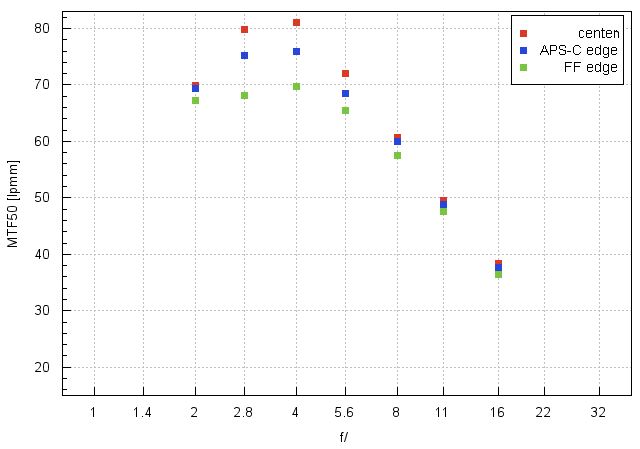
I want to post the sharpness profile of the (E vsn) Voigtlander 50/2 APO to illustrate a key point not often mentioned elsewhere. As you can see in this MTF50 profile, you lose 20% going from peak at f4 to f8 (average 75->60), and 33% going down to f11 (75->50). F16 delivers just on one half of what the lens is capable of. Also important is the near-unique MTF of this lens; all parts of the frame move together as you change aperture!
In the real world, however, f8 from the CV 50/2 delivers very nice images, a look we see in the best Zeiss lenses; I call this rendering 'mellow' because you get a near-perfect flat field, and even cross-frame performance. It's something you don't see in say, Sony's GM 50/1.2, at any aperture above f16. Most fast lenses quickly lose centre sharpness while gaining (or losing to a lesser extent) outer frame IQ on stopdown. And if you focus that 50/1.2 at infinity at f2, you are in for a rude shock.
But that is not my point here. Unseen by most, Cosina are giving these lenses (35/2 APO is similar) lovely focus fade character at all apertures, and the very high MTF at f2-f5.6 become very useable in deep images, with enough separation from on-plane to off-plane content courtesy of the high and even performance at these apertures - provided your plane is at moderate distance, say 15-30 metres. It flies in the face of the 'everything sharp' agenda boosted by stacking or loss-making small apertures. But it can produce engaging images - with a kind of soft detail shown behind the very sharp plane, graduated into the far distance. I've never read a review that mentioned mid aperture bokeh.
MTF50 profile by aperture: CV 50/2 APO (courtesy of Lenstip)
tsdevine wrote:
If interested, I posted a thread in the Post Processing forum where we can all process the same shot taken at f/16 to see what different approaches to sharpening can yield for a diffracted shot
graytrekker wrote:
After reading the one comment that is there, right now, I think I. should add one thing to this discussion here. It all depends on the size of the print, right? For the size of reproductions found in a book, I don't think there would be anything wrong with f16. The issue I had was that I was preparing my image large for a large print - 48x27 and as I enlarged it, that's when I noticed the "softness". Granted, it will be on canvas, so a little more forgiving that some of the high-end, fine detail prints. I wanted to avoid. the "capture sharpening" that Mark Metternich crusades against, as he claims it introduces artifacts which can be seen in large prints. I think he keeps a "master" file unsharpened, and the maybe he sharpens in PS when outputting for specific sizes/prints? in the comment section below a recent a YouTube video,, he also praised the deconvolution sharpening in Raw Therapy. All of this is beyond my current level of processing knowledge and competency, so I have to rely on the opinions and suggestions of others and where they may direct me to learn more about a topic.
Yes, final output size has a huge influence on whether or not you'll notice the small aperture diffraction in your image.
IME baking sharpening into an image will generally cause more problems when you need to scale up the image for a larger than native output size. Sharpening enhances contrast, either at low frequencies, or at the fine detail level, depending on the settings used. Once that contrast enhancement is applied, the range of tones in that area is reduced, and I can't think of any way to recover them after the fact. So that's where having an unsharpened master would be advantageous. That said, I suspect a gently 'well sharpened' master would also scale up well, especially if it's from a high megapixel original.
And IME sharpening sometimes isn't the last stage either. If it's strong sharpening, it will affect delicate color and tonality and may result in some perceived loss. In my pre-press days at a newspaper, we ran very strong USM on images sized for final output. I typically followed it up with a fade->luminosity IIRC, and then hit it with a color saturation boost, too.
When I output my raw files I output at native resolution without output sharpening so that I have more, though perhaps only slightly more flexibility down the road, depending on end uses. Images that are output in LR at lower than native resolution for a specific application have LR apply light sharpening to remove the slight softening that otherwise results.
I don't print much, but I tend to have a lighter touch when it comes to sharpening. And I realize that the ultimate output medium and size drives sharpening. But sometimes I think people are scared off of stopping down, even if it really would help convey the image they want.
rscheffler wrote:
Yes, final output size has a huge influence on whether or not you'll notice the small aperture diffraction in your image.
IME baking sharpening into an image will generally cause more problems when you need to scale up the image for a larger than native output size. Sharpening enhances contrast, either at low frequencies, or at the fine detail level, depending on the settings used. Once that contrast enhancement is applied, the range of tones in that area is reduced, and I can't think of any way to recover them after the fact. So that's where having an unsharpened master would be advantageous. That said, I suspect a gently 'well sharpened' master would also scale up well, especially if it's from a high megapixel original.
And IME sharpening sometimes isn't the last stage either. If it's strong sharpening, it will affect delicate color and tonality and may result in some perceived loss. In my pre-press days at a newspaper, we ran very strong USM on images sized for final output. I typically followed it up with a fade->luminosity IIRC, and then hit it with a color saturation boost, too.
When I output my raw files I output at native resolution without output sharpening so that I have more, though perhaps only slightly more flexibility down the road, depending on end uses. Images that are output in LR at lower than native resolution for a specific application have LR apply light sharpening to remove the slight softening that otherwise results....Show more →
I think Fred's two-shot solution is a good one. One image optimized for plane of focus acutance/micro-contrast and the second for deep depth of field.
In reference to my prepress experience, printing on newsprint is considerably different than fine art inkjet printing, etc. newsprint absorbs ink like toilet paper and the halos created by strong USM gives ink room to bleed into. That's why I agree final sharpening is very dependent on final usage - media, whether paper (and type) or electronic, as well as size, typical viewing distance, etc.
The pixel-peeping mindset currently, to avoid diffraction softness territory, is useful in respect to preserving as much detail/information as possible in the focal plane at native resolution. But yes, if it's a deep DoF scene, you run into conflicting priorities and need to decide whether to stick to a single capture or focus stacking. Sometimes the latter is not practical.
tschopp wrote:
The error in the image caused by diffraction is well understood mathematically. So a deconvolution to mathematically reverse the error makes sense. One of the issues is the image taken will have photon shot noise present that can cause artifacts with the deconvolution. If a good lens starts to get a reduction in sharpness around f/5.6 on a a7Riv that means diffraction is also present at wider aperture, just not the limiting factor in sharpness. Overall to me it seems like more good than harm. I typically run deconvolution for all images f/4 or higher.
Yes, deconvolution does result in a slight increase in noise, which may in part be an artifact of the inherent shot noise of the original. I suspect this is more of an issue in astro, where higher iso's are often used, and exposures can go on for hours or even days.
Its also much easier to deconvolve a point source of light, like a star, as we know the airy disk pattern well, as you say, so its fairly easy to correct for it. I'm not sure how they do it in more complex photographs, as points - and their airy disks, obviously overlap each other in that scenario, 'contaminating' the adjacent point spread function.
With an RIV, the blue spectrum in theory would start to diffract around f4, although this presents more of a slight loss in micro-contrast to the eye, rather than a resolution hit per see. The only possible downside I can see in applying deconvolution to your f4 and f5.6 images, is that the best lenses are so sharp here, that they often produce aliasing, and other spurious resolution artifacts - because their MTF's are still too high at the Nyquist frequency, and these artifacts may induce their own artifacts in the deconvolution process.
Fred Miranda wrote:
How do you like the CV 21/3.5? I've shot with it for a couple years but ended up exchanging it for the Leica 21/3.4 SEM. The latter is capable of more resolution off-axis but the Voigtlander is a great option as well. It works quite well on the Sony adapted.
Hey Fred,
Honestly, this lens does surprises me as well as impress me from time to time and once dialed it it's almost like an AF lens in theory. I jump around quite a bit between this one, the 40 NOK & 50/2 APO and getting use to them on a consistent basis
The 7.8 inch MFD of the E 21/3.5 is surprisingly useful and it's the shortest of the half dozen I checked (Loxia, CY/Milvus Distagon, ZM, CV 21/1.4, etc.). The CV/M version of the 21/3.5 is 19.7 inches MFD and the 21/3.4 is 27.3 inches MFD. The 21/3.5 E has neat bokeh at MFD, great for tight spots.
graytrekker wrote:
Thanks for the compliment and suggestion, Fred.
Is this what they call "Capture Sharpening"? After listening to Mark Metternich and others, I am a little reluctant to do that. What about the export sharpening? Looking to learn more about that stuff.
Of course the real solution is to avoid f16 - right?
Cheers
Doug
I had a look at Mark's video here:
which discusses what traditionally has been known as 'Capture Sharpening'. It's not that he's suggesting, don't do it, but rather you need to be careful how you go about it: i.e. don't use a monitor with too high ppi; always judge the effect at 100%; don't just blindly apply it on an image wise basis - assuming that it won't do any damage, because its mild, right? He admits that, if done correctly, it will give you gains in sharpness, that cannot be achieved with later processing.
Nothing really new here. Frankly, this smacks as just an infomercial for his 'sharpening masterclass', using the usual marketing psychology technique of trying to make it sound like he knows something very few people do, and trying to scare viewers into thinking they'll ruin their images if they don't spend the dollars to be let in on his 'secret'. Honestly, Bruce Frazer and Jeff Schewe were all over this years ago.
Petegh wrote:
Honestly, Bruce Frazer and Jeff Schewe were all over this years ago.
Yes, he does promote his workshop all the time - I can turn a blind eye to that (and fast forward).
My take on Mark's workflow, is he does a minimum in LR or ACR, and never sharpens there. Then he transfers the image as a smart object in PS and does all the other adjustments, including sharpening as separate layers, targeted through masking, rather tan globally in LR/ACR.
I have never heard of Bruce Frazer and Jeff Schewe - I guess I'll google them - thanks
philip_pj wrote:
I've never read a review that mentioned mid aperture bokeh.
Along the lines of considering when a lens looks best instead of when the background is most blurred, there's this from Mike Johnston:
"Years ago, rather unfortunately in some ways, I named the 35mm Summicron-M v.4 as the "King of Bokeh" (bokeh — or boke or boke-aji — meaning out-of-focus [o-o-f] blur). The epithet has taken on a life of its own since then...especially when that lens is for sale somewhere.... I was missing part of the story at the time (1997). You see I never shot the lens wide open and very seldomly as little as one stop down. It does have wonderfully coherent blur — from ƒ/5.6 and moderate distances."
graytrekker wrote:
Yes, he does promote his workshop all the time - I can turn a blind eye to that (and fast forward).
My take on Mark's workflow, is he does a minimum in LR or ACR, and never sharpens there. Then he transfers the image as a smart object in PS and does all the other adjustments, including sharpening as separate layers, targeted through masking, rather tan globally in LR/ACR.
I have never heard of Bruce Frazer and Jeff Schewe - I guess I'll google them - thanks
Doug
Actually, Jim Kasson has recently published this article about sharpening Leica Q2 files, which speaks to this topic: he says of Lightrooms default capture sharpening settings: 'There’s a technical word to describe this kind of input sharpening: horrendous.'
The 'correct' settings he ends up with, turn out to be the same as he uses for the GFX100S, which, with the same pixel pitch as the Sony A7RIV, should be something users of that camera should take note of.
The late Bruce Fraser was the technical doyen of all things Photoshop; his work has been carried on by Jeff Schewe in recent years.
Doug, if you want to learn more about this topic, I recommend 'The Digital Negative', and 'The Digital Print', by Jeff Schewe
The 'correct' settings he ends up with, turn out to be the same as he uses for the GFX100S, which, with the same pixel pitch as the Sony A7RIV, should be something users of that camera should take note of.
The late Bruce Fraser was the technical doyen of all things Photoshop; his work has been carried on by Jeff Schewe in recent years.
Doug, if you want to learn more about this topic, I recommend 'The Digital Negative', and 'The Digital Print', by Jeff Schewe
Thanks for Jim's link. He's always the "go to" guy for technical things like this. Even though I am a scientist (of sorts), his engineering is usually way beyond my skill level. Luckily, he usually brings his treatises down for a "soft landing" for us mere mortals.
When the soon to be fall shooting season winds down, I curl up to my fire and look at Jeff's work.
Petegh wrote:
Actually, Jim Kasson has recently published this article about sharpening Leica Q2 files, which speaks to this topic: he says of Lightrooms default capture sharpening settings: 'There’s a technical word to describe this kind of input sharpening: horrendous.'
The 'correct' settings he ends up with, turn out to be the same as he uses for the GFX100S, which, with the same pixel pitch as the Sony A7RIV, should be something users of that camera should take note of.
The late Bruce Fraser was the technical doyen of all things Photoshop; his work has been carried on by Jeff Schewe in recent years.
Doug, if you want to learn more about this topic, I recommend 'The Digital Negative', and 'The Digital Print', by Jeff Schewe ...Show more →
Thanks for posting the sharpening article. Very interesting indeed!
Fred Miranda wrote:
I've tried the suggestions by Jim and still think more sharpening is needed. I guess we just got used to seeing artifacts in our images!
I don't mind a bit of false detail from sharpening, either His suggestions in that article were about monochrome files (Q2M), which are quite crispy with C1/LR default sharpening. I think the M10M files are even more crispy.
highdesertmesa wrote:
I don't mind a bit of false detail from sharpening, either His suggestions in that article were about monochrome files (Q2M), which are quite crispy with C1/LR default sharpening. I think the M10M files are even more crispy.
Yes, due to color interpolation for bayer filter array images, more sharpening is needed.