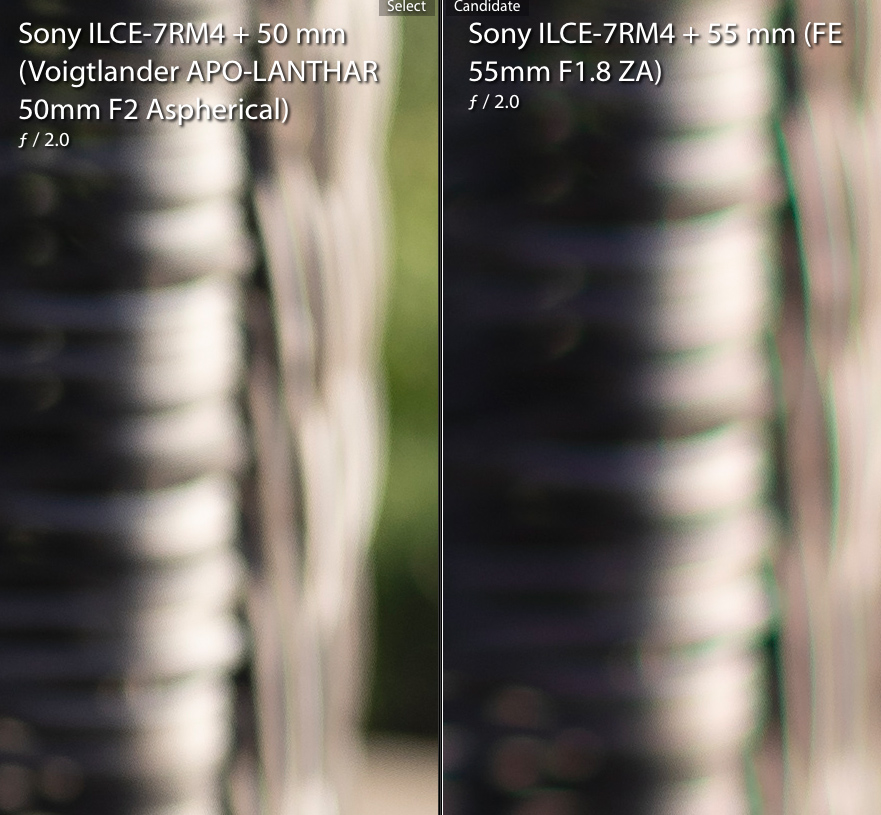
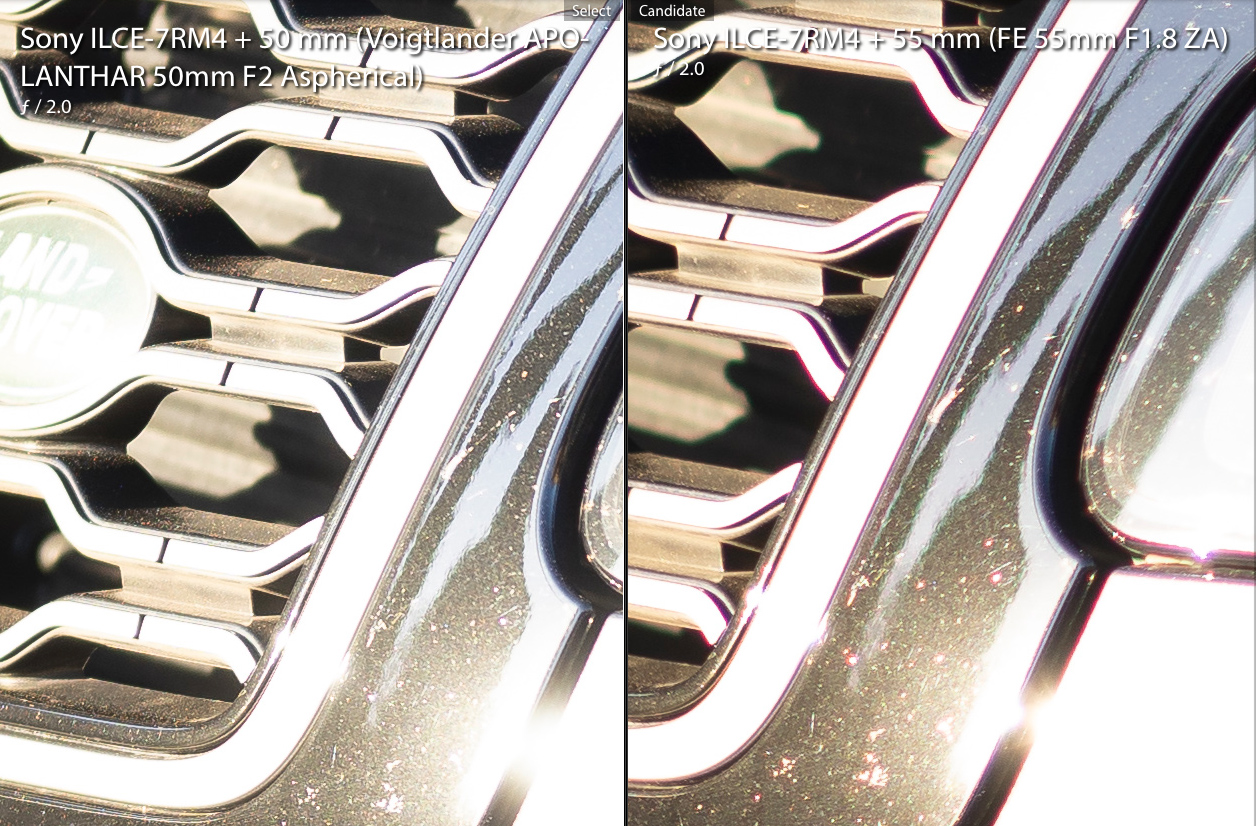
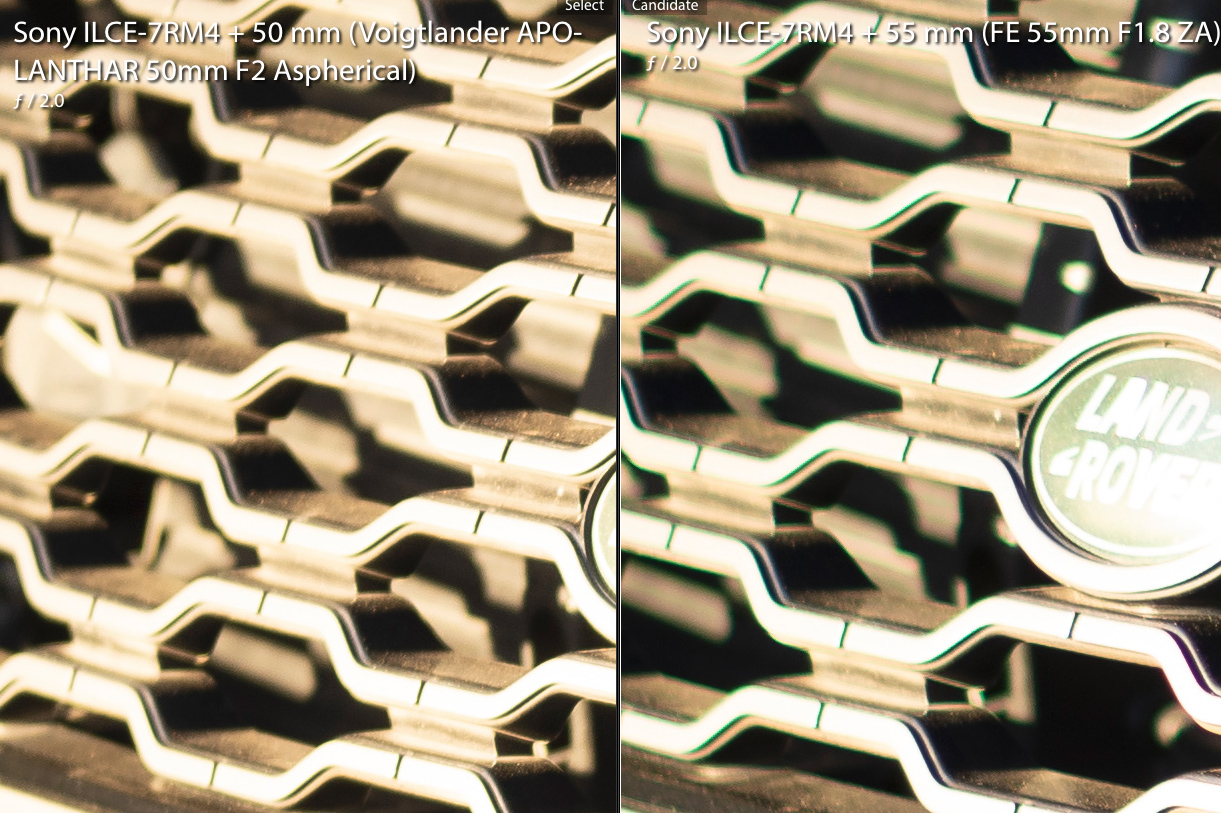
Steve Spencer wrote:
I think APO is defined as have three wavelengths of light that focus exactly on the focus plane. That is what APO really is. It has nothing to do with sharpness or high performance. I have one lens--the Minolta MD 400 f/5.6 APO that has very little CA and I think may well even meet the technical definition of APO, but it isn't really all that sharp. As I wrote earlier both Fred's and Phillip's review made it clear the lens was sharp across the field (i.e., flat field) from wide apertures. That is a good characteristic to have and has nothing to do with being APO. There are many excellent APO lenses that are not flat field (e.g., the CV 110 f/2.5 APO macro). The lens also has very low coma. Again there are many excellent APO lenses that are not low coma (e.g the Zeiss Otus 28 f/1.4 APO). The lens has quite nice bokeh and although APO lenses will have less bokeh fringing than non-APO lenses there is no guarantee, some APO lenses are quite bokeh challenged (e.g., the Leica M 90 f/2 APO). I could go on but your contention that APO means excellent in any category other than correction for CA just doesn't hold water at all. My contention is that the overall excellence of this lens which people on this forum have recognized and not that it was designated as APO is why people here have shown a great interest in this lens....Show more →
APO may not have anything to do with sharpness but it certainly contributes to the perception of sharpness.
Saturation also.
Jan 10, 2020 at 07:37 PM
Steve Spencer Offline • • • • • • • Upload & Sell: On
nhsonyshooter wrote:
My point is Steve is saying APO is not the main reason people are interested which is ridiculous because the APO design is what is contributing to the lens being so sharp and free of almost all aberrations. With out that design you have just a good small 50 most likely with newly designed blades. That alone would not have attracted the attention to this lens. Especially with the very nice 50 1.2 which is not much bigger, faster, and renders nicer IMO.
My point is that is a misunderstanding of what an APO design actually is. The APO design should minimize CA and that is it. An APO design does not necessarily mean that the lens is sharp or free from any other aberrations. I think the people on this forum are sophisticated enough to know that. I think a lens that was very sharp, had a flat field, had excellent close up performance, had low coma, had low distortion, had decent bokeh, was small and had excellent haptics, had excellent performance against bright light, had the new aperture design and was not APO but still had decent CA control would still be a very popular lens around here. Maybe someday we will see if such a lens comes around, but in my view the people on this forum are sophisticated enough to know what APO is and isn't to give it an appropriate weight and the APO designation is just one relatively small piece of the puzzle of why this lens has received a lot of positive attention here.
Jan 10, 2020 at 07:37 PM
Steve Spencer Offline • • • • • • • Upload & Sell: On
DaveFP wrote:
APO may not have anything to do with sharpness but it certainly contributes to the perception of sharpness.
Saturation also.
I would say this in a very different way. CA can interfere with the appearance of sharpness when it is apparent and what is a very sharp lens can sometimes appear as less sharp when CA is present. A great example of this phenomenon can be seen with the Zeiss ZE/ZF/Milvus 100 f/2 Macro. This is a very sharp lens and most tests show that it is even sharper than the CV 125 f/2.5 APO Macro when the two were tested side by side. If the Zeiss is hindered by CA, as it is in some situations, however, that reduces its apparent sharpness and in these situation the CV 125 f/2.5 APO Macro (which is less affected by CA) will appear sharper. So it is not that the APO nature of a lens increases apparent sharpness it is that a lens that suffers from CA in a situation will lose apparent sharpness in those situations and APO lenses that minimize CA will suffer less loss of sharpness in those situations.
The same thing applies to saturation. It is CA that robs some lenses of apparent saturation, so APO lenses which minimize CA don't suffer as much from this drop in apparent saturation in situations that provoke CA.
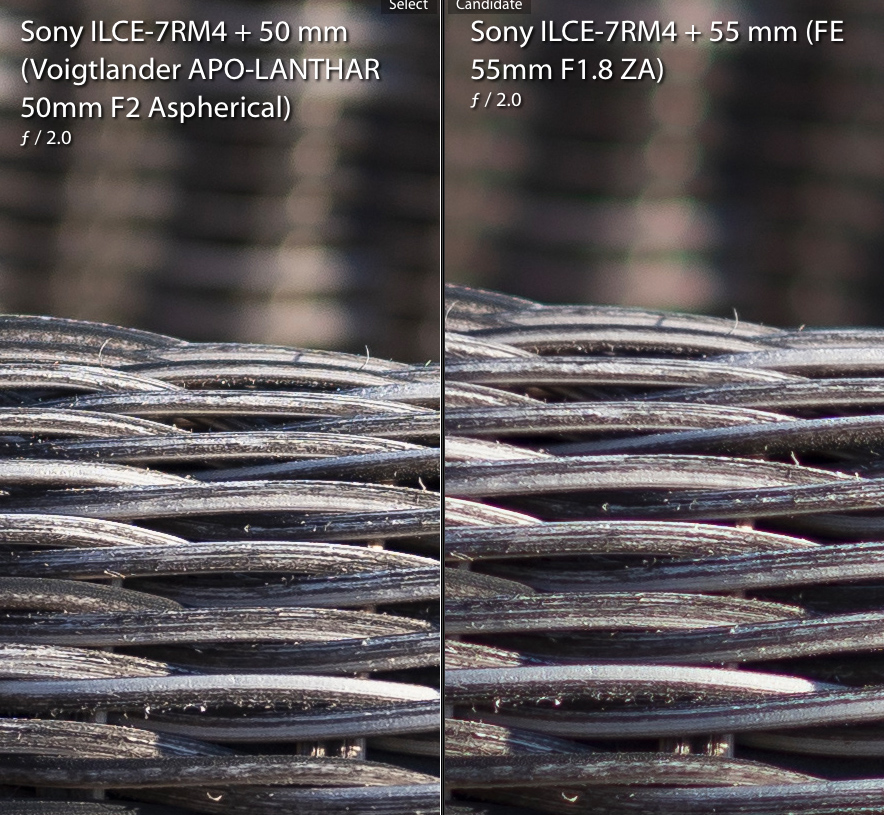
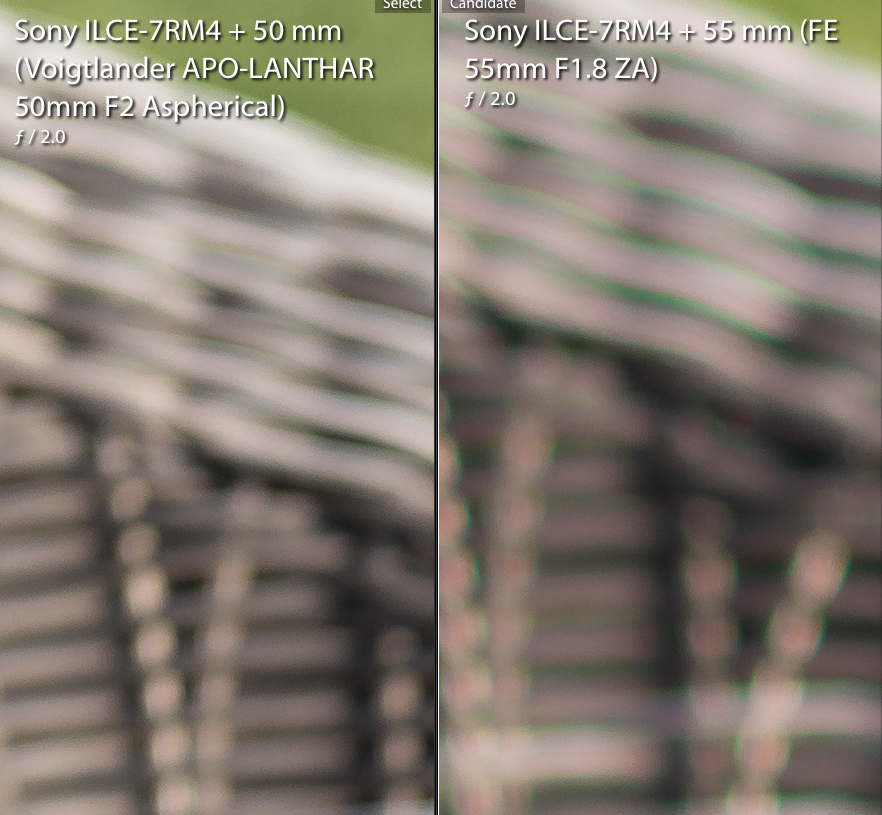
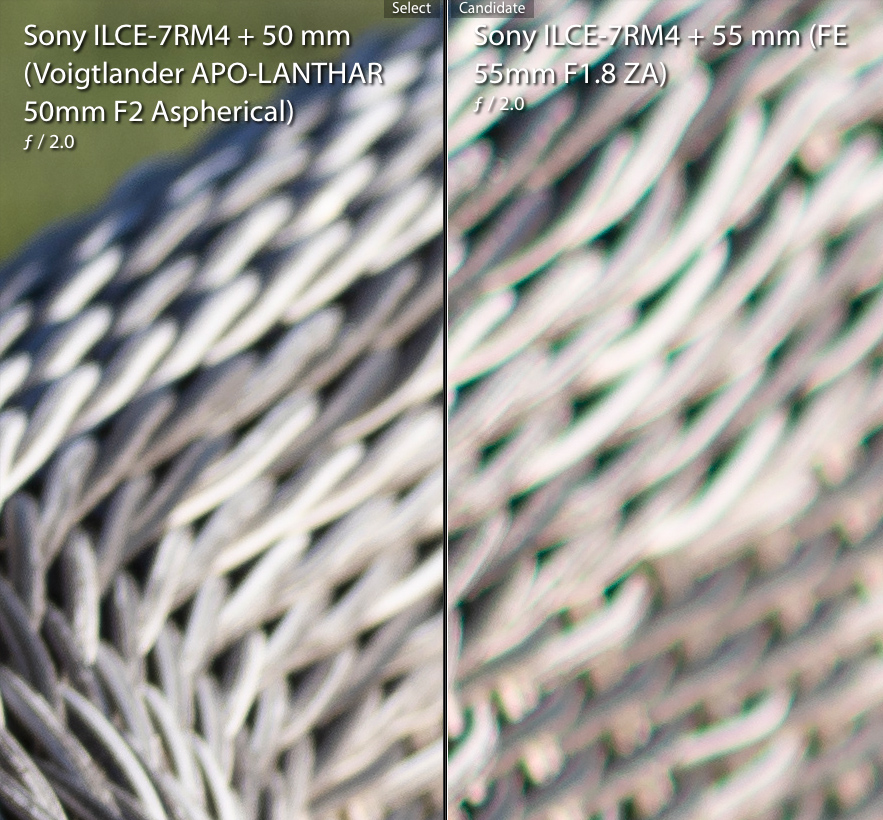
Even under low contrast lighting (1 hour before sunset) where longitudinal CA is more subtle, the 55/1.8 ZA's level of correction is very weak compared to the APO. This is not surprising to me as I find LoCA correction the main negative for the 55/1.8 ZA.
Not many 50mm lenses (if any) can match the CV 50/2 APO's performance.
PS:
All in-camera corrections "OFF"
In Lightroom, all corrections "OFF"
Still under low contrast lighting, reflective surfaces always show purple fringing (LoCA) on the focus area for the 55/1.8. It's never the case with the CV 50/2 APO which only has traces of color aberration.
If I was shooting under high contrast lighting (around noon), color aberration would look way worse for the 55/1.8 while the 50/2 APO would only show traces of color error.
Would I get rid of the 55/1.8 ZA because of this? Nope, but it's good to know the weakness and strengths of our lenses. They are all optical compromises after all.
Fred Miranda wrote:
If I was shooting under high contrast lighting (around noon), color aberration would look way worse for the 55/1.8 while the 50/2 APO would only show traces of color error.
Would I get rid of the 55/1.8 ZA because of this? Nope, but it's good to know the weakness and strengths of our lenses. They are all optical compromises after all.
Yep; need/want a small AF 50 for your Sony? Thats still the ZA. (IMO)
Steve Spencer wrote:
I would say this in a very different way. CA can interfere with the appearance of sharpness when it is apparent and what is a very sharp lens can sometimes appear as less sharp when CA is present. A great example of this phenomenon can be seen with the Zeiss ZE/ZF/Milvus 100 f/2 Macro. This is a very sharp lens and most tests show that it is even sharper than the CV 125 f/2.5 APO Macro when the two were tested side by side. If the Zeiss is hindered by CA, as it is in some situations, however, that reduces its apparent sharpness and in these situation the CV 125 f/2.5 APO Macro (which is less affected by CA) will appear sharper. So it is not that the APO nature of a lens increases apparent sharpness it is that a lens that suffers from CA in a situation will lose apparent sharpness in those situations and APO lenses that minimize CA will suffer less loss of sharpness in those situations.
The same thing applies to saturation. It is CA that robs some lenses of apparent saturation, so APO lenses which minimize CA don't suffer as much from this drop in apparent saturation in situations that provoke CA....Show more →
Actually what you're saying is not very different at all.
Steve Spencer wrote:
I think APO is defined as have three wavelengths of light that focus exactly on the focus plane. That is what APO really is. It has nothing to do with sharpness or high performance. I have one lens--the Minolta MD 400 f/5.6 APO that has very little CA and I think may well even meet the technical definition of APO, but it isn't really all that sharp. As I wrote earlier both Fred's and Phillip's review made it clear the lens was sharp across the field (i.e., flat field) from wide apertures. That is a good characteristic to have and has nothing to do with being APO. There are many excellent APO lenses that are not flat field (e.g., the CV 110 f/2.5 APO macro). The lens also has very low coma. Again there are many excellent APO lenses that are not low coma (e.g the Zeiss Otus 28 f/1.4 APO). The lens has quite nice bokeh and although APO lenses will have less bokeh fringing than non-APO lenses there is no guarantee, some APO lenses are quite bokeh challenged (e.g., the Leica M 90 f/2 APO). I could go on but your contention that APO means excellent in any category other than correction for CA just doesn't hold water at all. My contention is that the overall excellence of this lens which people on this forum have recognized and not that it was designated as APO is why people here have shown a great interest in this lens....Show more →
"I think APO is defined as have three wavelengths of light that focus exactly on the focus plane. That is what APO really is. It has nothing to do with sharpness or high performance"
So you think a lens focusing the red,green and blue light to different points is somehow going to be just as sharp as when an APO lens is focusing all three colors to a single point? I guess it is just a coincidence that most of the sharpest lenses across all brands are APO then since it has "nothing to do with sharpness"
Jan 10, 2020 at 08:33 PM
Steve Spencer Offline • • • • • • • Upload & Sell: On
nhsonyshooter wrote:
"I think APO is defined as have three wavelengths of light that focus exactly on the focus plane. That is what APO really is. It has nothing to do with sharpness or high performance"
So you think a lens focusing the red,green and blue light to different points is somehow going to be just as sharp as when an APO lens is focusing all three colors to a single point? I guess it is just a coincidence that most of the sharpest lenses across all brands are APO then since it has "nothing to do with sharpness"
You are demonstrating that you do not understand what APO actually is. It is not focussing red, green, and blue on the focal plane. It is focussing three specific wavelengths (e.g.. 525 nanometers, 780 nanometers, and 1100 nanometers) on the focus plane. All the other wavelengths still do not focus exactly on the focus plane. So it is a very specific red (or maybe an orange), a very specific green (or maybe a yellow), and a very specific violet (or maybe a blue) on the focal plane (and sometimes it isn't even a red in the visible spectrum but an infrared and sometimes it isn't a blue in visible spectrum but an ultraviolet) all the other reds, oranges, yellows, greens, blues, and violets don't focus on the focus plane. And whether a color focusses on the focus plane does not tell us anything about how well it resolves at that wavelength.
It is not a coincidence either that most lenses that are APO are sharp. Removing APO is not easy and arguably harder than making a lens sharp. So if you are designing a lens that you are going to the work of making it APO, you are also likely willing to go to the work of making it sharp, but there is no necessary relationship. It is also true that luxury cars tend to have engines with more horsepower, but nothing about having a high horse power engine makes a lens a luxury car. Just if you are designing a car with a big engine you likely are going to also go to the work of making the ride smooth and making the interior nice. So, it isn't a coincidence that luxury cars have high horsepower engines, but having a high horsepower engine has nothing to do with making a car a luxury car.
Jan 10, 2020 at 09:07 PM
Steve Spencer Offline • • • • • • • Upload & Sell: On
nhsonyshooter wrote:
Nope. But APO is the lens design so with out that design it definitely would change the lens performance.
Nope APO is not the lens design it is a measurement of how the lens performs. The number of elements, the types of elements, the spacing of the elements etc. is the lens design. Some lens designs have APO performance, but there is no such thing as an APO lens design.
Steve Spencer wrote:
Nope APO is not the lens design it is a measurement of how the lens performs. The number of elements, the types of elements, the spacing of the elements etc. is the lens design. Some lens designs have APO performance, but there is no such thing as an APO lens design.
Yup!
Again, Maybe you should let Voigtlander know. Since they are the ones that make the lens I think I will believe them over some guy on the internet named Steve.
"Voigtländer APO-LANTHAR 50mm F2.0 is a high performance manual focus standard lens optimized for the imaging sensors of Sony mirrorless cameras.
Inheriting the apochromatic optical design, the lens is highly corrected to eliminate optical aberrations including longitudinal chromatic aberration."
Steve Spencer wrote:
And that is a ridiculously simplistic analysis. How wide the aperture opens up and whether the lens is labelled as APO are not the only two differences between these lenses. Size, sharpness, bokeh, flatness of field, close up performance, coma, etc. all differ in these lenses as well. This statement does absolutely nothing to support your contention people here are swayed by APO rather than the other factors.
Interesting. So in your professional opinion, which of the following statements are best describing human behavior:
A) In a forum, people are most likely to click on, read and participate in threads where the subject line contains keywords of most interest to them
B) In a forum, people are most likely to click on, read and participate in threads where the subject line contains keywords of the least interest to them
C) In a forum, people are most likely to click, read and participate into random threads, ignoring the subject line
Additionally, please explain how comes that the bulk of this thread is about the APOidness of the lens, not the size, weight or some other parameter. Please pick a statement here too:
1) In a forum, people are most likely to debate the subjects of most interest to them
2) In a forum, people are most likely to debate the subjects of least interest to them
Yet, you are here despite not wanting a manual focusing lens that would not close focus and despite not liking the Voigtlander name.
vdo1 wrote:
Interesting. So in your professional opinion, which of the following statements are best describing human behavior:
A) In a forum, people are most likely to click on, read and participate in threads where the subject line contains keywords of most interest to them
B) In a forum, people are most likely to click on, read and participate in threads where the subject line contains keywords of the least interest to them
C) In a forum, people are most likely to click, read and participate into random threads, ignoring the subject line
Additionally, please explain how comes that the bulk of this thread is about the APOidness of the lens, not the size, weight or some other parameter. Please pick a statement here too:
1) In a forum, people are most likely to debate the subjects of most interest to them
2) In a forum, people are most likely to debate the subjects of least interest to them
realVivek wrote:
Yet, you are here despite not wanting a manual focusing lens that would not close focus and despite not liking the Voigtlander name.
I’m here to admire (and possibly debate) the optical quality of the lens, even if I knew from the beginning that it’s not for me (due to my personal preference for AF and close focus features). Pretty much like I did in the GM 135 thread, knowing very well that it’s not for me simply because of the FL. As for the 50mm debate, I don’t recall thrashing it in this thread. My remarks so far were directed at the test methodology, not the performance of the lens.