This topic is in the 2019 archive. You can read it and like its posts here. It is read only.
Archive 2019My AMD Ryzen 3900x build
p.1 #1My AMD Ryzen 3900x build
Thought it might be fun and perhaps helpful to others to share details and photos of a new photo/video editing system I'm putting together. I've had all the components ready for a while but been waiting months on the CPU to come in stock.
First here are the components and price paid (total so far is $1775):
I chose the 3900x because I'm a heavy user of Virtual Machines and usually have several open alongside my image/video editing apps (Photoshop/Lightroom/Premiere/After Effects/DaVinci Resolve/Fusion). The extra CPU cores are helpful to keep the system usable even when under load across the VMs and apps. A better value-performance alternative for those who don't need 12 cores is the 3700x, which sells for $330. I chose 64GB of memory for the same reason - the VMs take up quite a bit of memory, as do my editing apps.
For Ryzen motherboards you have two generations of chipsets to chose from, which is possible because the newer 3rd-generation Ryzen CPUs are backward compatible with existing/older chipsets - the older B450/X470 chipset boards (PCI 3) or the newer B550/X570 (PCI 4). I didn't see a specific need for the faster PCI 4 so I went with an older B450-based motherboard. I might upgrade to an X570 in the future when their prices come down. The difference between the 'B' and 'X' motherboards is whether they have SLI support support ('X' does). I specifically chose the MSI Tomahawk board because it has the Flashback+ feature, which lets you upgrade the BIOS without a CPU installed - this is necessary if you don't have an older-gen Ryzen CPU because most older B450/X470 boards require a BIOS upgrade to boot with the 3rd-generation Ryzen CPUs. Other brands have similar feature. AMD also has a Ryzen loaner program where they'll lend you an older Ryzen CPU for the sole purpose of upgrading the BIOS on a B450/X470 board.
I was debating between a single or dual GPU setup, especially since I'm transitioning from Premiere to DaVinci Resolve for my video editing and unlike Premiere, Resolve makes full use of the GPU, including multiple GPUs. I decided to go with a single GPU for now. I chose the 1080ti even though the 2070/2070 Super/2080 have equal or slightly better performance and offer newer hardware-based optimizations like ray tracing. I went with the 1080ti because it's a more mature platform that I thought GPU-accelerated apps would be better optimized for.
I haven't settled on my full storage setup yet but for the boot drive I went with a 1TB NVMe SSD. I chose a relative value model vs the ultra-fast options available that can approach 3GB/s sustained transfers. I didn't think the extra sustained performance would have made a significance difference. I'm more interested in IOPs/latency, which is especially important for the virtual machines since the I/O architecture is a bit slower to begin.
For the cooling solution the two basic choices are air-cooling vs water-cooling/AIO. The water-cooling solutions give you more temperature headroom for overclocking. I was only planning a very modest overclock (if any at all) so I went with air-cooling.
I'm less picky about my cases - I wanted something quiet and reasonably large for cooling but not gigantic.
I finally received the CPU today. I installed the CPU, heatsink, and memory and set up a make-shift test station to make sure everything works before I install it in the case. I also want to monitor the idle temps to make sure I did a good application of the thermal paste. On new systems I test memory for a minimum of 24 hours, esp dense-memory systems like this one without ECC support. Here are photos of
some of my components and test setup:
https://photos.smugmug.com/photos/i-d94bGSn/0/6dfabe9e/XL/i-d94bGSn-XL.jpg
https://photos.smugmug.com/photos/i-QWMLjsh/0/8df91a0c/XL/i-QWMLjsh-XL.jpg
https://photos.smugmug.com/photos/i-RL2LHCj/0/278cbe9f/XL/i-RL2LHCj-XL.jpg
https://photos.smugmug.com/photos/i-rjvt5tX/0/b4dad3de/XL/i-rjvt5tX-XL.jpg
https://photos.smugmug.com/photos/i-VqJHXZv/0/33fd5b56/XL/i-VqJHXZv-XL.jpg
https://photos.smugmug.com/photos/i-ZvVzTWS/0/997f4d64/XL/i-ZvVzTWS-XL.jpg
First here are the components and price paid (total so far is $1775):
- CPU: AMD Ryzen 3900x 3.8Ghz/4.6Ghz (12-cores, 24-threads) - $500
- Memory: 64GB Micron Ballistix Sport LT Series DDR4 3200 (4x16GB) - $300
- Video: MSI GeForce GTX 1080 Ti 11GB - $500
- Storage: XPG SX8200 NVMe 960GB (Boot Drive) - $150
- Motherboard: MSI B450 Tomahawk Motherboard - $100
- Power Supply: EVGA SuperNova 750W G+ - $60 (special sale last winter)
- Case: Antec Performance Series P8 Black Steel case - $65
- CPU Heatsink: Noctua NH-D15 SE-AM4 - $90
- CPU Thermal Paste: ARCTIC MX-4 - $10
I chose the 3900x because I'm a heavy user of Virtual Machines and usually have several open alongside my image/video editing apps (Photoshop/Lightroom/Premiere/After Effects/DaVinci Resolve/Fusion). The extra CPU cores are helpful to keep the system usable even when under load across the VMs and apps. A better value-performance alternative for those who don't need 12 cores is the 3700x, which sells for $330. I chose 64GB of memory for the same reason - the VMs take up quite a bit of memory, as do my editing apps.
For Ryzen motherboards you have two generations of chipsets to chose from, which is possible because the newer 3rd-generation Ryzen CPUs are backward compatible with existing/older chipsets - the older B450/X470 chipset boards (PCI 3) or the newer B550/X570 (PCI 4). I didn't see a specific need for the faster PCI 4 so I went with an older B450-based motherboard. I might upgrade to an X570 in the future when their prices come down. The difference between the 'B' and 'X' motherboards is whether they have SLI support support ('X' does). I specifically chose the MSI Tomahawk board because it has the Flashback+ feature, which lets you upgrade the BIOS without a CPU installed - this is necessary if you don't have an older-gen Ryzen CPU because most older B450/X470 boards require a BIOS upgrade to boot with the 3rd-generation Ryzen CPUs. Other brands have similar feature. AMD also has a Ryzen loaner program where they'll lend you an older Ryzen CPU for the sole purpose of upgrading the BIOS on a B450/X470 board.
I was debating between a single or dual GPU setup, especially since I'm transitioning from Premiere to DaVinci Resolve for my video editing and unlike Premiere, Resolve makes full use of the GPU, including multiple GPUs. I decided to go with a single GPU for now. I chose the 1080ti even though the 2070/2070 Super/2080 have equal or slightly better performance and offer newer hardware-based optimizations like ray tracing. I went with the 1080ti because it's a more mature platform that I thought GPU-accelerated apps would be better optimized for.
I haven't settled on my full storage setup yet but for the boot drive I went with a 1TB NVMe SSD. I chose a relative value model vs the ultra-fast options available that can approach 3GB/s sustained transfers. I didn't think the extra sustained performance would have made a significance difference. I'm more interested in IOPs/latency, which is especially important for the virtual machines since the I/O architecture is a bit slower to begin.
For the cooling solution the two basic choices are air-cooling vs water-cooling/AIO. The water-cooling solutions give you more temperature headroom for overclocking. I was only planning a very modest overclock (if any at all) so I went with air-cooling.
I'm less picky about my cases - I wanted something quiet and reasonably large for cooling but not gigantic.
I finally received the CPU today. I installed the CPU, heatsink, and memory and set up a make-shift test station to make sure everything works before I install it in the case. I also want to monitor the idle temps to make sure I did a good application of the thermal paste. On new systems I test memory for a minimum of 24 hours, esp dense-memory systems like this one without ECC support. Here are photos of
some of my components and test setup:
https://photos.smugmug.com/photos/i-d94bGSn/0/6dfabe9e/XL/i-d94bGSn-XL.jpg
https://photos.smugmug.com/photos/i-QWMLjsh/0/8df91a0c/XL/i-QWMLjsh-XL.jpg
https://photos.smugmug.com/photos/i-RL2LHCj/0/278cbe9f/XL/i-RL2LHCj-XL.jpg
https://photos.smugmug.com/photos/i-rjvt5tX/0/b4dad3de/XL/i-rjvt5tX-XL.jpg
https://photos.smugmug.com/photos/i-VqJHXZv/0/33fd5b56/XL/i-VqJHXZv-XL.jpg
https://photos.smugmug.com/photos/i-ZvVzTWS/0/997f4d64/XL/i-ZvVzTWS-XL.jpg
Oct 15, 2019 at 10:31 PM
p.1 #2My AMD Ryzen 3900x build
Snapsy
Thanks for sharing these, along with the photos of the progress of your build. Do let us know when the system is up and running, and how it performs under stress. I have an old Dell PowerEdge right now which serves as my home server/personal cloud, and am thinking of upgrading to a custom build along your lines.
Thanks for sharing these, along with the photos of the progress of your build. Do let us know when the system is up and running, and how it performs under stress. I have an old Dell PowerEdge right now which serves as my home server/personal cloud, and am thinking of upgrading to a custom build along your lines.
Oct 16, 2019 at 08:45 AM
p.1 #3My AMD Ryzen 3900x build
Thanks for the info. My system is getting old, it's an i5 4600, and it's getting long in the tooth. I've been using Intel for many years, but AMD's Ryzen models are very attractive. I also use VMs frequently, and I always find it aggravating to have to stop a VM before I can start using LR. This gives me some food for thought.
Oct 16, 2019 at 09:11 AM
p.1 #4My AMD Ryzen 3900x build
amacal1 wrote:
Thanks for the info. My system is getting old, it's an i5 4600, and it's getting long in the tooth. I've been using Intel for many years, but AMD's Ryzen models are very attractive. I also use VMs frequently, and I always find it aggravating to have to stop a VM before I can start using LR. This gives me some food for thought.
Another reason I went with Ryzen is they don't suffer from most of the Meltdown/Spectre side-channel processor exploits. Plus AMD added design mitigation/corrections for the Spectre variants it was vulnerable to. In contrast, Intel chips take significant performance hits from the firmware and OS mitigations they require.
Oct 16, 2019 at 09:33 AM
p.1 #5My AMD Ryzen 3900x build
I'm very tempted to do this! 
Thanks for posting Adam. The only thing I would change is to go with 128GB ram. It's hard to believe but image averaging is eating my current 64GB for breakfast!
Fred
Thanks for posting Adam. The only thing I would change is to go with 128GB ram. It's hard to believe but image averaging is eating my current 64GB for breakfast!
Fred
Oct 16, 2019 at 09:38 AM
p.1 #6My AMD Ryzen 3900x build
For those who prefer Intel or a pre-built there's a great deal right now on an i7-8700 system from Walmart for $999. It has been going in and out of stock due to the popularity but just went back into stock today:
https://www.walmart.com/ip/66JOIO7GH9ZB
Specs:
The system has gotten horrible reviews in the past due to shoddy assembly but the recent reviews have been better and the $999 price is much lower than when it was originally reviewed.
https://www.walmart.com/ip/66JOIO7GH9ZB
Specs:
- Intel i7-8600 3.2Ghz/4.6Ghz (6-core / 12-threads)
- NVIDIA GeForce GTX 1080TI
- 32GB RAM
- 512GB SSD
- 2TB HDD
The system has gotten horrible reviews in the past due to shoddy assembly but the recent reviews have been better and the $999 price is much lower than when it was originally reviewed.
Oct 16, 2019 at 10:07 AM
p.1 #7My AMD Ryzen 3900x build
Fun with computing gear! Those Noctua heatsinks can be huge but are very effective and the 120mm fans really keep the noise down (my pet peeve). My new build—dual Xeon Ivy Bridge—has 128GB with the other 128GB waiting to go in.
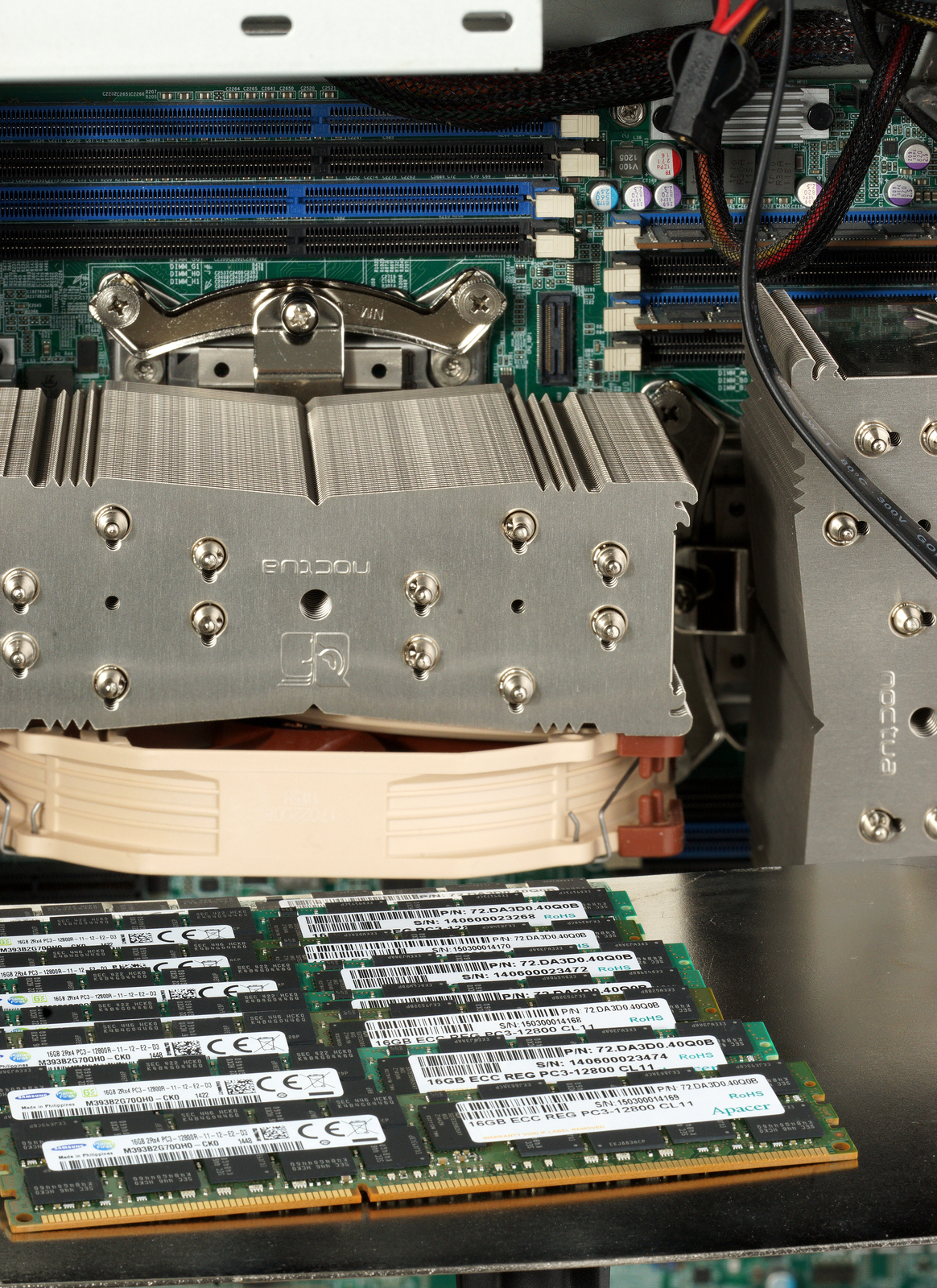
For storage, I just installed a 2TB PCIe flash card. Again, it's more about noise suppression than performance, although I don't turn my nose up at 3.5 GB/s sequential reads.
For storage, I just installed a 2TB PCIe flash card. Again, it's more about noise suppression than performance, although I don't turn my nose up at 3.5 GB/s sequential reads.
Oct 16, 2019 at 02:13 PM
p.1 #8My AMD Ryzen 3900x build
rico wrote:
Fun with computing gear! Those Noctua heatsinks can be huge but are very effective and the 120mm fans really keep the noise down (my pet peeve). My new build—dual Xeon Ivy Bridge—has 128GB with the other 128GB waiting to go in.
http://makino.fi/rico/fm/ddr3.jpg
For storage, I just installed a 2TB PCIe flash card. Again, it's more about noise suppression than performance, although I don't turn my nose up at 3.5 GB/s sequential reads.
Photo isn't showing up. Let's see that beast!
Oct 16, 2019 at 02:43 PM
p.1 #9My AMD Ryzen 3900x build
Installed Windows 10 and updates. Tip: The quickest way to get a new Windows installation up to date is to download the Windows 10 Update Assistant, which will bypass all the intermediate updates and get you the latest major release.
Idle temps looks good (28C for processor in a 19C ambient):
https://photos.smugmug.com/photos/i-xhGvxVh/0/b4be1838/XL/i-xhGvxVh-XL.png
Here's a video showing the multi-threaded Cinebench R15 run:
And on to the stress testing - starting with Prime95 and FurMark:
Idle temps looks good (28C for processor in a 19C ambient):
https://photos.smugmug.com/photos/i-xhGvxVh/0/b4be1838/XL/i-xhGvxVh-XL.png
Here's a video showing the multi-threaded Cinebench R15 run:
And on to the stress testing - starting with Prime95 and FurMark:
Oct 16, 2019 at 03:14 PM
p.1 #10My AMD Ryzen 3900x build
I've used water cooling for my last three builds, I much prefer it to air cooling for noise and dust. Though there is obviously forced airflow at the coolant radiator. But there's no weighty, towering heatsink completely full of dust inside my machine.
Oct 16, 2019 at 03:49 PM
p.1 #11My AMD Ryzen 3900x build
You're making my 3770K feel self-conscious.
I figure a new build is in my not-too-distant future (maybe in a year or so) and I'm so glad AMD is competitive again. FWIW, the 3770K replaced an Athlon 64 X2, so I obviously drive my machines into the dirt. I have to say, though, the current rig doesn't feel like it's holding me back like the old Athlon did at the end of its run. I suppose having twice the cores, a good overclock and 8X's the RAM goes a long way in that regard.
I figure a new build is in my not-too-distant future (maybe in a year or so) and I'm so glad AMD is competitive again. FWIW, the 3770K replaced an Athlon 64 X2, so I obviously drive my machines into the dirt. I have to say, though, the current rig doesn't feel like it's holding me back like the old Athlon did at the end of its run. I suppose having twice the cores, a good overclock and 8X's the RAM goes a long way in that regard.
Oct 16, 2019 at 04:32 PM
p.1 #12My AMD Ryzen 3900x build
Looks like a nice machine! I built with the 3700X, 16 GB of RAM, a mini 1070, gigabyte X570I board and dual NVMe drives in a custom SFF case, the MI-6. I don't use any VM's or video editing so I didn't need quite as much hardware, but it still screams compared to my circa 2009 Core 2 Quad build...
https://m.imgur.com/gallery/c44ArjD
https://m.imgur.com/gallery/c44ArjD
Oct 16, 2019 at 05:37 PM