p.2 #1 · Comparing 42MP vs 61MP: Real-World Resolution and Contrast
Fred, Maybe I'm missing something incredibly simple, but why is the resolution/contrast increase only expected or seen around the centre area of the image?
p.2 #2 · Comparing 42MP vs 61MP: Real-World Resolution and Contrast
StephenLowell wrote:
Fred, Maybe I'm missing something incredibly simple, but why is the resolution/contrast increase only expected or seen around the centre area of the image?
It's just because the higher the resolution, the higher the (absolute) increase in resolution when you increase the sensor resolution.
And central areas have higher resolutions to being with.
But all areas benefit, and all lenses benefit. A lot of rot is talked about lenses "not coping" with high MP. It's true that there will be very little improvement with a poor lens, but there will be improvement (of course you may be tempted to judge lenses by the pixel level, in which case you are looking at higher magnification when looking at a higher MP image: so flaws will be more visible, even if there is improvement. But if you compare at fixed magnification (of the sensor size, not pixel mag) you will mostly see improvement, perhaps in some poor lenses that improvement will be imperceptible.
p.2 #3 · Comparing 42MP vs 61MP: Real-World Resolution and Contrast
StephenLowell wrote:
Fred, Maybe I'm missing something incredibly simple, but why is the resolution/contrast increase only expected or seen around the centre area of the image?
Lens resolving power gradually drops away from the center, which means the lens becomes the limiting factor. It's actually a significant issue with high MP sensors for landscapes - not because there's less improvement away from the center by itself but because it creates a more noticeable difference in sharpness between the center and edges.
p.2 #6 · Comparing 42MP vs 61MP: Real-World Resolution and Contrast
Thanks Snapsy,
It was something I'm aware of but for some reason thought there may be something more
snapsy wrote:
Lens resolving power gradually drops away from the center, which means the lens becomes the limiting factor. It's actually a significant issue with high MP sensors for landscapes - not because there's less improvement away from the center by itself but because it creates a more noticeable difference in sharpness between the center and edges.
p.2 #7 · Comparing 42MP vs 61MP: Real-World Resolution and Contrast
DavidBM wrote:
It's just because the higher the resolution, the higher the (absolute) increase in resolution when you increase the sensor resolution.
And central areas have higher resolutions to being with.
But all areas benefit, and all lenses benefit. A lot of rot is talked about lenses "not coping" with high MP. It's true that there will be very little improvement with a poor lens, but there will be improvement (of course you may be tempted to judge lenses by the pixel level, in which case you are looking at higher magnification when looking at a higher MP image: so flaws will be more visible, even if there is improvement. But if you compare at fixed magnification (of the sensor size, not pixel mag) you will mostly see improvement, perhaps in some poor lenses that improvement will be imperceptible. ...Show more →
---------------------------------------------
snapsy wrote:
Lens resolving power gradually drops away from the center, which means the lens becomes the limiting factor. It's actually a significant issue with high MP sensors for landscapes - not because there's less improvement away from the center by itself but because it creates a more noticeable difference in sharpness between the center and edges.
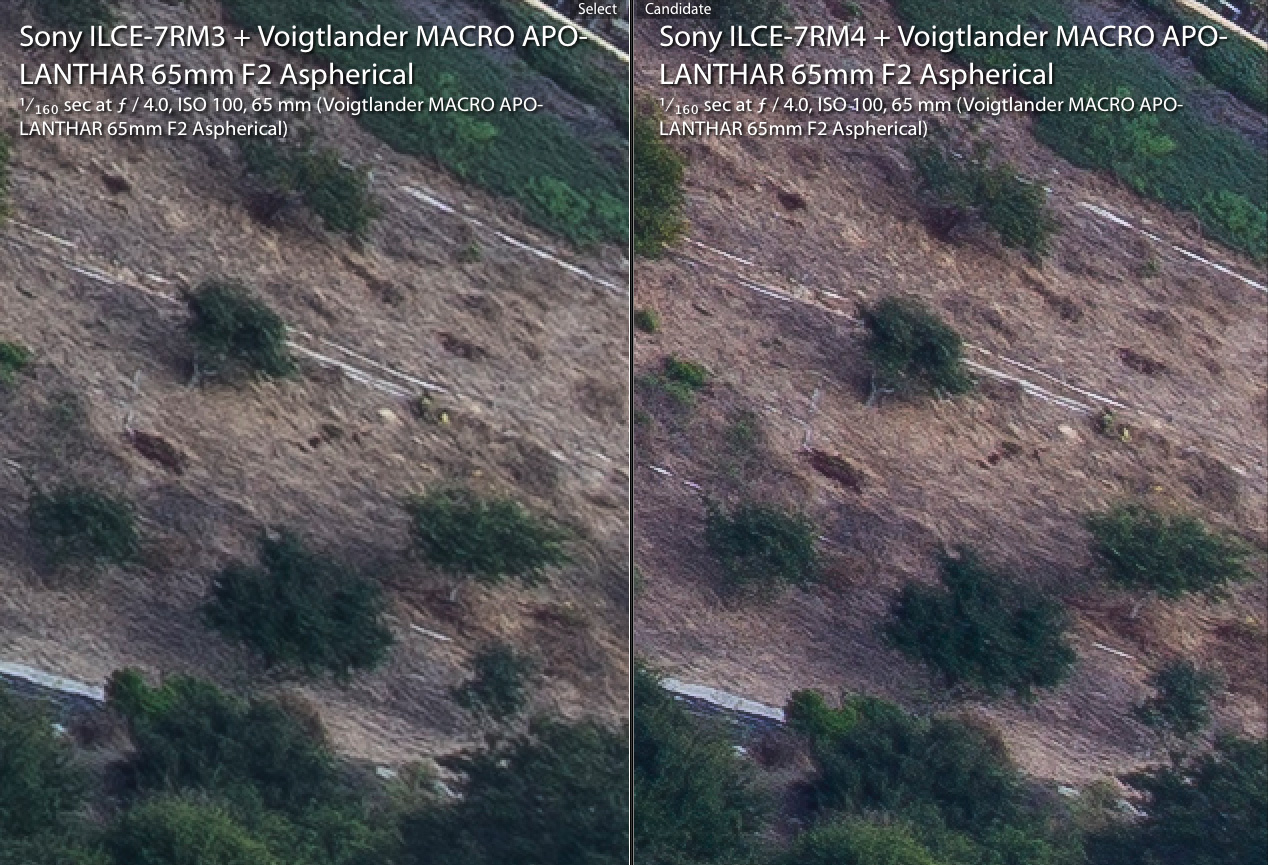
Yes! and even at the very corners, resolution is higher with the R4...just not the same level as center.
here is a 2:1 crop showing the extreme edge (R3 vs R4):
2:1 magnification - Ignore the color difference. The R4 has a beta LR profile
p.2 #8 · Comparing 42MP vs 61MP: Real-World Resolution and Contrast
1bwana1 wrote:
Yep, Ray Charles could see the difference side by side. The a7RIV is better.
Not sure how much I would notice viewed at different times, different viewing conditions, and if images were of different subjects.
Hmmm it’s hard to miss on screen at full resolution. The detail is popping really nice. Certainly beats the A7rIII and I love that cam. So far I’m glad I went for it
p.2 #10 · Comparing 42MP vs 61MP: Real-World Resolution and Contrast
Thanks for the tests, Fred.
At native resolution, it seems that the 4 is showing a tiny bit more actuance than the 3, if there is any difference. Normally, as we get higher resolution sensors and compare images at native resolution using the same lens at the same aperture, we should observe lower actuance with the higher resolution camera, because we are looking at a higher magnification and see more lp/mm, where the lens MTF is lower.
I am going to postulate that the A7r4 is using smaller microlenses, with lower fill factor than the A7r 3. The reports on increased ISO noise, even normalized, points in the same direction.
If this is the case, it is going to be good for:
- Less need for sharpening
- Possibly less corner smearing with certain lenses
And it is going to be less good for certain things as well:
- Lower light sensitivity
- More aliasing, compared to the same sensor resolution with gapless microlenses. However, increased resolution always means less aliasing, so it will still probably be better than the A7r III sensor in that regard.
If there is more data coming in that supports this, I am going to suggest to Jim Kasson to look into it. He found that the GFX 100 sensor is doing the opposite, abandoning the smaller microlenses used in the GFX50 sensors.
p.2 #12 · Comparing 42MP vs 61MP: Real-World Resolution and Contrast
alundeb wrote:
Thanks for the tests, Fred.
At native resolution, it seems that the 4 is showing a tiny bit more actuance than the 3, if there is any difference. Normally, as we get higher resolution sensors and compare images at native resolution using the same lens at the same aperture, we should observe lower actuance with the higher resolution camera, because we are looking at a higher magnification and see more lp/mm, where the lens MTF is lower.
I am going to postulate that the A7r4 is using smaller microlenses, with lower fill factor than the A7r 3. The reports on increased ISO noise, even normalized, points in the same direction.
If this is the case, it is going to be good for:
- Less need for sharpening
- Possibly less corner smearing with certain lenses
And it is going to be less good for certain things as well:
- Lower light sensitivity
- More aliasing, compared to the same sensor resolution with gapless microlenses. However, increased resolution always means less aliasing, so it will still probably be better than the A7r III sensor in that regard.
If there is more data coming in that supports this, I am going to suggest to Jim Kasson to look into it. He found that the GFX 100 sensor is doing the opposite, abandoning the smaller microlenses used in the GFX50 sensors. ...Show more →
Interesting. "tiny bit more [acutance]" You might be on to something. Like everyone else, I've been starring at /pixel peeping these and other test images on the iMac 5K...with a few questions yet to be answered. Early days of course and Sony has been known to make a few tweaks here and there after new product releases. Also, interesting and something I didn't know "the GFX 100 sensor is doing the opposite, abandoning the smaller microlenses used in the GFX50 sensors." Shooting Leica M10 for over a year now, I've seen the significance/results first hand of properly adjusted micro lenses.
p.2 #13 · Comparing 42MP vs 61MP: Real-World Resolution and Contrast
GabrielPhoto wrote:
Hey Fred I got Topaz Gigapixel if you want, I can use it to match the A7R3 file to the A7R4 size to see how close it can get to it.
At $99 that thing looks like the most effective upgrade to the R3, you don't even need new L brackets and stuff....
p.2 #14 · Comparing 42MP vs 61MP: Real-World Resolution and Contrast
alundeb wrote:
Thanks for the tests, Fred.
At native resolution, it seems that the 4 is showing a tiny bit more actuance than the 3, if there is any difference. Normally, as we get higher resolution sensors and compare images at native resolution using the same lens at the same aperture, we should observe lower actuance with the higher resolution camera, because we are looking at a higher magnification and see more lp/mm, where the lens MTF is lower.
I am going to postulate that the A7r4 is using smaller microlenses, with lower fill factor than the A7r 3. The reports on increased ISO noise, even normalized, points in the same direction.
If this is the case, it is going to be good for:
- Less need for sharpening
- Possibly less corner smearing with certain lenses
And it is going to be less good for certain things as well:
- Lower light sensitivity
- More aliasing, compared to the same sensor resolution with gapless microlenses. However, increased resolution always means less aliasing, so it will still probably be better than the A7r III sensor in that regard.
If there is more data coming in that supports this, I am going to suggest to Jim Kasson to look into it. He found that the GFX 100 sensor is doing the opposite, abandoning the smaller microlenses used in the GFX50 sensors. ...Show more →
The increase in High ISO noise is attributable to lower high ISO DR, which is attributable to no advancement in read noise with the new sensor in combination with more pixels, which increases aggregate read noise at high ISO. It's also due from the earlier ISO dual gain switch. I doubt the fill factor is any less - sensors with geometries much smaller than this still achieve near 100% fill factors (smartphone sensors).
p.2 #16 · Comparing 42MP vs 61MP: Real-World Resolution and Contrast
GabrielPhoto wrote:
Indeed I am very curious to see how different plugins results will compare to the real thing.
You know, I just went through some reviews and sample shots and I believe that asking an 120% scale from it is not a big ask at all. What was obvious from one review was that bicubic is terrible when compared with Topaz. There was no contest.
Maybe if Fred could share one of the RAWs you could do a run at it, just to show the difference vs bicubic on one of the images used here.
p.2 #17 · Comparing 42MP vs 61MP: Real-World Resolution and Contrast
vdo1 wrote:
You know, I just went through some reviews and sample shots and I believe that asking an 120% scale from it is not a big ask at all. What was obvious from one review was that bicubic is terrible when compared with Topaz. There was no contest.
I will try topaz gigapixel instead of PS bicubic when comparing both cameras.