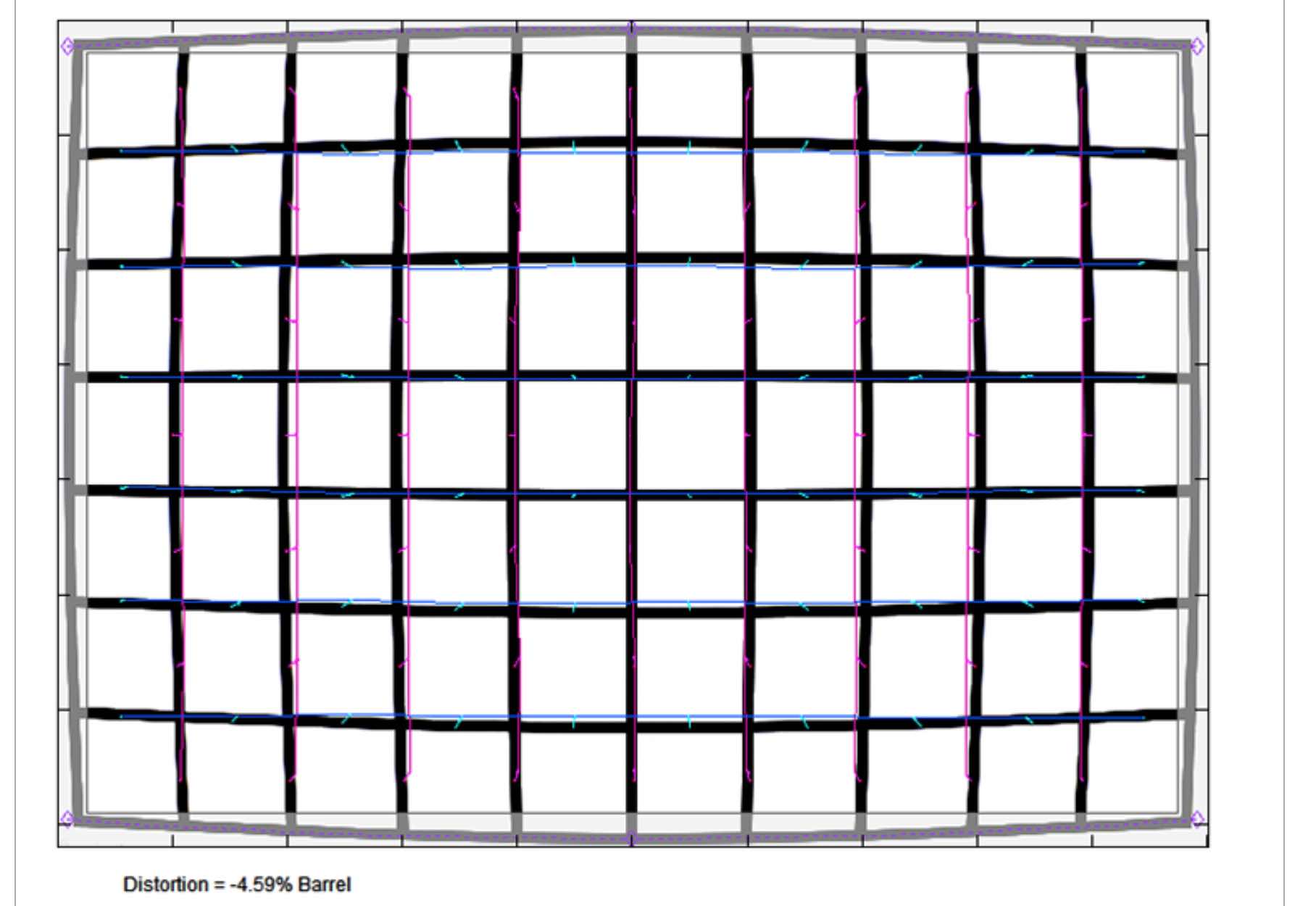
FWIW, a company many would think of as very conservative, Leica, also does this (black corners) with the $4000+ Q camera's fixed 28/1.7 lens (and also probably with some/many of their other 'fully electronic' cameras). One can see a bit of corner smearing in the Q's corrected images. As others have mentioned, this is the way everyone is going with non-optical viewfinder systems. Lenses are smaller and potentially sharper, though some of the latter is traded off with digital corrections. And this is probably just scratching the surface of what's to come in respect to software driven optical corrections.
Interesting read - Canon (and Sony) are now making lens that are really bigger eg 23mm instead of 24mm to permit cropping to 24mm to remove large distortion and vignetting - but the results are pretty good is what I understand.
But does that not mean that a 60mpx A7rIV or a 30mpx R are effectively 42mpx (eg) and 22mpx (eg) - when used with such a lens with correction applied? Thus resulting in less resolution than a lens that does not need this large correction?
Not sure you can look at it that way. Resolution loss in the center of the image should be minimal, if any. The biggest hit will be in the corners where the image is stretched to cover the native pixel dimensions of the sensor. The higher the resolution of the sensor, the more likely it will be to notice fine detail image degradation.
If much of the time key subject information is located centrally and/or where edge detail is not typically critical, such as people photos, the resolution loss will not be the same, if any, compared to scenes where high across-frame sharpness is desired.
IMO the 24-240 it needs to be realistically considered a prosumer travel lens that won't rival L primes, for example, in respect to edge-to-edge sharpness.
gdanmitchell wrote:
Something is very wrong if you are getting that "vignetting" with the lens. It looks like something (filter? step down ring? hood mounted incorrectly?) is interfering at the edges and corners.
That cannot possibly be right.
some lenses hard vignette BEFORE lens correction.
the 24-240 is an interesting lens, I'm a sucker for ultrazooms, gotta have one in my kit, but I chose the 24-105L simply because I already have the sony equivalent of 24-240...... not sure if I made a mistake or not. Use them mostly for video, and with good light, outstanding lenses especially when you factor in crop mode, so versatile.
I have the 24-240 lens and I'm fairly pleased with it. If you shoot jpeg and have lens correction on, you won't see the dark corners. Unfortunately I shoot RAW so I see it. If you back it off a bit (say 28 mm or so), the corners disappear. LR or Adobe RAW fix it right up. After correction, I don't think it's any different from the 24mm view you get from other lenses.
The lens is good enough to be used as a one-size-fit-all lens for travel. I do not think it can compare with other L-lenses within the focal ranges.
Here is a sample handheld @ 24mm, f/9, 1/640, ISO 320 (I forgot to lower the ISO)
Scott Stoness wrote:
Interesting read - Canon (and Sony) are now making lens that are really bigger eg 23mm instead of 24mm to permit cropping to 24mm to remove large distortion and vignetting - but the results are pretty good is what I understand.
But does that not mean that a 60mpx A7rIV or a 30mpx R are effectively 42mpx (eg) and 22mpx (eg) - when used with such a lens with correction applied? Thus resulting in less resolution than a lens that does not need this large correction?
The camera usually loses resolution mostly near the corners (often quite severe loss, like going from 30 to 10 MP) and hardly in the center (maybe 5-10% or so).
It is very similar to what has become common in many quality compacts with larger zoom range like e.g. Canon G1X III, G7X etc. and more and more consumer zooms (e.g. Canon EFS 10-18), with the main reason that it allows a much smaller (and cheaper) lens. For most users this works apparently as they don't care for IQ at the borders/corners. But if you care like e.g. for landscape or architecture style images, this can be a compromise with serious side effects. I especially dislike how it changes textures like sand grains, grass blades etc. going from image center to border/corner, from very sharp in the center to almost completely mush or "rough" in the corners, which looks very unnatural to me (maybe because I'm used to traditional lenses without this problem?). The resolution and contrast loss from the initial software corrections is countered with additional image processing gimmicks that have their own problems like strong increase in noise and rough detail appearance.
The effect seems to be less severe on this 24-240 lens compared to what is common in quality compacts, but personally I would prefer keeping the lens a bit larger (especially in those compacts, because the lenses are already much smaller than the camera itself). Clearly there is a market for such compact lenses, nowadays also on more expensive ML cameras.
it looked like the main correction profile involves cropping both horizontally and vertically. something one can do manually.
stanj wrote:
Ok, I have tested the lenses against each other, and I can only say a few things: The lens is not particularly good for servo shooting. Big surprise, but just for kicks I used it today for a shoot of wake boarding on a boat and let's just say that I have way more rejects than when I shoot with my L glass.
The question that I think has been on other people's mind - the huge uncorrected vignetting at the wide end - I think that has a fairly simple explanation, too: at 24mm the lens is actually wider than that, so that the correction profiles can do a pretty good job correcting. Shown below is the uncorrected vignetting compared to the RF24-10L and the EF 24-70m2 at the wide end, wide open to all the way to f8. Note that the uncorrected RF24-240 image is quite a bit wider. ...Show more →
My point is that it reduces a 60 mpx down significantly. Well maybe not that significantly but it could be the difference between a 60mpx and a 50 mpx that everyone gets excited about.
This is from Sony fe 24-105 at 24mm for example - significant 10% loss of sensor mix to fix
I may have into that lens. I have both 18-55 and 55-250 for light travel. Both EFS and the R has a crop setting but one lens for a travel general walk around sounds appealing.
As long as you can restrain yourself to using APS-C glass. I tried that with Sony, couldn’t help myself and brought FF glass most the time. Zenon Char wrote:
I may have into that lens. I have both 18-55 and 55-250 for light travel. Both EFS and the R has a crop setting but one lens for a travel general walk around sounds appealing.
kylebarendrick wrote:
Please tell me you have a filter on the lens... That's horrible.
The vignetting of this lens is by design. For its zoom range it is quite compact and it is relatively affordable. The intent is that the user can apply a lens correction profile in Lightroom or in-camera to effectively correct the vignetting. It’s not really horrible in practice and has typical consumer grade IQ.